Showing posts with label Conjunction. Show all posts

Tuesday, July 16, 2024

Night Sky Photography -- 07-15-2024 -- Mars & Uranus Conjunction Before Sunrise!

Greetings fellow stargazers!

On the morning of Monday, July 15, 2024, your favorite blogger had to wake up early -- about 90 minutes before sunrise to be exact -- to drive out into the country a little and find a nice spot to capture the conjunction of the planets Mars and Uranus. I was also able to capture some wonderful shots of the planet Jupiter and the bright red giant star, Aldebaran, in the Constellation Taurus the Bull.

After setting up my tripod, I captured this first photo over the tree line facing south-southeast. I decided not to label this one so you can get an idea of how I saw it for myself.


You can see what appears to be two red points and a large bright point set in a oblong triangle in the nautical twilight as they appeared to the naked eye. The large bright spot is Jupiter, while the smaller red spots are Aldebaran positioned to the right of Jupiter and the planet Mars in the upper corner.

Using the lens as a filter to capture more points of light not quite visible to the naked eye, I captured nearly all the stars of the Hyades Star Cluster -- which make up the "face" of the Constellation Taurus the Bull -- and the nearby Pleiades Star Cluster between Mars and the current position of Uranus in the night sky as seen from the Earth's surface. The wider shot also captured the nearby stars Elnath and Capella closer to the east and coming sunrise. The close up shot shows both the Hyades and Pleiades clusters more clearly.


Mars is easy to spot due to its bright red-orange hue, though distant Uranus is impossible to see with the naked eye and requires a really good lens to spot. Thankfully I have a good 35X Sony Optical Zoom lens on my camera and, at maximum magnification, was successfully able to capture a really good close-up of the two planets together at just half-a-degree apart.


Although they appear to be "meeting" in the early morning sky from out vantage point here on the surface of the Earth; the two worlds are actually quite a distance apart.

The large ice giant planet Uranus, the 7th planetary body in our Solar System, is roughly about 1.86 billion miles (just over 3 billion kilometers, or 20.16 AUs) from our Earth at the moment, while Mars, the 4th planet and our nearest planetary neighbor, is about 155 million miles (around 250 million kilometers, or 1.67 AUs) from Earth.

Finally, I took a couple of good shots of Jupiter, now currently a part of the Constellation Taurus for at least the next month in the early mornings. The first show a close-up of Jupiter with bright red Aldebaran, the "Eye of the Bull" close by. The final show captures all the stars of the Hyades Cluster, which I highlight outlining the head of the Constellation Taurus.
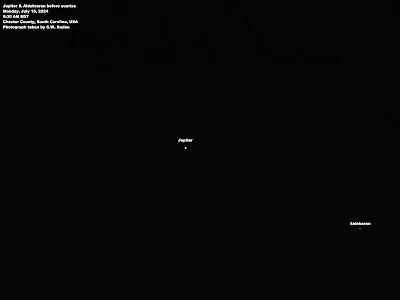


The large gas giant planet, Jupiter, the 5th planet in the solar system, is currently about 532 million miles (857 million kilometers, or 5.7 AUs) from the Earth. Aldebaran is much father away at a distance of approximately 65 light-years from our Sun and is the 14th brightest star in the night sky as seen from Earth.

Later this month, on Tuesday, July 30th, the crescent moon will cross between Mars and Jupiter in the early morning sky. Over the next month both planets will continue to move closer to each other towards their own conjunction in the morning sky on Monday, August 12, 2024....which I hope to be able to photograph, God and good clear skies willing.


Well folks, I hope that y'all enjoyed my photos and to all my fellow amateur sky watchers be sure to keep your eyes to the night skies, y'all hear.

Sunday, October 01, 2023

Night Sky Photography -- 10-01-2023 -- 1st Moon & Jupiter Conjunction of October 2023


Good evening fellow stargazers!

In addition to October being this blogger's favorite month of the year because it ends with my favorite holiday of the year, Halloween, this month will also be very interesting in terms of stargazing and night sky photography of the planets and fall constellations.

Tonight, October treats us to the first of two close meetings in the night sky of our lovely Luna and Jupiter, the largest planet in out Solar System. The second meeting will take place on the evening of Saturday, October 28th during the Full Hunter's Moon.

Tonight, Luna is currently in her Waning Gibbous Moon phase following the Full Harvest Moon a few days before. 

This evening, about an hour ago, I captured the pair between the branches of two trees, and even captured all four of Jupiter's largest and visible moons: Io, Europa, Ganymede, and Callisto. Five moon and a large planet all in one frame between the trees.


Well my friends, I hope y'all enjoyed these photos. Good clear skies willing I'll be able to hopefully capture these two again during October's Full Moon on the 28th....just three days before Halloween.

Wednesday, July 12, 2023

Night Sky Photography -- 07-10-2022 -- Mars & Regulus Conjunction With Venus After Sunset

Good evening fellow stargazers!

This evening the skies were beautifully clear after several cloudy evenings due to the usual hit-and-run summer storms that happen in this part of South Carolina this time of year, as well as the lingering smoke from the Canadian wildfires. Tonight I was able to capture a couple of beautiful shots of our two closest planetary neighbors: Venus and Mars together in the evening sky an hour after sunset.

As you can see from my photos, Mars is in close conjunction with the bright star, Regulus, in the Constellation Leo The Lion, appearing about a full moon's length apart from our vantage point here on the surface of the Earth. In actuality, Regulus is a quadruple star system, the largest of which (Regulus A) lies approximately 79 light-years (or about 24.2 parsecs) from our Sun.


Both Venus and Mars are moving slightly farther apart in the night sky after appearing closely together on Saturday, July 1st -- which I was unfortunately unable to get due to cloud cover. The two inferior planets (inner planets of our Solar System) will continue to remain close for most of this month, though they are drifting apart in their orbits around the Sun in relation of our own Earth.

Wednesday, December 28, 2022

Night Sky Photography -- 12-28-2022 -- Mercury & Venus Conjunction In Southwestern Sky

Good evening fellow stargazers!

Well my friends, the year 2022 AD is just about over and this one is going to be my final planetary/night sky photography of the year.

Oh don't worry, there will be plenty more outstanding photographs of the planets, stars, and heavenly events appearing in the sky dome over my corner of South Carolina coming up next year as well. Our beautiful night sky never fails to offer something wonderful if you know where to look for it.

For my final planetary photography of the year, its only fitting that the following shots take place just after sunset in the southwestern sky where I was able to capture two lovely photos of the conjunction of the inner planets Mercury and Venus.


As you can see tiny Mercury is about 1.4 degrees northeast of Venus (about three full moons apart) appearing about 35 minutes after sunset.

Mercury and Venus will remain close on Thursday, December 29th also, but they won’t be this close again until 2024 and then they’ll be too close to the sun to see without a telescope and a filter, so try not to miss it tomorrow night if y'all want to see it for yourselves.

Well, I hope that y'all enjoyed my photographs, and not just the ones today. Its my pleasure to post these humble night sky offerings and share my love for amateur astronomy to you my readers and fellow night sky enthusiasts across this wonderful world of ours. I hope to be able to continue to do so for a long time to come.

Until next time I want to wish all of y'all a very Happy New Year!


Sunday, October 04, 2020

Night Sky Photography -- 10-02/03-2020 -- The Moon & Mars Rising -- Venus & Regulus Conjunction In Morning Sky

 Good evening fellow stargazers!

Well folks, last evening and earlier this morning, I was able to capture some really outstanding shots of two conjunctions in the night sky taken over the course of a ten hour period, beginning after sundown on Friday the 2nd and ending just before sunrise on Saturday the 3rd of October. 
 
The still bright Full Moon (actually now it is a Waning Gibbous Moon at about 98 percent brightness) meets in the evening sky with the now bright planet Mars. I captured this shot of our bright Luna and the Red Planet rising over the treetops after sunset.


Next two shots I took later in the evening as Luna passed near Mars by less than a degree, or so, in the late night sky overhead. The first shot show the Moon and Mars as they appeared to the naked eye. The second shot is a close-up of Mars over the nearly full moon. Unfortunately, here in North America, we did not get to see the moon occult Mars, so this was about as close as the two heavenly bodies "met" in the sky here in South Carolina.


This final shot of the moon and Mars in the western sky was taken nearly seven hours later. As y'all can see, Mars is now below Luna and will continue to move farther away over the next several days as Mars eventually moves to its closest approach to Earth on the evening of Monday, October 5th.


The moon and Mars were not the only heavenly bodies close to Earth that were "meeting" in the sky dome.

Looking to the eastern sky again about an hour before the breaking dawn, I caught these two outstanding shots of bright Venus in the sky with the bright star, Regulus, appearing just above our bright neighboring planet by roughly half a degree. Regulus is the brightest star in the Constellation Leo The Lion.


The first shot is how I viewed them through the trees in my back yard -- Regulus is barely visible just above Venus. The second is a close up, showing the planet and the star together.

These two heavenly bodies won’t appear this close together again for another 8 years. 

 
Well my friends, I hope y'all enjoyed these photos as much as I continue to enjoy bringing them to y'all. Have a wonderful Dixie day, and be sure to keep your eyes to the night skies, y'all hear!

Monday, July 09, 2018

Night Sky Photography -- 07-09-18 -- Venus & Regulus Conjunction In Western Sky

Good evening fellow stargazers!

This evening just after sunset as darkness began to fall, I looked to the western sky for the bright evening wanderer, Venus and the bright star Regulus to appear in conjunction.
 
A conjunction is when two heavenly bodies appear very near to the north and south of each other in the night sky. At this particular conjunction, Venus sweeps to approximately 1.1 degree northeast of Regulus. One degree is equal to about two moon-diameters. 

Venus is the brightest of all the planets, the third-brightest celestial body to light up the sky after the sun and Luna (the moon). Regulus is the brightest star in the constellation Leo the Lion, and ranks as a 1st-magnitude star.

As you can see from the outstanding shots I took at the tree line, Venus can be seen easily and beams nearly 150 times more brilliantly than Regulus, the only 1st-magnitude star to sit almost squarely on the ecliptic.


Well I hope y'all enjoyed my photos.

Later on at the end of the month Mars will reach opposition to the Earth and will be very bright and visible next to the full moon. God willing and clear skies permitting, this blogger will try and get some shots of that meeting. 

Until then, have a wonderful evening, and y'all keeping looking to the night skies, ya hear? 

Sunday, January 07, 2018

Night Sky Photography -- 01-07-2018 -- Mars & Jupiter Conjunction With Galilean Moons

Greetings fellow stargazers! 

Well folks, for my first planetary photography of 2018, I have a real treat for y'all. 

In the morning hour before sunrise I woke to clear skies and a perfect view of the Jupiter and Mars conjunction in the southeastern sky. Here is the best photo I managed to get of the two wanderers at their closest proximity.


Mars is approximately 0.25 degrees south of Jupiter (equivalent to half of the moon's diameter), and you can just barely make out the red coppery coloring. The two appear to join though in reality they are just over 342 million miles apart. Jupiter appears brighter to the naked eye, approximately 20 times brighter than Mars at the moment due to the relative positions of the planets. 

This will change by summer of 2018 when Mars once again reach its closest approach to Earth and grow larger in the night sky. By the end of the first week of July 2018, Mars will finally catch up with Jupiter in brightness. Then on July 31st, Mars reaches its closest proximity to the Earth and will shine the most brilliantly in Earth’s sky since 2003, actually outshine Jupiter by some 1.8 times in late July and early August. The Red Planet will reign as the fourth-brightest celestial body (or third brightest in the nighttime sky, after the moon and Venus) will last two months from about July 7 to September 7. 

It's also good that I managed to capture the conjunction of these two wanderers and blessed that the skies were clear of cloud cover. The next conjunction between Jupiter and Mars will not occur until Friday, March 20, 2020. 

Now folks for the unexpected, but pleasant bonus: when I checked my close-up photo of the conjunction, I discovered that my 35X optical lens managed to capture all four of the visible Galilean Moons: Io, Europa, Castillo, and Ganymede! 


These four moons are also known as the Galilean Moons in honor of famed Italian astronomer Galileo Galilei who discovered them in January 1610 using an improved telescope with a 20X magnification lens. 

These four are the largest of Jupiter's 69 known moons. Three of them: Io, Castillo, and Ganymede are just slightly bigger than our own beautiful Luna. Io is the closest at around 218,000 miles from Jupiter's clouds and Castillo is the most distant at a whooping 1,168,180 miles from Jupiter, giving y'all an idea of the scale and distance of the largest planet in our solar system as seen from Earth's sky. 


Well folks that is all for now, but this won't be the last time we see Jupiter and Mars this month. The two will stay pretty close together throughout the month of January and will meet up with the waning crescent moon on the morning of Thursday, January 11th. 

Thank y'all for checking out this blog post, be sure to leave a review, and as always keep looking to the night skies, y'all hear?

Saturday, September 16, 2017

Night Sky Photography -- 09-16-2017 -- Conjunction of Mercury & Mars Before Sunrise

Greetings and Salutations again fellow stargazers! 

This morning I had to wake up a bit earlier than usual -- about 90 minutes before sunrise to be exact -- in order to set up the tripod and take some outstanding shots of all the inner planets of our solar system lined up beneath the beautiful Waning Crescent Moon, including a spectacular conjunction of Mercury and Mars low on the horizon. I needed to drive a ways to an unobstructed stretch along SC Highway 9 in order to get a clear shot of all three planets. 


Venus, the third brightest celestial body in Earth's sky is closer to Luna, which ranks as the second brightest next to the sun. Beneath Venus is the 1st magnitude star Regulus, the brightest star in the constellation Leo the Lion and one of the few stars that can still be seen from Earth just before sunrise. 


At the bottom close to the treetops on the eastern horizon are the two small planets Mercury and Mars are at conjunction. During conjunction, Mercury and Mars are only 0.06o apart -- roughly the equivalent of about 1/8th the moon’s visible diameter. Being closer to the sun, Mercury shows as brighter than the much further away Red Planet. 

I managed to get a spectacular close-up of the two conjoined planets just above the treetops.


My final shot is of all the inner worlds (including a slightly foggy Earth beneath) and Luna just before the sunrise began to obstruct the planets from view.  


Well folks, I hope that y'all enjoyed my photographs of the inner planets and our lovely Luna. Be sure to check out my other planetary photographs here and as always keep your eyes to the skies, y'all!