Showing posts with label Regulus. Show all posts

Monday, November 16, 2026

Night Sky Photography -- 11-16-2026 -- Mars & Jupiter Conjunction

Greetings fellow amateur stargazers!

Early this morning (about two hours before sunrise here in South Carolina) I was able to capture a very clear close-up shot of the close conjunction between the planets Mars and Jupiter.

Mars and Jupiter are at present about 1.2 degrees apart (or the width of about two full moons) in the night sky and positioned near Regulus, the brightest star of the Constellation Leo The Lion.


The photo came out really well, showing off the bright rusty red color of Mars, the white of Jupiter, and the bright blue-white of Regulus and nearby Algieba (Gamma Leonis), Leo's second brightest star.

The two planets together, along with Regulus, form a neat elongated triangle in the night sky dome. Mars and Jupiter will remain close together for another few days before the Red Planet continues in its orbit towards the east and later passing by Regulus later in the month of November.

Wednesday, October 14, 2026

Night Sky Photography -- 10-12-2026 -- Morning Planets & Stars & Mars With The Beehive

On the morning of Monday, October 12th (Columbus Day here in the Americas) about 50 minutes before sunrise, I took this great shots of the eastern sky with the planets Jupiter & Mars along with the brightest stars of the constellations Gemini the Twins (Pollux), Canis Minor (Procyon), Leo the Lion (Regulus), and Hydra the Sea Serpent (Alphard).


The second shot is a close-up of Mars showing it close to the faint Beehive Star Cluster (Praesepe/M44) which is a part of the constellation Cancer The Crab.


The planet Mars was actually inside the open cluster over the weekend of October 10th and 11th, however overcast skies and rain from the recent tropical storm prevented me from getting a good shot of that event unfortunately. Still, I'm proud of how this photo came out, showing the orange-tinted 4th planet of our Solar System with the faint cluster of stars.

The Beehive Cluster (M44) is estimated to be at a distance of about 610 light-years (or 187 parsecs) from our Sun. 

Mars will continue to be a part of the faint constellation Cancer itself for about two more weeks till its orbit takes it further eastward towards Jupiter and a conjunction with the large gas giant in November.

Thursday, October 08, 2026

Night Sky Photography -- 10-06/07-2026 -- The Moon & Planet Parade In Eastern Sky


Greetings fellow amateur stargazers!

Over the last few mornings I woke up about an hour, or so, before sunrise to capture a few wonderful shots of a couple of night sky wonders over the course of two days.

The first shots, taken on Tuesday, October 6th, show our beautiful moon in the early morning sky about 45 minutes before sunrise with the large planet, Jupiter, and its four largest moons visible. About two hours before, Luna occulted (passed in front of) Jupiter in its orbit eastward towards the sunrise. The photos I took show the planet emerging from behind the moon along with a close-up shot detailing the gas giant planet's four largest visible moons: Io, Europa, Ganymede, and Callisto.


The second set of photos, taken on Wednesday, October 7th, show our lovely crescent moon leading a parade of planets that include Jupiter and Mars, as well as the bright star, Regulus -- the brightest object in the Constellation Leo the Lion.
 

The first shot shows Luna along with Regulus and the two planets aligned in a "parade" headed towards the rising sun in the eastern sky about 45 minutes before sunrise.

The next is a close-up of Mars, which is currently about 149,615, 458 miles (or 240,731,272 kilometers -- about 1.61 Astronomical Units) away from Earth and on its way towards its next opposition to Earth in February of 2027, so the Red Planet will be get bigger and more visible in the night sky.

The third shot is another close-up of Jupiter and three of its large moons (Europa was hiding behind Jupiter). Jupiter is currently about 540,213,623 miles (or 869,203,719 kilometers -- about 5.81 AUs) from the Earth.

Regulus is actually a quadruple star system made up of two pairs of bright stars about 79 light years (or 24.2 parsecs) from our Solar System. Collectively the Regulus system is the twenty-first brightest star in the night sky as seen from Earth.

I hope to have more night sky photography soon, there are several celestial events that I am hoping to being y'all images of happening later this month. Stay tuned and keep your eyes to the night skies, y'all.

Tuesday, February 03, 2026

Night Sky Photography -- 02-02-2026 -- The Moon Occults Regulus


Last night our beautiful still Full Snow Moon passed in front of the bright star Regulus -- the brightest star of the Constellation Leo the Lion.

Regulus (Alpha Leonis) is
the 22nd brightest star in the night sky. Its a blue-white main-sequence star, also known as the "heart of the lion". As I've mentioned before on this site,
Regulus may appear to be a single point of light, but its actually a quadruple star system composed of four stars that are organized into two pairs. This system lies approximately 79 light years (or 24.2 parsecs) from our Solar System.

Beginning about 9:00 p.m. EST here in North America, Luna passed in front of (or occulted) Regulus and -- for about a little under two hours -- replaced Regulus to become a part of the Constellation Leo!

I was able to capture three great shots of the occultation of Regulus by our beautifully still mostly full Luna: one before with both bodies shinning through the tree branches, the second during the occultation, and the last after the Moon's orbit eastward finally passed away from Regulus.

Unfortunately I was unable to capture all of the stars of the constellation due to the bright full moon's glare, but I was able to capture the two other bright stars of Leo:
Denebola (Beta Leonis) the "lion's tail" and Algieba (Gamma Leonis) during the occultation of Regulus.


Saturday, February 24, 2024

Night Sky Photography -- 02-24-2024 -- Full Snow Moon & Regulus

Tonight I captured a couple of shots of the February Full Moon -- also known as the Full Snow Moon in North America -- along with the bright star, Regulus, in the evening sky.

Regulus is the brightest star in the Constellation Leo the Lion.
Regulus appears singular to the human eye, but its actually a quadruple star system composed of four stars that are organized into two pairs. The Regulus system lies approximately 79 light years (or 24 parsecs) from the Sun.


The February Full Snow Moon is 2024’s farthest full micromoon for year at a distance of about 252,225 miles (or 405,917 kilometers) from the Earth. This is in contrast to the average distance between the Earth and the Moon, which is around 238,900 miles (or 384,472 km).

Wednesday, July 12, 2023

Night Sky Photography -- 07-10-2022 -- Mars & Regulus Conjunction With Venus After Sunset

Good evening fellow stargazers!

This evening the skies were beautifully clear after several cloudy evenings due to the usual hit-and-run summer storms that happen in this part of South Carolina this time of year, as well as the lingering smoke from the Canadian wildfires. Tonight I was able to capture a couple of beautiful shots of our two closest planetary neighbors: Venus and Mars together in the evening sky an hour after sunset.

As you can see from my photos, Mars is in close conjunction with the bright star, Regulus, in the Constellation Leo The Lion, appearing about a full moon's length apart from our vantage point here on the surface of the Earth. In actuality, Regulus is a quadruple star system, the largest of which (Regulus A) lies approximately 79 light-years (or about 24.2 parsecs) from our Sun.


Both Venus and Mars are moving slightly farther apart in the night sky after appearing closely together on Saturday, July 1st -- which I was unfortunately unable to get due to cloud cover. The two inferior planets (inner planets of our Solar System) will continue to remain close for most of this month, though they are drifting apart in their orbits around the Sun in relation of our own Earth.

Friday, June 02, 2023

Night Sky Photography -- 05/31/23 -- 06/01/23 -- Mars Buzzing The Beehive In Constellation Cancer The Crab & Venus Alligns With The Gemini Twins


Good evening fellow Stargazers!

Well, now we're getting into the summer months down here in my little corner of Dixie. That means much later evenings, fireflies, noisy Cicadas, and of course some interesting early summer night sky planetary photography for the month of June.

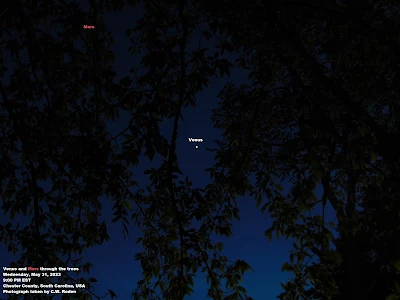
As the final day of May gave way to June, I was able to capture a some really outstanding photos of the both the planets Venus and Mars in the evening sky after sunset. 

As I mentioned in a previous post, our two nearest planetary neighbors are both traveling higher into the sky dome away from the setting late spring sun on their way to an early July conjunction as they both approach the bright star, Regulus, in the Constellation Leo The Lion. The faster orbit of Venus and the slower orbit of Mars will bring both "wandering stars" into a conjunction in the evening sky on the evening of Sunday, July 2nd of this year.

Over the course of three blessedly clear evening skies, I was able to capture some really cool evening photos of the two planets in the western sky about 45 minutes after sunset; as well as get a few outstanding shots of Mars traveling through the faint Constellation Cancer The Crab and the distant Beehive Star Custer (M44).

The Beehive Star Cluster is a faint open cluster of hundreds of stars located an estimated 577 light-years (or 176.9 parsecs) from our Sun.

Here are the photos I took of the two planets on the evening of Wednesday, March 31st, with Mars centered inside Cancer The Crab located between the Beehive and the binary star Tegmine (Zeta Cancri) -- also known as the "shell of the crab". You can also see Venus -- currently the brightest of the heavenly bodies in the western sky until the Moon appears later in the month -- lining up with the two "twin stars" Pollux and Castor of the Constellation Gemini The Twins.

In one of these shots, I was able to capture all of the major stars of the faint zodiac constellation -- this blogger's birth sign (fun fact) -- along with the approximate location of the Beehive Star Cluster, which isn't visible except in close-ups with higher exposure, which I captured much better in the close-up shots of Mars and the Beehive.


The next two shots I took over the course of the two nights of Thursday, June 1st and Friday, June 2nd when Mars began to move through the Beehive Star Cluster, the Red Planet surrounded by the small, faint points of light. By late Saturday, June 3rd, Mars will be above the Beehive; though it'll still be in the area of the Constellation Cancer a short while longer as it travels higher in the evening towards Regulus.


On Thursday, June 1st, Venus moved into a nearly perfect straight alignment with the Gemini Twins. Venus will also be moving higher towards the Constellation Cancer and will also buzz by the Beehive later this month on Monday, June 12th and Tuesday, June 13th as it races to catch up with Mars.


I hope y'all enjoyed my presentation and my photos. It was again my pleasure to share them with y'all. Hopefully we will be blessed with good clear skies this June down here in my little corner of Dixie so I can share more interesting night sky photography as we move closer to the summer equinox and the official start of the new season.

Until next time, keep your eyes to the night skies and y'all come back now, ya hear!

Tuesday, March 21, 2023

Night Sky Photography -- 03-20-2023 -- The March Equinox & Locating The Spring Triangle & Great Diamond Constellations

Happy Spring Equinox, Y'all!

Today is the first official day of spring equinox 2023 here in the Northern Hemisphere. Goodbye to those long, cold winter nights and hello to longer daytime hours and warmer weather.

The equinox refers to the moment when Earth's rotation axis is directly perpendicular to the Sun, or from our perspective here on Earth when the Sun travels just over the Earth's equator. This occurs twice a year in March and September when the axis of the Earth tilts and turns one hemisphere of the Earth towards the sun in our orbit.

In the Northern Hemisphere this is referred to as the March Vernal Equinox (or spring equinox). In the Southern Hemisphere below the equator this is actually the first day of autumn.

For us amateur stargazers, it also means that the constellations of the Winter Circle (Winter Hexagon) will be setting in the west earlier after dark and new constellations will begin to appear in our evening sky dome.

The first day of spring and the next few months will be the perfect opportunity to see the amazing stars of the Spring Triangle asterism and its spring time constellations in the evening sky.

The Spring Triangle connects three major stars:
Arcturus, Spica, and Regulus -- as well as their constellations: Bootes The Heardsman, Virgo The Virgin, and Leo The Lion  -- into a sort of isosceles triangle. A smaller and more equilateral Spring Triangle can also be formed using the star Denebola which is also a part of the Constellation Leo.

The following photos were taken in the late evening after midnight on Monday, March 20th and in the late evening before midnight of the same day of the Spring Triangle stars and their respective constellations.


The first star in the Spring Triangle is the large, orange-colored red giant star, Arcturus (or Alpha Bootes), the third-brightest star in the night sky visible in the Northern Hemisphere, and the brightest star in the Constellation Bootes The Heardsman. Arcturus is relatively the closest to us at about 36.7 light-years (or 11.2 parsecs) from the Sun.

The next is the
binary star Spica (or Alpha Virginis) the brightest star in the Constellation Virgo The Virgin (or Virgo The Maiden). The brightest of these binaries is a blue giant star located about 261 light-years (or 80 parsecs) from the Sun. Spica is the 16th brightest star in the night sky.

The third star in the Spring Triangle is Regulus (or Alpha Leonis)
the brightest star in the Constellation Leo The Lion, which is in reality a quadruple star system composed of four stars that are organized into two pairs. This system lies approximately 79 light-years (or 24.2 parsecs) from the Sun. Regulus is also known as the "Heart of the Lion" and is the 21st brightest star in the night sky.

The fourth star which comprises the smaller triangle is Denebola (or Beta Leonis), a A-type main sequence dwarf star and the second brightest star in Leo. The star is located at a distance of 36 light-years (or 11 parsecs) from the Sun -- also pretty close to us astronomically speaking.

Locating each of the Spring Triangle stars and their respective constellations is actually not all that hard even for those starting out learning about astronomy. In fact, its quite easy if you can locate the Big Dipper asterism in the evening sky.

The Big Dipper (or Plough) is an asterism of seven bright stars in the larger Constellation Ursa Major The Great Bear and its located near the Spring Triangle stars.

Using the Big Dipper as a guide to the Spring Triangle, you just need to remember three classical mnemonic phrases to navigate your way to their location:

(1) Using the bottom of the Big Dipper below the handle, draw a straight line in the sky using the two stars as a guide to "Make A Reach To Regulus."

(2) Use the end of the handle of the Big Dipper and draw another straight line to "Make An Arc To Arcturus." 
 

(3) Finally, make another straight line using Arcturus to "Drive A Spike To Spica." 


The smaller Spring Triangle stars are also included by a fourth star Cor Caroli in the small Constellation Canes Venatici to form yet another asterism known as the Great Diamond of Virgo -- Or Great Diamond. The Great Diamond connects four constellations and is slightly large than the nearby Big Dipper itself.


That is my presentation and photographic offerings for the beginning of the 2023 spring season. More will be coming soon. Until then, have a wonderful Dixie Day and keep your eyes to the night skies, y'all hear!

Sunday, October 04, 2020

Night Sky Photography -- 10-02/03-2020 -- The Moon & Mars Rising -- Venus & Regulus Conjunction In Morning Sky

 Good evening fellow stargazers!

Well folks, last evening and earlier this morning, I was able to capture some really outstanding shots of two conjunctions in the night sky taken over the course of a ten hour period, beginning after sundown on Friday the 2nd and ending just before sunrise on Saturday the 3rd of October. 
 
The still bright Full Moon (actually now it is a Waning Gibbous Moon at about 98 percent brightness) meets in the evening sky with the now bright planet Mars. I captured this shot of our bright Luna and the Red Planet rising over the treetops after sunset.


Next two shots I took later in the evening as Luna passed near Mars by less than a degree, or so, in the late night sky overhead. The first shot show the Moon and Mars as they appeared to the naked eye. The second shot is a close-up of Mars over the nearly full moon. Unfortunately, here in North America, we did not get to see the moon occult Mars, so this was about as close as the two heavenly bodies "met" in the sky here in South Carolina.


This final shot of the moon and Mars in the western sky was taken nearly seven hours later. As y'all can see, Mars is now below Luna and will continue to move farther away over the next several days as Mars eventually moves to its closest approach to Earth on the evening of Monday, October 5th.


The moon and Mars were not the only heavenly bodies close to Earth that were "meeting" in the sky dome.

Looking to the eastern sky again about an hour before the breaking dawn, I caught these two outstanding shots of bright Venus in the sky with the bright star, Regulus, appearing just above our bright neighboring planet by roughly half a degree. Regulus is the brightest star in the Constellation Leo The Lion.


The first shot is how I viewed them through the trees in my back yard -- Regulus is barely visible just above Venus. The second is a close up, showing the planet and the star together.

These two heavenly bodies won’t appear this close together again for another 8 years. 

 
Well my friends, I hope y'all enjoyed these photos as much as I continue to enjoy bringing them to y'all. Have a wonderful Dixie day, and be sure to keep your eyes to the night skies, y'all hear!

Monday, July 09, 2018

Night Sky Photography -- 07-09-18 -- Venus & Regulus Conjunction In Western Sky

Good evening fellow stargazers!

This evening just after sunset as darkness began to fall, I looked to the western sky for the bright evening wanderer, Venus and the bright star Regulus to appear in conjunction.
 
A conjunction is when two heavenly bodies appear very near to the north and south of each other in the night sky. At this particular conjunction, Venus sweeps to approximately 1.1 degree northeast of Regulus. One degree is equal to about two moon-diameters. 

Venus is the brightest of all the planets, the third-brightest celestial body to light up the sky after the sun and Luna (the moon). Regulus is the brightest star in the constellation Leo the Lion, and ranks as a 1st-magnitude star.

As you can see from the outstanding shots I took at the tree line, Venus can be seen easily and beams nearly 150 times more brilliantly than Regulus, the only 1st-magnitude star to sit almost squarely on the ecliptic.


Well I hope y'all enjoyed my photos.

Later on at the end of the month Mars will reach opposition to the Earth and will be very bright and visible next to the full moon. God willing and clear skies permitting, this blogger will try and get some shots of that meeting. 

Until then, have a wonderful evening, and y'all keeping looking to the night skies, ya hear?