Showing posts with label Mercury. Show all posts

Wednesday, April 10, 2024

Night Sky Photography -- 04-08-2024 -- The Visible Planets With Partial Solar Eclipse


It was a big day here in North America this week with the April 8th Total Solar Eclipse arriving this afternoon, appearing overhead in a line across the continent from Mexico to Canada.

Map showing the line of totality during the April 8, 2024 Solar Eclipse.
The Partial Solar Eclipse was visible throughout North America from Canada to Panama.
During a Solar Eclipse, the Moon crosses the path of the Sun casting its shadow on the surface of
the Earth.

During a Total Solar Eclipse, the deepest part of the Moon's shadow (the umbra) covers the narrow area of totality, while the lighter part of the Moon's shadow (the penumbra) covers the wider area where only a Partial Solar Eclipse can be seen.

Here in upstate South Carolina, those of us with the proper eye protection were only able to see about 75% of the totality, with the Moon's penumbra shadow casting down making the planets in our Solar System and some of the brightest stars visible.

On Monday, April 8th, I was able to capture one really beautiful image of all the visible planets of our Solar System between the Partial Solar Eclipse at its peak. It was a unique opportunity to see all of these planets in the daytime.

At present Venus is far too close to the Sun to be visible for the next few months, and Saturn and Mars are expected to pass each other on the mornings of Tuesday the 9th and Wednesday the 10th, but they are so low on the horizon before sunrise that its hard to catch them unless you live in an elevated place before the Sun blocks them out. Mercury can be seen low on the horizon just after sunset, but again you see a high place with no obstructions to really see it.

Wednesday, December 28, 2022

Night Sky Photography -- 12-28-2022 -- Mercury & Venus Conjunction In Southwestern Sky

Good evening fellow stargazers!

Well my friends, the year 2022 AD is just about over and this one is going to be my final planetary/night sky photography of the year.

Oh don't worry, there will be plenty more outstanding photographs of the planets, stars, and heavenly events appearing in the sky dome over my corner of South Carolina coming up next year as well. Our beautiful night sky never fails to offer something wonderful if you know where to look for it.

For my final planetary photography of the year, its only fitting that the following shots take place just after sunset in the southwestern sky where I was able to capture two lovely photos of the conjunction of the inner planets Mercury and Venus.


As you can see tiny Mercury is about 1.4 degrees northeast of Venus (about three full moons apart) appearing about 35 minutes after sunset.

Mercury and Venus will remain close on Thursday, December 29th also, but they won’t be this close again until 2024 and then they’ll be too close to the sun to see without a telescope and a filter, so try not to miss it tomorrow night if y'all want to see it for yourselves.

Well, I hope that y'all enjoyed my photographs, and not just the ones today. Its my pleasure to post these humble night sky offerings and share my love for amateur astronomy to you my readers and fellow night sky enthusiasts across this wonderful world of ours. I hope to be able to continue to do so for a long time to come.

Until next time I want to wish all of y'all a very Happy New Year!


Tuesday, May 03, 2022

Night Sky Photography -- 05-01/02-2022 -- Conjunction of Venus & Jupiter and Very Young Crescent Moon With Mercury

Good evening fellow stargazers!

Well my friends, this month has started out being pretty good for planet watching.

On the first day of May, I got up early to capture some really good shots of the conjunction between Venus and Jupiter about 45 minutes before sunrise.


As you can see in my first photo, the two bright planets are very close to each other, roughly 0.3 degrees (or the width of the moon) apart in the morning sky. They were actually closer the day before with Jupiter to the upper left of Venus at 0.2 degrees apart, but unfortunately cloud cover prevented me from capturing a shot that morning.

Even though Venus and Jupiter appear next to each other in the sky, they are really nowhere near each other in space being separated by 430 million miles (690 million km), or nearly five times the distance between Earth and the Sun!

The two planets will continue to move away from each other with Venus moving slowly towards the sunrise and Jupiter higher in the sky towards another conjunction with Mars on May 29th of this year.

The next set of photos I took the evening of the next day showing the tiny planet Mercury in the western sky along with our lovely moon in her very thin crescent form.


The winter constellations are sinking towards the western sky as summer looms closer, as seen by the position of the bright star Aldebaran in the Constellation Taurus The Bull in the photo closer to the horizon.

Mercury itself is moving closer to disappearing behind the western horizon with them but will be making its appearance in the eastern sky in the mornings with its fellow Wanderers next month in June. This is because Mercury's orbit around the Sun -- about 88 days -- will move the small planet around to the far side of the Sun for a least the next month, or so.

Throughout the morning of June, all five of the visible planets to Earth in the sky dome will be visible in a line following the ecliptic in the early morning hours before sunrise in order from closest to the farthest! (It should also be noted that the distant planets of Uranus and Neptune can also be seen in this lineup with a telescope, or really good camera lens if you know where exactly to look).

I will do my best to try and capture an image of that event when the time comes, until then I hope y'all have enjoyed my planetary photography. Until next time, be sure to keep your eyes to the skies, y'all hear!


Wednesday, February 09, 2022

Night Sky Photography -- 02-09-2022 -- The Inner Planets Before Sunrise

Good morning fellow stargazers, and at a whopping 28F its a pretty frosty morning down here in Dixie, as the old song goes!

Yeah I know, for some of y'all farther north, or in higher altitudes, 28F in the early morning hours is probably not that impressive. Its not the temperature, its the humidity for us here in South Carolina though. And for this Southern boy, anything below roughly 52F is liable to be pneumonia weather, LOL!

This morning I braved the cold weather and frost covered ground, scraped off my frost-covered windshield, and traveled a few miles into the nearby City of Chester so I could find a high enough place to get my latest planetary offerings for y'all to enjoy -- all of the inner planets of our Solar System at once!

Taken at approximately 50 minutes before sunrise in a wonderfully clear morning sky are bright Venus, and faint Mars nearby with tiny Mercury lower on the horizon. Add our own Earth in the foreground at the bottom of the photo, with some of my hometown and y'all have all four of the inner planets of our Solar System.


During the month of February y'all should be able to see our neighboring three planets: Mercury, Venus, and Mars in the early morning hours before sunrise in a rough, elongated triangle in the southeastern sky. Y'all might have to brave the cold morning hours to do so, and find a place clear enough on the horizon to see tiny Mercury -- although Mercury will rise higher in the morning sky as the month goes on.

Bright shinning Venus -- already the third brightest point of light in the sky dome after the moon and the Sun -- is at its peak brightness in the early morning sky this month with most of its surface reflecting the sun's light. It will continue to be a bright "morning star" visible in the eastern sky until early October of 2022.

Well folks, I hope y'all enjoyed this planetary offering and I hope to have more coming up soon. Until next time, have a wonderful Dixie day my friends.

Sunday, May 16, 2021

Night Sky Photography -- 05-13/15-2021 -- The Moon & The Smallest Of The Inner Planets

Good evening fellow stargazers!

This weekend looking towards the west y'all can see the waxing crescent moon with all of the inner planets in the night sky -- but only if you have a clear view of the horizon.

Venus is currently situated in the sky dome on the horizon chasing the setting sun. Unless you have an unobstructed view of the horizon then seeing the bright wandering "evening star" will be difficult.

While I was unfortunately unable to get a good shot of Venus (the cloudy skies were also a factor) I was able several beautiful shots of Luna in her waxing crescent phase meeting with the two smaller planets, Mercury (May 13th) and Mars (May 15th).


These three evening planets plus our planet Earth are called the inner (inferior) planets, to distinguish them from the outer (superior) planets: Jupiter, Saturn, Uranus, Neptune -- and yes Pluto too which is still a planet no matter what some astronomers claim!

On the evening of May 15th, the waxing crescent moon joined Mars inside the Constellation Gemini The Twins. As you can see in the first photo, there are the two bright twin stars, Pollux and Castor, above Luna and Mars, with a smaller bright star just visible beneath the moon.


The yellow supergiant star Mebsuta -- also know as Epsilon Geminorum -- marks Castor's right leg. At about 840 light years distant from our solar system, Mebsuta is a G8 lb star about 8,500 times brighter than our Sun with an estimated radius of between 105-175 times that of our star.

Epsilon Geminorum’s traditional name, Mebsuta, comes from the ancient Arabic Mabsutah, which means "the outstretched paw." In Arabic culture, Epsilon and nearby Zeta Geminorum represented the paws of a lion.

Well I hope y'all enjoyed my presentation this evening. I hope to have some more night sky photography again by the end of the month when Mercury and Venus meet in close conjunction on the evening of May 28th.

Until then have a wonderful evening and be sure to keep your eyes to the night skies, y'all!

Monday, November 16, 2020

Night Sky Photography -- 11-16-2020 -- Venus & Mercury With Arcturus & Spica

Good evening fellow Stargazers!

This morning, your favorite blogger woke up about 45 minutes before sunrise just in time to capture this outstanding photo of the bright planet, Venus, with little Mercury barely visible below it in the east. The two inferior planets were joined in the sky dome by the bright stars Arcturus and Spica.


Although the star Spica is brightest star in the Constellation Virgo the Maiden, serves as a prime example of a 1st magnitude star, it was hard to see this star in the pre-dawn sky. I was barely able to spot it as I took the photo.

Mercury I didn't even see very well until I downloaded the photo and saw it positioned just next to the tree as a very faint spot of light.

Arcturus is an orange-colored star in the far left and the brightest star in the Constellation
Bootes the Herdsman. It is the fourth-brightest star in the night sky and the brightest star in the northern celestial hemisphere. At just under 37 light-years away, Arcturus is actually about 25 times larger than the diameter of our sun. The reddish-orange color of Arcturus signifies its temperature, which is roughly about 7,300 degrees Fahrenheit -- about several thousand degrees cooler than the surface of the sun.  

Both Spica and Arcturus make up part of the three-star Spring Triangle asterism, which also includes the bright star Regulus in the Constellation Leo The Lion. Unfortunately, I was unable to capture Regulus in the shot through the tree branches, although if y'all get up early enough in the morning, spotting Regulus farther overhead between the two stars won't be hard.

Well folks, I hope y'all enjoyed my post. Have a wonderful Dixie day, and y'all be sure to keep your eyes to the night skies.

Thursday, May 21, 2020

Night Sky Photography -- 05-21-2020 -- Mercury & Venus Conjunction

Good evening fellow stargazers!

Here in my little corner of South Carolina, we've had ourselves some serious spring weather the last couple of days. Thankfully, the evening skies were quite clear giving me a wonderfully unobstructed view of the conjunction of our solar system's two innermost planets -- Mercury and Venus -- low in the west about half an hour after sunset.


As you can see the smallest planet, Mercury, is almost invisible in the bright twilight next to Venus
, even tough it shines as brilliantly as a 1st-magnitude star. Venus is, of course, the third-brightest celestial body in the night sky, so using it as a point of reference, spotting Mercury was easy.  


At conjunction, the two planets appear from our perspective here on Earth to pass within only about one degree (about the length of your little finger at arm's length) apart from one another in the western sky. Mercury, which is about 36 million miles from the sun, takes about 88 Earth days to complete an orbit around the sun; while Venus, which sits at a mean distance of about 67 million miles from the sun, takes 225 days to orbit the star.


Well, until next time, have a good evening and y'all be sure to keep your eyes to the night skies!

Thursday, November 23, 2017

Night Sky Photography -- 11-23-2017 -- Mercury & Saturn At Dusk

Happy Thanksgiving y'all!  

This evening while many folks were just finishing their turkey supper with family and friends, I was outside having recently finished my own Thanksgiving Day celebrations, and looked west after sunset waiting to see the two smallest of the Wanderers toward the western horizon. 


The giant planet Saturn only appears dim in the night sky because of it's great distance from the Earth -- a whopping 792 million miles at the planets closest orbital approach! Despite being the second largest planet in the solar system, from Earth it is the farthest planet that can be seen with the human eye without the aid of a telescope, and appears to be small and dim.

By contrast little Mercury often appears as a small white star low on the horizon just before sunrise and after sunset. Much of the time, this world is lost in the sun’s glare. Right now is good time to catch Mercury, though, because this planet is swinging to its greatest evening elongation, or its greatest angular distance from the setting sun.


Also managed to get a great shot of the waxing crescent moon just before the two planets became visible. A few good sized craters can be seen along the line of the Earth's shadow on Luna's surface. 


Well folks, I hope y'all enjoyed these Thanksgiving Day planetary photographs. Have a wonderful Dixie Day and keep looking to the night skies, y'all! 

Tuesday, January 24, 2017

Night Sky Photography - 01-24-2017 - Luna, Saturn & Mercury - Venus & Mars

This morning I caught a really good shot 40 minutes before sunrise of the thin waning crescent moon with distant Saturn and tiny Mercury low in the horizon, just as the predawn darkness was giving way to dawn's early light.

I took this shot looking east along SC Hwy 9 just outside of town. 


Then later after sunset, Venus and Mars became visible in the western sky. I took these two shots, one just after sunset and the other over an hour later. 


A week from today Luna will be making her appearance rising in the west to meet with Venus and Mars. Hopefully I will be able to get those shots, cloud cover and weather permitting.

Thursday, December 01, 2016

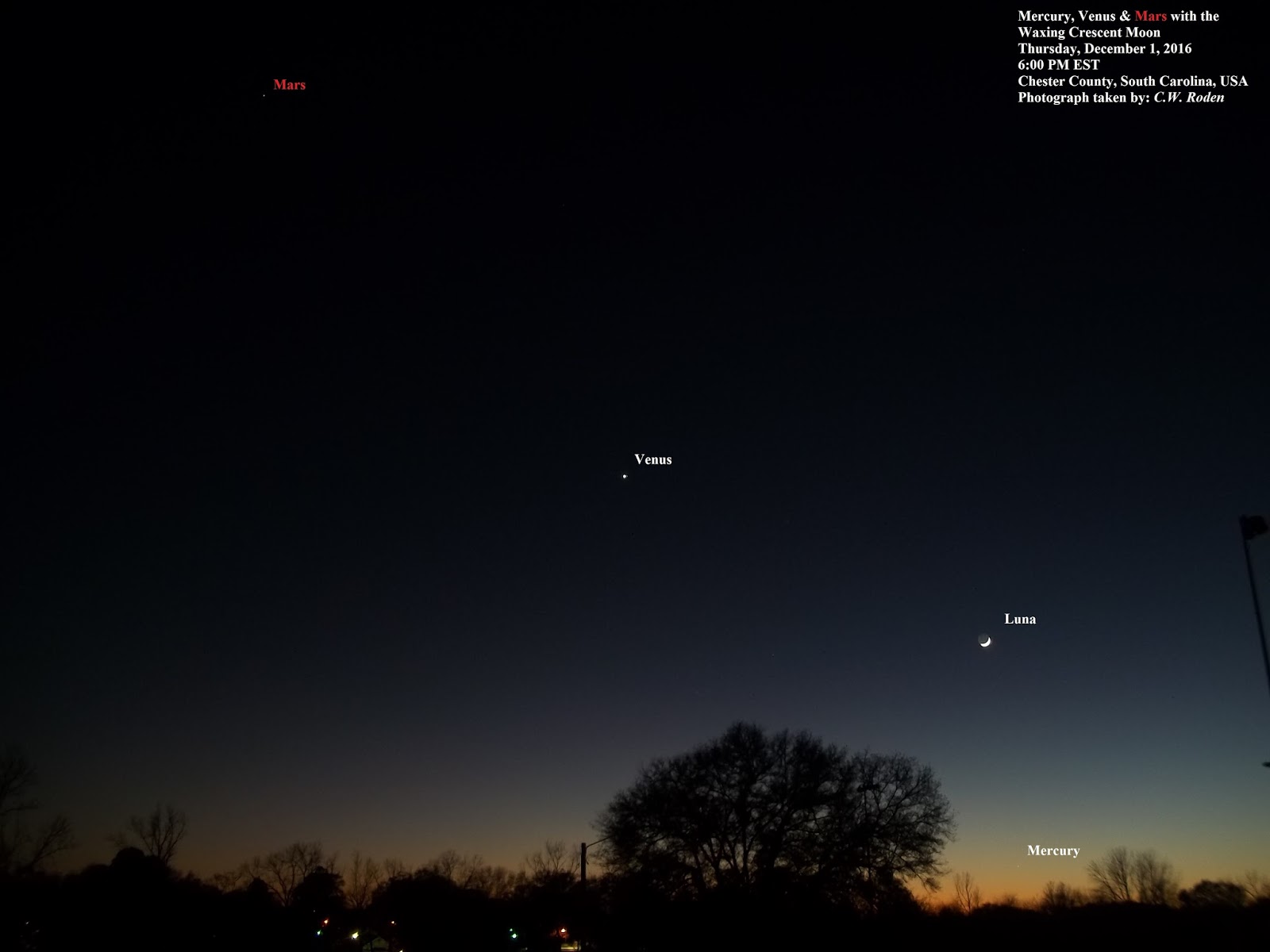
Night Sky Photography - 12-01-2016 - All Of The Inner Planets In Western Sky!

Folks, this evening as the sun set and night began to fall, I managed to get a couple of really great shots, and a really great wide shot of the Waxing Crescent Moon and all of the inner planets in the western sky in the same photo!

The first photo shows Luna in her waxing crescent phase after sunset between Venus above in the evening sky and Mercury below on the horizon chasing the sunset. 


The second photo is a closeup of Mercury on the horizon with Luna overhead. I was most fortunate to capture Mercury while it was still above the trees. It would set entirely twenty minutes later following the sunset. 


Finally the best shot of all -- a great wide-shot of the other three inner planets of the solar system in the western sky over South Carolina, USA on Earth (Terra). Mars is the highest overhead and the farthest from the sun, with Venus above Luna and Mercury on the horizon closest to the sun.


The Waxing Crescent Moon will continue to climb higher in the evening twilight -- moving farther each evening from the sunset in its orbit around the Earth. Luna will sweep close to Venus on Friday, December 2nd. By the evening of Sunday, December 4th, Luna will sweep close to Mars. Good weather and planetary viewing conditions permitting, this blogger will endeavor to capture both events over the next few nights.

Friday, October 09, 2015

Night Sky Photography -- 10-07/08/09-2015 -- Luna, Venus, Mercury, Mars & Jupiter

Photos I took over a three day period of the eastern early morning sky before sunrise and the parade of planets Venus, Mars, Jupiter, Mercury, and the bright star Regulus with the crescent moon in the October sky on the 7th, 8th, and 9th.

You can see the slow progression of Luna (the moon) moving closer to the planets, and the rise of Mercury in the horizon racing against the sunrise in the second photo. On the third day, Luna was between planets Venus and Jupiter (at least as seen from Earth) with pale Mars as a pale dot right beside it. The moon is slowly becoming a thin crescent as it makes it way towards Mercury on the horizon.

Unfortunately I was unable to get Mercury or Regulus in the last photo taken early Friday morning. 

Eastern Early Morning Sky. Wednesday, October 7, 2015.

Eastern Early Morning Sky. Thursday, October 8, 2015.

Eastern Early Morning Sky. Friday, October 9, 2015.