Showing posts with label Astronomy. Show all posts

Sunday, March 29, 2026

The Ludicrous Speed We Travel Through Our Universe


Being an amateur stargazer, I have to confess that very few sights on this planet can inspire more amazement and awe from me than the sight of the evening sky after sunset when twilight begins to deepen into night and the very first of our world's nearest heavenly neighbors begin to appear in our sky above.

Going outside at night and watching the moon rise, the planets of our Solar System appear, and thousands of visible stars and galaxies appear overhead in the night sky never ceases to amaze us stargazers.

Even the brightest star known to us, our own bright Sun that we see practically every clear, mostly cloudless daytime from sunrise to sunset, is a wonderful miracle in the heavens that most people seemingly take for granted because its a constant companion.

From our perspective standing here on our good Earth, everything in the heavens appears to be fixed -- aside from our lovely moon and the five visible "wanderers" that we can see with the naked eye.

However, outside of our visual range, our planet travels at an incredible speed of rotation every single day, and in orbit around the Sun. The planets of the solar system also cover distances that might seem surprisingly fast to most of us observing them. Our own bright Sun also travels at insanely fast speeds around our own Milky Way Galaxy.

The reason we don't readily notice this is because the space beyond our planet is so very vast, its nearly incomprehensible to imagine. The distances involved are so long that we cannot possibly measure them simply by miles.

Today, I'm going to tell y'all just how fast and how far we travel. Y'all better buckle up because this is gonna blow your minds.


The Sun, Earth, & The Moon

At the center of our solar system is our own beautiful Sun and this is where our journey begins.

Our Sun is a bright
G-type main-sequence star (or G-Type Star) that comprises about 99.86% of the mass of the Solar System. The Sun itself rotates at an average of about 28 days, although this varies at different latitudes since the Sun isn't a solid body but rather a giant ball of gaseous plasma. Its width is measured at approximately 864,000 miles, or 109 times that of Earth, with its mass measured at about 330,000 times that of the Earth.

To give you an idea of how huge that actually is, let me explain to y'all the exact speed and distance it takes our Earth to travel in its orbit around the Sun in a single year.

Our planet Earth is the third planet out from the Sun and the fifth largest planet in our Solar System. The mean diameter of the Earth
(the distance from one side to the other through Earth's center) is about 7,926 miles across. However, the interesting thing to realize here is that Earth is not quite a total sphere.

Our planet bulges out a bit more around the equator than it does at the poles because of its rotation
caused by the flattening at the poles, making it a slight oblate spheroid. Earth is therefore slightly smaller when measured between the North and South Poles (or the meridional circumference), which gives a diameter of 7,907 miles -- or a difference of about 20 miles. Earth's circumference (the distance all the way around the equator) is around 24,900 miles.

Earth itself rotates on its axis in space counter-clockwise approximately once every 23 hours, 56 minutes, and 4 seconds in a standard 24 hour day; spinning
at an incredible speed of about 1,037 miles and hour.
Because Earth spins steadily, as well as moves at a constant rate in orbit around the sun, we have the gravity that holds us all tightly in its grip to this beautiful blue world we all know and love.

The mean distance from the surface of the Sun to the surface of the Earth is around 93 million miles. This distance is measured by astronomers as one
astronomical unit (AU).

Since the Earth revolves in an oval shaped path (or elliptical orbit) around the Sun, rather than an even circular path, the exact distance varies
ranging between the extremes of perihelion (closest approach) in January and aphelion (most distant orbital position) in July. This actually puts Earth’s orbital distance from the Sun from between approximately 91.5 million to 94 million miles respectively.

Earth travels about 1.6 million miles daily at about 68,000 miles per hour in its orbit around the sun.
Over the span of the 365.26 days that makes up a single year, our planet Earth travels around 584 million miles in its orbit around the Sun.

That's pretty incredible huh?

Next to us in the night sky is our own beautiful lunar companion, Luna -- better known as simply the Moon.

The Moon's mean radius is 1,079.6 miles wide with an overall diameter of 2,159 miles, or about a little less than one-third the width of the Earth. Because of tidal forces that keep the Moon from rotating, one side always faces the Earth as it circles us in its monthly rotation.

Like the Earth travels around the sun in an oval-shaped path, the Moon also travels in an oblong orbit. When the Moon is the farthest away from Earth (or at its Apogee), it’s 252,088 miles away, while at it's closest approach (or at its Perigee), the Moon is 225,623 miles away -- the equivalent of about 32 Earths distant.

The Moon makes a complete orbit around the earth every 27.3 days, or approximately 13 times in a calendar year. Given the distance from the Earth and speed, the Moon travels a full distance of 1,423,000 miles an hour at a speed of 2,288 miles per hour to complete this orbit. Because of the rotation of the Earth and our own perspective standing on the surface, we humans do not perceive just how fast this is from our observations -- but its pretty fast!


The sunlight we see here on Earth takes approximately 8 minutes
and 20 seconds to travel the 93 million miles from the surface
of the Sun through the gulf of space to reach Earth.

The Speed Of Light 

Our Solar System is so large in sheer scale that using ordinary units of measurement like feet, or miles, simply won't do. On average, Pluto -- the farthest planet in our solar system (and yes, it's still a planet even if its a small one!) has a mind-blowing average mean distance of 3.6 billion miles from the Sun and takes a whopping 247.9 years to orbit the Sun just once!

In order to measure the size of our Solar System more accurately we must use the speed of light as our yard stick.

We use this because the speed of light is constant throughout the universe, traveling in the vacuum of space at an incredible speed of about 186,282 miles per second -- or
about 670.6 million miles per hour. To put that in perspective, if you could physically travel at the speed of light, you could go around the Earth a mind-blowing 7.5 times in one second; or travel from Earth to the Moon in about 1.5 seconds.

Now that's
ludicrous speed folks, and theoretically nothing can move faster than light outside of science fiction.

One light-minute is about 11,160,000 miles. One light-hour is 671 million miles -- roughly the distance between the sun and halfway between the planets Jupiter and Saturn in our Solar System. One light-day is 16.1 billion miles -- more than four times the distance between the Sun and Pluto. Finally, one light-year is a whopping 5.8 trillion miles!


Standing on the surface of the Earth, when we look up at the bright yellow Sun in the sky and the light that makes up the daytime hours; that light we see takes approximately 8 minutes and 20 seconds to travel the 93 million miles from the surface of the Sun through the gulf of space to reach Earth. So, one AU is a bit more than 8 light-minutes in distance.

From the 3.6 billion miles from Sun to Pluto at the far end of the Solar System, it would take sunlight about 5 hours and 40 minutes to cover that distance, or roughly about 39.5 AU.

Now when measuring distances outside of our Solar System, we must turn to another unit of measuring distances called parsecs. A parsec is approximately equal to 3.26 light-years, or 19.2 trillion miles (206,000 AU). A distance of 1,000 parsecs (or 3,262 light years) is called a kiloparsec (KPC).

Beyond our Solar System the nearest stars are in the Alpha Centauri system, a triple star system made up of three stars: Rigil Kentaurus (Centauri A), Toliman (Centauri B), and the small, red dwarf star Proxima Centauri (Centauri C). The closest of these stars, Proxima Centauri, sits at about 4.24 light-years (or 1.30 parsecs) from the Sun.

To put another way, the light from our stellar next door neighbors that we would see standing her on Earth took just over four years to reach us.
Also, if we tried to measure that in standard miles, that would be roughly 24,000,000,000,000 miles away! Now that's a lot of zeroes, y'all.


The Milky Way And Beyond

Our entire Solar System -- our Sun with its family of planets, asteroids, and comets -- orbits around the center of the large Milky Way Galaxy.

The Milky Way itself is a large barred spiral galaxy believed to be about 100,000 light years across (30.66 kiloparsecs) and made up of an estimated 100 - 400 billion stars, nebulae, and exoplanets.

The Solar System itself does not lie near the center of our Galaxy, rather it lies about 29,000 lights years (or 8 kiloparsecs) from the Galactic Center on what is known as the Orion-Cygnus Arm of the Milky Way.

Our Sun and Solar System move in a huge orbit around the center of the Milky Way Galaxy at about about 500,000 miles an hour.
That's roughly about 12,500 miles in 90 seconds. Because the Milky Way is such a big place, even at this ludicrous speed, it takes our Sun and Solar System approximately 225-250 million years to complete one single orbit around the galaxy’s center. To put that in perspective, that's roughly Earth's early-to-mid Triassic Period when the first dinosaurs appeared till the present day! This amount of time is referred to as a cosmic year, or a galactic year.

The Milky Way itself travels through the Universe at large at an astonishing 1.3 million miles an hour!

Outside of our galaxy the nearest local bodies are the two Magellanic Clouds that orbit the Milky Way. The
Large Magellanic Cloud (LMC) is approximately 163,000 light-years (49.9 kiloparsecs) away while the Small Magellanic Cloud (SMC) is approximately 206,000 light-years (63 kiloparsecs) away.   

Beyond the Magellican Clouds the closest neighboring galaxy is the Andromeda Galaxy (Messier 31, or NGC 224). Like the Milky Way, it is also a barred spiral galaxy approximately 2.5 million light years (770 kiloparsecs) from our Sun.
The Andromeda Galaxy has an estimated diameter of about 220,000 light years (67 kiloparsecs).

On and interesting note, due to the ever expanding nature of the Universe, the Andromeda Galaxy is currently racing toward our own Milky Way Galaxy at an estimated speed of about 70 miles per second and the two galaxies are expected to collide with each other sometime in about 4-5 billion years from now.

Once we move further out into the Universe itself, the distances become even more daunting. 
Astronomers typically express the distances between neighboring galaxies and galactic clusters in megaparsecs (MPC) and gigaparsecs (GPC) the largest units of length commonly used. A megaparsec is one million parsecs (or 3,260,000 light-years) and a gigiparsec is one billion parsecs (or 3.26 billion light-years)!

The most distant and probably oldest known galaxy in the observable Universe is
GN-z11 approximately 32 billion light-years (or 9.75 gigaparsecs) away from the Milky Way in a Universe that is estimated to be 93 billion light-years (or 28 gigaparsecs) across!

Now that's truly incredible to think about, y'all!


Conclusion

Going about our daily lives we can easily take for granted that we are traveling through this galaxy and universe of ours, propelled at incredibly ludicrous speeds.

Looking up at the night sky, seeing the heavens above us in the sky dome,
its truly a humbling experience knowing that in all of that infinity we are all of us merely a small speck of sand in an insanely large ocean of stars and galaxies -- and perhaps far more than we can readily observe even with our best astronomical instruments.

Probably the only thing more infinite than our known Universe is the human imagination itself.

I hope y'all have enjoyed this post, have a wonderful Dixie evening and y'all come back now, ya hear!


This blogger would like to offer a special thanks to the wonderful folks at earthsky.org and NASA for providing the information in this article.

Monday, February 17, 2025

The Supergiant Stars Of The Constellation Orion


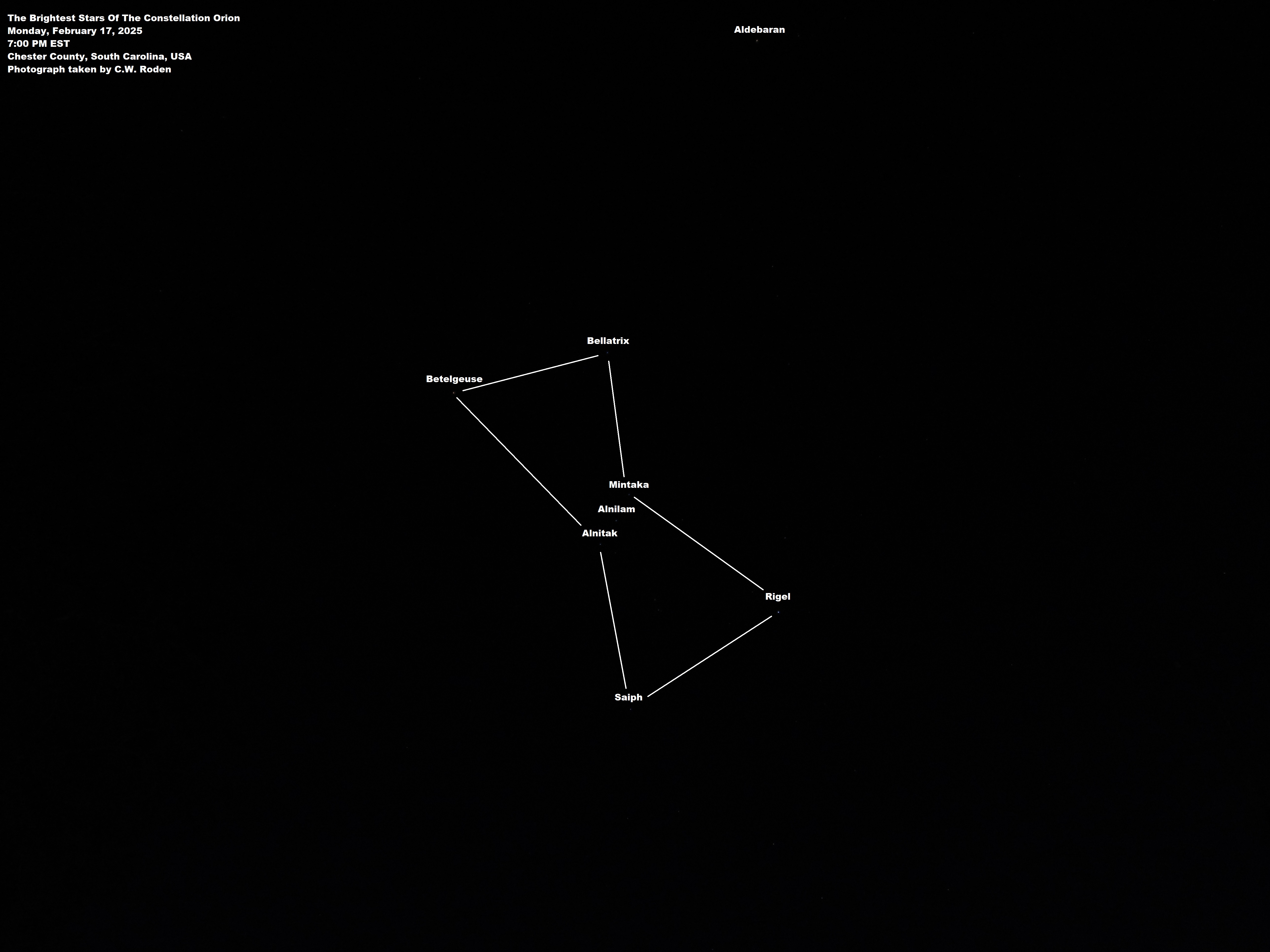
One of the most easily recognizable constellations in our night sky is Orion The Hunterespecially here in North America during the winter months. 

The constellation, made up of a quadrangle of four bright stars in our evening sky shaped like an hour glass with three additional evenly spaced stars making up the center (or belt), gives Orion its distinctive look. Although they look like tiny dots of light in our evening sky here on Earth, all of them are actually much larger than our own yellow Sun.

While the
G-type main-sequence star that inhabits the center of our own Solar System seems huge -- and make no mistake it is compared to the rest of the planets that orbits it -- next to the Constellation Orion stars, its relatively small in terms of scale and mass. 

Here are a few fun scientific facts about each of these bright stars.


Rigel
(or Beta Orionis) is 
generally the seventh-brightest star in the night sky and the brightest star in Orion. Rigel isspectral type B8Ia blue supergiant (BSG) star approximately 120,000 times as luminous as our own Sun and is 18 to 24 times as massive in scale.

It is the brightest and largest component of a star system of at least four stars that appear as a single blue-white point of light to the naked eye as seen here on Earth. The three smaller stars of this system are all blue-white main-sequence stars, each three to four times as massive as the Sun.


The Rigel system is located at a distance of approximately 860 light-years (or 260 parsecs) from the Sun.

Betelgeuse (or Alpha Orionis) is a red supergiant star that is the second-brightest star in the constellation, and the tenth-brightest star in the night sky. It is also the largest star in Orion with an estimated radius between 640 and 764 times that of the Sun -- which would roughly be the distance between the center of our Sun to the somewhere between the orbits of Mars and Jupiter!

Betelgeuse lies about 642 light-years (or 197 parsecs) from our Solar System.
Because Betelgeuse is a red supergiant, while it is much larger and closer to us than Rigel, it burns less brightly due to the late stage of its celestial lifespan.


Size comparison of Betelgeuse and Rigel compared to our Sun
and other stars.

Bellatrix (or Gamma Orionis) is the third-brightest star in Orion, and typically the 25th-brightest star in our night sky. Bellatrix is a B2 III-type giant star about six time the size of our own yellow Sun, and located about 244 light-years (or 75 parsecs) from the Sun, making Bellatrix the closest of the Orion constellation stars to our Solar System.

Saiph
(or Kappa Orionis) is the other blue supergiant star that makes up the forth star in the constellation's main quadrangle. It is the sixth-brightest star in Orion with an
estimated distance of about 650 light-years (or 200 parsecs) from the Sun.

Orion's Belt is one of the most recognizable asterisms in the night sky and easily one of the most easily identifiable parts of the constellation Orion consisting of three bright stars nearly equally spaced in a line in our night sky as seen from our vantage point here on Earth.
Although they appear close to each other in the night sky, they are at varying distances some of the farthest Orion stars from our Solar System and each other.

Alnitak (or Zeta Orionis), the easternmost star in Orion's Belt, is a triple star system approximately 1,260 light-years (or 486 parsecs) from our Solar System. The primary star, Alnitak Aa, is a hot blue supergiant and the brightest Class O star in our night sky. It has two companion stars: Ab and B. It's the fifth brightest star in Orion and the 31st brightest star in the night sky.

Alnilam (or Epsilon Orionis), the central star in Orion's Belt, is a massive blue supergiant around 1,344 light-years (or 412 parsecs) making it the farthest Orion star from our Solar System. Its the brightest of the three stars in Orion's Belt and the fourth-brightest star in the Orion constellation. Alnilam is also the 29th-brightest star in our night sky and about 40 times the mass of our own Sun.

Mintaka (or Delta Orionis), the westernmost star, is located about 1,240 light-years (or 380 parsecs) from our Solar System and is closest to the celestial equator. It is a multiple-star system composed of three spectroscopic components of about six stars, the main one being a Class O blue supergiant star similar to Alnitak Aa.

The stars of Orion's Belt are several times more massive than the sun and thousands of times brighter. Combined, the ten stars of these three systems possess a luminosity approximately 970,000 times that of our own Sun!


The size of the Orion Belt stars compared to our own Sun.


One more fun fact for all you amateur stargazers out there is that you can actually use these stars of Orion as a guide to locating other stars and nearby constellations. Please be sure to check out my previous blog post on the subject HERE.

Monday, March 25, 2024

Night Sky Photography -- 03-24/25-2024 -- Full Worm Moon & Penumbral Lunar Eclipse

Good evening, fellow stargazers!

The first full moon of spring 2024 her in the Northern Hemisphere rose this evening into a somewhat clear night sky with only a few small clouds.

The March full moon -- also known as the Full Worm Moon in North America -- is the second smallest (most distant) full moon from the Earth in 2024 at around 251,900 miles (or 405,394 kilometers) away.

The Full Worm Moon of 2024 also takes place during a Penumbral Lunar Eclipse -- when the outer part of Earth's shadow covers the full moon when Luna is on the opposite side of the Earth from the Sun. The Penumbra is the outer lighter part of the Earth's shadow as opposed to the darker inner part of the Earth's shadow, the Umbra.

Luna began to cross the Earth's penumbra shadow as viewed here in South Carolina at about 12:54 a.m. Eastern Standard Time and would reach peak eclipse at around 3:12 a.m. EST when the Full Worm Moon would cover roughly 90% of the lunar surface.

Since the Moon would only travel inside the lighter part of the Earth's shadow, Luna won't appear to have a dark bite taken out of her, but rather appear slightly darker to the naked eye.

The Penumbral Lunar Eclipse ended at 5:35 a.m. EST, but by then your favorite blogger had long since returned to bed.


The following are the photos I took of this late evening night sky event. One shows the Full Worm Moon in the eastern sky with the bright star Spica lower towards the horizon. Spica and Luna will appear next to each other over the next couple nights as the Moon moves past it towards the east. The second is a clearer shot of the surface of the Full Worm Moon prior to the lunar eclipse and the third and final photo shows the slightly darker moon now fully in the Earth's penumbra shadow. 


I hope y'all enjoyed my photos for the evening and, until next time -- be sure to keep your eyes to the night skies, y'all hear!

Saturday, February 24, 2024

Night Sky Photography -- 02-24-2024 -- Full Snow Moon & Regulus

Tonight I captured a couple of shots of the February Full Moon -- also known as the Full Snow Moon in North America -- along with the bright star, Regulus, in the evening sky.

Regulus is the brightest star in the Constellation Leo the Lion.
Regulus appears singular to the human eye, but its actually a quadruple star system composed of four stars that are organized into two pairs. The Regulus system lies approximately 79 light years (or 24 parsecs) from the Sun.


The February Full Snow Moon is 2024’s farthest full micromoon for year at a distance of about 252,225 miles (or 405,917 kilometers) from the Earth. This is in contrast to the average distance between the Earth and the Moon, which is around 238,900 miles (or 384,472 km).

Thursday, February 01, 2024

Night Sky Photography -- 01-31-2024 -- The Galactic Anticenter & Winter Stars

Good evening, fellow stargazers! 

As we get ready to exit the winter month of January here in the Northern Hemisphere and start into February, overhead the Winter Circle star constellations rise high into the sky dome in late evenings and travel westward to set in the late night-early morning hours.

Looking up at the brightest of these stars inside the Winter Circle (Hexagon) you are actually looking towards the opposite end of our own Milky Way Galaxy.

In the summer months in the Northern Hemisphere, you can look towards the spot in our evening sky where our own galaxy's center is located, as seen in my previous Night Sky Photography post HERE.

The opposite can be seen in the winter months where the season's most prominent constellations show us the location of the Galactic anticenter -- the area of space that's directly opposite to the Galactic Center looking towards the far end of the galaxy as viewed from our Earth.


The actual location of the Galactic anticenter is easy to find since its very close to the bright star, Elnath (or Beta Tauri) located at the point that connects the Constellations Taurus The Bull and Auriga The Charioteer. Elnath is the second-brightest star of Taurus and is located approximately 134 light-years distance from our Sun.

My photographs for the evening show the location of the Galactic anticenter near Elnath, as well as the best way to spot it using the winter constellations as a guide.
Locate Elnath and you find the Galactic anticenter in the night sky.

The first photo shows the bright stars overhead just two hours before midnight on the last day of the month of January. In my second photo (taken just a moment later), I outlined the location of the constellations themselves, with the Galactic anticenter located right at the junction where Taurus meets Auriga next to Elnath. 


Well, I hope that y'all enjoyed my photos for the evening. Let me know what y'all think in the comments section and as always have a wonderful evening and be sure to keep your eyes to the night skies, y'all.

Wednesday, January 03, 2024

Night Sky Photography -- 01-02-2024 -- Let's Talk About The Stars Of The Winter Triangle


Good evening fellow stargazers, and Happy New Year 2024!

Late last night, under beautifully clear starry skies here in upstate South Carolina, I photographed the major stars of the Constellations Orion The Hunter and his two dogs: Canis Major (The Greater Dog) and Canis Minor (The Lesser Dog) highlighting the position of the Winter Triangle that connects these three constellations.

For those of y'all who follow my night sky photography here on this blog site, you should be more than familiar with the Winter Triangle asterism. I've taken and outlined the three major stars that make up the Winter Triangle and their positions among their star constellations on several occasions.

Now that the winter season is in full swing here in North America, this is the best time of the year to talk about the three major stars of the Winter Triangle and some really interesting facts about these heavenly bodies.

One major fact about these stars is that all of them are much larger than our own bright yellow Sun. Two of the stars are almost double the size of the Sun and the final one is so large it would engulf half of our Solar System itself.

Let's begin with Sirius, the largest star in the Winter Triangle -- as well as the largest and brightest star visible in the night sky from here on the surface of the Earth.

Sirius (actual designation among astronomers by the Bayer designation Alpha Canis Majoris, or a Canis Majoris) is a bright bluish main-sequence star about twice the size of our own Sun and about 20 times as luminous. Its name is derived from the Greek word Seirios, meaning glowing.
Sirius is nicknamed "The Dog Star" because of its position in the constellation Canis Major (The Greater Dog).

Sirius is also a binary star system, meaning there are in fact two stars. Bright Sirius A is the bright star visible here on Earth, while Sirius B is a smaller white dwarf companion that is barely visible through a good telescope. Sirius B (nicknamed "The Pup") is believed to be nearly the diameter of the Earth (7,500 miles, or 12,000 kilometers) and 10,000 times dimmer than Sirius A.

Both Sirius A and Sirius B orbit each other every 50 years at a distance of
somewhere between 8.2 and 31.5 astronomical units -- roughly the distance between the planets Saturn and just between Neptune and Pluto in our own Solar System. At a distance of roughly 8.6 light-years, (or about 2.64 parsecs), the binary Sirius system is one of Earth's closest interstellar neighbors.

The next closest point of the Winter Triangle is the bright star Procyon (also known as Alpha Canis Minoris, or a Canis Minoris) in the smaller constellation Canis Minor (The Lesser Dog). The name is derived from the Greek word Prokyon, meaning "before the dog", since it seemingly precedes the "Dog Star" Sirius as it travels across the sky due to rotation of the Earth.


Procyon is relatively close to our Solar System at a distance of about 11.46 light-years (or 3.51 parsecs) from the Sun.
Procyon is usually the 8th brightest star in the night sky, with the best magnitude for brightness around the middle of January every year.

Just like Sirius, Procyon is also a binary star system made up of two stars: Procyon A, which is a white main-sequence star; and Procyon B, which is a much smaller white dwarf star. Procyon A is estimated to be 1.4 times larger than our Sun, while Procyon B is just smaller than the Earth at about 5,300 miles (or 8,528 km). Both stars are separated by about 15 AUs -- about the distance between Saturn and Uranus in our Solar System -- and orbit each other once every 40 years.

Finally, we have the bright star, Betelgeuse, located in the upper part of the constellation Orion the Hunter.
The name was derived from the Arabic phrase Yad al-Jawza' or "the hand of al-Jawza".

Betelgeuse is a
red supergiant star and the 10th brightest star in the night sky visible from the Earth's surface. Also known to astronomers as Alpha Orionis, or a Orionis, its the largest star in the constellation Orion as well as the largest in the Winter Triangle. It sits at a whopping 642 light-years (or, 40.6 million AUs) distance from the Sun.

Betelgeuse's diameter is approximately 760 million miles (or about 1.2 billion km, or 8.1 AU) across and is somewhere around 700 times as massive as the Sun. To put that in cosmic perspective, if Betelgeuse replaced our Sun in the Solar System, its circumference would engulf all of the four inner planets and the Asteroid Belt and would be just inside the orbit of Jupiter.

Despite being the largest star in the constellation, Betelgeuse is the second brightest star in Orion after the white supergiant star, Rigel, which sits near the bottom of the constellation. Although Betelgeuse is actually larger in terms of diameter, in terms of actual mass and energy output, Rigel is the king of Orion.

This huge red star is actually in the final stages of its life and is expected to become a supernova explosion at some point in the next 100,000 years.

So, when looking up at the winter constellations late at night over the next few months, really consider the size of those bright, beautiful points of light that make up the Winter Triangle.

Wednesday, August 30, 2023

Earth Is A Bright Evening "Twin Star" As Seen From Mars

Earth and the Moon as seen in the Martian night sky photographed by NASA's Curiosity rover at Gale Crater
on Friday, January 31, 2014 about 80 minutes after local sunset
during its 529th day on the Martian surface.
The Moon is only barely visible just below the bright Earth in close-up.

Image courtesy of NASA/JPL.


Imagine you were a human settler living on the planet Mars, the forth planet in our Solar System, in possibly as few as a couple hundred years from the present day.

You're walking outside the pressurized habitats built by the first and second generations born on Mars -- or possibly even domed terrariums as the first stages of the long process of terraforming the Red Planet are just beginning -- and stand out on the surface looking up at the evening sky.

Its about an hour following the beautiful blue Martian sunset in the crimson sky over the slightly closer horizon of the vast rust-colored desert planet and the first of the brightest objects appear overhead.

First would be the two moons: the larger, potato-shaped Phobos, and the smaller bright Deimos (both of which are also visible during the daylight hours). After these would come the first bright spots low in the evening sky -- our own planet Earth and its faint companion, our bright, beautiful Moon. 

On average the distance between Earth and Mars is about 140 million miles (or 225 million kilometers). From the surface of Mars, a hypothetical Martian would see our Earth the same way that we Earthlings view the planet Venus: as an inner planet, because Earth is in a closer and faster orbit to the Sun. Because of this, Earth, as seen from Mars, appears as a bright morning or evening "star" as Venus does here on Earth.

Also, from the surface of Mars, our lovely Luna (Moon), though appearing very faint, can actually be seen with the naked eye (or more likely through the safety glass plate of a pressure suit).

Because our Moon only averages a distance of about
238,855 miles (or 384,400 kilometers) in its orbit around our Earth, from the surface of Mars looking up into the night sky dome, Earth and the Moon would only appear to be separate by less than a degree (or, roughly just under the length of your pinky finger held at arms length) most of the time. So close together that the two heavenly bodies appear to be constantly in conjunction with one another, appearing to be a "twin star" in the evening and morning Martian skies.

A hypothetical Martian would also be able to see the Moon orbit the Earth, even see both heavenly bodies transit each other (pass in front of, or behind, the other) at certain times of the long Martian year in their orbit.

Thanks to modern science, we are able to view that magnificent sight or our home planet from another world right here from Earth via photographs taken from the surface of Mars by exploration rovers sent by us humans to study the possibility of human exploration (and possible future colonization) of our closest planetary neighbor -- as shown in the photo used for this article.

Through the yes of these robotic explorers we can see our own Earth and its beautiful Moon in a way that early humans looking up at the night sky could never have imagined; that only God, and perhaps maybe non-human intelligence beyond our Solar System, could ever have seen humanity's home before.

All the same, maybe someday soon Earth-born explorers in the coming decades -- and perhaps future generations of Martian-born humans hundreds of years from now -- will see that beautiful sight of our lovely Earth and Moon from the surface of the Red Planet with their own eyes with that same sense of wonder that us night sky observers here on Earth view the other planets in our Solar System? 

Saturday, August 12, 2023

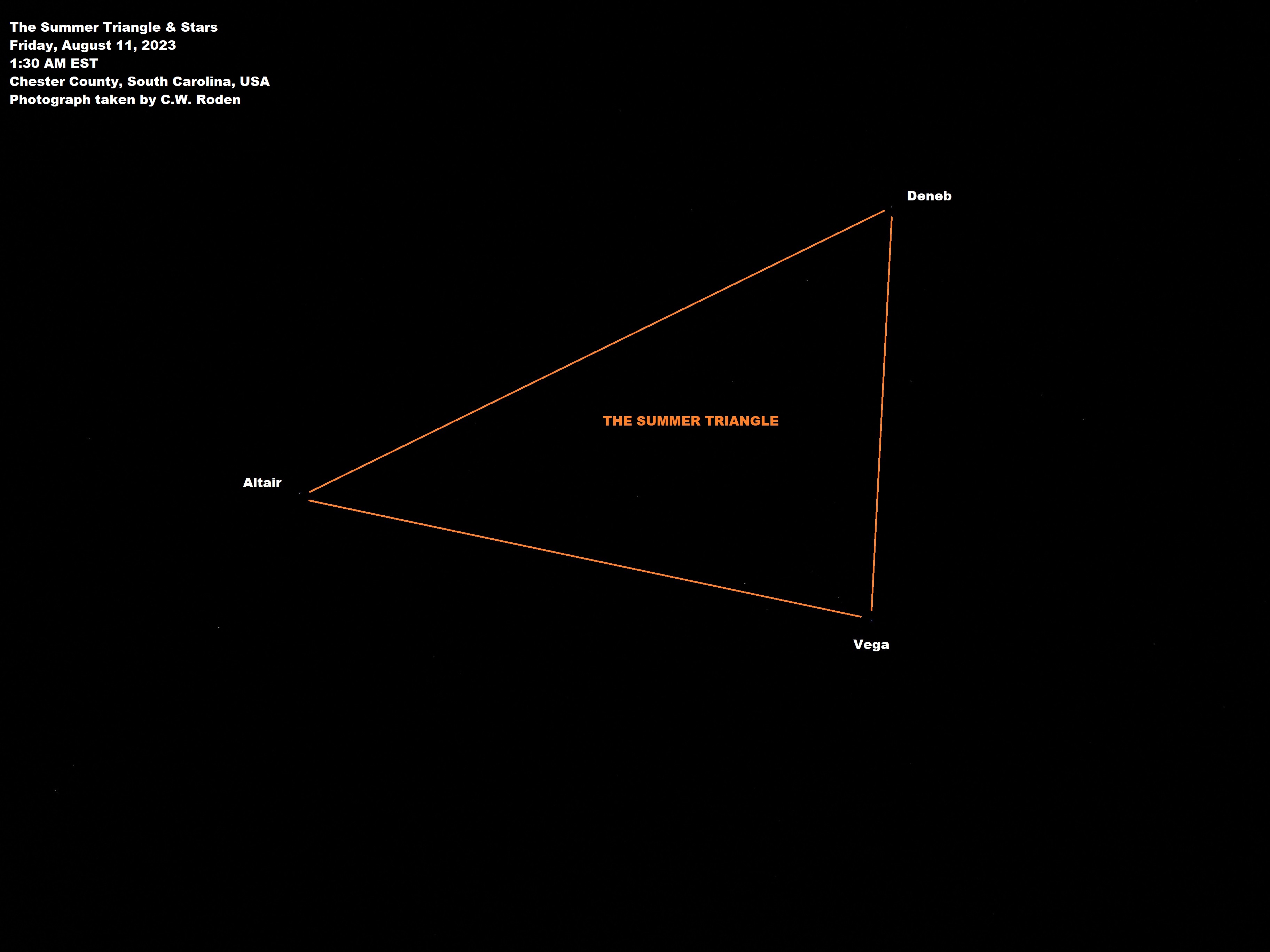
Night Sky Photography -- 08-11-2023 -- The Summer Triangle & The Northern Cross

Good evening, fellow stargazers! 

Now that we're well into summer here in the Northern Hemisphere, the three bright stars that make up the 
Summer Triangle asterism can easily be spotted overhead late in the evenings.

The three bright first-magnitude stars: Vega, Deneb, and Altair are all easily visible to the naked eye and make up the brightest stars of their respective star constellations. Vega is the brightest star of the small Constellation Lyra the Harp. Deneb is the brightest in the Constellation Cygnus the Swan. Altair is the brightest star in the Constellation Aquila the Eagle.

I captured a good pair of shots outlining the bright stars that make up the vertices (or corners) of the Summer Triangle, as well as the major stars of the three star constellations that make up the asterism. I highlighted the constellations as well as the two asterisms that make up both the Summer Triangle and the Northern Cross respectively.


Here are some interesting facts about the three main stars in the Summer Triangle and the Northern Cross. 

Altair, in the Constellation Aquila, is a A-type main-sequence star only about 16.7 light-years (or 5.1 parsecs) away from our Sun, making it one of our nearer interstellar neighbors. 

Vega, in the Constellation Lyra, sits only 25 light-years (or 7.7 parsecs) away and is the 5th brightest star in the night sky -- the second-brightest star in the northern celestial hemisphere after Arcturus

Deneb, in the Constellation Cygnus, is the 19th brightest star in the night sky and the head of the Northern Cross. The bright blue-white supergiant star is believed to be somewhere around 2,615 light-years (or 802 parsecs) distant from our Earth and estimated to be around 200,000 times as bright as our own Sun! This makes Deneb one of the most distant stars visible from Earth with the naked eye.

The Northern Cross itself consists of the six brightest stars in Cygnus: Deneb, Sadr, Gienah, Delta Cygni, and Albireo.
Albireo appears at the head of the Cygnus the Swan, and serves as the base of the Northern Cross.

Well folks I hope y'all enjoyed my photos. Be sure to leave a comment below and have a wonderful Dixie evening, and be sure to keep your eyes to the night skies, y'all!

Wednesday, August 09, 2023

What Is A Blue Moon And How Rare Are They?


Later this month, on the night of August 30-31, 2023, there will be a Super Blue Moon -- the second Supermoon of August in fact. Luna (aka Earth's Moon) will be very close to the Earth and appear along with the planet Saturn. It will also be the last Full Moon of the summer season of 2023.

How rare are Blue Moons? Well, the classic phrase "once in a Blue Moon" referring to a rare occurrence aside, Blue Moons take place in years when there are 13 Full Moons in a calendar year.
The Full Moon phase occurs every 29.5 Earth days. Because of this Blue Moons occur about once every two to three years on average, although sometimes they can occur in the next year during leap years -- as will be the case in 2024, which will also have a Blue Moon in the month of August.

Although the term Blue Moon nominally refer to the second Full Moon of a single calendar month, there are actually two types of Blue Moons: a monthly Blue Moon and a seasonal Blue Moon.

The monthly Blue Moon meets the traditional definition of the second Full Moon in a single calendar month, while a seasonal Blue Moon is the third Full Moon in a season that has four Full Moons.

The Blue Moon of August 30th will be a monthly Blue Moon, since there will only be three Full Moons in summer of 2023. The next Blue Moon will take place next year -- a leap year -- on the night of August 19-20, 2024, will be a seasonal Blue Moon since there will be four Full Moons during that year's summer season:
June 21st (on the summer solstice), July 21st, August 19th, and September 18th.

Finally, the term Blue Moon does not actually refer to the color of the Lunar surface itself. Moons that appear blue (such as the one in the photo above) are incredibly rare and have nothing to do with the calendar or the Moon's phases. Such coloring is usually a result of certain atmospheric conditions: smoke, dust, or even water droplets in the atmosphere from certain types of clouds can all contribute to a Full Moon taking on a blue shade on rare occasions.

Fun Full Moon Fact:
The month of February will never experience a monthly Blue Moon as it only has 28 days in a common year and 29 in a leap year. Sometimes February doesn't have a Full Moon at all and this is known as a Black Moon -- which will not happen again till February of 2037.

Saturday, May 06, 2023

Night Sky Photography -- 05-05-2023 -- The Full Flower Moon Over Downtown Chester, South Carolina

Good evening, y'all!

This evening I have a pair of really good photos of the May Full Moon over the evening lights and buildings of downtown Chester, South Carolina -- my hometown -- as well as a nice close-up shot of the Full Moon and all of its outstanding features.

The May Full Moon is known as the Full Flower Moon (or Blossom Moon) here in the Northern Hemisphere.

Sunday, April 30, 2023

Night Sky Photography -- 04-30-2023 -- Venus & Mars With Major Evening Stars & Constellations

Good evening my fellow stargazers!

Closing out the month of April, I was blessed to have some actual clear skies for this evening after rain and cloudy conditions for most of the last week.

This evening I was about to capture a couple of really beautiful shots of the bright planet Venus and the small red planet, Mars, along with four of the major evening star constellations over 50 minutes after sunset in the western sky. 

Venus and Mars are the second and fourth planets in our Solar System respectively, with our own good Earth in the orbit between them around the Sun.


As you can see from my first photograph, both planets appear in the western sky almost an hour after sunset with several bright stars in the western sky belonging to the winter constellations: Orion The Hunter, Canis Minor, Gemini The Twins, and Auriga The Charioteer.

Sirius, the Dog Star, is part of a fifth constellation, Canis Major which is largely obscured from view by the trees. While Venus is currently the brightest "wandering star" (planet) in the western sky, Sirius is actually the brightest of the evening stars in the night sky seen from the surface of the Earth.


In my second photo, I outlined the star constellations themselves in their current relations to the position of the planets.

Mars
is just inside of the Constellation Gemini The Twins and will remain in close proximity to them for the next month at least. As it moves further and further away in its wider orbit around the Sun, Mars will become dimmer and, unless you know where to look, you might have a hard time finding it.

Venus meanwhile is very bright and easy to spot towards the sunset in the evenings. It will be the brightest object to appear in the evening sky other than our lovely Moon.


Wednesday, April 05, 2023

Night Sky Photography -- 04-05-2023 -- The Full Pink Moon

In the North America, the April Full Moon is known as the Full Pink Moon. This year's April full moon is the first official full moon of spring here in the Northern Hemisphere....and despite the name, its not actually pink.

This evening I was able to capture these two really good shots of the April Full Moon. The first is the wide shot taken from the road down the street from my home, and the second is the close up showing the details of the lunar surface.


Thursday, March 30, 2023

Night Sky Photography -- 03-29/30-2023 -- Venus & Uranus An Hour After Sunset

Good evening fellow stargazers!

Well, I can't think of any better way to end this month out than with some photographs that I was able to take over the course of two days about an hour after sunset showing the bright planet Venus in conjunction with the dim gas giant planet Uranus in the western sky dome. I was truly blessed with cloudless skies on both nights in order to bring y'all this night sky photographic offering.

I took two photos each evening of the two planets. One a wide shot as it appears in the western sky, and the other a close-up of the two planets together. As you can see, Uranus was just above and to the left of Venus on Wednesday the 29th, and the next evening on Thursday the 30th, Venus had moved just above and to the right of Uranus.


The planet Venus is the brightest object in the
night sky after our own Moon and the second planet in our Solar System is nearly as big around as our Earth at about 7,520 miles (or 12,104 kilometers) across, compared to our planet which is about 7,926 miles (or 12,756 kilometers) wide. Venus is about 67 million miles (or 180 million km) from the Sun -- roughly 0.7 astronomical units (AUs). Due to its proximity to the Sun, it only takes Venus approximately 225 of our Earth days to circle our star.

Though it appears much smaller and very much dimmer to the naked eye, the gas giant planet Uranus -- the seventh planet in our Solar System -- is actually much bigger with a radius of 15,759.2 miles (or 25,362 kilometers), making Uranus about four times wider than our Earth. Uranus is much farther away from the Sun
with an average distance of 1.8 billion miles (or 2.9 billion kilometers) making Uranus about 19.8 AUs away from the Sun. Because of its greater distance, Uranus takes about 84 Earth years to travel once around the sun.

I hope y'all enjoyed my planetary photographs and as always have a wonderful Dixie Day and be sure to keep your eyes to the evening skies, y'all hear.