Saturday, May 08, 2021

The Jacket Of Gray -- Poem


The Jacket Of Gray

By Caroline Augusta Ball (1825-1900)


Fold it up carefully, lay it aside;
Tenderly touch it, look on it with pride;
For dear to our hearts must it be evermore,
The jacket of gray our loved soldier-boy wore.

Can we ever forget when he joined the brave band
That rose in defense of our dear Southern land,
And in his bright youth hurried on to the fray,
How proudly he donned it - the jacket of gray?

His fond mother blessed him and looked up above,
Commending to Heaven the child of her love;
What anguish was hers mortal tongue cannot say,
When he passed from her sight in the jacket of gray.

But her country had called and she would not repine,
Though costly the sacrifice placed on its shrine;
Her heart's dearest hopes on its altar she lay,
When she sent out her boy in the jacket of gray.

Months passed and wars thunders rolled over the land,
Unsheathed was the sword and lighted the brand;
We heard in the distance the sound of the fray,
And prayed for our boy in the jacket of gray.

Ah, vain, all in vain, were our prayers and our tears,
The glad shout of victory rang in our ears;
But our treasured one on the red battle-field lay,
While the life-blood oozed out of the jacket of gray.

His young comrades found him, and tenderly bore
The cold lifeless form to his home by the shore;
Oh, dark were our hearts on that terrible day,
When we saw our dead boy in the jacket of gray.

Ah! spotted and tattered, and stained now with gore,
Was the garment which once he so proudly wore;
We bitterly wept as we took it away,
And replaced with death's white robes the jacket of gray.

We laid him to rest in his cold narrow bed,
And graved on the marble we placed o'er his head
As the proudest tribute our sad hearts could pay -
'He never disgraced it, the jacket of gray.'

Then fold it up carefully, lay it aside,
Tenderly touch it, look on it with pride;
For dear must it be to our hearts evermore,
The jacket of gray our loved soldierboy wore!


Dedicated to all the men and boys who wore the hallowed jacket of gray ~ Lest we forget.

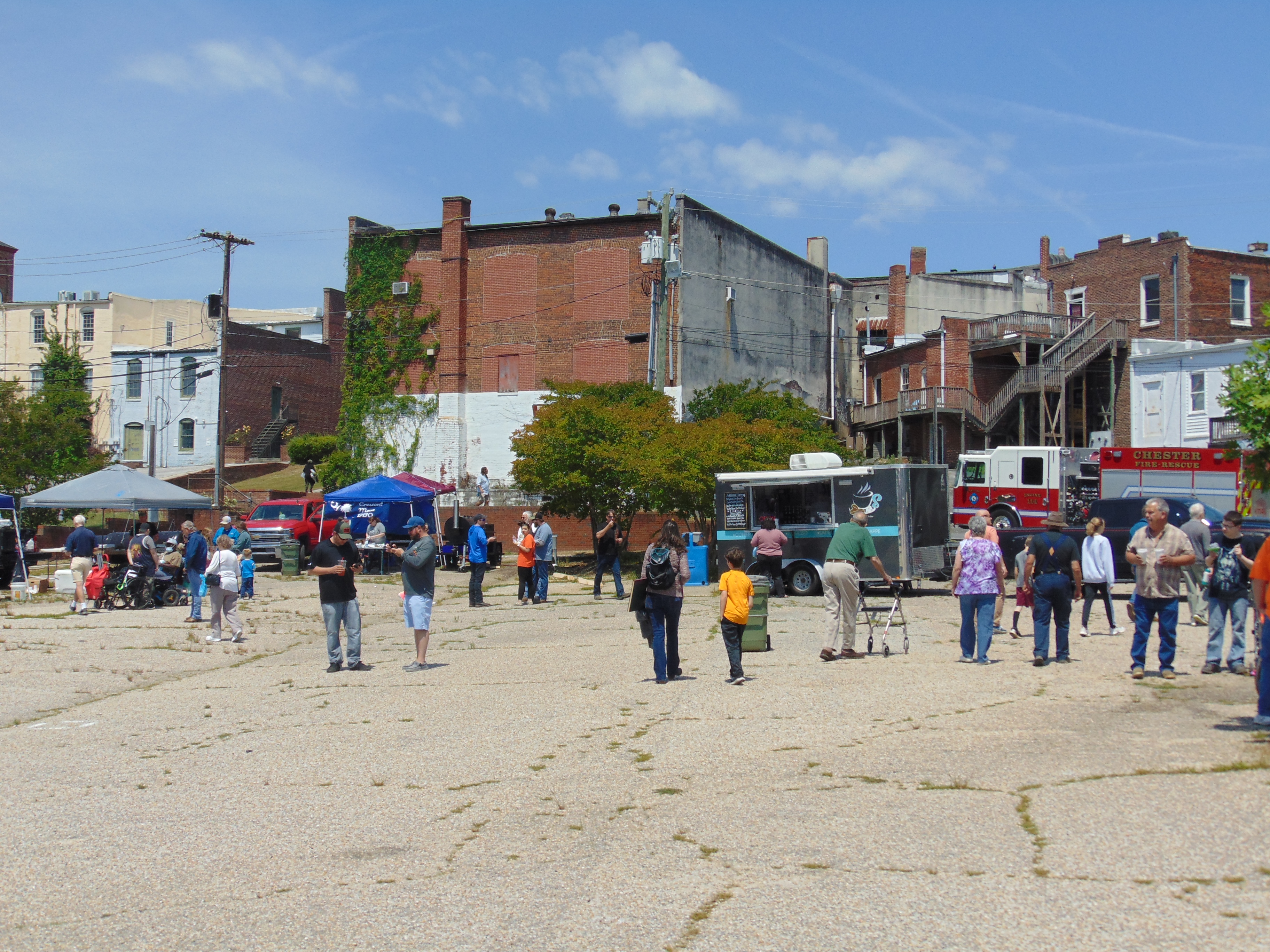
Hog On The Hill 2021 In Downtown Chester, SC


Good afternoon, y'all!

Hog On The Hill is a local annual gathering of barbecue vendors that takes place in this blogger's hometown of Chester, South Carolina about the first, or second, Saturday in May.

This charitable gathering of both local barbecue vendors from Chester and the neighboring counties offers a wide selection of some of the best barbecue in this part of the State of South Carolina -- and make no mistake South Carolina makes the very best barbecue.

Of course, I could be a tiny bit biased in that opinion, I will admit.

I stayed for about an hour just talking to folks and enjoying the wide selections of free samples and a couple of plates of outstanding barbecue. Everything from traditional sauces to delicious honey mustard (my personal favorite) and nice vinegary goodness.

The following are the photos I took of the event. It was a small gathering but then again we are still recovering from a national pandemic.


Well, once again I hope y'all enjoyed my photos and as always have a wonderful Dixie Day and y'all come back now, ya hear!

The Significance Of My Confederate Soldiers Uniform

My Confederate gray uniform & accessories for
memorial services, historical events & parades.


Each year hundreds of Confederate Memorial Day events take place in the American Southland from late April (around the 26th in most Southern States) to around early May (the 10th) in the Carolinas, but usually continue until close to U.S. Memorial Day national holiday (last Monday of May).

These events largely include the volunteer clean up of Confederate soldiers' graves, followed by humble memorial services with descendants decked out in their Sunday best laying flowered wreaths at the sites of those same graves and Confederate monuments to the dead.

Sometimes more elaborate events take place, which include volunteer War Between The States reenactors decked out in 19th century military and civilian attire, portraying people who died over 100 or more years ago (the last reported Confederate Veterans lived until the late 1950s). These include the ceremonial firing of musket volleys and cannons over the gravestones, women dressed up in black "widow" attire and children laying flowers at the flag decorated graves.

On some of these occasions, Confederate Memorial Day and U.S. Memorial Day overlap, with reenactors wearing the hallowed Confederate gray and butternut surprisingly (to some) marching in parades meant to honor the nation's American dead from its various wars.

As both a proud descendant of a Confederate soldier, and a Guardian of Confederate graves, every year around this time I too honor the Southern dead -- particularly a sergeant from northern Alabama who fell in defense of Southern independence and his home -- by going to a trunk and pulling out and retrieving a replica of the light gray uniform of a Confederate veteran.

There is no small amount of irony in my doing this given my anti-war views and my disgust for the death and destruction caused by the lack of reason that leads to armed conflict. In point of fact, I would like to make it very clear that wearing the uniform itself does not condone either the war itself and its causes, nor the results of the bloody conflict on my part.

My only reason for me to wear it is to honor the life and subsequent sacrifice of a man that I have never met and will never meet this side of Heaven, but one whom for the grace of God and the love he shared with his wife, I might never have existed -- nor my father, nor his father, and his grandfather.

My particular Confederate gray uniform is far from an accurate replica. Most troops from Alabama wore a type of light brownish-gray wool called Tuscaloosa Grey. My uniform's gray is a more a generic medium gray type similar to the uniforms wore in the late war period (circa 1864-1865) and has no lining. The jacket is of the type also worn in the post war years by the aged surviving Confederate Veterans for reunion.

Though my great-great-grandfather was a sergeant, my jacket is plain with no enlisted, or officer rank because, again, its not about the war for me. Its about the soldier. Also because I'm not an official Civil War reenactor, I would never presume to give myself a rank.

Seven brass buttons bearing the seal of the
State of South Carolina.

The seven brass buttons on the coat bear the seal of the State of South Carolina. These are actually official replicas of the type of Confederate buttons worn by soldiers from my home state.

The uniform also includes a matching pair of medium gray wool field trousers with period suspenders and carved bone buttons. The color of the trousers is actually a slightly lighter shade of medium gray wool, but nobody really seems to notice the difference.

By the mid-to-late period of the war, most Confederate soldiers switched from the original kepi caps to wide-brimmed black, or brown, slouch hats for more practical protection against the sun and rain on the march. The Rough Rider-style brown slouch hat I wear includes a period accurate black hat cord that signifies State militia infantry forces, and a brass South Carolina hat pin.


Affixed at all times to my gray uniform coat is the black memorial cockade ribbon with the worn 5/8 inch brass button
featuring the droopy winged eagle with the letters AVC (Alabama Volunteer Corps) of the type worn on the uniform of my own Confederate ancestor. I wear this ribbon anytime I put this uniform on for any event as a visual reminder of my family heritage.

My uniform appearance is completed by the carpetbag haversack. This item is also period, and serves as my only serious attempt at standing out slightly in groups.
Most of the haversacks during the war were either white canvas, or coated with black waterproofing to protect the contents from rain. The carpetbag haversack was largely homemade and features an extra pocket in the back for extra storage.

I normally use it to carry my everyday items when at events, but I also carry
at all times my personal 15X15 inch Dixie Cross (Confederate battle flag) to display on occasions whenever it is called for to respectfully honor the Southern dead.

A Bible that stopped a musket ball at the
Battle of Sharpsburg, Maryland on
Friday, September 19, 1862.
I also carry a small copy of the New Testament that I have owned since high school. The small Bible is always carried in the small interior pocket of my shell jacket near my heart -- most Civil War soldiers carried their Bibles there, and it often times literally saved their lives and not just their souls.

One more item I carry with me is what I like to refer to as my small "Scalawag Bag" with 9 plain brass CSA buttons.


After the war ended, occupying Union soldiers would stop former Confederates still wearing their uniform coats -- often because they did not have any other clothes -- and forcibly cut the brass Confederate buttons off their coats because of Federal occupation laws prohibiting the open display of Confederate symbols. The Southern veterans in return would gather up the buttons, put them in bags, and then shake them at the Yankees when they passed by in the streets in defiance.

I keep this small bag with 9 plain brass CSA buttons
in my haversack with my battle flag for those few occasions I have to deal with a heckler; just my way of keeping an old tradition alive.

Now I have to confess that, since I'm not an actual living history reenactor, when it comes to my portrayal, I kinda cheat a little in a couple of areas; especially when it comes to the area of the shoes and underwear.


During the war, the foot soldiers largely wore low-quarter boots called Brogans. I do own a pair of these with metal heel plates used to keep the boots from wearing out on long walks.

Unfortunately one downside to this footwear is that brogans, like all period shoes at the time, have to treads. This makes them pretty slippery on sidewalks, or stepping onto smooth surfaces. I've taken more than one or two tumbles as a result.

Because of the issues with the brogans, during parades I usually just wear a pair of brown, worn-looking modern-day work boots. The period trousers usually cover up all but the front of the boots so nobody really notices the difference.
I also wear a regular, plain white button up dress shirt underneath my uniform jacket, with modern-day plastic buttons.

An actual professional reenactor would dub me a "farb" (reenactor jargon for someone who portrays less than period authenticity) if I ever tried wearing these during an actual battle re-enactment.
For the general public, its not much of a big deal.

The gray uniform and my public portrayal are typically for modern Confederate memorial events, color or honor guard displays, or holiday parades like U.S. Veterans Day. While I wear the uniform to honor the Southern dead, I'm also a man who lives in the 21st century and not my Confederate ancestor himself.


As I said, I'm not a professional reenactor. I've never taken part in an actual living history battle reenactment -- being anti-war I doubt I would ever be comfortable doing so at any rate.

Yours truly at Confederate Memorial Day
in Columbia in May of 2017.

At any rate I don't believe the honored dead would begrudge me actually wearing my modern-day underwear -- though I would never wear sunglasses with my uniform though. I do try to outwardly look the part as well as a 6'2" (currently) 236 pound middle-aged pseudo-adult possibly can.

Finally, and this is a personal choice on my part, I will not carry a weapon while wearing the uniform. I have on a couple of occasions over the years been given a borrowed a musket from a friend for an honor guard service when an extra body is needed for a military rifle salute over the graves.
But for parades and other events, I will not carry a rifle -- preferring to be a color bearer. This is where I draw a fine line between honoring the dead and my anti-war stances. 

I hope y'all enjoyed this little explanation of my cosplay as a Confederate Veteran and how I honor the memory of my own Southern ancestor. Please let me know what you thought of this article in the comments below and feel free to ask any questions.

Have a wonderful Dixie day and y'all come back now, ya hear!

Tuesday, May 04, 2021

Friday, April 30, 2021

Lee To The Rear -- Poem by John Reuben Thompson (1823 - 1837)

Lee preparing to lead Texas Confederates at the Battle of the Wilderness (Friday, May 6, 1864).
Lee's Texans
(1984) by artist Don Troiani.
 

Lee To The Rear

John Reuben Thompson (1823 - 1873)

Dawn of a pleasant morning in May,
Broke through the Wilderness cool and gray;
While perched in the tallest tree-tops, the birds
Were carolling Mendelssohn's 'Song without Words.'

Far from the haunts of men remote,
The brook brawled on with a liquid note;
And Nature, all tranquil and lovely wore
The smile of the spring, as in Eden of yore.

Little by little, as daylight increased,
And deepened, the roseate flush in the East-
Little by little did morning reveal
Two long glittering lines of steel;

Where two hundred thousand bayonets gleam,
Tipped with the light of the earliest beam,
And the faces are sullen and grim to see
In the hostile armies of Grant and Lee.

All of a sudden, ere rose the sun,
Pealed on the silence the opening gun-
A little white puff of smoke there came,
And anon the valley was wreathed in flame.

Down on the left of the Rebel lines,
Where a breastwork stands in a copse of pines,
Before the Rebels their ranks can form,
The Yankees have carried the place by storm.

Stars and Stripes on the salient wave,
Where many a hero has found a grave,
And the gallant Confederates strive in vain
The ground they have drenched with their blood to regain.

Yet louder the thunder of battle roared,
Yet a dealier fire on the columns poured;
Slaughter infernal rode with Despair,
Furies twain, through the murky air.

Not far off, in the saddle there sat
A gray-bearded man in a black slouched hat;
Not much moved by the fire was he,
Calm and resolute Robert Lee.

Quick and watchful he kept his eye
On the bold Rebel brigades close by,
Reserves that were standing (and dying) at ease,
While the tempest of wrath toppled over the trees,

For still with their loud, deep, bull-dog bay,
The Yankee batteries blazed away,
And with every murderous second that sped
A dozen brave fellows, alas! fell dead.

The grand old gray-beard rode to the space
Where Death and his victims stood face to face,
And silently waved his old slouched hat-
A world of meaning there was in that!

'Follow me! Steady! We'll save the day!'
This was what he seemed to say;
And to the light of his glorious eye
The bold brigades thus made reply:

'We'll go forward, but you must go back'-
And they moved not an inch in the perilous track:
'Go to the rear, and we'll send them to hell!'
And the sound of the battle was lost in their yell.

Turning his bridle, Robert Lee
Rode to the rear. Like waves of the sea,
Bursting their dikes in their overflow,
Madly his veterans dashed on the foe.

And backward in terror that foe was driven,
Their banners rent and their columns riven,
Wherever the tide of battle rolled
Over the Wilderness, wood and wold.

Sunset out of a crimson sky
Streamed o'er a field of ruddier dye,
And the brook ran on with a purple stain,
From the blood of ten thousand foemen slain.

Seasons have passed since that day and year-
Again o'er its pebbles the brook runs clear,
And the field in a richer green is drest
Where the dead of a terrible conflict rest.

Hushed is the roll of the Rebel drum,
The sabres are sheathed, and the cannon are dumb;
And Fate, with his pitiless band, has furled
The flag that once challenged the gaze of the world;

But the fame of the Wilderness fight abides;
And down into history grandly rides,
Calm and unmoved as in battle he sat,
The gray-bearded man in the black slouched hat.

This poem describes a famous incident that took place during the second day of the Battle of the Wilderness near Tapp's Farm in which General Robert E. Lee rode to the front to witness the progress of the battle and was ordered back emphatically by his Confederates, who were concerned for their general's safety.

On the morning of Friday, May 6, 1864 in the clearing near the Widow Tapp's Farm stood 12 guns of Confederate Lieutenant Colonel William T. Poague’s artillery battalion. As the Union army pursued Lieutenant General A.P. Hill’s retreating Confederates into this field, Poague emptied his guns, shooting deadly double-canister shot and driving the Federals back into the woods. More Union soldiers soon infiltrated the woods south of the road and began picking off Poague’s gunners. Hill, who had once served in the artillery, hurried to help with the guns, but still the battalion threatened to give way.

Lee himself was nearby anxiously watching the progress of the battle with his staff. Just then, fresh gray-clad troops appeared on the field,
Brigadier General John Gregg's 800-man Texas Brigade, the vanguard of General James Longstreet's column.

General Lee, relieved and excited, waved his hat over his head and shouted, "Texans always move them! Hurrah for Texas!" Caught up in the excitement, Lee began to move forward with the advancing brigade, intent on leading the charge himself. As the Texans realized this, they halted and a sergeant and several others grabbed the reins of Lee's horse, Traveller.

With concern for their commanding officer, the men directly pleaded with him with shouts of "Lee to the rear!" They turned their commander back, telling the general that they were concerned for his safety and would only go forward if he moved to a less exposed location. Lee relented and the grey and butternut clad Confederates of the Texas brigade then swept ahead into the opposite woods, checking the Federals and giving Longstreet time to bring up the rest of his corps.

According to the memoirs of Colonel Charles S. Venable, an officer on Lee’s staff who was an eye witness to the event:

Much moved by the greeting of these brave men and their magnificent behavior, General Lee spurred his horse through an opening in the trenches and followed close on their line as it moved rapidly forward. The men did not perceive that he was going with them until they had advanced some distance in the charge; when they did, there came from the entire line, as it rushed on, the cry, "Go back, General Lee! Go back!…. We won’t go on unless you go back!" A sergeant seized his bridle rein. Just then I called his attention to General Longstreet, who sat on his horse on a knoll to the right of the Texans. He yielded with evident reluctance to the entreaties of his men and rode up to Longstreet’s position.

These Texans refused to let Lee risk his own life and their counterattack led to the halting of the Union breakthrough and fulfilling their pledge to their commanding general to drive back the enemy.
 

About the author

John Reuben Thompson, was born in Richmond, Virginia, in 1828 to Yankee parents and educated in Richmond and Connecticut. He attended the University of Virginia earning a law degree in 1845. He became the owner and editor of The Southern Literary Messenger, once edited by Edgar Allen Poe, whom Thompson worked with. His literary career then took off and he also worked with many other notable Southern authors, such as William Gilmore Simms, Henry Timrod, Paul Hamilton Hayne and Philip Pendleton Cooke.


When the War Between the States began, Thompson served as assistant secretary of the Commonwealth of Virginia. He was also a contributor to The Index -- the Confederacy's British publication. When failing health forced him to surrender his editorial duties, he ran the blockade and spent the remainder of the War in England, becoming The Index's chief writer.


Thompson remained in England after the War ended and moved in the highest English literary circles, counting William Makepeace Thackery, Robert Browning, and Lord Alfred Tennyson among his friends. He also edited the memoirs of Prussian soldier of fortune and Confederate veteran Lieutenant Colonel Heros von Borke, who had served the under General J.E.B. Stuart, and eventually returned to New York in the fall of 1866 to work for William Cullen Bryant at The Evening Post.


Upon his death in 1873, his body was returned to his native Virginia and was buried in Richmond's Hollywood Cemetery.