Saturday, April 28, 2018

My Rain-Drenched Trip To Virginia -- Part Two -- Dixie Caverns At Salem, VA

Dixie Caverns visitor center, gift shop, and antique mall.

Welcome back, y'all! 

Taking I-77 north and then turning northeast on I-81, the next stop on my trip north would prove to be a remarkable preview of things to come: lovely Dixie Caverns near Salem, Virginia (Exit 132).

This roadside attraction is a limestone solution cave discovered by a couple of local farm boys back in 1920 after their dog, Dixie, fell through a hole that led to the caves. They decided to name the caverns after their dog in honor of his discovery.

Dixie Caverns is unique in that instead of going down, the 45 minute tour leads you up inside a large hill, where outstanding formations of all sorts can be seen -- particularly in the large Cathedral Room where stalactite and stalagmite formations tower over everything. 

Two of the most beautiful parts of the tour included a reflecting pool and a formation called the Wedding Bell, where dozens of couples have actually gotten married. 

The temperature inside Dixie Caverns stays around 57 F year around, and can be enjoyed throughout the year regardless of the weather conditions outside -- good thing if you have been traveling in rain like I had been. 


The tour guide took this photo of yours truly inside one of
the formation. You can see me sporting my Svengoolie
Glow-In-The-Dark T-Shirt.

A funny story about the last photo. 

During the final stretch of the trip, our tour guide wanted to show us just how pitch black the caverns were with the lights off. So dark you shouldn't have been able to see in front of your face. 

He cut the lights off and there was a bright glow coming from .... me. Rather it was coming from my official Svengoolie Glow-In-The-Dark T-shirt that I ordered from the MeTV store a few months before. Everyone thought this was funny.

Svengoolie is a long-running horror movie show broadcast from Chicago, Illinois on the MeTV network that features classic monster films, particularly Hammer's horror movie monsters and Universal monster films, classic science fiction films, and the occasional Godzilla film -- all of which this blogger has a passion for. 

Well, I hope y'all enjoyed the photos and story of this part of my trip. Be sure to leave me a comment below and stay tuned for the next part where I visit one of the more breathtaking sites along the way. 

My Rain-Drenched Trip To Virginia -- Part One -- Mount Airy, North Carolina

Yours truly posing between the bars depicting the
Mayberry Courthouse/Jail from The Andy Griffith Show.

Greetings and Salutations my friends and fellow travelers!

On April 24th and 25th, my travels took me north up I-77 into North Carolina and Virginia. 

My final destination: beautiful Luray Caverns. 

I started my trip early in the morning of the 24th in the middle of a small spring shower. It would turn out that it would rain off and on, as well as maintain constant cloud cover the whole trip there and back. Fortunately most of the best parts of my trip would either be indoors, or underground, so the rain was little concern.

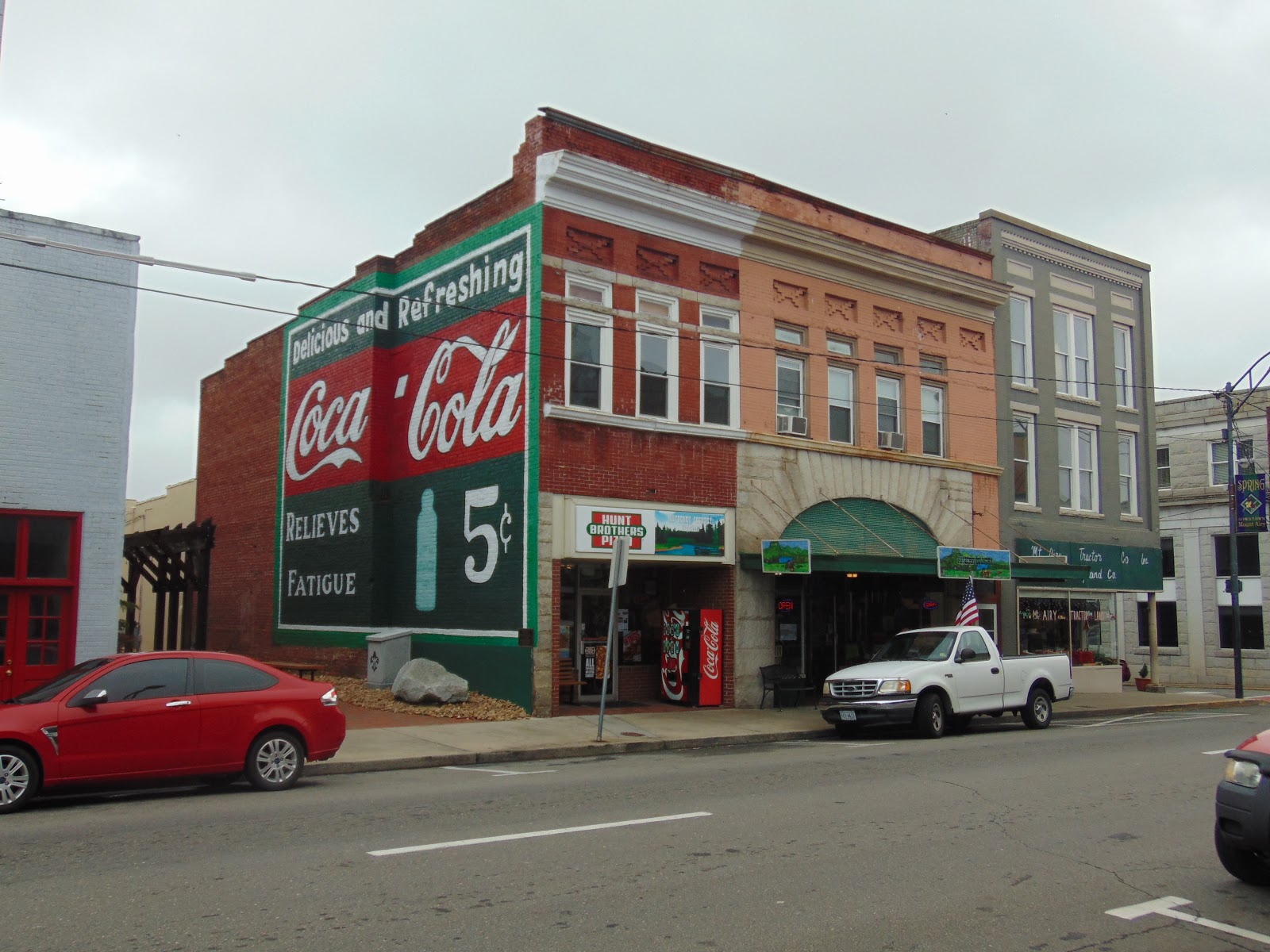
Along the way I also planned to make several stops to photograph several major sites of interest. The first of which was a stopover in the small town of Mount Airy, North Carolina -- the birthplace of actor Andy Griffith, and home of the Andy Griffith Museum. 

Mount Airy is noted for being the inspiration for the setting of the fictional town of Mayberry, North Carolina in the popular television series: The Andy Griffith Show. The show itself was largely filmed in Hollywood at the Desilu Studios (now Culver Studios) in California. 

The town is extremely proud of the connection to its most famous son and the show he helped produce, as you can see in the following photos of both the town and the famous Andy Griffith Museum itself. Founded in 2009 the museum attracts around 200 visitors daily and contains the largest collection of memorabilia from The Andy Griffith Show TV series.


An outstanding Little Free Library on the corner
of Main Street in downtown Airy.
The Andy Griffith Playhouse and TV Land monument.
Statue of Andy and Opie from The Andy Griffith Show
outside the Andy Griffith Museum in Mount Airy, NC.
A replica of Barney's Sidecar outside of the Andy Griffith Museum.
The Matlock suit worn by Andy Griffith in his
role as defense attorney Ben Matlock on the
mystery/drama series of the same name.
One of the uniform shirts and sheriff badge worn
by Andy Griffith in his role as Andy Taylor on
The Andy Griffith Show.
Barney Fife's Salt-n-Pepper suit from the show.
Actor Don Knotts wore this same suit in several
films, including The Ghost and Mr. Chicken.
Otis Campbell's suit jacket and hats.
Otis was played by actor Hal Smith.
The actual jailhouse keys from
The Andy Griffith Show.
Replica of Andy's desk from the Mayberry Jail/Courthouse.
"Now here at The Rock we have rules..."

After leaving lovely Mount Airy behind, I returned to I-77 and soon crossed over the Virginia State Line.

Well I hope you enjoyed these photos. Be sure to let me know what you think in the comments section below. The next part of my two-day site-seeing tour will be coming up on my next blog post. Don't go too far now, ya hear?

Thursday, April 26, 2018

Heritage Not Hate? Defining The True Meaning Of Southern Heritage & Confederate Identity

Defining The True Meaning Of Southern Heritage & Confederate Identity 

By C.W. Roden


"It’s about 'heritage, not hate,' I hear. This is sometimes naive, sometimes disingenuous, sometimes downright ignorant and sometimes a mingling of all three. I’m all for remembering history. I’m all for celebrating heritage. I’m all for celebrating the South. It has grits. It has Faulkner. It has barbecue. I’m just confused by the logic here. Why, if what you want to do is celebrate the South -- but not the racist, ugly parts of the South -- would you choose to do so by waving a symbol literally used by the Confederacy? This just seems like the least efficient possible route of achieving what you say you want to achieve."

That quote comes from some anonymous Social "Just Us" regressive and anti-Confederate heritage reactionary, and it sums up perfectly just how far behind many of them truly are when it relates to the idea of both Southern and Confederate heritage as a whole. 

It seems like these days those of us who honor Confederate heritage hear this argument -- or more likely some far less well spoken and more profanity-laden version of this talking point -- from those who remain largely ignorant of exactly what it is defenders of that heritage actually honor. 

Sadly many of the most ignorant and uninformed are themselves Southerners of Confederate descent that believe in their hearts based on some personal experience, or a great deal of misinformation, that there can be nothing behind the display of the Dixie Cross banner, or the many Confederate monuments throughout the Southland other than some vaguely defined attempt to promote fear and bigotry. 

Once upon a time back in my youth, this blogger once felt as these people did and understand where they come from. 

Now obviously if y'all have spent more than half an hour reading this blog then y'all know that I have long since grew past my ignorance on the subject of Southern heritage and Confederate identity long ago. This didn't happen overnight, not did it come from any one source.

It came from a couple of years of critical thinking and from taking the time and trouble to not only visit Confederate memorial services, but to talk with those who attended them and see them as free-thinking individuals rather than group-think caricatures and stereotypes. I did not allow myself to be indoctrinated in "Lost Cause" nostalgia, nor did I close my mind to new experiences as far too many of today's youth appear to be fond of doing. 

I watched these men, women and children dressed up in replica Confederate uniforms and 19th century clothes. I watched as "widows" in black gowns laid wreaths of flowers on graves and monuments for the dead. I watched children and adults alike kneel down to place flags on soldiers graves. I listened to they prayers, to the roll call of the dead, of stories of individual lives and who they were to the people telling them. I did not hear glorification of war, or hatred for anyone -- not even the Union soldier. All I saw were people who cared about the dead in the graves, the men honored on those monuments, and the connection through blood and family they have with the living today.

I learned from observation and keeping an open mind that these were not closed-minded people who saw everything in "Moonlight and Magnolias" terms. Nor were they folks who longed for the days of sitting on a porch while African-Americans and other minorities toiled in the fields and did their yard work. 

In fact I found that not all of them were in fact Anglo-Celtic at all! There were people from all walks of life, from all racial and ethnic identities there to honor the life of Johnny Reb and the men who led them -- many of them also direct descendants. 

What I found was simply a group of fellow Southerners who shared my love for history and personal identity. People whom, for the most part, simply do not look at the world entirely in terms of racial identity politics. White, black, Hispanics, Native, Jewish, Christians, and others -- a virtual tapestry of Southern cultural identity. All equal brothers and sisters who shared one important thing in common: they were all Southern and descendants of the Confederate dead.  

I saw the simple message in all of those memorial services and small acts of honor, especially to those laying in unmarked graves with Unknown Soldier as their own legacy: We remember you, soldier -- and we still care.

The more I learned and the more I came to understand that, these same people welcomed me into their small but interesting family. I was a son of Dixie that came home. A few years later I joined the Sons of Confederate Veterans and since then I have never failed to attend a year observance of Confederate Memorial Day, never failed to help clean the graves of the dead when called upon, or place the flags on their graves, or light luminaries at the monuments in the evenings.  

More so, I have never failed since that time to stand up and speak out whenever someone denigrates my fellow Confederate descendants, my brothers and sisters of Dixie, whenever someone says a cross word about them, or abuses the symbols of the heritage we share in one form or another.

Defining Southern Heritage

Now unfortunately there are still Southerners today who remain ignorant of the true meaning of their own heritage, or reject the idea of what they wrongly believe that heritage is in favor of presenting themselves favorably to modern-day political correct ideologies. For them, and many others who live outside of Dixie, terms like Southern heritage and Heritage Not Hatred mean very little, or are likely viewed as meaningless slogans. 

Perhaps the most amusing example of this comes from one of these regressive lost Southerners I witnessed only a year ago who showed up to protest the yearly reunion of the South Carolina Division Sons of Confederate Veterans, a somewhat middle-aged white woman standing around holding a sign that read: Y'all Means All. 

Ironically, in spire of her abysmal ignorance of the people she came to protest, or to virtue signal against in favor of gaining the approval of her assorted nuts -- oops, I mean peers -- this woman's slogan actually came far closer to the truth than I am certain she realizes -- Maybe not grammatically, but in the overall spirit of its meaning. 

True Southern heritage as a living heritage is about all of us.

To define Southern heritage as a whole the way a Confederate heritage supporter defines it, one would have to imagine that heritage as an large, old patchwork quilt with each square representing different cultural aspects from various origins that go back well before the modern-day Southern culture to pre-European colonial days: Cajuns, Creoles, Scots-Irish, English, Gullah-Geechee, African, Appalachian, Cherokee, ect. 
  
Now imagine that all of these differing cultural groups representing these squares are woven together on the same patchwork quilt by strings of history and shared cultural experiences that inter-connect them into the larger whole. In the end creating a beautiful old quilt. 

This old quilt called Southern heritage has its torn places certainly, its burn marks and old stains representing some of the less attractive parts of our shared identity as a Southern people; yet overall even with those old scars this big beautiful quilt is still held dear by everyone who defines themselves as a proudly Southern person. 

Everyone who has ever lived in what we call The South -- the New South or the Old South, really makes no difference -- and everyone who lives in it today is a part of that old patchwork quilt of Southern heritage.
 
Confederate heritage is only one of those patches in the quilt interwoven with the others. A frayed and worn one to be sure, but one that is as precious at the whole quilt itself, and also deeply connected to the other various multi-cultural patches mentioned. 

For those of us who honor Southern-Confederate historical heritage, we do not so much honor the War Between the States itself -- the destruction and the loss of human life, nor necessarily the Confederate government or its ideals -- although there are people who include the more positive of those in terms of representative government as opposed to the negatives which include, unfortunately slavery. That is not to say some people don't, although they represent only a fraction of the Confederate heritage movement. 

Rather when we honor this aspect of our living Southern heritage, we honor the courage of the Confederate soldier himself -- soldiers many recognize as American veterans (the old Union soldiers who fought against him accepted him as a fellow American soldier after the War ended) and his legacy in terms of the martial spirit he gave to his ancestors -- Southern men who served in the US military and fought with the descendants of his former Union opponents to defeat the enemies of America. That too is also a part of American heritage as a whole. 

For us the Confederate soldier wasn't just some nameless footnote in history, he was our ancestors. People who shared our last names, our family. Our blood. A piece of us. It is just about wanting to honor one's own sense of personal identity and the heritage given through blood and a sense of personal honor. 

Nothing more and never anything less than that.

Finally, because Confederate heritage is so interwoven into Southern identity as much as any other aspect of Southern cultural identity, it is a living heritage that represents not just one group of Southerners, but all Southerners everywhere of all colors and creeds worldwide. That heritage belongs to us all, even if one does not feel like honoring it while another does. It belongs more to the descendants of Confederate soldiers -- also men and boys of all races and religions -- who fought under the battle flag; yet that heritage is a gift to all Southern born people everywhere.

Now what happens when one tries to remove a square from a quilt folks? Obviously there is a large hole in the quilt, but more so the strings that hold the quilt together to other squares begin to come loose and unravel because those same strings bind that one square to others and in turn those other squares to others still. When you choose to reject one square, the entire quilt becomes useless or worse, falls apart.

To deny any of that, or to claim that you can pick and choose which aspects of that living heritage defines you is the worst sort of folly. Certainly one or more squares can personally represent your individual cultural identity directly, but overall the rest of those squares are also a part of you and other Southerners as a whole.

Our shared Southern heritage is all a part of us. Appalachian history is Southern history. Black history is Southern history. Scots-Irish history is Southern history. Cherokee history is Southern history. Hispanic history is Southern history. And yes Confederate history is Southern history. We are all bound together and a part of that same patchwork quilt that is Southern heritage.
   
So yeah, in that respect: Y'all does in fact mean All.


Monday, April 09, 2018

Accounts Of The Surrender Of The Army Of Northern Virginia


On the afternoon of Sunday, April 9, 1865, Confederate General Robert E. Lee commanding the Confederate Army of Northern Virginia meets Union Lieutenant General Ulysses S. Grant at the home of Wilmer McLean in the village of Appomattox Court House. 

It was there in the parlor of the McLean home that Lee and Grant discussed terms for the surrender of the Confederate army. The terms provided by Grant were extremely generous ones, even allowing the officers to keep their personal sidearms and swords and the Confederate cavalry to keep their horses. The Union army would even provide food for the now starving Confederate army from captured Confederate supply trains. Grant even refused to take Lee's dress sword. He just wanted the whole sorry mess over with, as did his defeated but still dignified opponent. Lee signed the hastily written terms and both men shook hands. 

In the distance cannons could be heard firing still. Grant is informed that the men were firing them in celebration of the surrender. Grant orders that the cannons cease firing, feeling no desire to rejoice in the downfall of fellow Americans.

Lee would return to his soldiers and inform them of the surrender of the army. Some soldiers would desert and attempt to get to North Carolina and the Army of Tennessee still fighting against Sherman's forces. Others, who were just as tired of the war, of the death and destruction, wanted to return to the homes they'd been fighting to defend and resume their lives and learn if their families were safe. 

Three days later, on Wednesday, April 12th, exactly four years to the day that the first shots of the War Between The States took place in Charleston Harbor, Union General Joshua L. Chamberlain assembles the Union Fifth Corps along the main street of Appomattox Court House as part of the formal surrender ceremony. Around 12,000 men of the Army of Northern Virginia under Confederate General John B. Gordon march past their Union counterparts and stack their arms and furled battle flags. Chamberlain and the Union men reportedly saluted the passing Confederates, who saluted back. 

The following are two accounts of that moment written by General Chamberlain:

The Last Salute Of The Army Of Northern Virginia.
From the Boston Journal, May, 1901
Details of the Surrender of General Lee at Appomattox Courthouse, April 9th, 1865.

LENIENT TERMS OF GENERAL GRANT.

By General J. L. Chamberlain


"Having thus formed, the brigades standing at 'order arms,' the head of the Confederate column, General Gordon in command, and the old 'Stonewall' Jackson Brigade leading, started down into the valley which lay between us, and approached our lines. With my staff I was on the extreme right of the line, mounted on horseback, and in a position nearest the Rebel solders who were approaching our right.
"Ah, but it was a most impressive sight, a most striking picture, to see that whole army in motion to lay down the symbols of war and strife, that army which had fought for four terrible years after a fashion but infrequently known in war.
"At such a time and under such conditions I thought it eminently fitting to show some token of our feeling, and I therefore instructed my subordinate officers to come to the position of 'salute' in the manual of arms as each body of the Confederates passed before us.
"It was not a 'present arms,' however, not a 'present,' which then as now was the highest possible honor to be paid even to a president. It was the 'carry arms,' as it was then known, with musket held by the right hand and perpendicular to the shoulder. I may best describe it as a marching salute in review.
"When General Gordon came opposite me I had the bugle blown and the entire line came to 'attention,' preparatory to executing this movement of the manual successively and by regiments as Gordon's columns should pass before our front, each in turn.
"The General was riding in advance of his troops, his chin drooped to his breast, downhearted and dejected in appearance almost beyond description. At the sound of that machine like snap of arms, however, General Gordon started, caught in a moment its significance, and instantly assumed the finest attitude of a soldier. He wheeled his horse facing me, touching him gently with the spur, so that the animal slightly reared, and as he wheeled, horse and rider made one motion, the horse's head swung down with a graceful bow, and General Gordon dropped his swordpoint to his toe in salutation.
"By word of mouth General Gordon sent back orders to the rear that his own troops take the same position of the manual in the march past as did our line. That was done, and a truly imposing sight was the mutual salutation and farewell.
"At a distance of possibly twelve feet from our line, the Confederates halted and turned face towards us. Their lines were formed with the greatest care, with every officer in his appointed position, and thereupon began the formality of surrender.
"Bayonets were affixed to muskets, arms stacked, and cartridge boxes unslung and hung upon the stacks. Then, slowly and with a reluctance that was appealingly pathetic, the torn and tattered battleflags were either leaned against the stacks or laid upon the ground. The emotion of the conquered soldiery was really sad to witness. Some of the men who had carried and followed those ragged standards through the four long years of strife, rushed, regardless of all discipline, from the ranks, bent about their old flags, and pressed them to their lips with burning tears.
"And it can well be imagined, too, that there was no lack of emotion on our side, but the Union men were held steady in their lines, without the least show of demonstration by word or by motion. There was, though, a twitching of the muscles of their faces, and, be it said, their battle-bronzed cheeks were not altogether dry. Our men felt the import of the occasion, and realized fully how they would have been affected if defeat and surrender had been their lot after such a fearful struggle.
"Nearly an entire day was necessary for that vast parade to pass. About 27,000 stands of arms were laid down, with something like a hundred battleflags; cartridges were destroyed, and the arms loaded on cars and sent off to Wilmington.
"Every token of armed hostility was laid aside by the defeated men. No officer surrendered his side arms or horse, if private property, only Confederate property being required, according to the terms of surrender, dated April 9, 1865, and stating that all arms, artillery, and public property were to be packed and stacked and turned over to the officer duly appointed to receive them.
"And right here I wish to correct again that statement so often attributed to me, to the effect that I have said I received from the hands of General Lee on that day his sword. Only recently, at a banquet in Newtown, glass., of the Katahdin Club, composed of sons and daughters of my own beloved State, it was said in press dispatches that a letter had been read front me in which I made the claim that I had received Lee's sword. I never did make that claim even, as I never did receive that sword.
"As I have said, no Confederate officer was required or even asked to surrender his side arms if they were his personal property. As a matter of fact, General Lee never gave up his sword, although, if I am not mistaken, there was some conference between General Grant and some of the members of his staff upon that very subject just before the final surrender. I was not present at that conference, however, and only know of it by hearsay.
"But, as I was saying, every token of armed hostility having been laid aside, and the men having given their words of honor that they would never serve again against the flag, they were free to go whither they would and as best they could. In the meantime our army had been supplying them with rations. On the next morning, however, the morning of the 13th, we could see the men, singly or in squads, making their way slowly into the distance, in whichever direction was nearest home, and by nightfall we were left there at Appomattox Courthouse lonesome and alone."

Source: Southern Historical Society Papers, Vol. XXXII, Richmond, Va., January - December. 1904.


From the book: The Passing of the Armies; An Account of the Final Campaign of the Army of the Potomac, Based Upon Personal Reminiscences of the Fifth Army Corps by Joshua L. Chamberlain (pp 260-261): 

The momentous meaning of this occasion impressed me deeply. I resolved to mark it by some token of recognition, which could be no other than a salute of arms. Well aware of the responsibility assumed, and of the criticisms that would follow, as the sequel proved, nothing of that kind could move me in the least. The act could be defended, if needful, by the suggestion that such a salute was not to the cause for which the flag of the Confederacy stood, but to its going down before the flag of the Union. My main reason, however, was one for which I sought no authority nor asked forgiveness. Before us in proud humiliation stood the embodiment of manhood: men whom neither toils and sufferings, nor the fact of death, nor disaster, nor hopelessness could bend from their resolve; standing before us now, thin, worn, and famished, but erect, and with eyes looking level into ours, waking memories that bound us together as no other bond; -was not such manhood to be welcomed back into a Union so tested and assured? Instructions had been given; and when the head of each division column comes opposite our group, our bugle sounds the signal and instantly our whole line from right to left, regiment by regiment in succession, gives the soldier's salutation, from the "order arms" to the old "carry" -the marching salute. Gordon at the head of the column, riding with heavy spirit and downcast face, catches the sound of shifting arms, looks up, and, taking the meaning, wheels superbly, making with himself and his horse one uplifted figure, with profound salutation as he drops the point of his sword to the boot toe; then facing to his own command, gives word for his successive brigades to pass us with the same position of the manual, - honor answering honor. On our part not a sound of trumpet more, nor roll of drum; not a cheer, nor word nor whisper of vain-glorying, nor motion of man standing again at the order, but an awed stillness rather, and breath-holding, as if it were the passing of the dead!

Source: Chamberlain, Joshua Lawrence (1915). The Passing of the Armies: An Account of the Final Campaign of the Army of the Potomac, Based upon Personal Reminiscences of the Fifth Army Corps. New York: G.P. Putnam's Sons. ISBN 0-553-29992-1.   
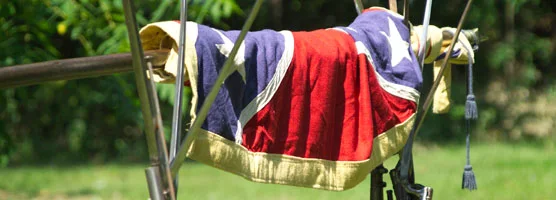

"Many are the hearts that are weary tonight,
Wishing for the war to cease;
Many are the hearts looking for the right,
To see the dawn of peace."
~Tenting Tonight On The Old Campground (1863)