 |
| Captain George D. Wallace (1849-1890) taken sometime in the 1880s while he was a member of the U.S. 7th Cavalry. Photo courtesy of the U.S. Dept. of Archives. |
George Daniel Wallace was born on Friday, June 29, 1849 in York County, South Carolina, the youngest son of South Carolina State House of Representative and later Republican U.S. Congressman Alexander Stuart Wallace (1810-1893) and Nancy Lee Ratchford Wallace (1810-1883).
The Wallace family immigrated from County Tyrone (Modern-day Northern Ireland, U.K.) in 1773. George Wallace's grandfather, McCasland Wallace (1773-1862), had been born on the boat ride on the North Atlantic. The family, like many other Irish and Ulster-Scots families, migrated to what was then the British North American Southern colonies via the Great Wagon Road just prior to the outbreak of the American Revolutionary War (1775-1783) and settled on a farm along Turkey Creek in modern-day York County, South Carolina.
His father, Alexander Wallace, served several terms in the South Carolina State House of Representatives (1852-1855, 1858-1859), but resigned when South Carolina seceded from the Union in December of 1860. Being a staunch Unionist, he vehemently opposed secession despite himself being a slaveowner (he apparently owned at least four slaves according to 1850 census records). Alexander Wallace retired to his farm in York County until the end of the War Between The States (1861-1865).
His oldest son, Robert McCaslan Wallace (1837-1902), would serve in the Confederate army in the Western Theater and achieve the rank of Colonel. Another family member, James Wylie Ratchford (1840-1910), would become a Major and serve on the staff of C.S. Generals Daniel Harvey Hill and Stephen D. Lee. The younger George Wallace was 11 years old when the war began and would not serve.
In April of 1865, at the age of 15, young George Wallace witnessed the flight of Confederate President Jefferson Davis and his escort through York County from the front porch of his family's home and the end of the bloody struggle.
Following the end of the War, Alexander Wallace was again elected to the S.C. House from 1865-1866. He would run for the U.S. House of Representatives as a Republican in 1868 and was elected four times, serving until the end of the Reconstruction Era in
1877 when he again retired to his farm.
It was during this time that young George Wallace, now 19-years-old, was accepted to the U.S. Military Academy at West Point, New York on Tuesday, September 1, 1868. He would graduate 9th in his class of 57 fellow cadets (Class of 1872) on Friday, June 14, 1872, just over two weeks shy of his 22nd birthday.
Upon graduation and being commissioned a U.S. Army 2nd Lieutenant, Wallace would begin his military career by joining Company G of Lieutenant Colonel George Armstrong Custer's famed U.S. 7th Cavalry which was then serving occupation duty and enforcing martial law in Laurens County, South Carolina.
Not long after, Lieutenant Wallace and Company G of the 7th Cavalry were sent out west to Fort Abraham Lincoln in the Dakota Territory (Modern-day U.S. State of North Dakota) to serve during their Yellowstone Expedition (Friday, June 20 - Tuesday, September 23, 1873).
A year later, 2nd Lieutenant Wallace would be appointed command of Indian Scouts during the 7th Cavalry's Black Hills Expedition (Thursday, July 2 - Sunday, August 30, 1874). He would then be stationed on detached duty in New Orleans, Louisiana from 1874 to 1876.
Wallace would return to Fort Lincoln in May of 1876 and would participate with Custer and the 7th Cavalry in the Great Sioux War (or Black Hills War) of 1876. Lieutenant Wallace served in Company G under the command of Major Marcus A. Reno during Custer's campaign into the Black Hills. He would become Regimental Adjutant during this campaign.
 |
| Lieutenant George D. Wallace as a member of the 7th U.S. Cavalry in 1872. Photo courtesy of findagrave.com. |
At only a few days shy of his 27th birthday, Wallace was present with the 7th Cavalry when the Battle of the Little Bighorn took place on Sunday, June 25, 1876 where Custer and three companies of his men (approximately 261 members of the 7th Cavalry) were outnumbered and subsequently slaughtered by the Lakota Sioux and Cheyenne. Wallace was with Major Reno several miles away, although Reno and his men were involved in their own running firefight with the Cheyenne at the time. Wallace survived the battle and was promoted to 1st Lieutenant and given command of Company G following the death of its previous commander, 1st Lieutenant Donald McIntosh.
First Lieutenant Wallace would later participate in the Nez Perce War of 1877 where Wallace was briefly involved in the pursuit of the Nez Perce tribe as they unsuccessfully fled toward Canada, and the Northern Cheyenne Campaign of 1878-1879.
Wallace would also testify at the Reno Court of Inquiry in Chicago, Illinois in January, 1879 convened by U.S. President Rutherford B. Hayes on the conduct of Major Reno during the Little Bighorn Campaign. His testimony and those of other officers present helped to officially exonerate Reno of the charges of "cowardice" and abandoning Custer to his fate.
Some of the enlisted men in the 7th Cavalry suggested that the officers (Wallace included) coerced them to give a positive report of Reno at the time. Years later, Major Charles DeRudio (then 1st Lieutenant of Company A, 7th Cavalry) told historical researcher Walter Mason Camp "that there was a private understanding between a number of officers that they would do all they could to save Reno." Reno would always remain the object of public scorn by those who admired Custer.
The official record of the court of inquiry can be read HERE.
Lieutenant Wallace then served at the newly established Cavalry School in Fort Leavenworth, Kansas in 1880 where he commanded Company K of the 7th Cavalry.
At 33 years old, Lieutenant George Wallace married then 22 year old Miss Caroline "Carrie" Mix Otis (1860-1942) on Thursday, October 12, 1882 in Minneapolis, Minnesota. The couple would have two children -- a daughter that died in childbirth in 1883 and a surviving son, Otis Alexander Wallace (1889-1955) who would later serve as a U.S. Army Captain of artillery when the United States entered World War I in 1917.
On Wednesday, September 23, 1885, George Wallace was promoted and appointed Captain of Company L and would later take command of Company K in September of 1890.
In his final service with the 7th U.S. Cavalry, Captain Wallace was commanding Company K during what would be known to history as the Wounded Knee Massacre (or Battle of Wounded Knee) on Monday, December 29, 1890.
On the morning of December 29th U.S. troops led by Colonel James W. Forsyth of the 7th Cavalry surrounded a Lakota Sioux camp at Wounded Knee Creek (modern-day Pine Ridge Indian Reservation in Oglala Lakota County, South Dakota) and went in with orders to disarm the Native Americas. During the process, a deaf Lakota tribesman named Black Coyote was reluctant to give up his rifle, claiming he had paid a lot for it. Black Coyote's rifle went off at that point accidentally and the troopers -- who had already been on edge -- began firing into the Lakota camp. The Lakota warriors fought back, but by that point many had already been disarmed.
At least 153 confirmed people of the Lakota tribe were killed and 51 wounded (4 men and 47 women and children, some of whom died later from their wounds). Some estimates placed the overall number of dead as high as 300. Twenty-five U.S. cavalrymen also were killed and 39 were wounded -- six of the wounded later died.
 |
| The burying of the Lakota dead in a common grave following the Wounded Knee Massacre on December 29, 1890. At least 153 men, women, and children were slaughtered along with 25 U.S. soldiers. Photo courtesy of the U.S. Library of Congress. |
Some accounts suggested that Wallace might have been killed as a result of friendly fire (Company B and K were apparently deployed badly on the field when the firing started), while others maintain he was shot in the stomach and then hit over the head by an Indian "war club" with the latter being the fatal wound. He was reportedly found dead with his Colt revolver in his hand along with nine other fallen men from Company K and the bodies of several Lakota Sioux warriors.
Captain Wallace's body was sent to Fort Riley, Kansas in a wooden casket covered with the flag of Company K. From there was returned by train to South Carolina escorted by his brother, Colonel Robert Wallace, where he was buried with full military honors in the family plot at historic Rose Hill Cemetery in York on Tuesday, January 6, 1891.
He is buried beneath a beautifully carved headstone with a U.S. flag and crossed swords between the larger grave monuments of his parents and his older brother, the Confederate veteran, in the family plot.
His widow, Carrie, died on Thursday, April 9, 1942 in Bronxville, Westchester County, New York.
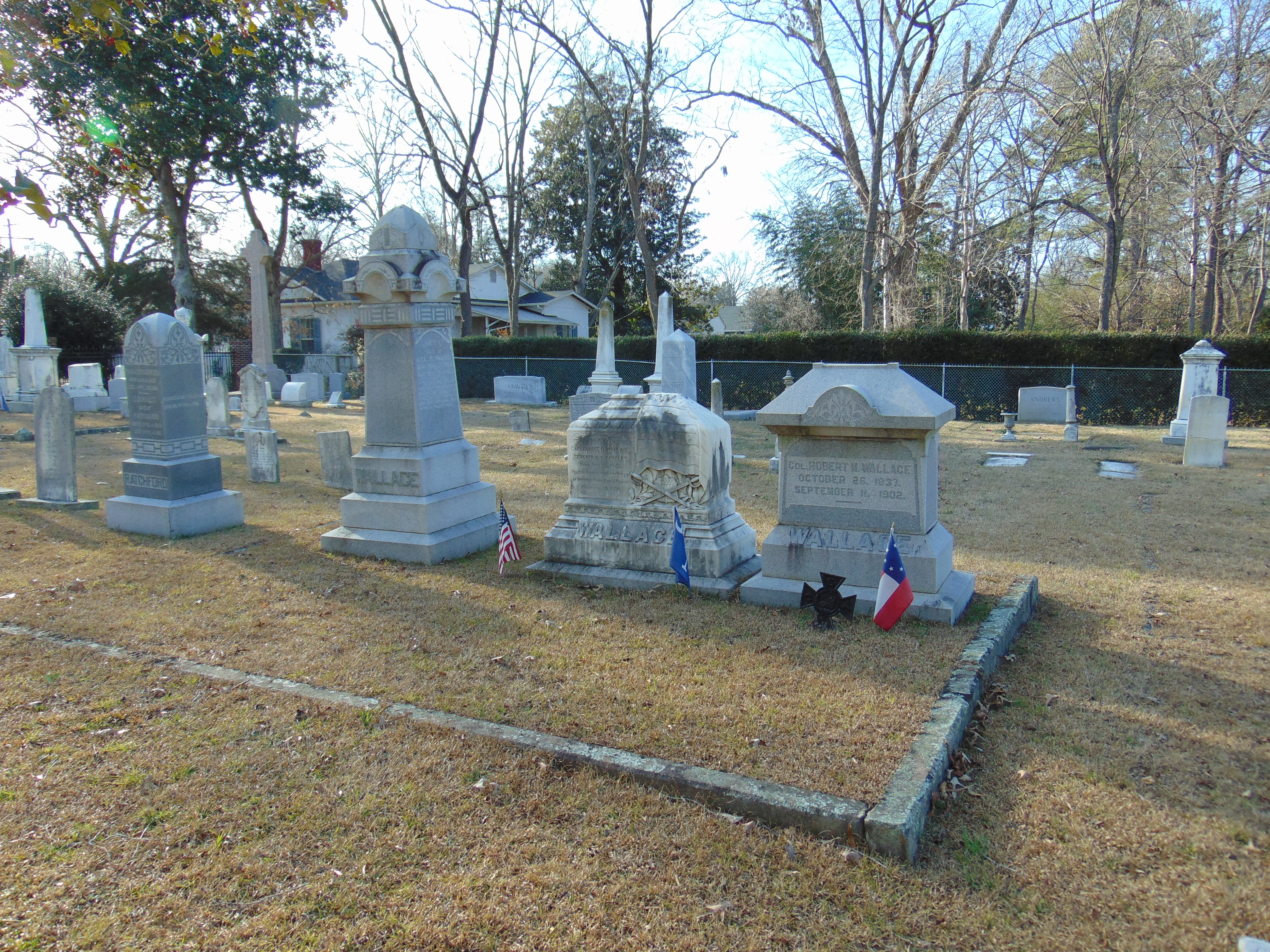 |
| The Wallace Family Plot at Rose Hill Cemetery, York, South Carolina. Included are the graves of Captain George D. Wallace in the center, his parents U.S. Representative Alexander Wallace and Nancy Wallace on the left and his brother, C.S.A. Colonel Robert M. Wallace on the right with Confederate Iron Cross marker. |


"Custodians of the Flag: The People Turn Out En-masse to do Honor to the Late Capt. George D. Wallace -- Eloquent Eulogies on the Flag, and on its Defender." Yorkville (South Carolina) Enquirer Wednesday, April 22, 1891, Pg. 1.
The South Carolina Department of Archives & History.
Find a Grave Memorial ID 5816415.


