Showing posts with label Space Travel. Show all posts

Sunday, March 29, 2026

The Ludicrous Speed We Travel Through Our Universe


Being an amateur stargazer, I have to confess that very few sights on this planet can inspire more amazement and awe from me than the sight of the evening sky after sunset when twilight begins to deepen into night and the very first of our world's nearest heavenly neighbors begin to appear in our sky above.

Going outside at night and watching the moon rise, the planets of our Solar System appear, and thousands of visible stars and galaxies appear overhead in the night sky never ceases to amaze us stargazers.

Even the brightest star known to us, our own bright Sun that we see practically every clear, mostly cloudless daytime from sunrise to sunset, is a wonderful miracle in the heavens that most people seemingly take for granted because its a constant companion.

From our perspective standing here on our good Earth, everything in the heavens appears to be fixed -- aside from our lovely moon and the five visible "wanderers" that we can see with the naked eye.

However, outside of our visual range, our planet travels at an incredible speed of rotation every single day, and in orbit around the Sun. The planets of the solar system also cover distances that might seem surprisingly fast to most of us observing them. Our own bright Sun also travels at insanely fast speeds around our own Milky Way Galaxy.

The reason we don't readily notice this is because the space beyond our planet is so very vast, its nearly incomprehensible to imagine. The distances involved are so long that we cannot possibly measure them simply by miles.

Today, I'm going to tell y'all just how fast and how far we travel. Y'all better buckle up because this is gonna blow your minds.


The Sun, Earth, & The Moon

At the center of our solar system is our own beautiful Sun and this is where our journey begins.

Our Sun is a bright
G-type main-sequence star (or G-Type Star) that comprises about 99.86% of the mass of the Solar System. The Sun itself rotates at an average of about 28 days, although this varies at different latitudes since the Sun isn't a solid body but rather a giant ball of gaseous plasma. Its width is measured at approximately 864,000 miles, or 109 times that of Earth, with its mass measured at about 330,000 times that of the Earth.

To give you an idea of how huge that actually is, let me explain to y'all the exact speed and distance it takes our Earth to travel in its orbit around the Sun in a single year.

Our planet Earth is the third planet out from the Sun and the fifth largest planet in our Solar System. The mean diameter of the Earth
(the distance from one side to the other through Earth's center) is about 7,926 miles across. However, the interesting thing to realize here is that Earth is not quite a total sphere.

Our planet bulges out a bit more around the equator than it does at the poles because of its rotation
caused by the flattening at the poles, making it a slight oblate spheroid. Earth is therefore slightly smaller when measured between the North and South Poles (or the meridional circumference), which gives a diameter of 7,907 miles -- or a difference of about 20 miles. Earth's circumference (the distance all the way around the equator) is around 24,900 miles.

Earth itself rotates on its axis in space counter-clockwise approximately once every 23 hours, 56 minutes, and 4 seconds in a standard 24 hour day; spinning
at an incredible speed of about 1,037 miles and hour.
Because Earth spins steadily, as well as moves at a constant rate in orbit around the sun, we have the gravity that holds us all tightly in its grip to this beautiful blue world we all know and love.

The mean distance from the surface of the Sun to the surface of the Earth is around 93 million miles. This distance is measured by astronomers as one
astronomical unit (AU).

Since the Earth revolves in an oval shaped path (or elliptical orbit) around the Sun, rather than an even circular path, the exact distance varies
ranging between the extremes of perihelion (closest approach) in January and aphelion (most distant orbital position) in July. This actually puts Earth’s orbital distance from the Sun from between approximately 91.5 million to 94 million miles respectively.

Earth travels about 1.6 million miles daily at about 68,000 miles per hour in its orbit around the sun.
Over the span of the 365.26 days that makes up a single year, our planet Earth travels around 584 million miles in its orbit around the Sun.

That's pretty incredible huh?

Next to us in the night sky is our own beautiful lunar companion, Luna -- better known as simply the Moon.

The Moon's mean radius is 1,079.6 miles wide with an overall diameter of 2,159 miles, or about a little less than one-third the width of the Earth. Because of tidal forces that keep the Moon from rotating, one side always faces the Earth as it circles us in its monthly rotation.

Like the Earth travels around the sun in an oval-shaped path, the Moon also travels in an oblong orbit. When the Moon is the farthest away from Earth (or at its Apogee), it’s 252,088 miles away, while at it's closest approach (or at its Perigee), the Moon is 225,623 miles away -- the equivalent of about 32 Earths distant.

The Moon makes a complete orbit around the earth every 27.3 days, or approximately 13 times in a calendar year. Given the distance from the Earth and speed, the Moon travels a full distance of 1,423,000 miles an hour at a speed of 2,288 miles per hour to complete this orbit. Because of the rotation of the Earth and our own perspective standing on the surface, we humans do not perceive just how fast this is from our observations -- but its pretty fast!


The sunlight we see here on Earth takes approximately 8 minutes
and 20 seconds to travel the 93 million miles from the surface
of the Sun through the gulf of space to reach Earth.

The Speed Of Light 

Our Solar System is so large in sheer scale that using ordinary units of measurement like feet, or miles, simply won't do. On average, Pluto -- the farthest planet in our solar system (and yes, it's still a planet even if its a small one!) has a mind-blowing average mean distance of 3.6 billion miles from the Sun and takes a whopping 247.9 years to orbit the Sun just once!

In order to measure the size of our Solar System more accurately we must use the speed of light as our yard stick.

We use this because the speed of light is constant throughout the universe, traveling in the vacuum of space at an incredible speed of about 186,282 miles per second -- or
about 670.6 million miles per hour. To put that in perspective, if you could physically travel at the speed of light, you could go around the Earth a mind-blowing 7.5 times in one second; or travel from Earth to the Moon in about 1.5 seconds.

Now that's
ludicrous speed folks, and theoretically nothing can move faster than light outside of science fiction.

One light-minute is about 11,160,000 miles. One light-hour is 671 million miles -- roughly the distance between the sun and halfway between the planets Jupiter and Saturn in our Solar System. One light-day is 16.1 billion miles -- more than four times the distance between the Sun and Pluto. Finally, one light-year is a whopping 5.8 trillion miles!


Standing on the surface of the Earth, when we look up at the bright yellow Sun in the sky and the light that makes up the daytime hours; that light we see takes approximately 8 minutes and 20 seconds to travel the 93 million miles from the surface of the Sun through the gulf of space to reach Earth. So, one AU is a bit more than 8 light-minutes in distance.

From the 3.6 billion miles from Sun to Pluto at the far end of the Solar System, it would take sunlight about 5 hours and 40 minutes to cover that distance, or roughly about 39.5 AU.

Now when measuring distances outside of our Solar System, we must turn to another unit of measuring distances called parsecs. A parsec is approximately equal to 3.26 light-years, or 19.2 trillion miles (206,000 AU). A distance of 1,000 parsecs (or 3,262 light years) is called a kiloparsec (KPC).

Beyond our Solar System the nearest stars are in the Alpha Centauri system, a triple star system made up of three stars: Rigil Kentaurus (Centauri A), Toliman (Centauri B), and the small, red dwarf star Proxima Centauri (Centauri C). The closest of these stars, Proxima Centauri, sits at about 4.24 light-years (or 1.30 parsecs) from the Sun.

To put another way, the light from our stellar next door neighbors that we would see standing her on Earth took just over four years to reach us.
Also, if we tried to measure that in standard miles, that would be roughly 24,000,000,000,000 miles away! Now that's a lot of zeroes, y'all.


The Milky Way And Beyond

Our entire Solar System -- our Sun with its family of planets, asteroids, and comets -- orbits around the center of the large Milky Way Galaxy.

The Milky Way itself is a large barred spiral galaxy believed to be about 100,000 light years across (30.66 kiloparsecs) and made up of an estimated 100 - 400 billion stars, nebulae, and exoplanets.

The Solar System itself does not lie near the center of our Galaxy, rather it lies about 29,000 lights years (or 8 kiloparsecs) from the Galactic Center on what is known as the Orion-Cygnus Arm of the Milky Way.

Our Sun and Solar System move in a huge orbit around the center of the Milky Way Galaxy at about about 500,000 miles an hour.
That's roughly about 12,500 miles in 90 seconds. Because the Milky Way is such a big place, even at this ludicrous speed, it takes our Sun and Solar System approximately 225-250 million years to complete one single orbit around the galaxy’s center. To put that in perspective, that's roughly Earth's early-to-mid Triassic Period when the first dinosaurs appeared till the present day! This amount of time is referred to as a cosmic year, or a galactic year.

The Milky Way itself travels through the Universe at large at an astonishing 1.3 million miles an hour!

Outside of our galaxy the nearest local bodies are the two Magellanic Clouds that orbit the Milky Way. The
Large Magellanic Cloud (LMC) is approximately 163,000 light-years (49.9 kiloparsecs) away while the Small Magellanic Cloud (SMC) is approximately 206,000 light-years (63 kiloparsecs) away.   

Beyond the Magellican Clouds the closest neighboring galaxy is the Andromeda Galaxy (Messier 31, or NGC 224). Like the Milky Way, it is also a barred spiral galaxy approximately 2.5 million light years (770 kiloparsecs) from our Sun.
The Andromeda Galaxy has an estimated diameter of about 220,000 light years (67 kiloparsecs).

On and interesting note, due to the ever expanding nature of the Universe, the Andromeda Galaxy is currently racing toward our own Milky Way Galaxy at an estimated speed of about 70 miles per second and the two galaxies are expected to collide with each other sometime in about 4-5 billion years from now.

Once we move further out into the Universe itself, the distances become even more daunting. 
Astronomers typically express the distances between neighboring galaxies and galactic clusters in megaparsecs (MPC) and gigaparsecs (GPC) the largest units of length commonly used. A megaparsec is one million parsecs (or 3,260,000 light-years) and a gigiparsec is one billion parsecs (or 3.26 billion light-years)!

The most distant and probably oldest known galaxy in the observable Universe is
GN-z11 approximately 32 billion light-years (or 9.75 gigaparsecs) away from the Milky Way in a Universe that is estimated to be 93 billion light-years (or 28 gigaparsecs) across!

Now that's truly incredible to think about, y'all!


Conclusion

Going about our daily lives we can easily take for granted that we are traveling through this galaxy and universe of ours, propelled at incredibly ludicrous speeds.

Looking up at the night sky, seeing the heavens above us in the sky dome,
its truly a humbling experience knowing that in all of that infinity we are all of us merely a small speck of sand in an insanely large ocean of stars and galaxies -- and perhaps far more than we can readily observe even with our best astronomical instruments.

Probably the only thing more infinite than our known Universe is the human imagination itself.

I hope y'all have enjoyed this post, have a wonderful Dixie evening and y'all come back now, ya hear!


This blogger would like to offer a special thanks to the wonderful folks at earthsky.org and NASA for providing the information in this article.

Wednesday, October 13, 2021

90 Year Old William Shatner Becomes The Oldest Man In Orbit

The crew of the Blue Origins NS-18 (left to right):
 Australian Chris Boshuizen, William Shatner, Audrey Powers
(Blue Origin’s vice president of mission and flight operations)
and Glen de Vries.
Image courtesy of the Associated Press.


Above actor William Shatner as Captain Kirk
in Star Trek The Original Series (1966) and below
astronaut Shatner viewing Earth and space
from inside the RRS First Step capsule (2021).
Well done, sir!

On Wednesday, October 13th of this year, the Blue Origin's New Shepard rocket and capsule RRS First Step (designated NS-18) took off from its launching point at Corn Ranch (Launch Site One) in the west Texas desert, sending its four passengers into the edge of space in the lower atmosphere just above the international boundary of space at the Karman line (set at 62 miles, or 100 km, above sea level).

The separated capsule reached an altitude of approximately 351,185 feet above sea level (about 66.5 miles, or 8.92 km) before beginning its descent to Earth, touching down not far from its launching site approximately 10:15 after liftoff. The four-person crew was greeted by their cheering families, ground recovery crews, and the founder of Blue Origins, Mr. Jeff Bezos.

Among the crew was 90 year old veteran Canadian actor, William Shatner, best known for his role as Captain James T. Kirk in Star Trek The Original Series (1966-68), cartoon series, and in seven of the Star Trek feature films between 1979 - 1994.

His fictional character inspired several generations of young people to take interest in science fiction and space exploration -- this writer included. Some astronauts also attribute Shatner's character with inspiring them to seek the dream of traveling to space.

Fifty-five years after first donning the uniform of Captain Kirk, Mr. Shatner at age ninety years and six months, became the oldest human being to date to travel into space and become an astronaut, if only for a few minutes; a wonderful lifetime achievement for someone who has helped inspire so many.

Also among the crew members of NS-18 were Blue Origin's vice president of mission and flight operations, Miss Audrey Powers, Mr. Glen de Vries, and Mr. Chris Boshuizen -- who became the first full Australian citizen to travel to space.

All four of the crew were given their official astronaut wings by Mr. Bezos personally after a brief celebration of their accomplishment.

Congratulations to all of y'all and to the people at Blue Origins who made this endeavor possible on a job very well done!

Yeah, take THAT one, Flat-Earthers!


Thursday, January 28, 2021

In Memory Of The 35th Anniversary Of The Challenger -- A Tribute To The Fallen Pioneers Of Space Travel

The crew of the space shuttle Challenger honored us by the manner in which they lived their lives. We will never forget them, nor the last time we saw them, this morning, as they prepared for their journey and waved goodbye and "slipped the surly bonds of earth" to "touch the face of God." 
                                  ~ U.S. President Ronald Reagan addressing the nation on January 28, 1986 

Space shuttle Challenger (OV-099) Mission STS-51-L crew:
(front row left to right) Michael J. Smith, Dick Scobee, Ronald McNair;
(back row left to right) Ellison Onizuka, Christa McAuliffe, Gregory Jarvis, Judith Resnik.
Photo courtesy of NASA/ 1986.


Today marks the 35th anniversary of the deadly accident that took the lives of the crew of the NASA space shuttle orbiter Challenger (OV-099). 

I was nine years old and home from school on the morning of January 28, 1986. I was playing a game of some sort with my sister in the family living room when my dad came into the room stunned and told everyone present that the space shuttle Challenger exploded on television. 

I remember feeling a little bit of cold in my stomach at the news. My grandparents quickly turned on the television set to the breaking news story. One of the reasons that me and my sister were home that day was school being let out for teachers work day, and the launch of the space shuttle mission -- which was to have included what should have been the first civilian school teacher into orbit. In fact, I recall that we were assigned homework to write a report on the launch. 

My sister, Olivia, was in probably worse shock than I was over the news. She was in complete denial at the time that the crew died in the explosion (later it would be learned that the crew did in fact survive for a short time following the breakup of the shuttle). I will never forget my teary-eyed seven year old sister saying, "No, teachers can't die! They're teachers!" I too was somewhat disillusioned to learn at such a young age that teachers were not invincible. To me educators were tough (and at times grumpy) people, but regardless people who seemed to be above concepts like being moral human beings. 

There were two things other than these moment that stood out for me on that terrible day in American history: the constant replay of the explosion itself, the fireball and smoke trails; and the address to the nation given by President Ronald Reagan. 

Even as a child, the words Reagan spoke about the importance of the space program and the crew of the space shuttle and others before them as the first pioneers into the next great frontier for humanity stuck with me. He spoke of the tragedy, of the dedication of the men and women lost in the disaster, and quoted from the poem High Flight by John Gillespie McGee Jr. He also reaffirmed that mankind would continue to move forward to conquer space.

The loss of the seven crew members was a shock to the nation, and would delay the US space program for several years. Yet just as the past sacrifices of the first great pioneers of space travel inspired those seven brave American men and women; the memory of the sacrifices made by the crew of the Challenger lives on today in the dedication of those who continue to serve as astronauts, technicians and engineers designing the crafts that will someday take humanity beyond our pale blue dot and into the solar system, and possibly beyond in some distant day. 

This blog post is dedicated to the honored memories and sacrifices of those pioneers of humanity's space program tragically killed while helping to advance humanity's scientific knowledge of the universe. Their noble sacrifices to that service will be remembered as human pioneers continue our march into space in the decades, centuries, and possibly the  millennium to come.


In Honored Memory

Valentin Bondarenko (Ukraine, USSR) 
Killed in an altitude trainer accident on March 23, 1961.

Killed in a training jet crash on October 31, 1964. 

Gemini 9 Crew
Killed in a training jet crash on February 28, 1966. 

Apollo 1 Crew
Killed in a spacecraft test accident on January 27, 1967. 

Vladimir Komarov (Russia, USSR)
Soyuz 1 Commander
Killed on impact from re-entry parachute deployment failure on April 24, 1967. 

Killed in training jet crash on October 5, 1967. 

X-15 Flight 3-65-97
Killed in training flight crash on November 15, 1967. 

Killed in training jet crash on December 8, 1967.

Yuri Gagarin (Russia, USSR)
Vladimir Seryogin (Russia, USSR)
Soyuz 3 Crew
Killed in training jet crash on March 27, 1968. 

Georgi Dobrovolski (Ukraine, USSR) 
Viktor Patsayev (Kazakh, USSR - modern-day Republic of Kazakhstan)
Vladislav Volkov (Russia, USSR)
Soyuz 11 Crew
Killed by decompression in space on June 30, 1971. 

Ronald McNair (USA) 
Space Shuttle Challenger (OV-099) Crew
Killed during explosion during the mission launch over the Atlantic Ocean on January 28, 1986.

Sergei Vozovikov (Russian Federation)
Killed during water recovery training on July 11, 1993. 
  
Ilan Ramon (Israel)
Space Shuttle Columbia (OV-102) Crew
Killed in vehicular disintegration upon re-entry of Earth's atmosphere on February 1, 2003. 

Killed in spacecraft flight test crash on October 31, 2014.

You Will Not Be Forgotten!


Wednesday, October 16, 2019

Robinson Crusoe On Mars And My Childhood Journey To The Red Planet

The opening scene to the science fiction cult classic Robinson Crusoe On Mars (1964).
US spaceship Mars Gravity Probe One "Eleanor M" on final approach to Mars.
 
(Photo courtesy of Paramount Pictures & The Criterion Collection)


Robinson Crusoe On Mars
And My Childhood Journey To The Red Planet  


By C.W. Roden 


The planet Mars holds a special interest for the human race. Ancient human civilizations worshiped the Red Planet as a god. In more recent times Mars has been a major inspiration for many science fiction and fantasy writers for over the last century. It is certain to be the first planetary body beyond Earth's moon that human beings will set their first footprints.

As a lifelong science fiction fan I've always held a profound fascination with stories and films about Mars. There have certainly been a number of influences over the years, but it all began sometime around the early part of October 1984 with an old science fiction movie and an old modular jungle gym.

At then eight years old I was completely obsessed with two subjects: dinosaurs and space travel. My overactive imagination and tendency to daydream at off times made me sort of an oddball among my peers -- a fact that I must admit still hasn't changed all that much today. Many times I would find myself sitting alone in one corner of the playground, or classroom, with nothing but my trusty collection of dinosaur toys, a stack of library books, and my imagination to keep my company.

Also unchanged since my youth has been my enjoyment of reading and thirst for knowledge. Whenever I became interested in a subject I would go to my local library and seek out as much information about it as my mind could soak up. These days I get my information mostly through the internet and online sources, although I still manage to find my way to the local library that I practically grew up in. In my humble opinion nothing can replace the actual weight and feel of a good book in your hands, or the smell of the ink and glue binding, or the feel of the paper at your fingertips. Screw Kindles!

My obsession with the Red Planet came about sometime in the summer of 1984 when I was first introduced to the ridiculously titled cult classic science fiction film Robinson Crusoe On Mars (1964) directed by the legendary Byron Haskin, the genius behind the 1953 film version of H.G. Wells' 1898 science fiction novel War of the Worlds. The screenplay for the film, written by screenwriters Ib Melchior and John C. Higgs, is based on source material from Daniel Defoe's 1719 classic novel Robinson Crusoe. The film was independently made and distributed by Paramount Pictures. 


The robinsonade film follows the adventures of Commander Christopher "Kit" Draper, USN, (actor Paul Mantee) -- astronaut and copilot of the US spaceship Mars Gravity Probe One (MGP-1) "Eleanor M". Draper and his commanding officer, Colonel Dan "Mac" McReady, USAF,  (actor Adam West -- before he put on the Batsuit) and a female monkey named Mona (actually a male monkey named Barney, though the credits simply refer to him as "The Woolly Monkey") are the first human explorers from Earth sent to the Red Planet.


Commander Christopher "Kit" Draper (Paul Mantee) and
Colonel Dan "Mac" McReady (Adam West) aboard
Mars Gravity Probe One "Eleanor M" examining the
surface of the Red Planet.

(Photo courtesy of Paramount Pictures & The Criterion Collection)


In orbit observing Mars, they encounter a large meteor that forces a course correction that sends the trio into a the lower orbit of the Red Planet and uses up their propulsion fuel. With no means of leaving the planetary orbit, the two astronauts and monkey are forced to use a pair of attached landing vehicles to
make an emergency landing on Mars and take refuge.

Draper's lander crashes into rocks, leaving him stranded in the middle of what appears to be a fire-covered planet with roaming fireballs. With a limited supply of air and emergency supplies, Draper sets off across the barren and apparently lifeless planet in search of shelter until he can make contact with McReady, who landed nearby.

After encountering some strange yellow rocks that appear to be like some form of coal and the source of the fires, Draper finds a shelter cave. Using a handy device called an Omnicomp (a form of computer, recorder, transmitter and receiver) Draper chronicles his time on Mars, which he admits will be brief. He realizes that the air of the planet is much too thin for humans to breathe for very long, and once his air supply runs out, he will not survive, unless he can make contact with McReady.


Kit Draper discovers the possible source of the fires.
(Photo courtesy of Paramount Pictures & The Criterion Collection)


The next day he goes off in search of McReady's lander over a group of mountains (the film was shot at picturesque Zabriskie Point in Death Valley National Park, California, USA) and eventually finds -- to his disappointment -- both Colonel McReady's crashed lander and McReady's dead body. He also discovers that Mona has survived the crash and can tolerate the thin air of the planet.


Rest in peace, Mac.
(Photo courtesy of Paramount Pictures & The Criterion Collection)
 
Upon returning to the shelter cave, Draper's air runs out and he accepts his inevitable death, collapsing beside the yellow rocks he'd gathered for his fire. To his amazement, he wakes still alive to find that the yellow rocks somehow produce oxygen, possibly the source of the planet's oxygen since there is no vegetation on the planet. Draper manages to learn how to harvest breathable air from the rocks and rig up a breathing apparatus, and conserve air through moderate exertion.


Kit Draper refilling his air tanks.
(Photo courtesy of Paramount Pictures & The Criterion Collection)
   
His biggest problems are now food and water. The spaceship Eleanor M continues to orbit low in the planet's atmosphere, but all attempts to contact the computer and order it to land fail. The ship has no fuel to land or maneuver, and all of the supplies for the journey to Mars remain aboard. Draper himself has only enough supplies of both to last barely two weeks through strict rationing. Mona however doesn't seem to need water much, which puzzles Draper until he follows her and discovers that she has found a pool of water. Draper also finds some form of sea pods growing in the water, that contains edible sausage-like protein.


Kit Draper (Mantee) and Mona (Barney The Woolly Monkey).
(Photo courtesy of Paramount Pictures & The Criterion Collection)


As the film progresses, Kit Draper encounters the same problem that Crusoe did in Defoe's novel: isolation. With only a woolly monkey for company, Draper argues with an echo of his own voice, and then later begins to hallucinate about his dead friend Colonel McReady visiting him one night after becoming sick from the cooked sausages. 

Despite the dread of being without human company, Draper makes the most of his time on Mars, building a bunch of Robinson Crusoe-type inventions, including a primitive alarm clock in order for him to wake every hour to take in boosters of air from his breather. Another interesting gadget is a primitive bagpipe that he plays Dixie on -- another nice touch this Southern boy thought. He even announces his intentions to Mona that they are going to explore this new world of theirs, since their mission to Mars was for that endeavor.


"Oh I wish I was on Mars, hurray hurray..."
(Photo courtesy of Paramount Pictures & The Criterion Collection)


It is during one of these exploration trips that Kit Draper discovers a grave and the skeleton of what appears to be a human with a hole in the middle of his forehead, indicating that he was murdered. Realizing he might not be as alone as he thought, and dreading the people who might have done this, Draper removes all outside evidence that he is there, including ordering the crippled Eleanor M to self-destruct.

A short time later, Draper witnesses what appears to be a spaceship landing nearby. Believing them to be a rescue party from Earth, he rushes out to find them, only to see that the ships are not from Earth, but rather some type of alien ship -- the same ones used for the Martian invaders in Byron Haskin's War of the Worlds (1953)....another personal favorite classic of this writer.


Hey those ships look kinda familiar!
(Photo courtesy of Paramount Pictures & The Criterion Collection)


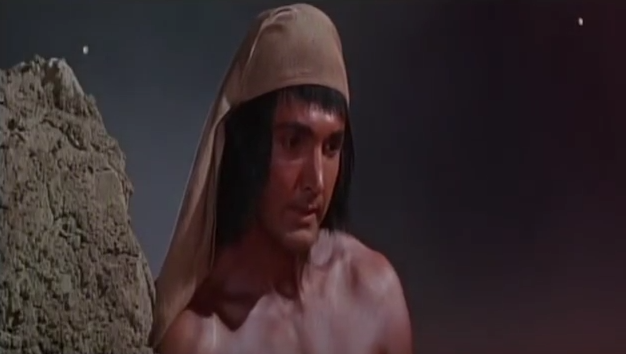
While observing the strange visitors, Kit Draper encounters an escaped slave (actor Victor Lundin -- best known as the first onscreen Klingon from the original Star Trek series: Errand of Mercy, Season 1, episode 26) whom Draper takes back to his cave and names Friday -- another nod at the film's source material.


Meeting Friday (Victor Lundin).
(Photo courtesy of Paramount Pictures & The Criterion Collection)


As the movie progresses, we see Draper's attitude towards Friday go from one of mistrust where Draper has Friday do manual labor for him (a fact that bothered me more than a little as a kid, and apparently didn't sit well with actor Paul Mantee either) to one of sympathy when they discover that the alien slave masters slaughtered Friday's fellow slaves and friends before departing with the mined ore. Then when a falling meteor nearly kills Draper, Friday saves his life by pulling him from the choking ashes and giving him a breath pill -- which apparently helps make oxygen in the lungs and bloodstream. This act ultimately causes Draper to trust Friday more and the two walk back to the cave arm in arm, with Kit reciting from the Twenty-Third Psalm.


"The Lord is my shepherd, I shall not want..."
(Photo courtesy of Paramount Pictures & The Criterion Collection)


Speaking of faith, the movie has an interesting scene later on when Draper and Friday are on the run from the alien slave masters and find water. There is a discussion between the two of them about God and the nature of divine order, something that is rarely done in science fiction films these days, except maybe as a way to mock or debunk Christian faith. The scene is well done and shows a dynamic between the two characters and their growing friendship.

Eventually, Kit is able to remove the slave bracelets the alien slave masters use to track Friday and they arrive at one of the polar ice caps of Mars. There after surviving yet another large meteor strike that buries them in an avalanche, the Omnicomp picks up a radio message from an Earth rescue ship. Kit and Friday cheer as they respond to the message, and are greeted by the surprised exclamation: "My god, a voice from Mars!" (the voice provided by director Byron Haskins himself). 

The movie ends with Draper, Friday and Mona rescued and Mars receding into the darkness of space as they return to Earth. 


Kit Draper, Friday and Mona being rescued by an Earth landing craft that apparently doesn't cast
a reflection in the water.

(Photo courtesy of Paramount Pictures & The Criterion Collection)


Thanks to the adventures of Commander Kit Draper, Friday, and Mona -- as well as the creative vision of director Byron Haskins and the people who put together Robinson Crusoe On Mars -- I developed a young boy's fascination with the solar system, particularly with Earth's small red neighbor. The idea of astronauts landing on and actually exploring Mars had the most profound impact on me. The visionary effects in the film (at least for 1964 Hollywood) including the landing craft used by the movie's main character (visionary for its time since it was portrayed several years before the famous Apollo Lunar Module was even off the drawing board) inspired me to read up on the Apollo Moon Landings and space travel theories in general.

As a result of this film, I gathered up every library book about Mars in the junior and adult non-fiction section of my local library and soaked up every little detail about the Red Planet that I could find. After that I found the fiction stories like: The Martian Chronicles by Ray Bradbury, Out of the Silent Planet by C.S. Lewis, and certainly A Princess of Mars by Edgar RiceBurroughs. By the time summer vacation ended, I was a regular Martian expert - well, at least I thought so at the time.

The movie -- which I recorded from television back the days when VHS tapes were beginning to come into wide use -- became a favorite of mine. That summer I watched it until I had the dialogue memorized word for word. Even today there's a DVD copy of Robinson Crusoe On Mars from the Criterion Collection complete with extras and commentary from the actors, writers, and director that holds a special place of honor in my movie collection.

Now obviously the entire premise of a man surviving any length of time on Mars without a pressure suit, let alone finding standing water or plant life is ridiculous. Mars as we know it in today has next to no air and no atmospheric pressure tolerable for human life. The images the NASA Mariner 1 and Mariner 2 Probes sent back to Earth in 1965 showed the cratered, moon-like Martian surface devoid of the so-called canals, or ancient cities that astronomers like Lowell and Schiaparelli "discovered" around the end of the 19th century - which also inspired classic science fiction writers like H.G. Wells and Edgar Rice Burroughs to create amazing stories about life and civilizations on the Red Planet. A decade later in June of 1976 (same month and year I was born) NASA's Viking 1 and Viking 2 probes showed just a cold, dry desert landscape with violent dust storms, rock, and lots and lots of red sand dunes. No ancient city ruins, no vast canal systems artificial or otherwise, no "little green men" or large, four-armed giants, and no nearly naked red-skinned princesses clad only in jewels (damn it!). No surface life of any kind at all.

Of course none of that mattered at all to an eight year old small town Southern boy with a huge imagination and a tendency to daydream constantly during math classes. To that youngster, Mars was the next great frontier.

One of my favorite places at elementary school was an ancient modular jungle gym set between the playground and a dusty red activity field where outdoor P.E. classes were sometimes held. The jungle gym was the exact shape of how my imagination envisioned a Mars Landing Module complete with cockpit and airlock. The red dirt and virtually weed free activity field looked almost exactly like the surface of Mars from the Viking landing probe photos -- minus the pine trees in the background and the blue sky.

So thanks to a (then) twenty year old science fiction movie and my active imagination, on a moderately cool, but slightly sunny day in October of 1984, eight year old NASA Major Carl "Beau" Roden from South Carolina, USA, became the first human being from Earth to set foot on and explore the planet Mars in my unbuttoned light weather jacket, planting humanity's first footprints on the Martian surface in my worn and dirty sneakers.

For the next couple of months, or so, while my other male classmates were into contact team sports, or the popular classic G.I. Joe and Transformers action figures, I was an astronaut/space explorer; a combination of Kit Draper, Neil Armstrong, and James T. Kirk, making huge scientific discoveries by collecting rock, soil and plant samples in my empty lunch containers. I even got to discover (with the help of my trusty dinosaur toy collection) the existence of miniature dinosaurs on Mars! At other times I pretended to be a castaway who crashed on Mars, writing out S-O-S in huge letters in the red dirt, or with lined up rocks big enough for rescue ships to see. Every once in awhile a couple of classmates would act as my crew members, at least for a few days before getting bored and again leaving me marooned all alone on the "Martian" surface.

The gears of a young boy's mind turn very quickly though. By the time spring arrived "Mars" was again an activity field and taken over by the rest of my third grade class. I would soon be joining my classmates in group soccer games, where I had the distinction (usually against my will) to be goalie and collecting bumps and bruises when I was not daydreaming between goal attempts. Mars and my adventures there were soon replaced by my next big obsession, namely trying to -- and usually failing -- to be a good goalkeeper. 


Soon other obsessions and short-term life goals took higher priority in my life, not least of which was later surviving the urban jungles of Middle School and High School -- not an easy task for a tall, skinny kid who was shy, socially inept and possessed zero athletic ability to speak of outside being fairly average at kickball. 

Even so I've never quite forgotten my boyhood dreams of Mars, dreams kept alive thanks to great science fiction writers like Kim Stanley Robinson, and others. Those dreams continue to be kept alive with the growing popularity of ideas like Robert Zubrin's Mars Direct and great movies like The Martian (2015) based on an excellent robinsonade book by Andy Weir. 

Mars continues to invite us through fiction and science to explore its many mysteries. We know that liquid water once existed on the surface of Mars. Did life exist there, and does it still do so under the surface? If we find fossilized microorganisms there, and those organisms appear like similar ones here on Earth, then what does it say about the origins of life in our solar system and the universe? And finally the ultimate goal of human expansion into the solar system and possibly beyond. Could we build a successful colony on Mars? Build terrariums in the craters and smaller valleys of Mars and create Earth-like biospheres? Could we even develop the technology in a few hundred years to successfully terraform the planet and make it Earth-like on the surface with an atmosphere that can sustain human life? Could the Red Planet someday be a second home for humanity?

It is possibly we will actually see human exploration of Mars within the next 30 years. If so I also wonder if someone will be stranded there by some accident, like Commander Kit Draper and my highly imaginative eight year old self, and if they could find a way to survive through good ole human ingenuity.


Alone on Mars.
(Photo courtesy of Paramount Pictures & The Criterion Collection)