Showing posts sorted by relevance for query Asbury Coward. Sort by date Show all posts

Wednesday, August 03, 2022

The Life Of Colonel Asbury Coward C.S.A. (1835 - 1925) & The Kings Mountain Military Academy

Colonel Asbury Coward (1835 - 1925).


Asbury Coward was born on Saturday, September 19, 1835 on the Quenby Plantation in Berkeley County, South Carolina to Mr. Jesse Coward (1805-1850) and Mrs. Keziah Ann Dubois Coward (1807-1835). The couple were lowcountry rice planters who lived in Charleston County.

At age 19 Coward graduated from The Citadel Military College in Charleston, South Carolina in 1854. At the Citadel he was classmates with future Confederate Brigadier General Micah Jenkins (1835-1864).

He moved to Yorkville, South Carolina (modern-day York) in 1854 to study law
under the direction of Mr. William Blackburn Wilson, one of the leading lawyers of his day. After only a couple of months, however, young Coward -- who reportedly liked to sign his name "A. Coward" -- decided against the law as his line of work. He much preferred outdoor activities and military life to working in some law office.

Coward persuaded his old classmate, Micah Jenkins, to come to Yorkville and together the two young men founded the Kings Mountain Military Academy in January of 1855.

Named for the nearby site of a major battle of the American Revolutionary War in 1780, the Kings Mountain Military Academy was a sort of prep school for the Citadel in the upcountry.
The school's first class had 12 male students ranging from ages 11 to 16.

The school would quickly gain an outstanding reputation for its academics, as well as its strict discipline. 
The five-year curriculum included classes in mathematics, chemistry, astronomy, geology, physiology, history, grammar, English literature, foreign languages (French and German), Latin, and philosophy.

The Kings Mountain Military Academy thrived in those first years and by 1860, the academy had 10 instructors and nearly 200 student cadets.

Boasting a large campus building and dorms, the Kings Mountain Military Academy in York, South Carolina
had nearly 200 students and 11 instructors at its height, including Asbury Coward and Micah Jenkins.
The school operated from 1855 till 1861 when the American Civil War began. The academy would reopen
following the war, but never again achieved its initial success.
Photo courtesy of the SC Department of Archives & History.


On Christmas Day, Thursday, December 25, 1856, Coward married Elise Corbett Blum of Yorkville. Eventually the couple would have 17 children and would sadly outlive all but one.

When South Carolina seceded from the Union on Thursday, December 20, 1860, and the War Between The States broke out on Friday, April 12, 1861, both Coward and Jenkins immediately enlisted in the South Carolina military forces, and the school closed its doors for the duration of the war.


Asbury
Coward entered the Confederate Army as captain in the adjutant general's department under Brigadier General David R. Jones. Later he was transferred to the field along with General Jones, who now commanded a brigade in the division of Major General John B. Magruder in the Peninsula Campaign where he was given a promotion to major following the Battle of Malvern Hill on Tuesday, July 1, 1862.

A few months later, on Tuesday, August 12, 1862 Coward was promoted to colonel and not long after given command of the 5th South Carolina Infantry Regiment. The regiment was attached to a brigade commanded by his old friend -- now Brigadier General -- Micah Jenkins under the command of Lieutenant General James Longstreet.

The following is an excerpt from Reminiscences of a Private by Frank M. Mixson, Company E, 1st South Carolina Volunteers (also assigned to Jenkins' Brigade) recalling when Coward first took command of the 5th South Carolina in late 1862:

It was here that Col. Coward took command of the Fifth South Carolina. I recollect how game he looked. He had the regiment formed for dress parade. He was dressed in a brand new suit, polished high top boots, shining spurs and bright sword. He did not weigh over one hundred and twenty pounds, but he looked game. He had the orders read appointing him colonel, and then he told the men that he was now their colonel and would be respected as such; he would not tell them to go only as he led them. When he got through his talk the Fifth knew they had a colonel, and after-events proved it, for from then on the Fifth was one of the best regiments in our brigade.

As a military academy teacher, Colonel Coward was said to have been a very strict, but excellent field officer.

The 5th South Carolina Infantry saw action with General Robert E. Lee's Army of Northern Virginia at the
Second Battle of Bull Run (August 29-30th), and during Lee's first invasion of the North at Turner's Gap at the Battle of South Mountain (Sunday, September 14th) and the Battle of Sharpsburg, Maryland (Friday, September 19th).

Jenkins' brigade now served in the division of Major General George Pickett and was present at the Battle of Fredericksburg (December 11-15th) although it was not engaged.

Brigadier General Micah Jenkins CSA
(1835 - 1864) was Coward's best friend
and commanding officer both before
and during the War Between the States.
Through the first half of 1863, the 5th South Carolina would be detached from the Army of Northern Virginia. Jenkins' brigade was retained to defend Richmond, Virginia in June of that year missing Lee's second invasion of the North and the subsequent Battle of Gettysburg (July 1-3, 1863).

Coward's 5th South Carolina Infantry Regiment and Jenkins brigade went with Major General
John Bell Hood's Division to Georgia in the autumn of 1863 and participated in the second day's fighting at the Battle of Chickamauga on Sunday, September 20th with the Confederate Army of Tennessee under General Braxton Bragg.

Later that same year, the 5th South Carolina fought with Bragg's army during the disastrous Chattanooga Campaign at the Battle of Wauhatchie (October 28-29th) and the Knoxville Campaign.


On Saturday, January 16, 1864, General Micah Jenkins led his brigade to victory in the small Battle of Kimbrough's Crossroads (Dandridge) against Federal cavalry, which Colonel Coward's regiment took part in. Not long after Longstreet's Corps would return to Virginia and Lee's Army in time for the new spring campaign.

Tragically, during the Battle of the Wilderness (May 5-7, 1864), Brigadier General Micah Jenkins was riding ahead with General Longstreet when both men were accidentally struck down by friendly fire on Friday, May 6, 1864. Although Longstreet survived his neck wound, Jenkins -- along with two of Longstreet's aides -- died a few hours later. Colonel Coward witnessed his longtime friend and commanding officer's death.

That same afternoon Coward led his regiment in an attack through the now burning wilderness and, when the colors of the 5th South Carolina Regiment fell, Coward himself picked them up and led the charge over the Union earthworks along the Brock Road in the thick of the battle where he was wounded for the first time in the war. He would be back in command a week later, but was wounded again at the Battle of Chaffin's Farm on Friday, September 30, 1864.

The regiment's final engagement was at the Battle of Cumberland Church (Farmville, Virginia) on Friday, April 7, 1865.

Colonel Asbury Coward during his service
as Superintendent of The Citadel
(1890-1908).
Coward was still in command of the 5th South Carolina Infantry Regiment when it, along with the rest of Lee's Army of Northern Virginia, surrendered two days later at Appomattox Court House, Virginia on Sunday, April 9, 1865.  The regiment surrendered and subsequently paroled its remaining 19 officers and 263 men.

Following the surrender and end of the war, Asbury Coward returned to Yorkville to his wife and family. He would go on to have a very productive life beyond his service to the Confederate army.

Colonel Coward reopened the Kings Mountain Military Academy in 1866, but things were not the same as they were before. His friend, and former commanding officer, General Micah Jenkins, was dead. In the decades following the end of the war, not many families could afford to send their kids to boarding school. South Carolina was also under Federal military occupation until 1876 and the end of the Reconstruction Era and the school's cadets were not allowed the use of military rifles for their drills.

In spite of this, Coward kept the school going and maintained its usefulness and prestige, despite the extreme poverty in the State.


Colonel Coward also served as the chairman of the Kings Mountain Centennial Committee in 1880 and helped commemorate the Centennial Monument at the site of the Revolutionary War battlefield in Blacksburg, South Carolina.

His dedication to education would be well rewarded.

From 1884-1886, Colonel Coward would hold the office of
South Carolina Superintendent of Education, and in 1890 would become Superintendent of The Citadel in Charleston and served at that post until 1908 when he was awarded a Carnegie Pension for his service to mankind. The Citadel made great strides under the leadership of Coward who gained the respect and affection of every student body he ever commanded.

The University of South Carolina in Columbia awarded him the honorary degree of doctor of laws in 1896 and
U.S. President Theodore Roosevelt appointed Coward to the prestigious West Point Board of Visitors in the early 1900s.

After briefly living in Johnson County, Tennessee with one of their adult children, both Colonel Coward and his wife (now 89 and 87 respectively) returned to York to live out the remainder of their lives.


Colonel Asbury Coward and his wife, Elise Corbett Blum Coward, taken in 1923, nearly 67 years after
the couple were married on Christmas Day in 1856.


Colonel Asbury Coward died on Tuesday, April 28, 1925 at the age of 89. He is buried in historic Rose Hill Cemetery in York, South Carolina next to his wife, Eliza, underneath a beautiful granite monument.

On Wednesday, October 7, 1931, the Kings Mountain Chapter of the Daughters of the American Revolution erected a small monument honoring Colonel Coward near the Centennial Monument at Kings Mountain National Military Park in recognition for his work in helping to preserve the battlefield site for future generations.

Colonel Coward's marker near the Centennial
Monument at the Kings Mountain National
Military Park in Blacksburg, South Carolina.


The Kings Mountain Military Academy would close down permanently in 1908. A year later the property the academy stood on was sold to the York Episcopal Church. Today the York Place Episcopal Church Home For Children sits on the site of the former military school. A historical marker notes both the site of the academy and its first commandant, Brigadier General Micah Jenkins, who is buried in Magnolia Cemetery in Charleston.

The marker is located on Kings Mountain Road (SC Highway 321) in York, South Carolina.


Both the Citadel and Winthrop University in Rock Hill, South Carolina have collections of Colonel Asbury Coward's personal letters during and after the war. His memoir was published in 1968.

One of Asbury and Elise Coward's sons, Dr. Francis Asbury Coward (1877-1922) would serve in the American Expeditionary Forces A.E.F. as a 1st Lieutenant and doctor in the Medical Corps on the Western Front in France in 1918 -- the last year of the First World War. He's buried in the family plot near his parents at Rose Hill Cemetery in York, South Carolina.


The grave of Colonel Asbury Coward and his wife Elise at
Rose Hill Cemetery in York, South Carolina.


This blogger would like to thank the good folks at the South Carolina State Department of Archives and Winthrop College in Rock Hill, South Carolina for providing the information for this article.

Wednesday, October 07, 2015

The Battle Of Kings Mountain 235th Anniversary Service (1780 - 2015)

Members of the South Carolina Sons of the American Revolution
(SC SAR) and other members and reenactors honoring those
men who fell at the Battle of Kings Mountain (Oct. 7, 1780).

On Wednesday, October 7th of this year, I had the opportunity to visit one of my favorite historical site in the South Carolina upcountry, the Kings Mountain National Military Park and observe the 235th Anniversary of the Battle Of Kings Mountain (October 7, 1780). 

Traveling along with me was my brother, Alex, who helped take some of the following photos of the trip along the park trail and the Laying of the Wreaths ceremony that took place at 11 AM on the battlefield site.

The following photos chronicle this little adventure. 

Kings Mountain National Military Park Visitors Center.
Clothing of the type worn by the Patriot Militia from
the backcountry and Over-The-Mountain Regions at the battle.
Also typical clothing worn by both the Patriot Militia
and the British Loyalist Militia at the battle.
Uniform of the American Volunteers.
These were men of the Provincial Regulars: American Loyalists who
formally enlisted in the British Army. About a hundred of the Loyalist
forces at the battle wore uniforms, leading to the myth that all those
loyal to the Crown at Kings Mountain wore the red uniform.
Aside from a company of these Provincial Regulars, all other
British Loyalists at Kings Mountain wore civilian militia clothing.
The only actual British Regular soldier at Kings Mountain was
Major Patrick Ferguson, commander of the Loyalist Militia forces.
Portrait of Colonel William Campbell of Virginia,
who was elected overall commander of the Overmountain Men and
Patriot Militia forces at Kings Mountain.
He was a militia commander and not a regular Continental officer.
In fact, no regular Continental soldiers fought in the battle.
The battle that effectively turned the tide of the war in America's
Southern Theater was fought entirely by Patriot militiamen.
The famous "Ferguson Rifle" designed by Major Patrick Ferguson.
The story of this rifle I chronicled in a previous blog post.
Map detailing the British Campaign in South Carolina
in the summer and fall of 1780.
Your humble blogger standing on the Kings Mountain Battlefield Trail.
My brother Alex Wallen.
The Chronicle Marker.
The spot where Patriot Major William Chronicle fell
during the battle.
These two markers are dedicated to Major William Chronicle and his men.
The one to the left with the Betsy Ross flag is the old
marker - now time-worn - that was placed at the site in 1815.
It is one of the oldest Revolutionary War monuments in the nation.
To the left is the marker placed there in 1915 with the same inscription.
Both monuments read:

Sacred to the memory of Maj. William Chronicle, Capt. John Mattocks,
William Rabb, and John Boyd, who were killed at this place on
the 7th of October, 1780, fighting in defense of America.

Both during and after the battle, men on both sides
used this creek as a source of water.

As my brother and I walked the trail around the site where the Patriot forces surrounded the base of the large, rock-covered hill that makes up the Kings Mountain battlefield, I could not help but look at the early autumn foliage and remember that it was on the same date 235 years before that the battle took place.

The American Loyalists and the Patriot Militiamen who fought here on that afternoon must have seen some of the same fall colors. For some of them it would have been their last sight as they lay wounded or dying. 

In point of fact, I would like to add that in the fall of 1780 Kings Mountain itself was covered with an old growth forest with trees far thinker -- in some cases almost redwood sized -- than the forest that surrounds the battlefield today. Those old trees were so thick and wide, the Patriots could take cover and be safe around them as they fired up at the Loyalists silhouetted against the sky on top of the large hill, which was then and still is barren of trees. 


This simple stone and bronze plaque marks the site of US President
Herbert Hoover's grandstand during the park's formal dedication
ceremony on October 7, 1930 -- the 150th year anniversary of the battle.
He delivered an address in front of a estimated crowd
of nearly 80,000 people.
The Centennial Monument.
Dedicated during the 1880 celebration, this monument stands at the
highest point along the trail. The marker honors the American
officers and several of the Virginia troops who fell in the battle. 


Probably the last thing many would expect to find on
a Revolutionary War battlefield is a monument to a Confederate officer.
This marker and plaque recognizes Colonel Asbury Coward, a resident of
York, South Carolina who was instrumental in establishing the park.
Coward served as a colonel in the 5th South Carolina Infantry Regiment (CSA)
during the War Between the States and had opened the Kings Mountain
Military Academy at York before the war.
His cadets came to the battleground to drill annually.
After the war, with the support of the Daughters of the American Revolution,
Coward helped foster interest in a park at Kings Mountain.
The stone and plaque were placed here in 1931 to honor his memory.
*See a previous blog post here to see the grave of Colonel Asbury Coward
in York, South Carolina.


We both arrived at the US Monument at the top of the hill just in time for the beginning of the annual Laying Of The Wreaths ceremony celebrating the 235th Anniversary of the Battle of Kings Mountain. 

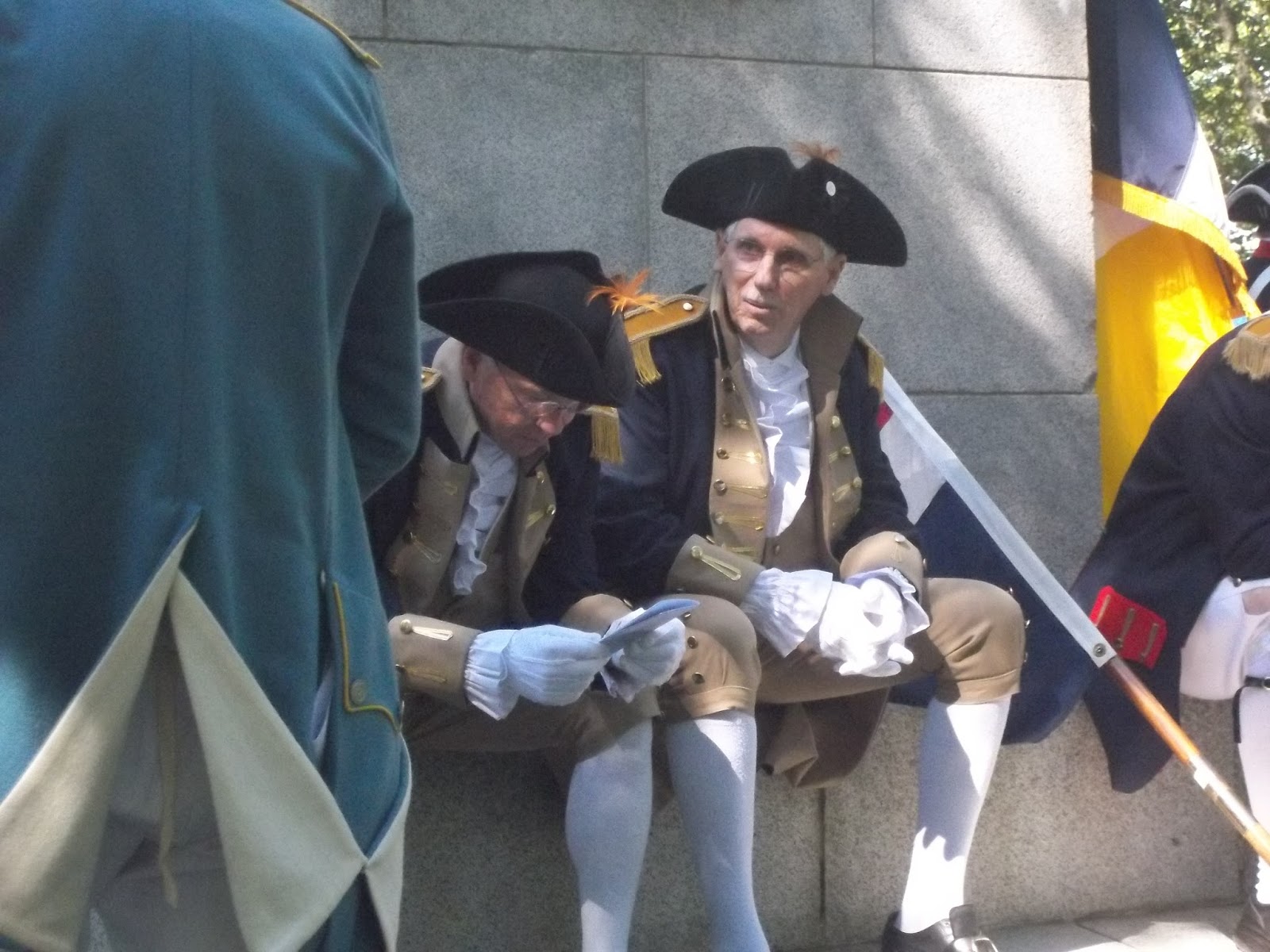
The event is sponsored by the North and South Carolina Societies of the Sons of the American Revolution.  Members of the Sons of the American Revolution and Daughters of the American Revolution from many states were in attendance and provided wreaths in memory of those who fought at the battle. Reenactors portraying the American Patriots (and a few American Loyalists) were also in attendance. 

After several speeches were made by representatives of the SAR and DAR, the wreaths were presented and the representatives of close to 100 chapters of both fraternal heritage organizations and various re-enactor groups. It was truly an amazing time and I know the photos I took cannot do it justice. 

Arriving at the large US Monument on top of the hill.
It was placed there in 1909 by the US Government on the site
where Ferguson's Loyalist forces surrendered in their campsite.
A wide shot of the massed colors and wreaths that honor the
fallen American Patriots who died during the battle and
the veterans who survived. 
Reenactors firing a ceremonial volley in memory of the fallen.
Closing Prayer.
Plaque dedicated to those Patriot Militiaman killed and
wounded during the battle.
Plaque dedicated to the victory at Kings Mountain.
Plaque that tells the story of the battle.
The plaque is historically inaccurate because it mentions
"British Regular Troops" -- aside from a hundred American Provincials
that were formally enrolled into the British army, the rest of the
British forces here were Loyalist militia commanded by a British officer.
Yours truly posing in front of the US Monument with the
Betsy Ross Flag representing the original thirteen united
States of America.


The arrival of the Overmountain Victory Trail Association reenactors.
These dedicated folks annually march the same path taken by the
Overmountain Men -- a two week trek from Abingdon, Virginia
following the Overmountain Victory National Historic Trail to the
Kings Mountain National Military Park.
Marker dedicated to Patriot Colonel James Hawthorne
who died at the battle.
This stone placed here in 1909 marks the spot where British Major
Patrick Ferguson was shot off his horse and killed near the end of the battle.
(Note that while Ferguson had been promoted to the rank of colonel,
he did not formally receive the promotion before his death.
He was still technically a major when the battle took place.)

Some reenactors coming back down from the top in style.
The final stop on my trip was the grave of Colonel Patrick Ferguson, which sits not far from the spot where he was shot from his horse. The marker was placed there in the 1930s in memory of the fallen Scottish officer. Beneath the cairn of stones behind the marker lies Ferguson's grave.

Also buried beside Ferguson in an unmarked grave is a camp follower named Virginia Sal. She was believed to have been Ferguson's lover. Sal was shot and killed in the crossfire during the battle while tending to the wounded Loyalists -- her red hair possibly making her a target through the smoke.

Several reenactors placed stones as they passed by. I likewise placed two stones on the cairn out of respect for the fallen British officer from Scotland who died so far from his home, and for Virginia Sal. It is part of an old Celtic tradition to place stones on the graves of the dead in their memory. An old Scottish Gaelic blessing is: Cuiridh mi clach air do charn (which translated means: "I'll put a stone on your cairn"). 

Yours truly holding the Kings Colours at the grave and
cairn of Colonel Patrick Ferguson -- the flag of Great Britain
at the time of the American Revolutionary War.
The red saltier (St. Patrick's Cross) of Ireland would not be added
to the modern Union Jack until 1801.


Overall, I have to say a good time. It was an huge honor to be there to help pay tribute to the Southern-born Patriot militiamen - most of them Scots-Irish - who defeated the Loyalists on that early autumn day in October of 1780. America would not be the nation that it is without the efforts of those who fought there. Their success literally turned the tide of the American Revolution in the South in favor of the Continentals and Patriots.

I hope y'all enjoyed this blog post as much as I enjoyed writing it and posting the photos. Be sure to check out the links in the blog post to learn more about various aspects of the Battle of Kings Mountain and the men who fought there.