 |
| Frank Vizetelly of the Illustrated London News traveled with
President Jefferson Davis between Greensboro, N.C. to just before his capture in Georgia. |
On Wednesday, April 26, 1865 with the Southern Confederacy crumbling around them, a column of Confederate cavalry crossed the state line and entered what would be York County, South Carolina.
Commanded by C.S. Brigadier General Basil Wilson Duke of Kentucky, brother-in-law of the famous Confederate raider John Hunt Morgan, the force was composed of between 2,000 - 3,000 cavalrymen and a number of horse-drawn wagons carrying with personal items, important government paperwork, and several very important passengers, which significantly slowed their progress.
Their arrival in South Carolina was part of the retreat from Richmond, Virginia just prior to the city's capture by Union forces a few weeks before on April 3rd. The trek took this convoy through Danville, Virginia, Greensboro and Charlotte, North Carolina. Their ultimate destination was either Texas, or Mexico, where they could continue fighting the Union with other Confederate forces still in the field, or seek better surrender terms.
General Duke wished for more speed to escape pursuing Union cavalry forces and to protect his charges; however, the slow pace may also have been intentional, largely due to the wishes of the most important passenger on the convoy: Confederate President Jefferson Finis Davis.
Despite being on the run, President Davis wanted to maintain a semblance of normalcy even as he and the remainder of his cabinet fled south to escape the victorious Union forces.
"Jefferson Davis is traveling like a president and not a fugitive," Duke later wrote. Burton Harrison, the president’s personal secretary, observed that Davis often looked sad and dispirited during his retreat, but he refused to feel like a beaten man.
The Flight From Richmond to Charlotte & Lincoln's Assassination
On Sunday, April 2, 1865, after more than 8 months of consistent fighting, the Confederate defenses at the besieged city of Petersburg, Virginia collapsed.
That same day, while seated in St. Paul's Episcopal Church in Richmond attending worship services, President Davis received a telegram from General Robert E. Lee, announcing the fall of Petersburg, the partial destruction of his army, and the immediate necessity for flight. Davis and his cabinet were forced to abandon Richmond and flee south away from General U.S. Grant's advancing Union army. Davis escaped to Danville, Virginia, together with the Confederate Cabinet, leaving on the Richmond and Danville Railroad. Richmond would fall the next day on Monday, April 3rd.
Davis would be on the run for six weeks, an epic journey through four states by railroad, ferry boat, horse, cart, and wagon.
It was at Greensboro that Davis learned the full details of Appomattox, given in a personal letter from Lee, the reading of which left Davis weeping in near-despair. The following conversations with his cabinet and his remaining generals revealed that virtually everyone counseled surrender. Davis refused to even consider that option.
On Friday, April 14th, Lincoln was assassinated and died the next morning. It would be in Charlotte, North Carolina on Wednesday, April 19th while delivering a speech to a small crowd where Davis would first hear of Lincoln’s assassination. He was about to enter the Lewis F. Bates residence when he received the following dispatch from his Secretary of War (and former U.S. Vice President) John C. Breckinridge:
Greensboro, April 19, 1865.
His Excellency President Davis:
President Lincoln was assassinated in the theater in Washington on the night of the 11th instant. Seward's house was entered on the same night, and he was repeatedly stabbed, and is probably mortally wounded.
President Lincoln was assassinated in the theater in Washington on the night of the 11th instant. Seward's house was entered on the same night, and he was repeatedly stabbed, and is probably mortally wounded.
JOHN C. BRECKINRIDGE.
 |
| A bronze plaque marks the spot on the corner of South Tryon St. and Fourth St. in downtown Charlotte, North Carolina where President Davis first heard of Lincoln's assassination while speaking to a small crowd. The plaque erroneously lists April 18th as the date of this event. |
However, according to Davis' biographer, Mr. Hudson Strode, Davis was shocked when he was handed the telegram informing him of Lincoln's assassination and death, and had to read it twice before handing it off to the person next to him, saying, "Here is a very extraordinary communication. It is sad news."
A column of Kentucky's Confederate Cavalry from Davis' escort rode up to the house at that moment, and when someone read the dispatch aloud, one cavalryman shouted in jubilation, but Davis raised his hand to silence any further cheering before entering into the house. Inside, the President commented further to his personal secretary, Burton Harrison, saying, "I am sorry. We have lost our best friend in the court of the enemy."
Also traveling with the President was Secretary of the Navy Stephen Mallory, who recorded in his diary the following conversation with Davis about the assassination:
"I expressed my deep regret, expressing among other views, my conviction of Mr. Lincoln's moderation, his sense of justice, and my apprehension that the South would be accused of instigating his death. To this Mr. Davis replied sadly, 'I certainly have no special regard for Mr. Lincoln; but there are a great many men of whose end I would much rather have heard than his. I fear it will be disastrous to our people and I regret it deeply.'"
Davis also expressed that he believed Lincoln would have been less harsh with the South than his successor, Andrew Johnson.
In the aftermath of Lincoln's assassination, President Johnson issued a $100,000 reward for the capture of Davis and wrongly accusing him of helping to plan the assassination. An irony when one considers that, almost 13 months prior, there was an attempt by the Lincoln Administration to kill President Davis and his cabinet (see Dahlgren affair).
President Davis In York County, South Carolina
On Wednesday, April 26th, Davis left Charlotte, immediately after a particularly gloomy cabinet meeting that discussed Johnson’s surrender to Sherman. After riding all afternoon on Wednesday, April 26, the column crossed into York County, South Carolina and approached the Catawba River, where they were greeted around 4 P.M. by Colonel Andrew Baxter Springs, owner of the Springfield Plantation in Fort Mill.
The Confederate President was also greeted by a group of Southern ladies with bouquets of spring flowers. Springs, a colonel in the Confederate Army who'd helped recruit and supply troops, offered his home to President Davis and the Confederate cabinet. Secretary of the Treasury and Charleston businessman George Trenholm and his wife, Helen, both of whom opted to spend the night nearby at the home of Colonel William Elliott White further down the road.
According to the Springs family archives, that evening, with all of the Union forces pursuing them and a price on their heads, President Davis and his fugitive cabinet members played a game of marbles with Spring's two young sons, Eli, 13, and Johnny, 12 in the parlor. Eli was paired with Davis and Postmaster General John H. Reagan, while Johnny was paired with Secretary of State Judah P. Benjamin and Secretary of War John C. Breckenridge. The teams got down on the knees, laughing and relaxing.
Secretary of the Navy Stephen Mallory wrote of the evening, "It was an hour of refreshing, well-contested game of marbles. Breckinridge, the best marble player since (John) Marshall, with his usually good luck, came off victorious. He is the best grown-up player in the Confederacy, if not the world."
It was said that, for their part, the two Springs boys were amazed that these four powerful men knew all the rules about marbles.
 |
| The Springfield Plantation House In Fort Mill, South Carolina. The site of a rather interesting game of marbles on the evening of Wednesday, April 26, 1865. It was listed on the National Register of Historic Places in 1985. |


Despite the diversion with Colonel Springs' sons, President Davis, later that same evening wrote in a letter to his wife that General Wade Hampton of South Carolina offered to command a group of Confederate forces that would lead Davis across the Mississippi River. "The route will be too rough and perilous for you and the children to go with me - the tide of war will follow me."
The Confederate First Lady, Varina Davis, and their children had already left Richmond on March 30th, several days before Davis, and traveled south by railroad as far as Chester, South Carolina before setting out again by horse-drawn carriages. The family would not be reunited again until May 7th in Georgia.
For more historical details on the Confederate First Family's time in Chester County, please check out the article written previously on this blog on the subject HERE.
The next day, Thursday, April 27th, President Davis and his cabinet met up with Trenholm at the home of Colonel White in Fort Mill and held what would be the last meeting of the full Confederate cabinet.
During the meeting, Trenholm, who had been ill for some time -- and likely at the urging of his wife who had been acting as his nurse -- asked Davis if he could resign. Davis accepted his resignation and thanked him for his service. Trenholm would later flee with his wife to Chester and then Columbia, where he was arrested. He was imprisoned until pardoned on Wednesday, October 11, 1865 and later returned to Charleston.
Postmaster General John Reagan, who was late to the meeting, was appointed the new secretary of the treasury. He protested that his duties of postmaster and keeper of the telegraph will keep him busy, but Davis, showing a good deal of humor despite the situation, replied, "Don't worry, there’s not much left for the secretary of the treasury to do. There's but little money left for him to steal." This brief moment of levity from Davis convinces Reagan to hold both jobs.
During the meeting, Trenholm, who had been ill for some time -- and likely at the urging of his wife who had been acting as his nurse -- asked Davis if he could resign. Davis accepted his resignation and thanked him for his service. Trenholm would later flee with his wife to Chester and then Columbia, where he was arrested. He was imprisoned until pardoned on Wednesday, October 11, 1865 and later returned to Charleston.
Postmaster General John Reagan, who was late to the meeting, was appointed the new secretary of the treasury. He protested that his duties of postmaster and keeper of the telegraph will keep him busy, but Davis, showing a good deal of humor despite the situation, replied, "Don't worry, there’s not much left for the secretary of the treasury to do. There's but little money left for him to steal." This brief moment of levity from Davis convinces Reagan to hold both jobs.
 |
| The White Homestead as it would have appeared when President Davis and his cabinet visited in April, 1865. Photo taken in 1870 courtesy of the Fort Mill Historical Society. |
 |
| The home of Colonel William Elliott White, believed to be the site of the last full Confederate cabinet meeting on the morning of Thursday, April 27, 1865. It was added to the National Register of Historic Places in 1987. |


Later that day, as Davis, the cabinet and the cavalry escort crossed the Catawba River at Nation's Ford (modern-day US HWY 21) on a pontoon bridge -- the wooden railroad bridge was burned by Yankee cavalry eight days before on Wednesday, April 19th -- one member of the cavalry noted: "The cause has gone up. God only know what will be the end of all this."
After crossing the Catawba, the column followed a path over what today is Cherry Road (U.S. HWY 21) at Eden Terrace in Rock Hill, South Carolina. A historic marker on Eden Terrace near the Winthrop University baseball park marks the Confederate President's path.
Later that evening the column traveled west (along modern-day SC HWY 5) and reached Yorkville (modern-day York, South Carolina) where Davis and his cabinet spent he night at the home of Doctor James Rufus Bratton, a Confederate Army surgeon who served under Davis' old friend, General Braxton Bragg in the Army of Tennessee. Bratton had arrived home about Sunday, April 9, 1865, the day Lee surrendered the Army of Northern Virginia at Appomattox Court House.
York citizens were given the opportunity to greet their former leader that night when Dr. Bratton held a reception in honor of his famous guest. Davis refused to make a speech, but women and children gathered around him, so the story goes, kissing his hand and saying, "You are my President."
President Davis spent the night in a huge four poster bed in the upstairs bedroom over the drawing-room.
According to a family story, following the reception, Old Pete, the Bratton family butler, was sent to the President's room with a waiter holding priceless decanters of wine and whiskey. Old Pete evidently slipped among the stairs, because as he opened the door of Mr. Davis' room he fell sprawling on the floor.
Late that night a knock was heard on the door of the widow, Mrs. William Hackett, whose home was opposite the Bratton house. Again it was Old Pete who said, "Marse Rufus done sent me to ask you to send him a nightshirt for Marse President, Jefferson Davis." So Pete recrossed the street carrying the long white nightshirt which had belonged to William Hackett, who'd been killed in the Battle of the Crater (Saturday, July 30, 1864) at Petersburg the year before.
Dr. Bratton's house no longer stands, having been gutted by a fire in 1956. At the site where the house sits today there is a historical marker. There is also a marker in front of the York County Courthouse that mentions Davis' visit to the town.
 |
| An old photo of the Bratton House (circa 1948) courtesy of The Rock Hill Herald. |
 |
| The site of the home of Dr. James Rufus Bratton, a surgeon in the Confederate army in York, South Carolina. The house was destroyed by a fire in 1956. |

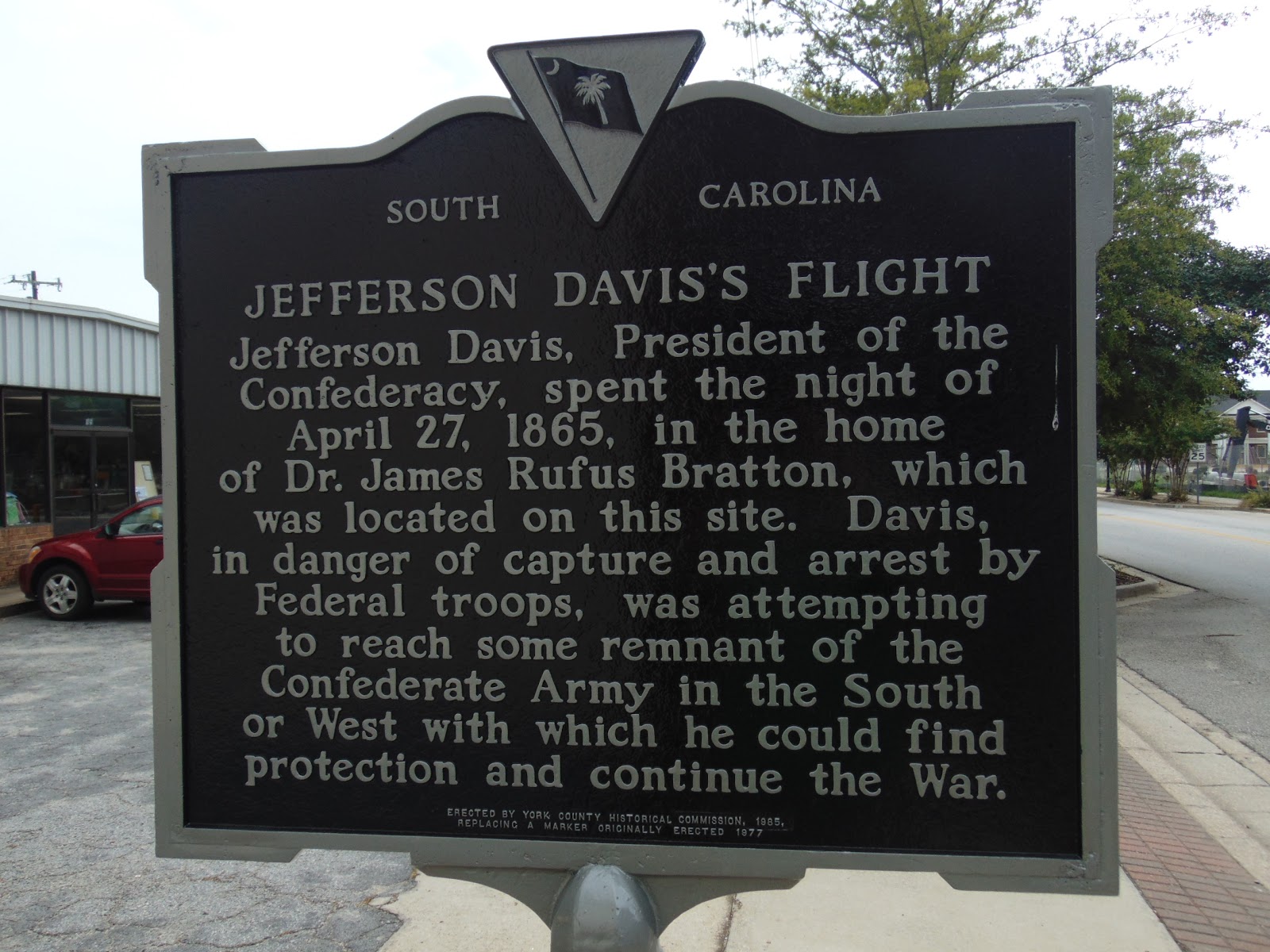
President Davis In Union County, South Carolina
The next day, on Friday, April 28, 1865, President Davis, along with the four of his remaining cabinet members, and his escort continued west and reached the Broad River. They crossed the ferry at Pinckneyville (an old settlement town which is a ghost town today) and made their way to the town of Union.
The Confederate President stopped over at the two-story home of Brigadier General William Henry Wallace. There Wallace's wife, Sarah, provided a meal for Davis and his entourage. Wallace, who started the war as a private in the 18th South Carolina Infantry Regiment and later rose to become colonel of the regiment, was promoted to brigadier general by Davis himself on September 20, 1864. General Wallace himself probably still returning from Virginia on parole following the surrender of Lee's army and not home at the time.
 |
| The home of Confederate Brigadier General William Henry Wallace on 430 East Main Street in Union, South Carolina. The house was built in 1850. |
 |
| Marker to Jefferson Davis in front of the Wallace home. |
Two days later, on Sunday, April 30th, about a dozen miles west of Union, Davis' escorts arrived at Cross Keys House, a Colonial Georgian manse which sat at the intersection of two major roads.
Mary Ann Bobo Whitmire Davis, who lived in the house at the time, answered a knock at the door around mid-day and found five well-dressed men asking for a meal. No doubt she was shocked to see the men and the large number of Confederate cavalry escorting them. Davis invited the President and the four remaining members of his cabinet in and served them lunch while their military escort rested on the grounds of the plantation.
Even though she had invited them into her home and served them lunch, Mrs. Davis initially did not know who her five well-dressed guests were. She supposed they were high-ranking government officials being escorted to safety from the Yankees, but didn't ask who they were.
As President Davis and his party departed, he remarked to Mrs. Davis with a smile that they shared the same last name. It was only then that she realized who she'd just dined with.
 |
| The Cross Keys Plantation House of Mrs. Mary Ann Bobo Whitmire Davis. Built in 1814 the house is one of the oldest in the South Carolina Upstate and listed on the National Registry of Historical Places in 1971. Today it is owned and operated by the Union County (SC) Historical Society. |


The Grave of the Confederacy
President Davis, his cabinet, and his escorts reached the town of Abbeville, South Carolina, about 30 miles short of the Georgia Border at the Savannah River, on Tuesday, May 2, 1865 -- exactly one month following the fall of Petersburg and collapse of Confederate resistance.
The day before Davis' friend and Confederate General Braxton Bragg finally caught up to the party. While Davis was pleased to see him, he was probably the only one.
Davis and company decided to spend the night at the Burt-Stark Mansion House because the owner was Colonel Armistead Burt, another close friend of the president.
The day before Davis' friend and Confederate General Braxton Bragg finally caught up to the party. While Davis was pleased to see him, he was probably the only one.
Davis and company decided to spend the night at the Burt-Stark Mansion House because the owner was Colonel Armistead Burt, another close friend of the president.
At about 4:30 P.M. that afternoon, Davis held what would be the final Confederate Council of War. Here Davis convened an extraordinary
meeting. It was not a cabinet meeting, so much as a council of war. In attendance were Breckinridge, Benjamin, Mallory, Reagan, General Braxton Bragg his military advisor, General Basil Duke the commander of his now 2,000 strong escort, along with brigadier generals Samuel W. Ferguson, John C. Vaughn, George Gibbs Dibrell, and Colonel William C. P. Breckinridge, a cousin of the Secretary of War.
After some initial discussions, Davis made a startling proposal. He still professed hope of continuing the fighting. Though there were now barely 2,000 soldiers accompanying them as they fled south, the president thought these troops could form the nucleus of a new army to rally the people and continue the war.
After some initial discussions, Davis made a startling proposal. He still professed hope of continuing the fighting. Though there were now barely 2,000 soldiers accompanying them as they fled south, the president thought these troops could form the nucleus of a new army to rally the people and continue the war.
Though the Confederate President had the will to continue the struggle, it was clear that his cabinet and remaining generals did not share his belief. One by one, the generals told Davis their men were not willing to continue to fight for what was now a lost cause.
Colonel William Breckinridge asserted flatly that "there was no war to continue."
Surprised by that statement, Davis then asked why these last few troops were still with him.
Colonel William Breckinridge asserted flatly that "there was no war to continue."
Surprised by that statement, Davis then asked why these last few troops were still with him.
"We are here to help you escape," General Duke said. "Our men will risk battle for that, but they won't fire another shot to continue the war." That accomplished, the troops would then disperse and go home.
Davis made one more plea for his generals to rally their men for the failing Confederacy. They stared at their boots and did not answer. No one was willing to continue the war, especially in the form of a destructive guerrilla conflict of the sort that General Lee himself wished to avoid. The South was ravaged enough without that. The officers would get Davis out of the country if they could, but that would be the extent of their mission.
Realizing that all was lost, a bitter Jefferson Davis, now the former president of the Confederate States of America, then said, "All is lost indeed. I see that the friends of the South are prepared to consent to her degradation." Then he went up to his room alone.
Davis made one more plea for his generals to rally their men for the failing Confederacy. They stared at their boots and did not answer. No one was willing to continue the war, especially in the form of a destructive guerrilla conflict of the sort that General Lee himself wished to avoid. The South was ravaged enough without that. The officers would get Davis out of the country if they could, but that would be the extent of their mission.
Realizing that all was lost, a bitter Jefferson Davis, now the former president of the Confederate States of America, then said, "All is lost indeed. I see that the friends of the South are prepared to consent to her degradation." Then he went up to his room alone.
It is because of this meeting that Abbeville is sometimes referred to as the
"Grave of the Confederacy."
On Wednesday, May 3rd, Davis and his escorts would leave the Burt-Stark House and cross the Savannah River into Georgia, leaving South Carolina behind.
Davis would meet with his cabinet for the last time on Friday, May 5, 1865 in Washington, Georgia, where the Confederate government was officially dissolved. After that it became every man for himself.
Of the remaining members of the former Confederate president's cabinet, only one, Reagan, remained with Davis. After the war, Reagan actually returned to the United States government, being elected to the U.S. House and then Senator for Texas. Among his later accomplishments was forming of the Interstate Commerce Commission.
The others set off to try and escape capture by the pursuing Yankees. Two of them (Breckinridge and Benjamin) managed to escape. Benjamin never returned to America, dying in exile in Paris, France on Tuesday, May 6, 1884.
Many of the troops from his escort -- the ones that Davis had counted on to keeping fighting -- had already abandoned him and surrendered to U.S. government authorities, making their long walk home to learn what happened to their families in their absence.
As for Davis, his only thought following the collapse of the Confederacy was finding his wife and children, then escaping the pursuing Yankee cavalry. He would catch up to his family near Dublin, Georgia on Sunday, May 7th.
Any chance of escape ended in the early morning hours of Wednesday, May 10, 1865, near Irwinville, Georgia when Union cavalrymen of the 1st Wisconsin and 4th Michigan Cavalry Regiments captured the Davis family and their remaining escorts.
The former Confederate President was taken to Fortress Monroe, Virginia and held for two years -- some of that time wearing heavy leg irons -- faced with charges of treason and conspiracy to assassinate Lincoln. Never brought to trial, Davis was finally released on bail after two years of confinement.
Jefferson Davis died on Friday, December 6, 1889 in New Orleans, Louisiana. Today he rests in peace in Richmond, Virginia beside his wife, Varina. His grave marker does not mention his tenure as President of the Confederate States of America.
Even though in the final years of his life the former Confederate President never sought to have his citizenship restored, on Tuesday, October 17, 1978 U.S. President Jimmy Carter signed a joint resolution of the United States Congress restoring Davis' U.S. citizenship.
On Wednesday, May 3rd, Davis and his escorts would leave the Burt-Stark House and cross the Savannah River into Georgia, leaving South Carolina behind.
Davis would meet with his cabinet for the last time on Friday, May 5, 1865 in Washington, Georgia, where the Confederate government was officially dissolved. After that it became every man for himself.
Of the remaining members of the former Confederate president's cabinet, only one, Reagan, remained with Davis. After the war, Reagan actually returned to the United States government, being elected to the U.S. House and then Senator for Texas. Among his later accomplishments was forming of the Interstate Commerce Commission.
The others set off to try and escape capture by the pursuing Yankees. Two of them (Breckinridge and Benjamin) managed to escape. Benjamin never returned to America, dying in exile in Paris, France on Tuesday, May 6, 1884.
Many of the troops from his escort -- the ones that Davis had counted on to keeping fighting -- had already abandoned him and surrendered to U.S. government authorities, making their long walk home to learn what happened to their families in their absence.
As for Davis, his only thought following the collapse of the Confederacy was finding his wife and children, then escaping the pursuing Yankee cavalry. He would catch up to his family near Dublin, Georgia on Sunday, May 7th.
Any chance of escape ended in the early morning hours of Wednesday, May 10, 1865, near Irwinville, Georgia when Union cavalrymen of the 1st Wisconsin and 4th Michigan Cavalry Regiments captured the Davis family and their remaining escorts.
The former Confederate President was taken to Fortress Monroe, Virginia and held for two years -- some of that time wearing heavy leg irons -- faced with charges of treason and conspiracy to assassinate Lincoln. Never brought to trial, Davis was finally released on bail after two years of confinement.
Jefferson Davis died on Friday, December 6, 1889 in New Orleans, Louisiana. Today he rests in peace in Richmond, Virginia beside his wife, Varina. His grave marker does not mention his tenure as President of the Confederate States of America.
Even though in the final years of his life the former Confederate President never sought to have his citizenship restored, on Tuesday, October 17, 1978 U.S. President Jimmy Carter signed a joint resolution of the United States Congress restoring Davis' U.S. citizenship.
 |
| Jefferson Davis years after the war and his capture in Georgia in 1865. Image courtesy of the Library of Congress |
To follow the approximate modern-day route of the flight of Confederate President Jefferson Davis and his cabinet through York and Union Counties (SC) first start at the North Carolina/South Carolina state border on U.S. Highway 21 then go south to S.C. 160 then right to the town of Fort Mill. Then take U.S. 21 (S.C. 322) east from Fort Mill across the Catawba River to the city of Rock Hill. From Rock Hill, take S.C. 5 west to the city of York. Continue southwest on S.C. 49 across the Broad River to the city of Union. Continue southwest on S.C. 49 to Cross Keyes and then continue to follow the highway to Laurens County.
 |
| President Davis' flight through South Carolina using current SC Highway maps highlighting the path taken by Davis and his cabinet through South Carolina's Piedmont and Upstate regions in April, 1865. |
References For This Article:
Hudson Strode, ed., Private Letters of Jefferson Davis, 1823-1889 (1966).
Jefferson Davis, The Rise and Fall of the Confederate Government (1881).
Michael B. Ballard, A Long Shadow: Jefferson Davis and the Final Days of the Confederacy (1986).
Also a special thanks to the folks at the York County (SC) Historical Society, the Union County (SC) Historical Society, and the South Carolina Department of Archives.


