Showing posts with label World War 1. Show all posts

Thursday, December 25, 2025

A Carol From Flanders -- Christmas Poem


A Carol from Flanders
by Frederick J. Niven


In Flanders on the Christmas morn
The trenched foemen lay,
The German and the Briton born,
And it was Christmas Day.

The red sun rose on fields accurst,
The gray fog fled away;
But neither cared to fire the first,
For it was Christmas Day!

They called from each to each across
The hideous disarray,
For terrible has been their loss:
"Oh, this is Christmas Day!"

Their rifles all they set aside,
One impulse to obey;
'Twas just the men on either side,
Just men--and Christmas Day.

They dug the graves for all their dead
And over them did pray:
And Englishmen and Germans said:
"How strange a Christmas Day!"

Between the trenches then they met,
Shook hands, and e'en did play
At games on which their hearts were set
On happy Christmas Day.

Not all the emperors and kings,
Financiers and they
Who rule us could prevent these things --
For it was Christmas Day.

Oh ye who read this truthful rime
From Flanders, kneel and say:
God speed the time when every day
Shall be as Christmas Day.

Frederick John Niven (March 31, 1878 - January 30, 1944) was a Canadian novelist of Scottish heritage. A prolific author, he produced over thirty works of fiction, an autobiography, poetry, essays, and pieces of journalism.

The Christmas True reported by The Daily Mirror (London, U.K.) on Friday, January 8, 1915 featuring a
photograph of British and German soldiers standing together between the trenches on the
Western Front near Ypres, Belgium.


On Christmas Eve, Thursday, December 24, 1914, along the four-hundred-mile Western Front of World War I (1914-1918), a famous ceasefire took place, as enemy soldiers -- largely British and Germans -- spontaneously emerged from their trenches and laid their weapons aside to celebrate the birth of Christ together in the No-Man's-Land between the trenches.

They sang carols, exchanged gifts (jams and candies, cigarettes, alcohol, and newspapers), kicked around soccer balls, and shared photos of loved ones. They also buried each other’s dead and prayed together communally over the bodies, led by chaplains reciting the Lord's Prayer in both English and German. Some even exchanged home addresses and promised to visit after the war.


Its estimated that as many as 100,000 British and German men along the western front took part in what history refers to as the Christmas Truce of 1914 (
der Weihnachtsfrieden in German). In most places it lasted from Christmas Eve (Thursday, December 24th) through the end of Boxing Day (Saturday, December 26).

The Christmas Truce of 1914 remains one of the most remarkable stories of both war and the brotherhood of mankind. 


Never Forget!

Thursday, June 06, 2024

Southern Fried Nostalgia & Fandom: What Have We Learned, Charlie Brown? A Tribute (1983) TV Special Review

Charlie Brown, Linus, Peppermint Patty, Marcie, Woodstock,
and Snoopy with a World War II era tank overlooking Omaha Beach.
Image courtesy of CBS and Charles M. Schulz.


The sixth day of June, marks the anniversary of D-Day, the name given to the Allied invasion of Normandy in Northern France and the beginning of the subsequent liberation of Western Europe from occupation by forces of Nazi Germany during World War II. The invasion took place in the morning hours of Tuesday, June 6, 1944.

Allied casualties on the first day were around just over 10,000 men, with 4,414 of these confirmed dead. The highest casualties inflicted among the U.S. forces were those inflicted on the 1st Infantry Division and 29th Infantry Division who stormed Omaha Beach -- about 2,000 casualties. The Germans suffered anywhere between 4,000 to 9,000 casualties.

Nearly 160,000 American and British soldiers were sent across the English Channel with nearly 5,000 landing and assault craft, 289 escort vessels, and 277 minesweepers participating.
The Normandy landings were the largest seaborne invasion in military history to date. The invading Allied forces established five beachheads in Normandy and a base of operations leading to the final defeat of Nazi Germany less than a year later on Monday, May 7, 1945 -- V-E Day.

One of the very first times I'd ever heard of the details of this remarkable story of D-Day and World War II came from the 1983 CBS Peanuts special What Have We Learned, Charlie Brown? A Tribute, which premiered on US Memorial Day, Monday, May 30, 1983.

As a kid, I found the story fascinating. As a pseudo-adult, I look back on it and the story it told fondly. Peanuts creator Charles M. "Sparky" Schulz -- himself a U.S. veteran of WWII -- came up with the idea for the story in 1981, which would immediately follow the events of the 1980 Peanuts special Bon Voyage, Charlie Brown (and Don't Come Back!!) continuing the adventures of that blockhead, Charlie Brown, Linus, Peppermint Patty, Marcie, Snoopy and Woodstock as they traveled in northern France.  

The story was written by Schulz, produced by the late Lee Mendelson (1933-2019) and directed by long-time Peanuts director Jose "Bill" Melendez (1916-2018) The music for the special was composed by Judy Munsen.


The story begins with Charlie Brown back home placing photos from his trip to France in a photo album. Sally, his younger sister, joins him asking how the trip went, leading into the story being told in the form of a flashback.


Charlie Brown tells his sister, Sally, about the
return trip through northern France.


Charlie Brown and his friends: Linus, Peppermint Patty, Marcie, along with his dog Snoopy and sidekick Woodstock, begin their adventure leaving the chateau from Bon Voyage, Charlie Brown heading on the road back to the train station for the return trip to London in their somewhat dilapidated rental car with Snoopy driving -- and getting into one more accident and eventually breaks down completely in a small French town.

The gang rent another car from a French lady who largely accepts their offer after seeing Snoopy dressed in his World War I Flying Ace outfit. The new car has its own set of problems for Charlie Brown in particular because it uses a problematic hand-crank that throws him to the ground whenever Snoopy starts up the engine. This gag happens on three separate occasions in the course of the 28 minute special. There is another gag where Snoopy has to contend with a flock of French birds who mob their rental car on two different occasions.

 
The gang camping on the side of the road near the French
coast in Normandy.

Soon the gang end up getting lost somewhere in Northern France along the Normandy coast and camp at a nearby beach for the night. Linus appears to be haunted by the spot they are camping in and wakes up shortly before daybreak. He walked along the beach and realizes from the landscape and the ruins of several fortifications, and his imagining of the battle itself, that they are at Omaha Beach. He then informs the others as they wake up. 


Linus imagining the metal obstacles used for the Atlantic Wall
and realizing that he is standing on Omaha Beach.


Linus then tells the story of the battle of D-Day, showing them the sites, including the German pillboxes, the remains of the artificial port built by the Allies to land supplies and soldiers, and La Pointe du Hoc, where Marcie reads, then translates a nearby marker at the memorial site.


From there, Linus leads the group to the nearby Normandy American Cemetery and Memorial for all of the American soldiers. The voice of U.S. General Dwight D. Eisenhower is also heard reminiscing about the experiences of the battle.


Linus showing the gang the battle-scarred German artillery
casemates along Omaha Beach.
Marcie reading a memorial marker at La Pointe du Hoc
where U.S. Army Rangers scaled the cliff to take the shore
guns from German forces during D-Day.
ICI des combattants demeurent, la bataille dans son choos
les a unis pour L'ETERNITE.

HERE remain combatants, the battle in its chaos has
united them for ETERNITY.
The gang walk among the crosses and monuments at the
Normandy American Cemetery and Memorial where thousands
of U.S. soldiers who died during the invasion are buried.


The tribute includes some really outstanding (for their time) animated images of the battle imposed over actual newsreel footage of the actual battle itself
-- in some cases with the characters inserted through rotoscoping -- as Linus continues to tell the story of the Normandy invasion.


Leaving Normandy behind, the gang proceeding north and arrive near Ypres, Belgium, which Linus recognized as the site of a series of major battles during the First World War. They pull over near a field of red poppies with white crosses, which grew throughout the wastelands of battles fought during the war.

They arrive at the John McCrae Memorial Site and the gang walk among the large bomb craters and trenches still visible at the site of the British field dressing station.
Looking at the fields of red and white poppies, Linus then recites the haunting poem: In Flanders Fields written on the site in 1915 by Canadian Lieutenant Colonel John McCrae (1872-1918).

In Flanders fields the poppies blow
Between the crosses, row on row,
That mark our place; and in the sky
The larks, still bravely singing, fly
Scarce heard amid the guns below.
We are the dead, short days ago
We lived, felt dawn, saw sunset glow,
Loved and were loved, and now we lie
In Flanders fields.
Take up our quarrel with the foe:
To you from falling hands we throw
The torch; be yours to hold it high.
If ye break faith with us who die
We shall not sleep, though poppies grow
In Flander's fields.


Today, the red poppy flower is a widely recognized symbol today by the Armed Forces communities of many North American and European countries of remembrance for military personnel who died during war, and as a symbol of hope for a peaceful future.

Next we see the gang walking among the World War I veterans graves at the nearby Essex Farm Cemetery, which is also overgrown with poppies.


The gang walking among the site of the field hospital
where Canadian poet, Lieutenant Colonel John McCrae
wrote his most famous poem: In Flanders Fields during the
Second Battle of Ypres in 1915. The nearby Essex Farm
Cemetery monument can be seen in the background.


In a really moving scene, the group comes away realizing what the human impact of the wars were, and how important the sacrifice of the soldiers truly was in shaping the world we live in today. Standing among the field of red poppies, Linus then turns and asks, "What have we learned, Charlie Brown?"

The scene flashes back to our favorite wishy-washy kid and Sally, who tells Charlie Brown that he is pasting the pictures upside down -- one last bit of comic relief in what ended up being a pretty deep and moving tribute to the fallen of war.

What Have We Learned, Charlie Brown?
would go on to win a Peabody Award for "distinguished achievement and meritorious public service" in broadcasting. It also remains one of this bloggers top ten favorite Peanuts animated stories of all time -- certainly in the top five overall, largely because of the outstanding way the story of D-Day and the reading of In Flanders Fields was presented by the animators and told by Linus throughout the special.

Its truly a tribute to remember.


In closing I will leave y'all with the following classic Peanuts comics honoring D-Day and those who fought to liberate Europe during World War II. 


Never Forget!


Friday, November 11, 2022

World War One Monument & Graves At Unity Cemetery In Fort Mill, South Carolina


This blog post is dedicated to recognition and memory of the men and boys from Fort Mill, South Carolina who served in the United States armed forces during the First World War (1914-1918) and in honored memory of those that made the supreme sacrifice in service to their duty.

Sergeant James E. Bailes
1st Lieutenant James C. Dozier
Private Carey L. Farris
Private William Gray
Sergeant Thomas Lee Hall
Private Leonard Jennings
Private Walter O. Leazer
Corporal Harvey F. McManus
Corporal Fred T. Miller
Private William G. Patterson
Private William O. Purser
Private Seth E. Robbins
Private Eugene S. Ross
Private Clyde W. Stevens
Private St. Clair Sutton


Veterans Park is located at 106 North White Street
not very far from the Confederate Park on Main Street in downtown Fort Mill, South Carolina -- in fact about fifty or sixty yards, or so, across the railroad tracks. Surrounded by green space, this park is centered around a beautiful monument that honors the memories and sacrifices of those men and boys from Fort Mill that served in the First World War (1914-1918).

In some ways its fitting that the monument honoring the soldiers of what was then termed the Great War should sit a good stone throw away from the monuments honor the Confederate veterans themselves. Many of those who served from Fort Mill when the United States entered the war on Friday, April 6, 1917 were the sons and grandsons of the veterans who wore the gray and butternut of the Confederate soldier and were likely inspired by the same devotion to duty passed down through the generations.

When the U.S. government and State of South Carolina called up their sons to join up and go fight the German Kaiser's invading hordes in Western Europe, many were all-too eager to join the fight and put on the khaki uniforms of the American Doughboy -- the popular nickname for American servicemen at the time. It was a young army too as nearly sixty percent of U.S. servicemen who volunteered were between the ages of 17 to 25!

Of the 123 young men from this small Southern town in the Piedmont region of South Carolina who went off to fight in World War I, fifteen of them did not return.


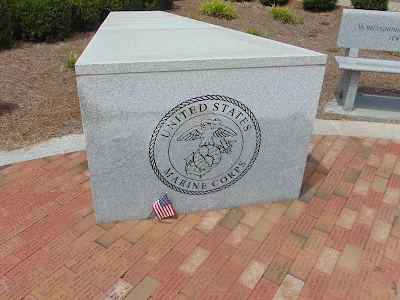
The park’s centerpiece is an 8-foot tall pedestal topped by a World War I soldier. The pedestal is engraved with the names of fallen Fort Mill servicemen and women. Five granite walls in the shape of a five-point star represent the five branches of the uniformed services. In addition there are eight flag poles which fly the flags of the United States of America, the State of South Carolina, the five branches of the U.S. Armed Forces, and the POW-MIA Flag.

The American Legion Post 43 and the Veterans Of Foreign Wars Post 9138 of Fort Mill contributed to the creation of this park and monument in everlasting memory of these men.


World War One Soldiers Monument in downtown
Fort Mill, SC, USA.

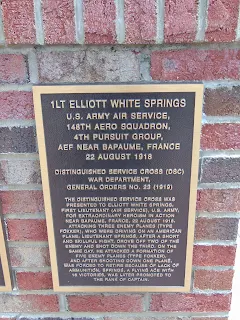
The monument lists the names of three major local World War I
heroes. Among them a World War I fighter ace and Distinguished
Service Cross
winner and two
posthumous Medal of Honor winners.

The names of World War One veterans engraved on red bricks
at the base of the monument. Around these are the logos of the
five U.S. Armed Services branches.


Many of the men and boys represented by this monument are buried in Fort Mill's Unity Cemetery among other local veterans of America's wars, while others are buried in plots with other foreign servicemen in France and Belgium where they fell in battle.

A small plot in the cemetery with a beautiful stone monument marks the graves of six local men buried there -- including one posthumous Medal of Honor winner, Sergeant Thomas Lee Hall (1893-1918), who'd previously served in the Mexican Border Campaign of 1916. All of them were members of Company G, 118th Infantry, 30th Division of the U.S. Expeditionary Forces killed during the Meuse-Argonne Offensive (September 26 - November 11, 1918) a major part of the Hundred Days Offensive (August 8 - November 11, 1918) -- the final major Allied offensive of the War on the Western Front in Belgium and France that broke the Hindenburg Line.


A small plot and monument at Fort Mill's Unity Cemetery marks the graves of six local World War I
soldiers buried there.


The grave of Elliott White Springs, who served as a flying ace in World War I.
He buried with his wife, Frances, and son, Leroy.


Probably the most well known person to serve in the war from Fort Mill was Mr. Elliott White Springs (1896-1959) who served as a World War I fighter pilot between 1917-1918. Springs was the grandson of local Civil War veteran, Captain Samuel Elliott White (1837-1911) the founder of downtown Fort Mill's Confederate Park.

At the rank of 1st Lieutenant, Springs became the 5th ranked US Fighter Ace of the war credited with shooting down 16 enemy aircraft and becoming a Squadron Commander and a captain at the age of 22. He was awarded the U.K. Distinguished Flying Cross and the U.S. Distinguished Service Cross.

Springs survived the war and would later return to military service as in World War II in the US Army Air Corps and retire as a lieutenant colonel.


Elliott White Springs photographed smiling in front of his crashed
Sopwith Camel fighter plane at the Remaisnil Aerodrome
(France) of the 148th Aero Squadron on Monday, September 16, 1918.
(Courtesy of The Springs-Close Family Archives, Fort Mill, SC.)

Included among those men and boys of Fort Mill who served in the war, 25 of these were African-Americans.

Nearly 200,000 black Americans served in World War I, mostly in service positions -- largely due to the prejudices at the time in the country that African-Americans were better suited to manual labor than combat roles. Most of these men were part of the American Expeditionary Forces Service of Supply (SOS) which transported supplies, dug trenches, cleaned latrines and debris, and buried corpses. Thought not an unimportant job by any means, it was likely far less "glamorous" than combat.

Other black U.S. servicemen, including eight individuals from Fort Mill, became members of the 92nd and 93rd U.S. Infantry Divisions, both segregated infantry divisions with white officers who were both "loaned" the the French army and fought in the trenches on the Western Front wearing French helmets and issues French military rifles. Despite this, both divisions fought extremely well and won a number of awards for bravery in the final year of the war in 1918.

Probably the most notable black Doughboy from Fort Mill was Private Ishmong Edwards, who fought with the 369th U.S. Infantry Regiment, nicknamed the "Harlem Hellfighters."

The 369th served an impressive 191 consecutive days in the trenches --
more than any other American unit. They also suffered the most losses of any American regiment with about 1,500 casualties. This regiment was also the first of the Allied forces to reach the Rhine River following the Armistice of Monday, November 11, 1918. The French government awarded the Croix de Guerre to 170 individual members of the 369th (the first Americans to receive that award), and a unit citation was awarded to the entire regiment. One Medal of Honor and numerous Distinguished Service Crosses were awarded to members of the regiment.

African-American U.S. soldiers of the 369th Infantry Regiment "Harlem Hellfighters" in France in 1918.
Note the French
Adrian Helmets these men are wearing.
(Photograph courtesy of the US Department of Archives)


If y'all are ever in Fort Mill, South Carolina, be sure to stop by Veterans Park and Unity Cemetery and pay your respects to these men. Neither the services of all these men honored here, nor the memories of who they were as individuals, should ever be forgotten.