|
Confederate Memorial Park in downtown Fort Mill, SC.
Note the railroad tracks in the foreground. |
Confederate Park in downtown Fort Mill, South Carolina is perhaps one of the most unique in all of the United States for containing four monuments to supporters of the Southern Confederacy during the War Between The States (1861-1865). The park also includes a nearly 120 year old band stand and two large Civil War naval cannons.
The name of the town originates from a fort that was
meant to be built by the British military to protect
the local Catawba Indian tribe from Shawnee and Cherokee attacks, though never completed; and
after Webb's Grist Mill -- named for a local Anglo settler. Officially
incorporated into a township in 1873,
it is the only town in the United States named Fort Mill.
The small hamlet of Fort Mill was the site of the organization of one of the
first companies raised to defend South independence in 1861. Captain John M. White
commanded the York Volunteers, also called the York
Guard, which became Company H, 6th South Carolina Volunteer Infantry Regiment. After the
reorganization of the Army of Northern Virginia in 1862, it became Company B, 6th SC
Regiment. White ultimately rose to the rank of lieutenant colonel of the 6th Regiment.
The park was established a few decades after the end of the war in 1891 on property donated by local landowner, Captain Samuel Elliott White, Colonel John White's brother.
 |
Captain Samuel Elliott White (1837-1911)
standing in front of the Confederate Soldiers'
Monument in his United Confederate Veterans (UCV)
uniform not long after the monument was
dedicated in 1891.
Photo courtesy of the Fort Mill Historical Society. |
A former captain of Company
B, 7th North Carolina Regiment, Samuel E. White organized South Carolina's first branch
of the Jefferson Davis Memorial Association in Fort Mill in 1889 and became its first president. Its membership
comprised the men and women who had known the hardships of the war. This group subsequently divided into the Ladies' Memorial
Association, the Fort Mill Camp of the United Daughters of the
Confederacy (UDC), the sons and daughters
of the United Confederate Veterans (UCV), and the Daughters of the American
Revolution (DAR).
He
conceived the idea of a Confederate park, "a semi-sacred spot" for many
Fort Mill citizens to remember the sacrifices of the Southern people during the war.
White, who was one of the largest property owners in the area, provided the land
for the park and led the efforts to erect the four monuments located there between 1891 to 1900. On the park's completion, White
donated it not to the municipal government but to the people of Fort
Mill.
Although
he was financially capable of purchasing them himself, White felt that
if the people of Fort Mill, especially the Confederate veterans themselves, had a
part in the purchase of the monuments, it would result in stronger
interest and a deeper feeling of pride. The people of Fort Mill -- many of them former Confederate Veterans and some former African-American slaves -- subscribed to the fund for the monument honoring the
Confederate soldiers, the monuments to the women, and the monument to
the faithful slaves. White himself purchased the fourth monument to the Catawba
Indians. White and his associates designed the monuments and ordered them cut to
exact specifications.
The park was built next to the local railroad station and also originally served as a place for visiting travelers to relax. Today Confederate Park still serves as a gathering place for local annual events.
 |
Historical marker at Confederate Park erected by the Fort Mill
Historical Society. |
The first monument built on the site was the Confederate Soldiers' Monument, which was unveiled on Tuesday, December 22, 1891.
 |
| The Confederate Soldiers' Monument. |
The pure marble statue of the Confederate soldier
rests on a marble pedestal surmounting a foundation of granite
elevations, standing sixteen feet tall. The figure on top stands resting on his rifle facing to the South. White unveiled this monument,
intending to honor the Confederate soldiers, both living and dead,
whose names are engraved on the monument.
The inscriptions on the monument are as follows:
[South Side]:
1860
Dum Spiro Spero
(Translation: While I breathe, I hope)
(The State Seal of South Carolina)
Spes Animis Opibuscue Parati
(Translation: Prepared In Mind And Resources)
1891
Defenders of
State Sovereignty.
1865
Image of the 2nd Confederate National Flag flying
at night against stars and a crescent moon.
The warrior's banner takes its flight
to greet the warrior's soul.
The east and west sides of the monument list the names of many of Fort Mill's 170 Confederate Veterans, most of whom served in the 6th South Carolina Volunteer Infantry Regiment.
 |
Confederate soldier standing on top
of the monument with musket at
parade rest. |
The second monument build on the site was the Women of the South Monument which was dedicated on Tuesday, May 21, 1895.
 |
| The Women of the Confederacy Monument. |
This monument was actually one of the first erected in the South in memory
of the women of the Confederacy, in particular to the women of Fort Mill who worked to support the home front while their men and boys fought to defend Southern independence.
The following is an interesting excerpt from the local newspaper at the time which demonstrates one of the efforts made on the part of the women of Fort Mill, South Carolina for their husbands, sons, fathers, and brothers fighting in the war:
Yorkville Enquirer, Thursday, November 7, 1861
Fort Mill Ladies’ Aid Association
The letter to the YE noted papers had given notice of “the patriotic
munificence of the ladies in behalf of our suffering and needy soldiers”
while Fort Mill Ladies had been working to the same end. But they were “cut off by the
Catawba river, and thereby somewhat isolated from our sisters of York
and elsewhere,” but they had “a deep interest in the common weal.” They
were busy working to the common weal, not to praise themselves. “We
would fain hope that our vanity, if we have any in this little work,
will be readily pardoned.”
The Fort Mill Association met in the Fort Mill Academy and were assisted by “an auxiliary society, composed of a few
ladies of lower Steel Creek,” had the following results of their work.
They sent “a large box of woolen shirts, drawers and socks, with a
variety of other articles” to the 6th Regiment, SC
Volunteers. Mr. A. Huffman was in charge of delivery of this box and it
was received safely. In past two weeks this Association made “an entire
suit of uniform” for Captain White’s company of the 6th SCVIR
and were about to send “a goodly sized box of hospital stores.”
Gentlemen of the neighborhood packed and delivered boxes to the depot.
Officers were: Mrs. T. D. Spratt, President; Mrs. Dr. Stewart, Vice
President; Mrs. A. B. Springs, Secretary and Mrs. T. B. Withers,
Treasurer.
The Board of Managers consisted of Mrs. Benjamin Massey, Mrs. John Stewart, Mrs. J. H. Faulkner and Mrs. George Truesdel.
The Committee to Receive Donations consisted of Mrs. Dr. Wilson, Mrs,
Dr. Cobb, Miss Lizzie Watson, Miss Rebecca Faulkner and Mrs. B. J.
Patterson.
The monument itself sits on four pedestals of masonry and two steps of marble, a
total of seventeen feet in height. It is a highly polished shaft
wrought from the finest grained clouded marble. The female figure on top is shown kneeling in supplication with the flag dropped around her knees with her hands clasped in prayer and eyes turned towards Heaven, was
carved in Italy of white marble.
The inscriptions on the monument are as follows:
[South Side]:
1860
Affectionately
dedicated by
the Jefferson Davis
Memorial Association
to the women of
the Confederacy.
The living and the dead,
who midst the gloom of war
were heroines in the strife,
to perpetuate their noble
sacrifices on the altar of
our common country. Let
sweet incense forever
rise, till it reach them,
in robes of victory
beyond the skies.
1865
[East Side]:
Mesdames
White - Johnston
Spratt - Epps
Springs - Culp
Harris - Graham
Merritt - Coltharp
Kimbrell - Bailes
Armstrong - Garrison
Burns - Stewart
Jones - Massey
and many others.
[North Side]:
1895
Respectfully
donated by
Samuel E. White
to the Jefferson Davis
Memorial Association.
[West Side]:
"Many are the hearts that
are weary to-night
wishing for the war to
cease.
Many are the hearts praying
for the right
to see the dawn of peace."
 |
Southern woman on top of the
monument kneeling in prayer. |
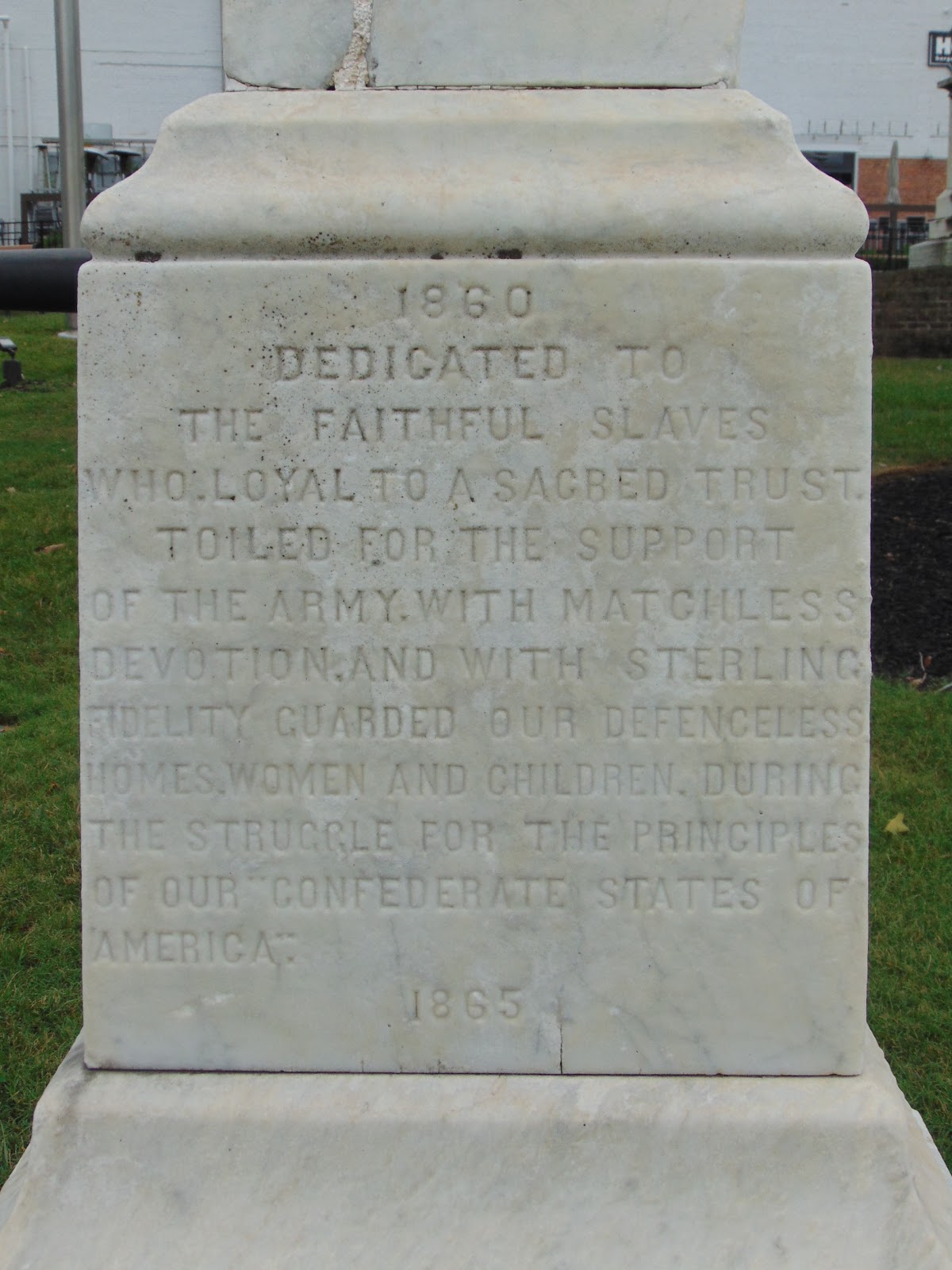
The third monument erected on the site is often referred to as the Faithful Slaves Monument which was dedicated on Friday, May 24, 1895, three days after the unveiling of the Women of the South Monument.
 |
| The Faithful Slaves Monument. |
 |
Mr. Solomon Spratt (1839-1894)
was a formerslave on the plantation of
Thomas Dryden Spratt.
During the War Between the States
he led a group of slaves in an endeavor
to care for the women and children left
behind when the men went to the front
lines keeping families fed and
farms running.
Photo courtesy of the Fort Mill History Museum. |
During the war while most of the local able bodied men were away fighting, the local women, children and elderly faced difficulty keeping their farms running. Food was scarce as were other necessities.
A local slave named Solomon Spratt took it upon himself to organize other African-American slaves in the area to help tend the farms, harvest and distribute food supplies, and provide work when and where it was necessary. Their actions kept the local population from starvation and ruin. The surviving Confederate veterans from the area returned home to find their families provided for and (unlike much of the rest of the now devastated Southland) their farms and homes virtually untouched by the hard hand of war, all by the actions of Spratt and the other local slaves.
This monument is largely dedicated to the memories of those slaves and what they did and the names of at least ten of these men are listed on the monument, including Solomon Spratt. It is considered somewhat unique as it specifically commemorates a group of African-Americans loyal to the South -- if not specifically to the Confederate cause.
The thirteen-foot
pure white marble obelisk monument is supported by four
steps of
masonry.
The inscriptions on the monument are as follows:
[West Side]:
1860
Dedicated to
the faithful slaves
who, loyal to a sacred trust,
toiled for the support
of the army with matchless
devotion and sterling
fidelity [and] guarded our defenseless
homes, women and children during
the struggle for the principles
of our "Confederate States of
America."
1865
[East Side]:
1895
Erected by Sam'l E. White
in grateful memory of earlier
days. With approval of the
Jefferson Davis
Memorial Association.
Among the many faithful:
Nelson White - Anthony White
Sandy White - Jim White
Warren White - Henry White
Silas White - Nathan Springs
Handy White - Solomon Spratt
[South Side]:
Engraving of an African-American field worker resting on a log under a tree with a sickle in his hand.
[North Side]:
Engraving of an African-American woman holding a child and sitting on porch steps.
The Catawba Indians Confederate Monument was unveiled on Saturday, August 4, 1900.
 |
| The Catawba Indians Monument. |
The town of Fort Mill,
originally called Little York, takes its name from a colonial-era fort
built by the British. Fort Mill began as a gift from Native Americans in the 1700s to whites
that were passing through the area. Thomas Spratt was the first European to settle
here around 1750.
Before the Revolutionary War, Mr.
and Mrs. Thomas Spratt spent a night among the friendly Catawba Nation,
were invited to live there, and given a large tract of land. The local Catawbas nicknamed Thomas Spratt "Old Kanahwa". Many of the Catawbas served with Spratt and other local Patriots during the Southern Campaign of the American Revolutionary War.
The Catawba Indian Monument commemorates the bravery of the Catawba
Indians who served in the Confederate army and lists the names of
seventeen of them.
Originally, the
monument held the statue of a Catawba brave holding a bow and arrow as
if stalking game. Over half a century ago, a storm blew down a large oak
branch, which served both of the brave's arms and the bow and arrow.
The damage was never repaired.
John McKee Spratt, who was preparing to join
the Confederate army at age sixteen when the Confederacy collapsed,
helped White with the
purchase. Spratt, the great grandson of "Old Kanahwa," had interests in
farming, lumber, fertilizer, and the cotton mill in Fort Mill after the
war.
The inscriptions on the monument are as follows:
[South Side]:
1600
Erected to the
Catawba Indians
by
Sam'l Elliott White
and
John McKee Spratt
The latter is a descendant of Thos.
Kanawha Spratt and the former a descendant
of Wm. Elliott a descendant of Kanawahs
two of the first settlers in this portion of
the Indian Land, 1755-60.
1900
Engraving of a forest.
CATAWBA
Some noted Catawbas, King Hagler - Gen. New-River - Gen. Ayers
Gen. Jim Kegg - Col. David Harris - Major John Joe Cap - Billy George
Lieut. Phillip Kegg - Sallie New-River - Pollie Ayers - Peter Harris
The latter being made an orphan by the small-pox scourge was raised by "Kanahwa".
He received a pension for services in the Revolution of 1776 at 70 years of age. He died at the Spratt homestead and at his own request was buried in the family grave yard.
[East Side]:
Engraved image of a Bison.
Some of the Catawbas who served in the Confederate Army
Jeff Ayers - John Scott - Alex Timins - Bill Sanders - John Harris - Wm
Canty - Billy George - Gilbert George - Jim Harris - Robt. Marsh - Bob
Crawford - Nelson George - Peter Harris Jr. - John Brown - John Sanders -
Epp Harris - Bob Head
[North Side]:
The Catawba Indians, although a war
like nation, were ever friends of the white
settlers. They aided and fought with the
Americans in the Revolution and the Confederates
in the Civil War.
Tradition says they immigrated to this
portion of South Carolina from Canada
about 1600, numbering some 12,000.
Wars with the Cherokees, Shawnees, and
other nations, together with the small-pox
depleted their numbers greatly.
In 1764, the province of South Carolina allotted
them 15 miles square in
York and Lancaster
Districts. About 1840 a new treaty was made,
the State buying all their land, and afterwards
laying them off 700 acres on
the west bank
of the Eswa Tavora (Catawba River) 6 miles
south of Fort
Mill. Where the remnant,
about 75, now live receiving a small annuit
from the state.


 |
Chief Samuel Taylor Blue (1871-1959) examines the
Catawba Indian Monument at Confederate Park in the 1950s
not long after the storm damage to the monument.
Mr. Blue was chief of the Catawba tribe from 1928-1939 and
again in the late 1950s. He was active in tribal affairs and
advocacy, and was also known to be the last speaker
of the Catawba language. He is buried at the Church of Jesus
Christ of Latter-day Saints Cemetery in York County, SC.
Photo courtesy of the Fort Mill Historical Society. |
 |
| The old bandstand in the background was built in 1900. |
The bandstand at Confederate Park has a rather amusing history.
It was built in 1900 with municipal funds
left over at the end of the mayoral administration of W.B. Meachem. Town regulations required any surplus funds to be spent before a new
administration took office and Mayor Meachem used his $50 surplus to
fund the building of the bandstand to solve a longstanding problem.
Town
Hall at the time was right across the alley in a building that sat
where the lawn and deck area for nearby Hobo’s restaurant is now located.
Along the side of Town Hall was a long covered porch where local men
used to sit and whittle to pass the time.
Unfortunately, many of the men
were avid tobacco chewers, necessitating the need for regular spitting.
The combination of tobacco juice and wood shavings made for quite a
mess on the mayor’s front porch. Meachem thought the $50 could be best used
to building a new structure where the men could engage in their pass
time and he could finally get the spitters off the porch.
No evidence exists that proved it worked, though the beautiful bandstand constructed at the park remains to this day, and hosts a number of annual local events every year.
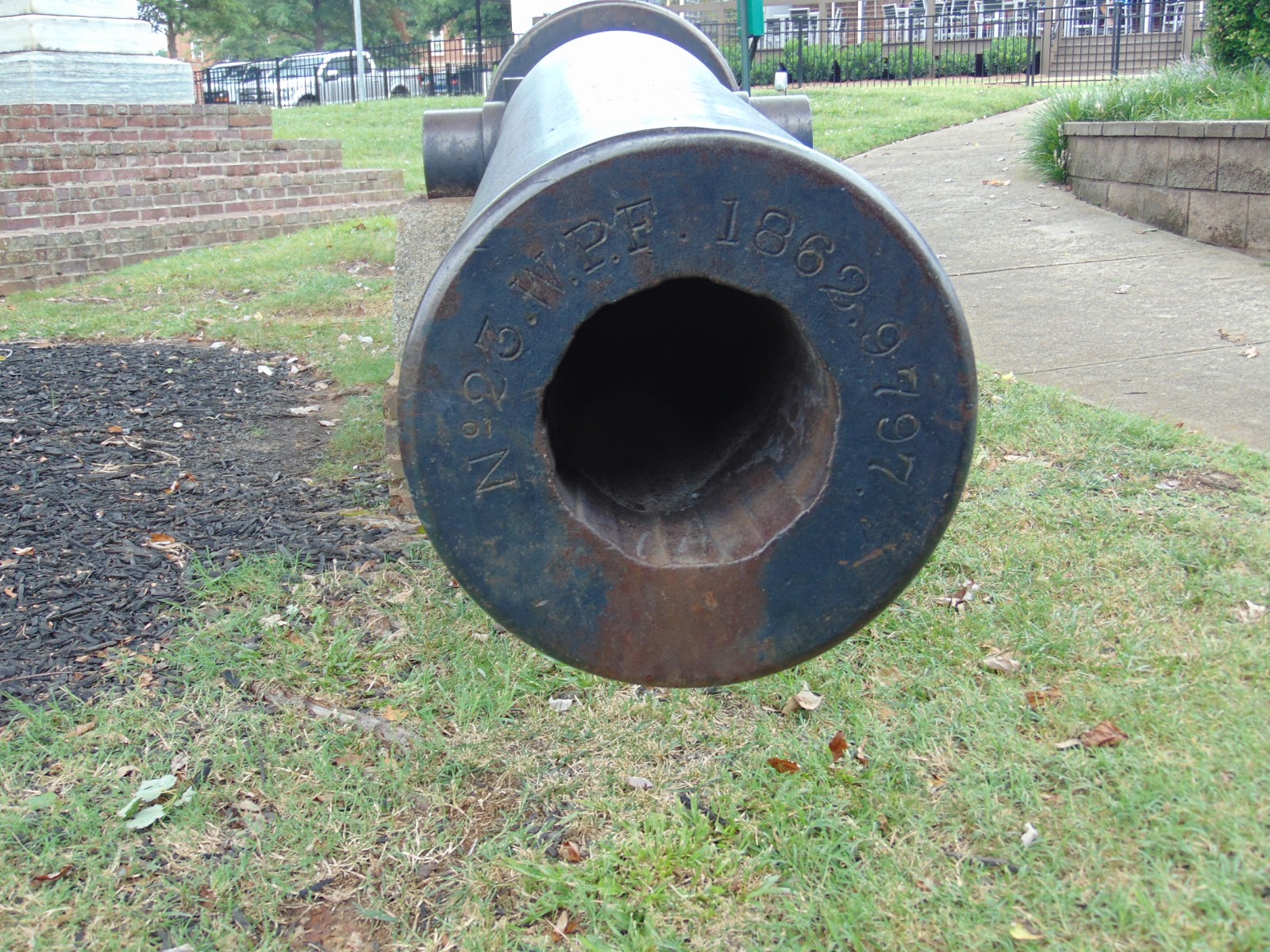
The two large 6.4 inch (100-lb) Naval Parrott Rifle Cannons in Confederate Park were added in 1901, when cannons that once guarded the South Carolina coast in the defenses around Charleston were given
away decades after the war as obsolete surplus and the town of Fort Mill requested two of them for the park.
The town of Fort Mill continues its yearly U.S. Independence Day tradition of firing the cannons on July 4th.
 |
| The two Confederate Naval Parrott Rifle Cannons. |
Well folks, I hope y'all enjoyed this article. Special thanks to the folks at the Fort Mill Historical Society and Fort Mill History Museum for their efforts in providing information for this article.
Have a wonderful Dixie day, and y'all come back now, ya hear!