Showing posts with label Pollux. Show all posts

Sunday, February 01, 2026

Night Sky Photography -- 02-01-2026 -- The Full Snow Moon After The Snowstorm

Good evening fellow stargazers!

Tonight, I captured some outstanding photos of February's full moon in the evening sky, along with a beautiful show of Jupiter and the bright star, Sirius, rising in the eastern sky between the recently snow-covered trees.

The February full moon is known as the Full Snow Moon here in North America -- a beautiful irony since it's a day following the bomb cyclone that hit the Carolinas; ushering in more snowfall that we usually see in these parts, even in the winter!

The first shot shows Jupiter, the largest planet in our solar system, with the bright twin stars, Castor and Pollux, close by. A close-up of Jupiter shows three of its four largest moons: Callisto, Ganymede, and Io. Europa, the fourth moon, was currently behind Jupiter in its rotation. Sirius, the Dog Star, is nearby further to the southeast clearly visible through the bare trees (a few of which still have snow on them).

The Full Snow Moon is hidden behind the trees for another hour before finally appearing in all her glory. The final shot is the close-up of our lovely full Luna.


A fun fact: because the month of February only has 28 days and the full moon on average only happens once every 29-30 days, there are years where there is no full moon in February! This only happens about once every 19 years, give or take. The last time that happened was in 2018. The next time February won’t have a full moon will be in 2037.

Sunday, January 04, 2026

Night Sky Photography -- 01-01-2026 -- The Full Wolf Moon & Jupiter


Good evening fellow stargazers!

The first Full Moon of the year 2026 -- the Full Wolf Moon here in North America -- is also the first supermoon of the year. Our beautiful Luna was at her perigee (the Moon's closest point to Earth in its orbit)  at 225,130 miles (362,312 kilometers) away, making it appear significantly larger and brighter than usual.

In the evening sky it rose in the east along with Jupiter, the largest planet in our Solar System. Jupiter is also really close to Earth in its orbit around the Sun. The large planet will reach its closest point for the year on Friday, January 9th, when it reaches opposition (when Earth passes between Jupiter and the Sun) will be about 393 million miles (633 million km) away, making it exceptionally bright and visible pretty much all month long. 

Jupiter is very close in the night sky to the twin stars Pollux and Castor in the Constellation Gemini the Twins and will continue to be throughout the month of January.

The following are the photos I took on the evening of January 3rd of the meeting between all of these heavenly bodies....including capturing three of Jupiter's moons: Europa, Callisto, and Ganymede just visible in the photographs. These include closeups of the Full Wolf Supermoon, and a lovely shot through the trees with my U.S. Flag in the foreground.


Thursday, October 16, 2025

Night Sky Photography -- 10-16-2025 -- Jupiter With The Twins

Late this evening I captured this great shot of the giant planet Jupiter rising in the eastern sky with the largest stars of the Constellation Gemini stars Castor and Pollux, with all the major stars of the nearby Constellations Orion The Hunter and Taurus The Bull nearby. The planet Jupiter, the fifth planet of our Solar System, will remain close to the bright star Pollux for the remaining months of 2025 so you won't have trouble locating it.

A very important fact for all you amateur stargazers. In the early morning hours of Tuesday, October 21st, the Orionids Meteor Shower will be at its peak and anywhere between 10 to 30 meteors can be spotted an hour. You can best spot them in the space between the Constellation Orion near Betelgeuse and the Constellation Gemini.


Monday, September 01, 2025

Night Sky Photography -- 09-01-2025 -- Venus and Jupiter In The Early Morning Sky

Hello fellow stargazers!

Early this Labor Day morning at about forty-five minutes before sunrise, I captured a couple of really good shots of the planets Venus and Jupiter just ahead of the rising sun in the eastern sky.

Venus can be seen through the trees shining brightly with Jupiter overhead above. Nearby are a couple of the brighter stars still visible: Procyon in the Constellation Canis Minor (the Lesser Dog) and Pollux in the Constellation Gemini The Twins.


A close-up shot of Jupiter shows all four of the giant gas planet's largest moons: Io, Europa, Ganymede, and Callisto -- all in a nearly straight line. At present Jupiter sits inside the Constellation Gemini near the star Wasat (Delta Geminorum).


Well, that's all I have for now, but I will have more planetary and night sky photography coming later this month. Until then have a wonderful Dixie day and a happy Labor Day, y'all!

Tuesday, February 11, 2025

Night Sky Photography -- 02-10-2025 -- Mars & Jupiter Seen Through The Clouds

Good evening, fellow stargazers!

Well my friends, due to cloudy and rainy conditions forecasted for this week I am uncertain if I will be able to capture any photos of the second Full Moon of the year (the Full Snow Moon) -- which falls on Wednesday, February 12th -- which will be lined up with the Constellation Leo The Lion and its brightest star Regulus closest to Luna.

Still, I went outside early last evening and could barely see the Waxing Gibbous Moon's silhouette and Luna's glorious shine through the breaks in the clouds. The early buds on the tree limbs overhead show that (six more weeks of winter, or not) spring was ready to arrive here in the South Carolina Piedmont. I did however notice that those clouds were moving fast and between them I got glimpses of the planets Mars and Jupiter near the Moon. 

I quickly retrieved my camera and set up my tripod and captured two absolutely gorgeous shots of both "wandering stars" through the clouds.

The first photo shows the two planets glowing brightly with Luna's glow through the tree and clouds nearby -- Mars its small dull orange-red and Jupiter a bright white. In the second photo I captured some of the brightest nearby stars through the cloud cover overhead: the twins Castor and Pollux near Mars, large red Aldebaran near Jupiter, along with Capella, Elnath, and Procyon nearby.


I hope y'all enjoyed my photographic offerings for the evening. I hope to have some more night sky photos soon. I will still hope for clear skies to capture the moment, but if I'm unable be sure to check the skies where y'all live and look for Regulus next to the Full Snow Moon on Wednesday.

Tuesday, February 20, 2024

Night Sky Photography -- 02-20-2024 -- The Moon, The Twins, & Major Winter Stars

Good evening, fellow stargazers!

On the evening of Tuesday, February 20th, I captured this really clear shot of our lovely Moon near the twin stars: Castor and Pollux -- the two main stars of the Constellation Gemini The Twins -- along with the other nearby winter stars and their constellations.

The first is the original photo taken showing Luna along with the stars and their positions in the sky dome. The second is the same photo with the star constellations of Orion The Hunter, Canis Minor "The Lesser Dog", and Taurus The Bull in relation to the bright Gemini Twins -- the stars for their constellation are unfortunately not visible due to the brightness of the Waxing Gibbous Moon phase.

The Winter Triangle stars of Procyon and Betelgeuse are all clearly visible and mark the positions of Orion and Canis Minor. Sirius, the brightest star of the Constellation Canis Major "The Greater Dog" is at the very bottom making up the final point of the Winter Triangle. Unfortunately I could not get the entire constellation itself into frame.


Luna sits right beside the giant star Pollux, the brightest star of the Constellation Gemini and the 18th brightest star in our night sky. Pollux sits about 34 light-years (or 10.4 parsecs) distance from our Sun and its the closest giant star relative to our Solar System.
Pollux is almost nine times the diameter of our sun and about 30 times the sun’s brightness in visible light.

Its "twin" Castor, the second-brightest star in Gemini, is a bit more tricky since its not one, but six stars that appear as one to the naked eye. The Castor system is organized into three binary pairs made up of two bright white A-Type stars with four smaller M-Type red dwarf stars that orbit each other. Castor sits about 51 light-years (or 15.6 parsecs) from the Sun.


Castor Aa, the main star of the system, is more than twice the
size of our own Sun.
Image via NASA/ JPL-Caltech/ Wikimedia Commons (public domain).

Friday, June 02, 2023

Night Sky Photography -- 05/31/23 -- 06/01/23 -- Mars Buzzing The Beehive In Constellation Cancer The Crab & Venus Alligns With The Gemini Twins


Good evening fellow Stargazers!

Well, now we're getting into the summer months down here in my little corner of Dixie. That means much later evenings, fireflies, noisy Cicadas, and of course some interesting early summer night sky planetary photography for the month of June.

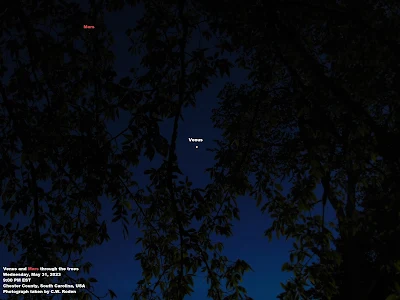
As the final day of May gave way to June, I was able to capture a some really outstanding photos of the both the planets Venus and Mars in the evening sky after sunset. 

As I mentioned in a previous post, our two nearest planetary neighbors are both traveling higher into the sky dome away from the setting late spring sun on their way to an early July conjunction as they both approach the bright star, Regulus, in the Constellation Leo The Lion. The faster orbit of Venus and the slower orbit of Mars will bring both "wandering stars" into a conjunction in the evening sky on the evening of Sunday, July 2nd of this year.

Over the course of three blessedly clear evening skies, I was able to capture some really cool evening photos of the two planets in the western sky about 45 minutes after sunset; as well as get a few outstanding shots of Mars traveling through the faint Constellation Cancer The Crab and the distant Beehive Star Custer (M44).

The Beehive Star Cluster is a faint open cluster of hundreds of stars located an estimated 577 light-years (or 176.9 parsecs) from our Sun.

Here are the photos I took of the two planets on the evening of Wednesday, March 31st, with Mars centered inside Cancer The Crab located between the Beehive and the binary star Tegmine (Zeta Cancri) -- also known as the "shell of the crab". You can also see Venus -- currently the brightest of the heavenly bodies in the western sky until the Moon appears later in the month -- lining up with the two "twin stars" Pollux and Castor of the Constellation Gemini The Twins.

In one of these shots, I was able to capture all of the major stars of the faint zodiac constellation -- this blogger's birth sign (fun fact) -- along with the approximate location of the Beehive Star Cluster, which isn't visible except in close-ups with higher exposure, which I captured much better in the close-up shots of Mars and the Beehive.


The next two shots I took over the course of the two nights of Thursday, June 1st and Friday, June 2nd when Mars began to move through the Beehive Star Cluster, the Red Planet surrounded by the small, faint points of light. By late Saturday, June 3rd, Mars will be above the Beehive; though it'll still be in the area of the Constellation Cancer a short while longer as it travels higher in the evening towards Regulus.


On Thursday, June 1st, Venus moved into a nearly perfect straight alignment with the Gemini Twins. Venus will also be moving higher towards the Constellation Cancer and will also buzz by the Beehive later this month on Monday, June 12th and Tuesday, June 13th as it races to catch up with Mars.


I hope y'all enjoyed my presentation and my photos. It was again my pleasure to share them with y'all. Hopefully we will be blessed with good clear skies this June down here in my little corner of Dixie so I can share more interesting night sky photography as we move closer to the summer equinox and the official start of the new season.

Until next time, keep your eyes to the night skies and y'all come back now, ya hear!

Saturday, May 27, 2023

Night Sky Photography -- 05-24-2023 -- Venus & Mars After Sunset

Hello fellow amateur stargazers!

If you are blessed to have clear mid-spring skies this time of year, look towards the west about an hour after sunset and you will see our Earth's two closest planetary neighbors moving closer together in the sky at dusk as we move closer to the summer solstice.

As you can see from my photograph (taken on one of the rare cloudless evening skies this month here in South Carolina), both Venus and Mars can both be seen in and near the twin stars: Castor and Pullox -- the two brightest stars of the Constellation Gemini.


Because Venus -- the second planet in our Solar System -- is closer to the Sun, it has a much faster orbit. There are 225 of our Earth days that make up a yearly trip around the Sun for Venus. I say our Earth days because (fun fact) Venus has a very long day -- approximately 243 days for the hot planet to rotate on its axis in fact, making a day on Venus slightly longer than its actual year!

By contrast, Mars has a orbital period of 687 of our Earth day, and a day on Mars is about 24.7 of our hours here on Earth (closer to 25 hours) and takes the Red Planet about a little less than two of our Earth years to revolve around the Sun.

Venus is moving higher in the sky away from the Sun, while Mars is moving much slower but also higher in the sky.

In a little over a month, the orbits of both planets will have them meeting in the night sky in conjunction in the Constellation Leo The Lion on the evening of Saturday, July 1, 2023. The two wanderers will be about 3 degrees apart just above the point of the Summer Triangle and the bright star, Regulus.

Conjunctions between Venus and Mars usually happen once a year and both planets stay close together (at least from out point of view here on Earth) for about ten days to two weeks.
After this year, the next Venus-Mars conjunction will take place on Thursday, February 22, 2024.

Saturday, January 07, 2023

Night Sky Photography -- 01-06-2023 -- The Full Micro Wolf Moon & Gemini Twin Stars

Well good evening, fellow stargazers!

This evening clear skies afforded me the opportunity to capture some outstanding shots of the first Full Moon of 2023.

The January Full Moon is referred to as the Full Wolf Moon in North America according to the Old Farmer's Almanac.

This year the Full Wolf Moon appears slightly smaller that normal in the night sky because our lovely Luna is currently at its farthest point (apogee) from our Earth in its elliptical orbit around our planet at about 252,145 miles (or 405,789 kilometers) distance at the time of totality, making this year's Full Wolf Moon a Micromoon (
or Apogee Moon)....a Micro Wolf Moon

Because a Micromoon is further away, it looks approximately 14% smaller than a Supermoon. The February and March Full Moons will also be micromoons, although they will be slightly closer to the Earth in orbit.

The following are the photos I took of the January 2023 Full Wolf Moon, taken between 6:00 PM EST to 9:00 PM EST.


My final photo is a picture of the Full Wolf Moon near the twin stars of Pollux and Castor in the Constellation Gemini the Twins. The rest of the stars of the constellation itself are lost in the glare of the beautiful moonlight, though the two main stars themselves are still easily visible.


The brightest star in Gemini is Pollux, a red giant star that sits closest to our Sun at a distance of about 34 light-years (or 10.4 parsecs) which is about two times the mass of our Sun and nine times the estimated radius.

The second-brightest is Castor, which sits a bit farther away at about 51 light-years (or 15.6 parsecs) from the Sun.  

The Full Wolf Moon -- the first official Full Moon of the winter season in the Northern Hemisphere -- quite fittingly rests just inside the Winter Circle asterism. By tomorrow evening, Saturday the 7th of January, Luna's path will take her past the twins and just outside of the Winter Circle as she begins waning towards her New Moon Phase two weeks from now on Saturday the 17th of January.


Most years there are 12 full moons, one for each month. The year 2023 however will have 13 full moons, with two in August. The second of which is known as a Full Blue Moon, or Blue Moon....like in the classic phrase "once in a blue moon" which only happens about once every two-and-a-half years, like an astronomical leap-year of sorts.


The Blue Moon, which will occur this year on the evening of Wednesday, August 30th, will also be a Supermoon when our lovely Luna will be at her closest point to the Earth (Perigee) in orbit at a distance of
222,043 miles (or 357,344 kilometers).

The dates of the 2023 full moons.
Image courtesy of facebook.com.

Well folks, have a wonderful evening and y'all be sure to keep your eyes to the night skies, y'all hear!

Sunday, March 06, 2022

Night Sky Photography -- 03-06-2022 -- The Constellations And Major Stars Of The Winter Circle In One Shot!

Good evening fellow stargazers!

Happy March everyone! The month that sees the winter season give way to the renewal of the spring equinox on Sunday, March 20th.

In the evening and night sky dome the six main constellations that make up the Winter Circle (or Winter Hexagon) will continue to be visible in clear skies even as they continue to move west following the setting sun as winter gives way to spring in the Northern Hemisphere.

As I've mentioned in previous Night Sky Photography posts on this blog, the Winter Circle consists of seven bright stars in six separate constellations:

Pollux and Castor in the Constellation Gemini the Twins
Procyon in the the Constellation Canis Minor the Lesser Dog
Sirius in the Constellation Canis Major the Greater Dog
Rigel in the Constellation Orion the Hunter
Aldebaran in the Constellation Taurus the Bull
Capella in the Constellation Auriga the Charioteer

With the exception of the star Castor in the Constellation Gemini, the Winter Circle stars are all 1st-magnitude with Sirius (the Dog Star) being among the brightest stars in our sky. Castor is slightly fainter 2nd magnitude star, though still very bright and visible next to its companion twin, Pollux.

This evening, I was able to capture virtually all the major stars of five of the six constellations of the Winter Circle with one exception. Though I was able to capture the bright star Sirius, the Constellation Canis Major unfortunately would not completely fit in the frame from the only angle I was able to pick up all the stars of the other constellations with.

The following are the photos I was able to take, the first of the major stars in the Winter Circle (outlined in blue) and then the second photos outlining the constellations themselves in white with the Winter Triangle (outlined in red) inside the Winter Circle itself.


Oh and for those of y'all wondering, that small orb-like thing on the bottom right of the photographs is NOT a UFO! It's just the road light that blew out in my front yard recently that the folks at the power company has yet to fix. Thankfully the blown bulb allows for both some foreground scale, and for less light pollution where I didn't have to drive a few miles away to some open field for the shot, so no complaints there at all.

The Winter Circle will still remain fully visible throughout the rest of the month of March with our lovely moon passing between Aldebaran and the Pleiades Star Cluster this week on Tuesday, March 8th and Luna beginning her march through the Winter Circle phasing to First Quarter beauty on Thursday, March 10th. Y'all be sure to check that out -- God and clear skies willing that is.

Sunday, May 30, 2021

Night Sky Photography -- 05-30-2021 -- Venus, Mars & The Constellation Gemini

Good evening y'all, and Happy U.S. Memorial Day weekend!

This evening I traveled over to the local baseball field and using it as a backdrop was able to capture some really outstanding photos of the planets Venus and Mars an hour after sunset.

Venus appeared not long after sunset, being the brightest object in the evening sky. Mercury was unfortunately below the tree line, otherwise I might have been able to capture all of the inner planets this evening.

In the first photo you can see bright Venus appearing in the evening dusk.


Between about 9:00 PM EST and 9:08 PM EST I was able to capture several shots of Venus sinking below the top of the ballpark fence as it sank lower into the west following the sun.

As the evening progressed and dusk started deepening more into night time, smaller Mars and the major stars finally began to appear in the sky.

In this next shot you can faintly see Mars in the top left of the photo with Venus now just above the tree line.


Finally you can see the major stars of the Constellation Gemini The Twins with Mars close to the bright stars Castor and Pollux. The other bright stars Procyon and Capella, which together with the Twin Stars make up the top portion of the now waning Winter Hexagon asterium, can also be seen in the photo.

I've also outlined the major stars of the Constellation Gemini and Canis Minor. Venus can still be seen in this wide shot overlooking the baseball field.


Well folks, I hope y'all enjoyed my photos for the evening. This will close out the month of May for this year. Have a Happy U.S. Memorial Day 2021 tomorrow and be sure to keep your eyes to the night skies, y'all!

Sunday, May 16, 2021

Night Sky Photography -- 05-13/15-2021 -- The Moon & The Smallest Of The Inner Planets

Good evening fellow stargazers!

This weekend looking towards the west y'all can see the waxing crescent moon with all of the inner planets in the night sky -- but only if you have a clear view of the horizon.

Venus is currently situated in the sky dome on the horizon chasing the setting sun. Unless you have an unobstructed view of the horizon then seeing the bright wandering "evening star" will be difficult.

While I was unfortunately unable to get a good shot of Venus (the cloudy skies were also a factor) I was able several beautiful shots of Luna in her waxing crescent phase meeting with the two smaller planets, Mercury (May 13th) and Mars (May 15th).


These three evening planets plus our planet Earth are called the inner (inferior) planets, to distinguish them from the outer (superior) planets: Jupiter, Saturn, Uranus, Neptune -- and yes Pluto too which is still a planet no matter what some astronomers claim!

On the evening of May 15th, the waxing crescent moon joined Mars inside the Constellation Gemini The Twins. As you can see in the first photo, there are the two bright twin stars, Pollux and Castor, above Luna and Mars, with a smaller bright star just visible beneath the moon.


The yellow supergiant star Mebsuta -- also know as Epsilon Geminorum -- marks Castor's right leg. At about 840 light years distant from our solar system, Mebsuta is a G8 lb star about 8,500 times brighter than our Sun with an estimated radius of between 105-175 times that of our star.

Epsilon Geminorum’s traditional name, Mebsuta, comes from the ancient Arabic Mabsutah, which means "the outstretched paw." In Arabic culture, Epsilon and nearby Zeta Geminorum represented the paws of a lion.

Well I hope y'all enjoyed my presentation this evening. I hope to have some more night sky photography again by the end of the month when Mercury and Venus meet in close conjunction on the evening of May 28th.

Until then have a wonderful evening and be sure to keep your eyes to the night skies, y'all!

Sunday, April 25, 2021

Night Sky Photography -- 04-25-2021 -- The Whole Winter Hexagon In One Photograph!

Good evening everyone!

This evening I went out to the local baseball field -- the biggest open view of the sky close to where I live -- to try and get a photo of Mercury and Venus low in the west toward the sunset.

Unfortunately, both planets were far too low over the horizon for me to get a good shot of them. But it wasn't a total loss. I was able to finally capture the major stars of the Winter Hexagon (Circle) asterism and Mars in a single photo.


The best way to find the Winter Hexagon is to look for the Constellation Orion The Hunter -- the only constellation that is completely encircled in the asterism. Orion is quite helpful in locating half of the stars in the Winter Circle.

The bright star Rigel, one of the feet of Orion, is a starting point. Use either Rigel, or Orion's Belt, in a line to the bright star Aldebaran in the Constellation Taurus The Bull. You can also use Orion's Belt to point out Sirius, the brightest star in both the Constellation Canis Major (The Greater Dog) and the Winter Hexagon.

The star that makes up Orion's right shoulder, Betelgeuse, is one third of the second asterism, The Winter Triangle, along with Sirius and Procyon in the Constellation Canis Minor (The Lesser Dog).

Once you locate these its easy to find the rest of the bright stars in the Winter Hexagon: Pollux, Castor, and Capella.

Mars will continue to remain a part of the Winter Hexagon till at least June 12th of this year when it joins the twin stars Pollux and Castor. The Red Planet will continue to grow fainter as it moves farther away in its orbit from Earth.

Well everyone I hope y'all enjoyed my final night sky photographic offering of this month. Next month promises to have some really exciting moments for night sky observers -- including a Lunar Eclipse on the night of May 25-26th! Hopefully we will be blessed with clear skies for that here in South Carolina.

Until next time have a wonderful Dixie evening and y'all be sure to keep your eyes to the night skies, y'all hear!