Showing posts with label Aldebaran. Show all posts

Tuesday, January 20, 2026

Night Sky Photography -- 01-20-2026 -- Jupiter Inside The Winter Circle

Late last night -- or early this morning, depending on how y'all look at it -- at about 90 minutes after midnight I captured a lovely shot of Jupiter inside the Winter Circle (also known as the Winter Hexagon) in the southwestern night sky.


Finding Jupiter for stargazers in the Northern Hemisphere will be easy this year. The 5th and largest planet in our Solar System will remain inside the Winter Circle in our night sky for the rest of winter 2026 in North America as its orbit will take it further inside the circle and will remain a part of the Constellation Gemini the Twins with the bright stars Castor and Pollux nearby.

Thursday, January 01, 2026

Night Sky Photography -- 01-01-2026 -- Bright Winter Stars & First Moonrise Of The New Year!

Greetings & Happy New Year 2026 Y'all!

Like many folks across this wonderful world of ours, I stayed up to celebrate the New Year by counting down to midnight (12 a.m. Eastern Standard Time, or EST) here in my home state of South Carolina on the United States eastern coast in North America.

After watching my neighborhood turn into a fireworks war zone for about half an hour (and in truth they continued to pop off sporadically until well after 1 a.m.) my eyes turned to the beautifully clear night sky dome overhead to see the beautiful bright stars of the Hyades Star Cluster which makes up the "horns" of the Constellation Taurus The Bull, the beautiful stars of the Constellation Orion The Hunter, and the smaller Winter Triangle asterisms -- along with a beautiful Waxing Full Moon and the planet Jupiter overhead.

I captured a good shot of all these from my front yard to share with y'all.


This is the first of what I hope will be many more night sky photographs I'll be presenting to y'all this year....God and clear skies permitting, of course.

Happy New Year!

Thursday, October 16, 2025

Night Sky Photography -- 10-16-2025 -- Jupiter With The Twins

Late this evening I captured this great shot of the giant planet Jupiter rising in the eastern sky with the largest stars of the Constellation Gemini stars Castor and Pollux, with all the major stars of the nearby Constellations Orion The Hunter and Taurus The Bull nearby. The planet Jupiter, the fifth planet of our Solar System, will remain close to the bright star Pollux for the remaining months of 2025 so you won't have trouble locating it.

A very important fact for all you amateur stargazers. In the early morning hours of Tuesday, October 21st, the Orionids Meteor Shower will be at its peak and anywhere between 10 to 30 meteors can be spotted an hour. You can best spot them in the space between the Constellation Orion near Betelgeuse and the Constellation Gemini.


Sunday, October 12, 2025

Night Sky Photography -- 10-09/10-2025 -- Luna Occults The Seven Sisters In The Eastern Sky

Greetings fellow stargazers! 

On the evening of Thursday, October 9th, the waning gibbous moon occulted (passed in front of) the Pleiades Star Clusters, also known as the "Seven Sisters" cluster just before midnight. 

In my first shot I was able to capture a really good shot between the trees of the eastern sky with the brightest nearby stars of the three closest constellations: Taurus, Aquila, and Perseus. I also labeled the approximate location of the planet Uranus, which is currently close to the Pleiades as viewed from Earth, but unfortunately too far away to see with the naked eye.


My second shot is the close-up of our lovely Luna occulting the brightest stars of the miniature dipper that makes up the Pleiades. I was able to capture the remaining "Seven Sisters" well despite the bright moon glare.


My final photo was taken over an hour later in the early hours of Friday, October 10th showing Luna and all of the Pleiades very close together once the Moon moved away in its orbit going eastward.


Overall I believe all of the photos came out very well. Let me know what y'all think in the comments below, and as always have a wonderful evening.

Sunday, July 20, 2025

Night Sky Photography -- 07-20-2025 -- Luna Occultation Of The Pleiades Star Cluster


Early this morning, about an hour before sunrise here in South Carolina, I set up my camera and tripod and captured these outstanding shots of the Waning Crescent Moon with Venus rising in the eastern sky just 45 minutes ahead of the Sun.

The first photo is a really beautiful shot of Luna overhead with bright, beautiful Venus between the branches of the trees. Venus is currently inside the Constellation Taurus The Bull.

The planet Uranus is also currently close to Luna in the moon's orbit as seen from here on the Earth. Uranus is too far away to be visible in the shot -- about 1.86 billion miles (or 3 billion kilometers, or 19 astronomical units (AU) away -- but I labeled the current location of the 7th planet of our Solar System where it could be seen with a good telescope.


When I downloaded the photos to edit and label them, I noticed that I'd also captured the bright star Aldebaran -- the Eye of the Bull -- clearly visible through the leaves of the trees. In my second photo I captured a close-up of Venus and saw that Aldebaran was visible in that one as well.


The main event, the reason that I was up so early, was to capture the moon as it passed in front of the Pleiades Star Cluster (or "Seven Sisters") in its orbit around the Earth. I perfectly captured the moment when Luna was almost dead center in its occulation with the Seven Sisters catching all of the major stars of the cluster, except for Maia which is hidden by the moon. 


Finally, this morning at around 10 a.m. EDT Luna reached perigee -- the moon's closest point to Earth in its elliptical orbit -- at approximately 228,690 miles (or 368,041 km) away.

Tomorrow at about the same time, Luna will move lower towards the east and the sunrise between Venus and Aldebaran in the morning sky. If clear skies permit I will try and capture a good photo of that celestial event as well. Till then keep your eyes to the skies, y'all!

Tuesday, February 11, 2025

Night Sky Photography -- 02-10-2025 -- Mars & Jupiter Seen Through The Clouds

Good evening, fellow stargazers!

Well my friends, due to cloudy and rainy conditions forecasted for this week I am uncertain if I will be able to capture any photos of the second Full Moon of the year (the Full Snow Moon) -- which falls on Wednesday, February 12th -- which will be lined up with the Constellation Leo The Lion and its brightest star Regulus closest to Luna.

Still, I went outside early last evening and could barely see the Waxing Gibbous Moon's silhouette and Luna's glorious shine through the breaks in the clouds. The early buds on the tree limbs overhead show that (six more weeks of winter, or not) spring was ready to arrive here in the South Carolina Piedmont. I did however notice that those clouds were moving fast and between them I got glimpses of the planets Mars and Jupiter near the Moon. 

I quickly retrieved my camera and set up my tripod and captured two absolutely gorgeous shots of both "wandering stars" through the clouds.

The first photo shows the two planets glowing brightly with Luna's glow through the tree and clouds nearby -- Mars its small dull orange-red and Jupiter a bright white. In the second photo I captured some of the brightest nearby stars through the cloud cover overhead: the twins Castor and Pollux near Mars, large red Aldebaran near Jupiter, along with Capella, Elnath, and Procyon nearby.


I hope y'all enjoyed my photographic offerings for the evening. I hope to have some more night sky photos soon. I will still hope for clear skies to capture the moment, but if I'm unable be sure to check the skies where y'all live and look for Regulus next to the Full Snow Moon on Wednesday.

Saturday, November 16, 2024

Night Sky Photography -- 11-15-2024 -- The Super Full Beaver Moon & The Pleiades


Good evening, fellow Stargazers!


In the Northern Hemisphere the full moon is called the Beaver Moon and its the last full moon of the autumn season before the winter solstice.

This year's Full Beaver Moon is the fourth and last supermoon of 2024 at a distance of about 225,000 miles (or 361,867 km) from the Earth.

As an extra special bonus this year, the Super Full Beaver Moon aligns with the Pleiades Star Cluster with the two appearing about just over half-a-degree apart in the evening sky as seen from the surface of the Earth. The Pleiades are actually about 444.2 light-years (or 136.2 parsecs) distance from our Solar System.

The following are the photos I took of the Super Full Beaver Moon with the nearby Pleiades Star Cluster.


The first photo being a close-up shot of the our lovely Luna with every dark "sea" and large surface feature visible.

The second is a wider unfiltered view of the full moon with the nearby Pleiades showing just outside of Luna's glare.

The final show showing the Super Full Beaver Moon and Pleiades with several nearby bright stars including the red-giant star, Aldebaran, in the Constellation Taurus and the large bright star, Capella, in the Constellation Auriga. Jupiter, the largest planet in our Solar System, can be seen rising just below between the tops of the trees.

I hope y'all enjoyed my photos and I hope to have some more soon. Till next time have a good evening and be sure to keep your eyes to the night skies, y'all hear.

Friday, October 20, 2023

Night Sky Photography -- 10-17/18-2023 -- The Winter Triangle Stars & Constellations In The Early Morning

Greetings fellow stargazers!

As we move past the middle of October here in South Carolina, the Winter Circle & Winter Triangle Stars and their constellations begin to return in the early morning sky. 

Over the course of two mornings, Tuesday the 17th and Wednesday the 18th, about 45 minutes hour before sunrise I was able to capture some great shots of the brightest stars of the Winter Triangle constellations: Orion The Hunter, Canis Major, and Canis Minor.

On Tuesday the 17th -- just about 35 minutes, or so, before sunrise -- I captured a really great early morning shot of all the major stars of the Constellation Orion, the bright beautiful star, Sirius (Canis Major), Procyon (Canis Minor), as well as the red giant star, Aldebaran (Taurus The Bull), in my photograph.


On Wednesday the 18th I was able to capture some slightly earlier shots that captured the Winter Triangle stars, and all the major stars of their constellations wonderfully. The Winter Triangle connects Orion and his two hunting dogs in the sky dome.


My final photograph is a wide shot showing the major stars of these constellations, along with those of Taurus The Bull, as well as the two major star clusters: The Hyades -- the head of the Bull -- and the Pleiades.


These stars will continue to be early morning stars in autumn for at least the next month, or so, before becoming the prominent evening and nighttime stars of the winter months here in North America once again.

Wednesday, October 04, 2023

Night Sky Photography -- 10-03-2023 -- The Moon & The Pleiades


Late last night I captured some really outstanding shots of the Waning Gibbous Moon in conjunction with the Pleiades "Seven Sisters" Star Cluster in the eastern sky. The star cluster can be seen just above and to the left of our lovely Luna just outside the glare of the moonlight.

The wider shots also include the Hyades Star Cluster located in the Constellation Taurus The Bull and the constellation's two brightest stars, Aldebaran -- the Eye of the Bull -- and Elnath.

Jupiter can be seen as the brightest object in the eastern night sky at the moment. 

Thursday, August 31, 2023

Night Sky Photography -- 08-31-2023 -- The Super Blue Moon & Orion Stars In Early Morning Hours

Good morning, fellow stargazers!

Today I had to wake up extra early -- about just over 90 minutes before sunrise in fact -- to capture my photographs of the second Full Moon and third Supermoon of August, 2023: the Blue Supermoon, or Super Blue Moon.

The reason I had to wait till the early hours to take the shots was due to extensive cloud cover from summer thunderstorms brought about as a result of the recent hurricane in the Gulf of Mexico. Thankfully those storms moved off about 5 AM Eastern Standard Time (EDT) and gave way to perfectly clear early morning skies, as you can see in my first shot.

Currently, the Super Blue Moon is 222,043 miles (or 357,344 kilometers) from the Earth, making it the closes of the four Supermoons this year -- which is why I was thankful to be able to capture some great photos of it.


The next two photos are close-up of the features of the Super Blue Moon showing all the larger craters and the dark gray "seas" on the visible Lunar surface that we see here on the Earth.

My final Full Moon photo is a wider shot of the Super Blue Moon along with the planet Saturn just above the tree lines.


Since I was up so early I turned my camera to the eastern sky where the Constellation Orion The Hunter was making his way back into the early morning sky.

In my final two photos I was able to capture all the major stars of Orion, as well as the nearby bright stars Aldebaran and Procyon.


That concludes my night sky offerings for the month of August 2023. I hope y'all enjoyed my photos as I continue to enjoy posting them for y'all.

Have a wonderful Dixie Day and y'all be sure to keep your eyes to the night skies.

Wednesday, March 29, 2023

Night Sky Photography -- 03-28-2023 -- How To Use The Constellation Orion As An Astronomical Signpost


Good Evening, fellow stargazers!

One of the coolest things about certain star constellations and asterisms that make up our evening sky dome is that they can be used to locate other nearby constellations and asterisms.

For example, in a previous post, I showed how one can use the Big Dipper to locate two of the major stars in the Spring Triangle and the Great Diamond asterisms.

This evening I took a few great photos of the major stars of the Constellation Orion the Hunter and his two dogs -- the constellations Canis Major The Greater Dog and Canis Minor The Lesser Dog.

Three of the major stars of these three separate constellations -- Betelgeuse in Orion, Procyon in Canis Minor, and Sirius in Canis Major -- form an
equilateral triangle asterism in the evening sky called the Winter Triangle.


The Constellation Orion is the key to locating not only two dogs, but also the constellations Taurus The Bull and Gemini The Twins; as well as the Pleiades Star Cluster by following a series of lines using Orion as a starting point.

When you locate the asterism "Orion's Belt" in the sky dome, picture Orion The Hunter standing upright, with the stars Betelgeuse and Bellatrix marking out Orion's left and right shoulders, and Saiph and Rigel marking out his left and right feet.


Follow the three stars of Orion’s Belt down and to the left and draw line to find the bright star Sirius --The Dog Star -- in the Constellation Canis Major The Greater Dog.


Draw a line from Betelgeuse -- Orion's left shoulder -- and keep going to find a solitary bright star, Procyon in the Constellation Canis Minor The Lesser Dog. This line also serves as one of the three triangular lines of The Winter Triangle.

Draw a line from Rigel -- Orion's right foot -- up past Betelgeuse and keep going until you reach the two bright stars Castor and Pollux in the Constellation Gemini The Twins.

Going back to Orion’s Belt, your next target lies up and to the right, following the line of the belt to the bright reddish star Aldebaran in the Constellation Taurus the Bull. If you keep on following this line past Aldebaran, a short distance later you’ll reach the Pleiades Star Cluster (also known as the "Seven Sisters").


If you remember these easy steps, then finding all the major constellations and asterisms near Orion in the evening sky is simple.

Be sure to try it out and please let me know what y'all thought of this little presentation in the comments section below. As always have a wonderful evening and be sure to keep your eyes to the night skies, y'all hear.

Tuesday, January 03, 2023

Night Sky Photography -- 01-03-2023 -- The Moon & Pleiades Star Cluster In Cloudy Western Sky

Good evening fellow stargazers!

For my first night sky photographic offerings of the 2023 year, I was able to capture some really great shots of our lovely moon along with all the major stars of the Pleiades Star Cluster "Seven Sisters" in the late night sky through the bare tree branches of my backyard through the partly cloudy sky overhead.

The first photo is truly a gorgeous shot. You can see the Pleiades to the left of Luna in the gap in the clouds just past the larger tree branch separating the two. The next two photos were taken about ten minutes later when the skies were clearer capturing the moon and the star cluster together and one showing the stars of the Seven Sisters shining brightly.


My final photo of the evening I took while there was still partial cloud cover but clearly shows both Luna and the Pleiades, along with the planet Mars and the bright red-giant star, Aldebaran.


Luna is currently passing through what is referred to as the Golden Gate of the Ecliptic asterism -- the space between the V-shaped Hyades Star Cluster and the Seven Sisters. Both star clusters are among the nearest ones to our Sun, with the nearest stars of the Hyades located about 153 light-years (or 47 parsecs) away and the Pleiades at a distance of about 444 light years (or 136 parsecs) away from the Sun.

Mars is still pretty bright in the night sky, though it will continue to dim in brightness over the next couple of months as it moves away from us in its orbit around the Sun following last month's opposition. Mars will remain near the Eye of Taurus for at least the rest of the winter months as the Red Planet begins the end of its retrograde motion in the night sky and starts turning back eastward on the late evening of  Thursday, January 12th and reentering the Constellation Taurus The Bull.

The moon is currently in its Waxing Gibbous phase headed towards the first Full Moon of 2023 on the evening of Friday, January 6th. On an interesting note, the January 2023 full moon (also known in North America as the Full Wolf Moon) is the first official full moon of winter, and will be present inside the Winter Circle asterism for the occasion right next to the twin stars: Castor and Pollux in the Constellation Gemini The Twins.

Well, I hope yall enjoyed my first night sky photos of the year 2023, more will be coming soon. Until next time have a good evening and y'all keep your eyes to the night skies, y'all hear?


Wednesday, November 30, 2022

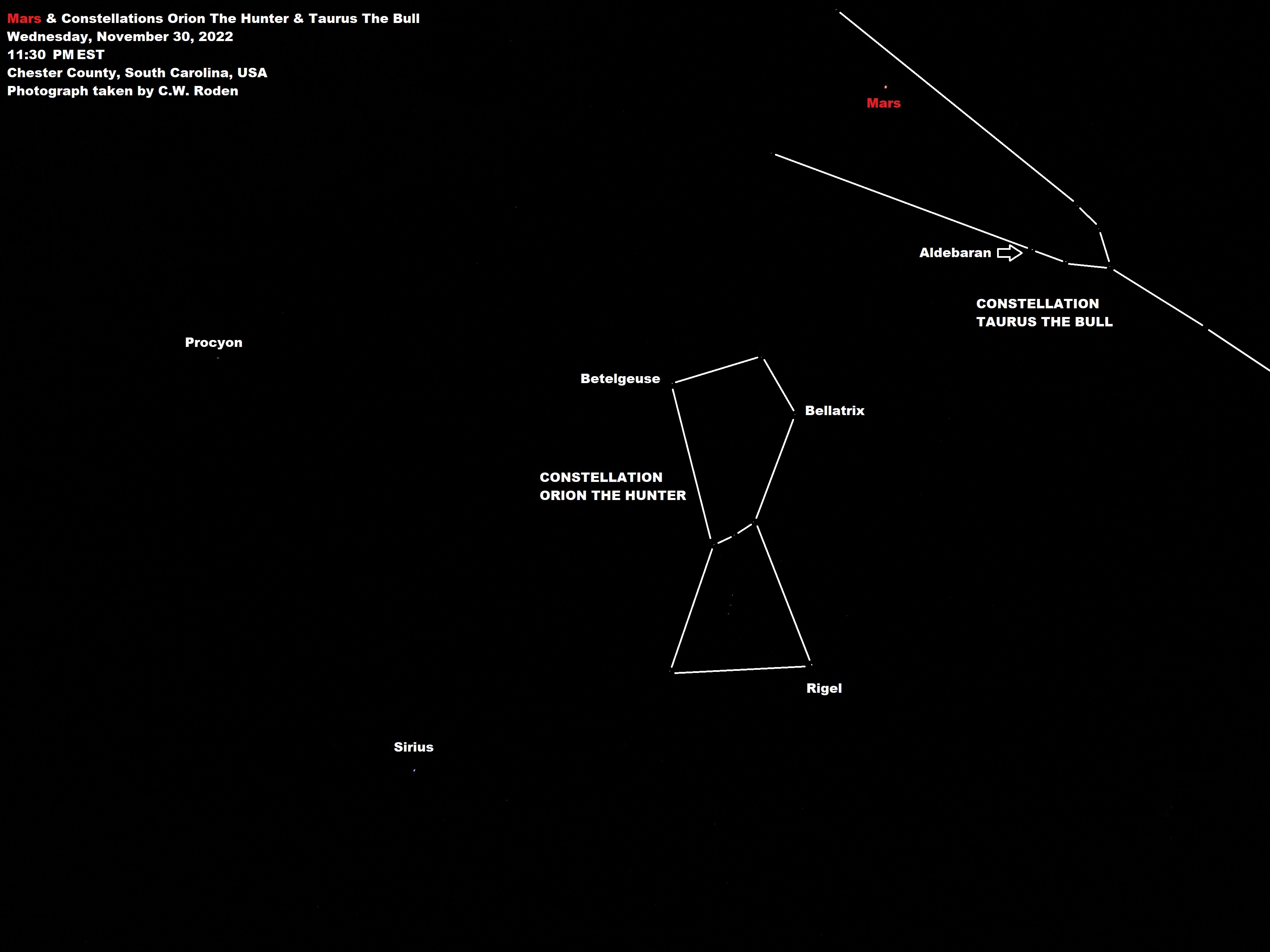
Night Sky Photography -- 11-29-2022 -- Mars Closest To The Earth Before Opposition

Good even fellow stargazers!

About every 26 months, our closest neighboring planet, Mars, reaches its opposition to Earth -- the moment that Earth is directly between a planet and the Sun. This also puts the Red Planet closer to our Earth in its orbit, making it glow slightly brighter as it approaches.

On the evening of Tuesday, November 29th and early morning of Wednesday, November 30th, Mars was at its closest to the Earth during this transition towards opposition.
At its closest approach this year, Mars was about 51 million miles (or 4.5 light-minutes) from the Earth.

Right now Mars is slightly brighter now than Sirius, the night sky’s brightest star, and it’s noticeably red-orange in color. Mars will continue to increase in brightness until its opposition on the night of December 7th - 8th, then will begin fading by the end of the month.

Mars is currently located inside the Constellation Taurus The Bull and will be for most of this month. Aldebaran, the brightest star of Taurus (also known as the "Eye of the Bull") also shares a slightly reddish color, meaning that there are two bright red evening "stars" in our night sky this month.

The following are the photos I took of Mars at its current location in the night sky compared to the brightest stars near it, as well as the Constellations Orion The Hunter and Taurus The Bull.


Hopefully I'll be able to capture a good image of our little red neighbor the night of its opposition, which won't occur again for another 26 months in January of 2025.

Saturday, September 17, 2022

Night Sky Photography -- 09-17-2022 -- Constellations Orion, Taurus, & Auriga With Mars & Last Quarter Moon

Good evening, fellow Stargazers!

Looking east two house after midnight, you can see the bright red planet Mars in the eastern sky between the Last Quarter Moon and the red giant star, Aldebaran -- the Eye of the Bull -- and the brightest star in the Constellation Taurus The Bull.

I was about to capture two really good wide shots of the brightest stars of three constellations: Taurus, Auriga, and Orion just above the tree lines.


As we move closer into the autumn months, these constellations, along with the other Winter Circle constellations will begin to return to the night sky.

Saturday, September 10, 2022

Planetary Photography -- 09-09-2022 -- Full Harvest Moon With Planets & Mars With Taurus and Auriga Rising

Good evening, fellow stargazers!

Well folks, autumn is only a few weeks away. Summer here in South Carolina is beginning to wind down, although the humidity will likely be sticking around for at least another month -- possibly till just after Halloween into November.

About an hour after midnight on Friday, September 9th, I was able to capture some really good photos of the Full Harvest Moon -- the name given to the Full Moon in September here in North America in relation to the coming autumn harvest season.

The Full Harvest Moon can be seen in my first photograph taken between the two large gas giant planets, Jupiter and Saturn. The second photo is a close-up of the Harvest Moon as it appears to us from the surface of the Earth.

Just above the tree line to the south between the planets and Luna, you can easily spot Fomalhaut, one of the brightest stars in the night sky (the third-brightest as seen from Earth), forming a sort of inverted triangle in the southeastern sky.


Looking towards the eastern sky, also just above the tree line, Mars can still be seen close to the bright red giant star, Aldebaran -- the Eye of Taurus the Bull.

In my last two photos, I captured Mars as it appears now between Aldebaran and the Pleiades Star Cluster. Mars currently sits just inside the Constellation Taurus the Bull and will remain so throughout the month of September.

The bright star, Capella, can be seen just to the side forming a triangle in the eastern sky. Capella is the brightest star of the Constellation Auriga the Charioteer.

In my final photo I outlined the major stars of the Constellations Taurus and Auriga in their relation with the "Seven Sisters" and Mars rising in the eastern sky.


All of these photos were taken an hour after midnight. If y'all are able to stay up another hour, or so, the bright stars of the Constellation Orion the Hunter will also appear above the horizon as the winter constellations will being to reappear overhead in the sky dome.

Y'all might also notice that Mars is getting brighter in the sky as our Earth is moving closer to opposition with the Red Planet -- the point where Earth will be between Mars and the Sun, which will take place on Thursday, December 8th of this year. Given the distances and the orbits of our two worlds, Mars only reaches opposition to the Earth every 26 months, or so.


Once again I hope y'all enjoyed my night time photography. If y'all live in the Northern Hemisphere, be sure to check out the visible planets of our Solar System this month.

Tuesday, August 23, 2022

Night Sky Photography -- 08-23-2022 -- Mars & Aldebaran: Twin Red "Stars" In The Early Morning

Good evening, fellow Stargazers!

Once again I was awake very early in the morning to capture another really good photo of two red "stars" rising in the eastern sky hours before sunrise.

The stars in question are the red giant star, Aldebaran -- the "eye" of Constellation Taurus The Bull and the planet Mars, one of the traditional "wandering stars" which can be seen together for the next month, or so, rising in the eastern sky. Their slightly red color helps both to stand out well in the evening sky.


In spite of the mostly cloudy conditions, I was able to successfully capture both red "stars" together -- well together being a subjective term since Aldebaran is about 65.23 light-years (or 20 parsecs) from the Sun.

Though its so far away, the red giant star Aldebaran is actually about 400 times brighter than our own Sun, and 44 times its size. Aldebaran is also the 14th brightest star in the night sky as seen from the surface of the Earth. 

Aldebaran is the brightest star in the Constellation Taurus the Bull, which I was unable to get a good photo of all the stars due to the cloudy conditions. I was able to capture the bright star Elnath (Beta Tauri), the second-brightest star in Taurus in the left corner of the shot. Elnath is about 134 light-years (or 41.8 parsecs) from the Sun.

Mars is one of the five "wandering stars" (or classical planets -- those visible to the naked eye in the night sky from the surface of the Earth) and at present is moving slowly towards the sunrise and past Aldebaran. Mars will actually be traveling within the Constellation Taurus beginning on September 9th through the first week of October of this year and can be seen between Aldebaran and Elnath to observers here on Earth.

Well, until next time have a wonderful evening and be sure to keep your eyes to the night skies, y'all hear.

Sunday, March 06, 2022

Night Sky Photography -- 03-06-2022 -- The Constellations And Major Stars Of The Winter Circle In One Shot!

Good evening fellow stargazers!

Happy March everyone! The month that sees the winter season give way to the renewal of the spring equinox on Sunday, March 20th.

In the evening and night sky dome the six main constellations that make up the Winter Circle (or Winter Hexagon) will continue to be visible in clear skies even as they continue to move west following the setting sun as winter gives way to spring in the Northern Hemisphere.

As I've mentioned in previous Night Sky Photography posts on this blog, the Winter Circle consists of seven bright stars in six separate constellations:

Pollux and Castor in the Constellation Gemini the Twins
Procyon in the the Constellation Canis Minor the Lesser Dog
Sirius in the Constellation Canis Major the Greater Dog
Rigel in the Constellation Orion the Hunter
Aldebaran in the Constellation Taurus the Bull
Capella in the Constellation Auriga the Charioteer

With the exception of the star Castor in the Constellation Gemini, the Winter Circle stars are all 1st-magnitude with Sirius (the Dog Star) being among the brightest stars in our sky. Castor is slightly fainter 2nd magnitude star, though still very bright and visible next to its companion twin, Pollux.

This evening, I was able to capture virtually all the major stars of five of the six constellations of the Winter Circle with one exception. Though I was able to capture the bright star Sirius, the Constellation Canis Major unfortunately would not completely fit in the frame from the only angle I was able to pick up all the stars of the other constellations with.

The following are the photos I was able to take, the first of the major stars in the Winter Circle (outlined in blue) and then the second photos outlining the constellations themselves in white with the Winter Triangle (outlined in red) inside the Winter Circle itself.


Oh and for those of y'all wondering, that small orb-like thing on the bottom right of the photographs is NOT a UFO! It's just the road light that blew out in my front yard recently that the folks at the power company has yet to fix. Thankfully the blown bulb allows for both some foreground scale, and for less light pollution where I didn't have to drive a few miles away to some open field for the shot, so no complaints there at all.

The Winter Circle will still remain fully visible throughout the rest of the month of March with our lovely moon passing between Aldebaran and the Pleiades Star Cluster this week on Tuesday, March 8th and Luna beginning her march through the Winter Circle phasing to First Quarter beauty on Thursday, March 10th. Y'all be sure to check that out -- God and clear skies willing that is.