Showing posts with label Biography. Show all posts

Sunday, January 25, 2026

RIP H.K. Edgerton (1948 - 2026) -- U.S. Veteran & Southern-Confederate Heritage Defender

Mr. Harold Kenneth (H.K.) Edgerton
February 18, 1948 - January 18, 2026
  

Harold Kenneth (H.K.) Edgerton passed over the river to rest beneath the shade of the trees with our Lord on Sunday, January 18, 2026 at the Asheville Veterans Administration Medical Center in his native Asheville, North Carolina.

He was born on February 18, 1948, to Asheville residents Roland Roger Edgerton and Anna B. Edgerton.
He passed away peacefully in his sleep after a prolonged illness arising from the COVID vaccine. Mr. Edgerton was 77 years old. 

Mr. Edgerton is survived by his brothers, Rashad Hasan of Stone Mountain, Georgia and Terry Lee Edgerton, sister Obra Elaine Hall,  niece Danielle
Hall, niece Shykita Hill, nephews Corey Edgerton and Darius Edgerton, and a host of great nieces and Nephews of Asheville, North Carolina.

Mr. Edgerton graduated Asheville High School in 1967 and served in the United States Army during the Vietnam War as Signal Corp Instructor at
Fort Monmouth, New Jersey between 1969-1972. He graduated from the University of Minnesota in 1976 with a Batchelor of Science (B.S.) degree. 

While in college, he was Chairman of the Board of the United Way Agency that was responsible for running the Sabathani Community Center in south Minneapolis. He founded the
University of Minnesota Black Student Center and served on the Student Regent Board of Directors. He served as an intern for the Green Giant Company, Customer Service Engineer for International Business Machines (IBM), and later he and his brother Terry Lee owned and operated Edgerton and Edgerton Office Products in Fullerton, California from 1981-1989. He later consulted with APAC, a Fortune 500 company.

He returned to Asheville to serve his hometown in various roles after his retirement including serving as Chairman of the Program Planning and
Implementation Committee for the Asheville-Buncombe County Drug Commission, first as Vice President and later as President of the Asheville Branch of the National Association for the Advancement of Colored People (NAACP) and conducted an unsuccessful bid for mayor of Asheville. He received the Citizen of the Year Award. He was a supporter and leader of youth sports and education, including being a volunteer and founder of the Boys and Girls Golf Team at Shiloh Community Center in Asheville and volunteer coach at Oakley Middle School for girl’s and boys’ basketball. He also served as a teacher’s aide at Ira B. Jones Elementary School in Asheville.

Mr. Edgerton was probably best known for his civil rights activism and moral defense of our shared Southern identity and historical heritage in regards to the memories of the Confederate dead -- particularly Confederate veterans of color. He saw the peoples of the South being discriminated against and he fought vigorously to support them. 

He gained
international recognition during his historical 1,300 mile March Across Dixie in 2002 which began in Asheville in early October of 2002 and culminated on January 26, 2003 in Austin, Texas, walking solo across seven Southern states wearing a gray Confederate soldiers uniform and carrying the historical Confederate battle flag Army of Northern Virginia (Dixie Cross).

The March Across Dixie brought attention to the decision by then Governor George W. Bush to
remove historic plaques from the Texas Supreme Court Building and the ongoing destruction and removal of Southern and Confederate symbols and names by radical anti-Southern heritage reactionary ideologues. Hundreds of Southern heritage activists walked with him for a few miles along his trek, and he was warmly greeted by Southern men, women, and children of all creeds -- particularly school children and teachers interested in his story.

Mr. Edgerton in Confederate uniform bearing the Dixie Cross banner in 2003 during his historic
3 month 1,300 mile March Across Dixie.


Mr. Edgerton was a plaintiff in several lawsuits including against the U.S. Army to prevent the removal of the Reconciliation Memorial at Arlington National Cemetery. He authored an Open Letter and Report on his activities for two decades and was a frequent public speaker on Southern history and served as an expert witness in two lawsuits. These actions earned him the respect and admiration of fellow Confederate heritage defenders.

He was widely acclaimed for his efforts on behalf of Southern heritage defense and received the Key
to the City of Carthage, Texas and the Key to the City of Toccoa, Georgia, the Horace L. Hunley Award from the Sons of Confederate Veterans (SCV), the General Robert E. Lee Medal from The Virginia Division, SCV, the Jefferson Davis Medal from the Texas Division, United Daughters of the Confederacy (UDC), SC Division SCV, Lifetime Achievement Award, North Carolina Order of Confederate Rose (OCR), John F. Harris Award, Mississippi Division, SCV and others.

In addition, H.K. Edgerton earned his stripes as an unofficial color sergeant among Confederate heritage defenders and helped lead the historic funeral procession through downtown Charleston, South Carolina in honor of the burial of the last 8-man crew of the Confederate submarine H.L. Hunley on Saturday, April 17, 2004.


Mr. H.K. Edgerton standing as color sergeant with Confederate living history reenactors as color guards
during a Southern Heritage Youth Day event in York County, SC in September of 2017.
Photo courtesy of this blog and taken by C.W. Roden.


He was a member of numerous organizations including Chairman Board of Advisors Emeritus Southern Legal Resource Center (SLRC); Save Southern Heritage Florida; Founder, Veterans Defending Arlington; Honorary Scots of Austin; Honorary Life Member of the North Carolina, Tennessee and Georgia Orders of the Confederate Rose (OCR); Honorary Life Member Jackson Rangers Camp #1917 SCV; Associate Member Abner Baker Chapter #2614 United Daughters of the Confederacy (UDC), Honorary Member of Augusta Jane Evans Wilson, Chapter #2640 UDC and the Judah P. Benjamin Camp #2210, SCV; Honorary Life Member, Longstreet Zollicoffer Camp #87 SCV; Honorary Member Simonton-Wilcox Camp #257 SCV; Honorary Life Member, Zebulon Baird Vance Camp #15, SCV; Honorary Member Maria Baker Lemmon, TN OCR #25; Honorary Life Member, Forest Orphans Camp #1744, SCV; Honorary Camp Commander, Granbury, Texas Brigade Camp #1479 SCV; and Honorary Life Member Bradford Rose Camp #1638, SCV.

Those who knew the man that Southern heritage advocates affectionately called "Brother H.K." or "Sergeant H.K." have found him to be a man of great conviction and honor, who earned the admiration and respect of those who spoke in defense of the memory of the Confederate soldier and American veterans as a whole.

I have been honored to have met Mr. Edgerton on several occasions and deeply respected him for being a voice for the defense of our shared Southern-Confederate ancestry and heritage; as well as being a fellow Southerner of great compassion and warmth.

When a color bearer falls in the face of the enemy, another picks up the standard and continues forwards them. I know that there will be many others who will continue to carry forward as H.K. Edgerton did -- I will be one of them.

Till the day we meet again in the presence of our Lord in paradise on the other side of the river, God Bless you, Brother H.K....you will never be forgotten!

"Neither death nor life, neither angels nor demons, neither the present nor the future, nor any powers, neither height nor depth, nor anything else in all creation, will be able to separate us from the love of God that is in Jesus Christ our Lord."
~Romans 8:38-39 NIV


Saturday, July 05, 2025

Private Louis Leon (1841-1919) -- A Tarheel Confederate Soldier

Louis Leon (1841-1919) pictured in his United
Confederate Veterans (UCV) uniform.


Louis Leon was born on November 27, 1841 in Sheffield, South Yorkshire, England, U.K. to German-born Jewish parents Abraham Leon (1898-1878) and Eva Hirsch Leon (1800-1874). The family immigrated to America and settled in New York City, then sometime around 1858, at the age of 16, Louis moved to Charlotte, North Carolina and settle into the small Jewish community in Mecklenburg County, finding work as a clerk in a clothing store.

When the State of North Carolina seceded from the Union on May 20, 1861, Leon -- then 19 years-old -- joined the "Charlotte Grays" Company C of the 1st North Carolina Volunteers Regiment under Captain Egbert Ross, and began his tour of duty on May 21, 1861 in Richmond, Virginia, one day after North Carolina seceded from the Union.

His tour of duty through Virginia lasted six months, during which time he participated in the Battle of Big Bethel on June 10, 1861. The 1st North Carolina Regiment was commanded in the battle by then Colonel Daniel Harvey Hill. This was also the battle where the war's first enlisted Confederate soldier -- 19 year-old Private Henry Lawson Wyatt -- was killed, the only Southern soldier to die that day.

The regiment disbanded shortly after, and he returned to Charlotte.


On April 14, 1862, Leon would again join the service of his new country and become a private in Company B, 53rd North Carolina Infantry Regiment. The regiment was mustered into Confederate service at Camp Magnum in Raleigh, North Carolina on April 30, 1862 and sent to Virginia to serve in General Robert E. Lee's Army of Northern Virginia throughout the war.

Leon kept a diary of his wartime experiences as a private soldier through the war and later as a prisoner of war when he was captured along with other members of his regiment at the Battle of the Wilderness on May 6, 1864. Leon would remain a POW at the infamous Elmira Prison in New York until the end of the war when he would take the Oath of Loyalty to the Union upon learning of General Lee's surrender. Once he was released, he visited his parents in New York City, then returned to Charlotte to resume his career as a store clerk.

After the war and the Reconstruction Era, Leon became a Major in the North Carolina United Confederate Veterans (UCV) becoming very active in that organization both locally and nationally, and was known locally in Charlotte a "Major Leon" in honor of his service. Leon was also instrumental in helping to erect Charlotte's Mecklenburg Declaration of Independence Monument on May 20, 1898.

He married Sarah Levy (1850-1909) of New York and the couple had three children: Rebecca Leon DeLane (1874-1920), Henry L. Leon (1876-1943), and Clarence Leon (1886-1955).

His youngest son, Clarence, would serve in the United States Army in the American Expeditionary Forces as a Private in World War I. There is a photo showing the aged United Confederate Veterans at the State Capitol in Raleigh, North Carolina welcoming home North Carolina's American Veterans from Europe in early 1919 -- both father and son were in attendance.

North Carolina UCV members welcoming home North Carolina's "Doughboys" from the
European Western Front at the NC State Capitol in Raleigh in early 1919.
Image courtesy of the NC Department of Archives and History.


In 1913 at the age of 72, Louis Leon published his Diary of a Tar Heel Confederate Soldier with Stone Publishing Company in Charlotte, North Carolina. At the time when most first-hand accounts of the War Between The States were written by officers, Leon wanted to show the war from the point of view of the private Confederate soldier. The diary, which he kept throughout his military service and his time as a prisoner of war, shows the grizzly reality and horror of war up close and personally.

The following are the excerpts of Leon's account of the Gettysburg Campaign including the three days of fighting at the Battle of Gettysburg (July 1-3, 1863) and aftermath:


June 25 --
Marched on, passed through Leesburg, Canada, Hockinsville, and Centerville, all small villages. We got to Carlisle, Pa., at sundown. Marched 21 miles to-day. This city is certainly a beautiful place. It has 8,000 inhabitants, and we were treated very good by the ladies. They thought we would do as their soldiers do, burn every place we passed through, but when we told them the strict orders of General Lee they were rejoiced. Our regiment was provost guard in the city, but were relieved by the 21st Georgia Regiment, and we went to camp at the U. S. barracks. So far we have lived very good in the enemy’s country. “We stayed here until the 30th, when we took the Baltimore pike road, crossed South Mountain at Holly Gap, passed through Papertown and Petersburg. We then left the Pike and took the Gettysburg road – 17 miles to-day. This has been a hard day for us, as we were the rear guard of the division, and it was very hot, close and very dusty, and a terrible job to keep the stragglers up.


July 1 -- We left camp at 6 A.M., passed through Heidelsburg and Middleton. At the latter place we heard firing in the direction of Gettysburg. We were pushed forward after letting the wagon trains get in our rear. We got to Gettysburg at 1 P.M., 15 miles. We were drawn up in line of battle about one mile south of town, and a little to the left of the Lutheran Seminary. We then advanced to the enemy’s line of battle in double quick time. We had not gotten more than 50 paces when Norman of our company fell dead by my side. Katz was going to pick him up. I stopped him, as it is strictly forbidden for anyone to help take the dead or wounded off the field except the ambulance corps. We then crossed over a rail fence, where our Lieutenant McMatthews and Lieutenant Alexander were both wounded. That left us with a captain and one lieutenant. After this we got into battle in earnest, and lost in our company very heavily, both killed and wounded. This fight lasted four hours and a half, when at last we drove them clear out of town, and took at least 3,000 prisoners. They also lost very heavily in killed and wounded, which all fell into our hands. After the fight our company was ordered to pick up all straggling Yankees in town, and bring them together to be brought to the rear as prisoners. One fellow I took up could not speak one word of English, and the first thing he asked me in German was “Will I get my pay in prison?” After we had them all put up in a pen we went to our regiment and rested. Major Iredell, of our regiment, came to me and shook my hand, and also complimented me for action in the fight. At dusk I was about going to hunt up my brother Morris, when he came to me. Thank God, we are both safe as yet. We laid all night among the dead Yankees, but they did not disturb our peaceful slumbers.

July 2 -- Our division was in reserve until dark, but our regiment was supporting a battery all day. We lost several killed and wounded, although we had no chance to fire — only lay by a battery of artillery and be shot at. The caisson of the battery we were supporting was blown up and we got a big good sprinkling of the wood from it. Just at dark we were sent to the front under terrible cannonading. Still, it was certainly a beautiful sight. It being dark, we could see the cannon vomit forth fire. Our company had to cross a rail fence. It gave way and several of our boys were hurt by others walking over them. We laid down here a short time, in fact no longer than 10 minutes, when I positively fell asleep. The cannonading did not disturb me. One of the boys shook me and told me Katz was wounded by a piece of a shell striking him on the side, and he was sent to the rear. We went on to the Baltimore Turnpike until 3 in the morning of the 3d.

July 3 -- When under a very heavy fire, we were ordered on Culps Hill, to the support of Gen. A. Johnson. Here we stayed all day — no, here, I may say, we melted away. We were on the brow of one hill, the enemy on the brow of another. We charged on them several times, but of course, running down our hill, and then to get to them was impossible, and every time we attempted it we came back leaving some of our comrades behind. Here our Lieutenant Belt lost his arm. We have now in our company a captain. All of our lieutenants are wounded. We fought here until 7 P.M., when what was left of us was withdrawn and taken to the first day’s battlefield. At the commencement of this fight our Brigade was the strongest in our division, but she is not now. We lost the most men, for we were in the fight all the time, and I have it from Colonel Owens that our regiment lost the most in the Brigade. I know that our company went in the fight with 60 men. When we left Culps Hill there were 16 of us that answered to the roll call. The balance were all killed and wounded. There were 12 sharpshooters in our company and now John Cochran and myself are the only ones that are left. This day none will forget, that participated in the fight. It was truly awful how fast, how very fast, did our poor boys fall by our sides — almost as fast as the leaves that fell as cannon and musket balls hit them, as they flew on their deadly errand. You could see one with his head shot off, others cut in two, then one with his brain oozing out, one with his leg off, others shot through the heart. Then you would hear some poor friend or foe crying for water, or for “God’s sake” to kill him. You would see some of your comrades, shot through the leg, lying between the lines, asking his friends to take him out, but no one could get to his relief, and you would have to leave him there, perhaps to die, or, at best, to become a prisoner. Our brigade was the only one that was sent to Culps Hill to support General Johnson. In our rapid firing today my gun became so hot that the ramrod would not come out, so I shot it at the Yankees, and picked up a gun from the ground, a gun that some poor comrade dropped after being shot. I wonder if it hit a Yankee; if so, I pity him. Our regiment was in a very exposed position at one time to-day, and our General Daniels ordered a courier of his to bring us from the hill. He was killed before he got to us. The General sent another. He was also killed before he reached us. Then General Daniels would not order any one, but called for volunteers. Capt. Ed. Stitt, of Charlotte, one of his aides, responded, and he took us out of the exposed position.

July 4 -- We laid on the battlefield of the first day, this the fourth day of July. No fighting to-day, but we are burying the dead. They have been lying on the field in the sun since the first day’s fight; it being dusty and hot, the dead smell terribly. The funny part of it is, the Yankees have all turned black. Several of our company, wounded, have died. Katz is getting along all right. The battle is over, and although we did not succeed in pushing the enemy out of their strong position, I am sure they have not anything to boast about. They have lost at least as many in killed and wounded as we have. We have taken more prisoners from them than they have from us. If that is not the case, why did they lay still all today and see our army going to the rear? An army that has gained a great victory follows it up while its enemy is badly crippled; but Meade, their commander, knows he has had as much as he gave, at least, if not more. As yet I have not heard a word from my brother Morris since the first day’s fight.

July 5 -- Left this morning a 5 o'clock. Only marched ten miles to-day. The enemy being in our rear, and skirmishing very strong. 


Major Louis Leon, at the age of 78, died in his sleep on June 28, 1919 in New York City, New York while visiting relatives. He is buried with is wife in the
Hebrew Cemetery in Charlotte, North Carolina.

The grave of Confederate veteran Louis Leon & his wife, Sarah 
at Hebrew Cemetery, Charlotte, North Carolina.

I would like to add an important caveat to this story.

In doing research on the life of Private Louis Leon, I found that there was a granite marker at the Charlotte Hebrew Cemetery near the old chapel honoring Leon along with 12 other Jewish men from Mecklenburg County who served in the Confederate military. In addition to photographing Private Leon's grave site, I was going to add a photo of that marker as well.

However, I was informed by cemetery employees that the marker had since been removed at some point by staff around 2017 out of "fears of vandalism" following the dishonorable purge of Confederate symbols and markers around that time.

Out of respect for the South's dead, I will list the names of those Jewish Confederates buried there:

Captain Julius Roessler, 13th Regiment NC Troops
1st Lieutenant Edward B. Cohen, 1st Regiment NC Volunteers
2nd Lieutenant Solomon A. Cohen, 1st Regiment NC Volunteers
Sergeant Major Aaron Katz, 53rd Regiment NC Troops
Corporal Henry Wertheim, 53rd Regiment NC Troops
Corporal Phillip Schiff, 44th Regiment GA Infantry
Private Louis Leon, 53rd Regiment NC Troops
Private Charles S. Liberman, 13th Regiment, NC Troops
Private Jonas Engel, 53rd Regiment NC Troops
Private Jacob Donau, 53rd Regiment NC Troops
Private I.C. Levi, 1st Regiment NC Volunteers
Private Sam Oppenheim, 1st Regiment NC Volunteers
Private Jacob Katz, 1st Regiment NC Volunteers

"Shema Yisrael, Adonai Eloheinu, Adonai Echad."
("Hear, O Israel, the Lord our God, the Lord is one.")
In blessed and eternal memory of those Southern men of Jewish faith who answered the call to defend Dixie 1861-1865.
May their names continue to live on as a blessing to their heritage and community.
Deo Vindice.


Source for the quotes come from the Diary of a Tar Heel Confederate Soldier, North Carolina Collection, Wilson Library, University of North Carolina at Chapel Hill. ISBN-13: 978-0692288214. Pages 33-38.

Sunday, December 29, 2024

The Life & Death Of Captain George Daniel Wallace (1849-1890)

Captain George D. Wallace (1849-1890)
taken sometime in the 1880s while he was a
member of the U.S. 7th Cavalry.
Photo courtesy of the U.S. Dept. of Archives.
 

George Daniel Wallace was born on Friday, June 29, 1849 in York County, South Carolina, the youngest son of South Carolina State House of Representative and later Republican U.S. Congressman Alexander Stuart Wallace (1810-1893) and Nancy Lee Ratchford Wallace (1810-1883).  

The Wallace family immigrated from County Tyrone (Modern-day Northern Ireland, U.K.) in 1773.
George Wallace's grandfather, McCasland Wallace (1773-1862), had been born on the boat ride on the North Atlantic. The family, like many other Irish and Ulster-Scots families, migrated to what was then the British North American Southern colonies via the Great Wagon Road just prior to the outbreak of the American Revolutionary War (1775-1783) and settled on a farm along Turkey Creek in modern-day York County, South Carolina.

His father, Alexander Wallace, served several terms in the South Carolina State House of Representatives (1852-1855, 1858-1859), but resigned when South Carolina seceded from the Union in December of 1860. Being a staunch Unionist, he vehemently opposed secession despite himself being a slaveowner (he apparently owned at least four slaves according to 1850 census records). Alexander Wallace retired to his farm in York County until the end of the War Between The States (1861-1865).

His oldest son, Robert McCaslan Wallace (1837-1902), would serve in the Confederate army in the Western Theater and achieve the rank of Colonel. Another family member, James Wylie Ratchford (1840-1910), would become a Major and serve on the staff of C.S. Generals Daniel Harvey Hill and Stephen D. Lee. The younger George Wallace was 11 years old when the war began and would not serve.

In April of 1865, at the age of 15, young George Wallace witnessed the flight of Confederate President Jefferson Davis and his escort through York County from the front porch of his family's home and the end of the bloody struggle.

Following the end of the War, Alexander Wallace was again elected to the S.C. House from 1865-1866. He would run for the U.S. House of Representatives as a Republican in 1868 and was elected four times, serving until the end of the Reconstruction Era in 1877 when he again retired to his farm.

It was during this time that young George Wallace, now 19-years-old, was accepted to the U.S. Military Academy at West Point, New York on Tuesday, September 1, 1868. He would graduate 9th in his class of 57 fellow cadets (Class of 1872) on Friday, June 14, 1872, just over two weeks shy of his 22nd birthday.

Upon graduation and being commissioned a U.S. Army 2nd Lieutenant,
Wallace would begin his military career by joining Company G of Lieutenant Colonel George Armstrong Custer's famed U.S. 7th Cavalry which was then serving occupation duty and enforcing martial law in  Laurens County, South Carolina.

Not long after, Lieutenant Wallace and Company G of the 7th Cavalry were sent out west to Fort Abraham Lincoln in the Dakota Territory  (Modern-day U.S. State of North Dakota) to serve during their Yellowstone Expedition (Friday, June 20 - Tuesday, September 23, 1873).


A year later, 2nd Lieutenant Wallace would be appointed command of Indian Scouts during the 7th Cavalry's Black Hills Expedition (Thursday, July 2 - Sunday, August 30, 1874). He would then be stationed on detached duty in New Orleans, Louisiana from 1874 to 1876. 

Wallace would return to Fort Lincoln in May of 1876 and would participate with Custer and the 7th Cavalry in the Great Sioux War (or Black Hills War) of 1876. Lieutenant Wallace served in Company G under the command of Major Marcus A. Reno during Custer's campaign into the Black Hills. He would become Regimental Adjutant during this campaign.

Lieutenant George D. Wallace as a member
of the 7th U.S. Cavalry in 1872.

Photo courtesy of findagrave.com.

At only a few days shy of his 27th birthday, Wallace was present with the 7th Cavalry when the Battle of the Little Bighorn took place on Sunday, June 25, 1876 where Custer and three companies of his men (approximately 261 members of the 7th Cavalry) were outnumbered and subsequently slaughtered by the Lakota Sioux and Cheyenne. Wallace was with Major Reno several miles away, although Reno and his men were involved in their own running firefight with the Cheyenne at the time. Wallace survived the battle and was promoted to 1st Lieutenant and given command of Company G following the death of its previous commander, 1st Lieutenant Donald McIntosh.

First Lieutenant Wallace would later participate in the Nez Perce War of 1877
where Wallace was briefly involved in the pursuit of the Nez Perce tribe as they unsuccessfully fled toward Canada, and the Northern Cheyenne Campaign of 1878-1879.

Wallace would also testify at the Reno Court of Inquiry in Chicago, Illinois in January, 1879 convened by U.S. President Rutherford B. Hayes on the conduct of Major Reno during the Little Bighorn Campaign. His testimony and those of other officers present helped to officially exonerate Reno of the charges of "cowardice" and abandoning Custer to his fate.

Some of the enlisted men in the 7th Cavalry suggested that the officers (Wallace included) coerced them to give a positive report of Reno at the time. Years later, Major
Charles DeRudio (then 1st Lieutenant of Company A, 7th Cavalry) told historical researcher Walter Mason Camp "that there was a private understanding between a number of officers that they would do all they could to save Reno." Reno would always remain the object of public scorn by those who admired Custer.

The official record of the court of inquiry can be read HERE.


Lieutenant Wallace then served at the newly established Cavalry School in Fort Leavenworth, Kansas in 1880 where he commanded Company K of the 7th Cavalry.


At 33 years old, Lieutenant George Wallace married then 22 year old Miss Caroline "Carrie" Mix Otis (1860-1942) on Thursday, October 12, 1882 in Minneapolis, Minnesota. The couple would have two children -- a daughter that died in childbirth in 1883 and a surviving son, Otis Alexander Wallace (1889-1955) who would later serve as a U.S. Army Captain of artillery when the United States entered World War I in 1917.

On Wednesday, September 23, 1885, George Wallace was promoted and appointed Captain of Company L and would later take command of Company K in September of 1890.

In his final service with the 7th U.S. Cavalry, Captain Wallace was commanding Company K during what would be known to history as the Wounded Knee Massacre (or Battle of Wounded Knee) on Monday, December 29, 1890.

On the morning of December 29th U.S. troops led by Colonel James W. Forsyth
of the 7th Cavalry surrounded a Lakota Sioux camp at Wounded Knee Creek (modern-day Pine Ridge Indian Reservation in Oglala Lakota County, South Dakota) and went in with orders to disarm the Native Americas. During the process, a deaf Lakota tribesman named Black Coyote was reluctant to give up his rifle, claiming he had paid a lot for it. Black Coyote's rifle went off at that point accidentally and the troopers -- who had already been on edge -- began firing into the Lakota camp. The Lakota warriors fought back, but by that point many had already been disarmed.

At least 153 confirmed people of the Lakota tribe were killed and 51 wounded (4 men and 47 women and children, some of whom died later from their wounds). Some estimates placed the overall number of dead as high as 300. Twenty-five U.S. cavalrymen also were killed and 39 were wounded -- six of the wounded later died.


The burying of the Lakota dead in a common grave following the Wounded Knee Massacre on
December 29, 1890. At least 153 men, women, and children were slaughtered along with 25 U.S. soldiers.
Photo courtesy of the U.S. Library of Congress.

Of the 25 U.S. soldiers killed during the massacre Captain George D. Wallace was the only officer killed, having reportedly been shot in the stomach and the side of the head in the official records. He was 41 years old.

Some accounts suggested that Wallace might have been killed as a result of friendly fire (Company B and K were apparently deployed badly on the field when the firing started), while others maintain he was shot in the stomach and then hit over the head by an Indian "war club" with the latter being the fatal wound. He was reportedly found dead with his Colt revolver in his hand along with nine other fallen men from Company K and the bodies of several Lakota Sioux warriors.

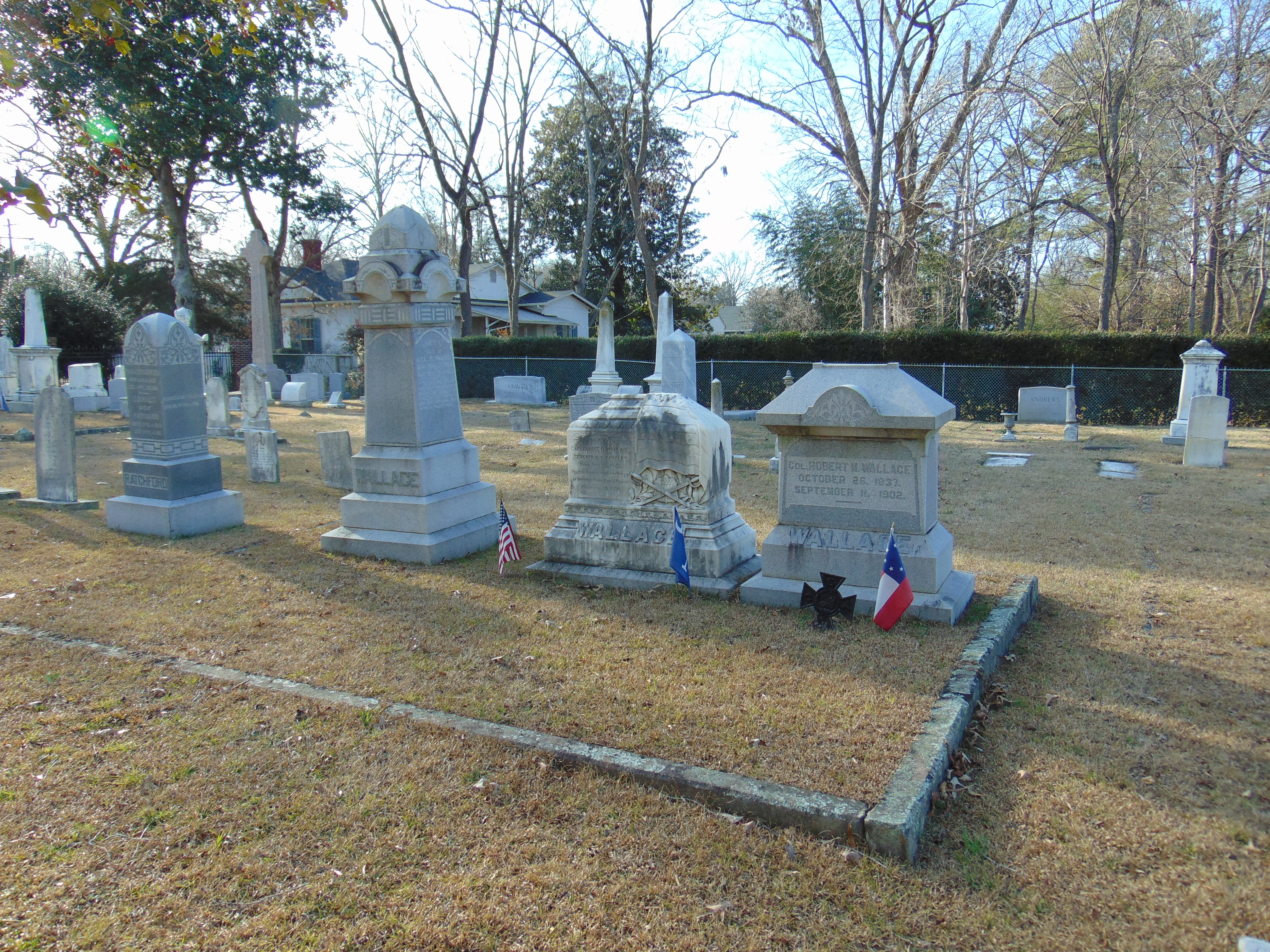
Captain Wallace's body was sent to Fort Riley, Kansas in a wooden casket covered with the flag of Company K. From there was returned by train to South Carolina 
escorted by his brother, Colonel Robert Wallace, where he was buried with full military honors in the family plot at historic Rose Hill Cemetery in York on Tuesday, January 6, 1891.

He is buried beneath a beautifully carved headstone with a U.S. flag and crossed swords between the larger grave monuments of his parents and his older brother, the Confederate veteran, in the family plot.

His widow, Carrie, died on Thursday, April 9, 1942 in Bronxville, Westchester County, New York.


The Wallace Family Plot at Rose Hill Cemetery, York, South Carolina.
Included are the graves of Captain George D. Wallace in the center, his parents U.S. Representative
Alexander Wallace and Nancy Wallace on the left and his brother, C.S.A. Colonel Robert M. Wallace
on the right with Confederate Iron Cross marker.


The following sources of information were used for this article:

Custer's Southern officer: Captain George D. Wallace, 7th U.S. Cavalry by John D. MacKintosh (2002); ISBN-10 0615120520, ISBN-13 978-0615120522.

"Custodians of the Flag: The People Turn Out En-masse to do Honor to the Late Capt. George D. Wallace -- Eloquent Eulogies on the Flag, and on its Defender." Yorkville (South Carolina) Enquirer Wednesday, April 22, 1891, Pg. 1.

The South Carolina Department of Archives & History.

Find a Grave Memorial ID 5816415.

Monday, May 06, 2024

The Life And Death of Brigadier General Micah Jenkins C.S.A. (1835 - 1864)

Confederate Brigadier General Micah Jenkins
(December 1, 1835 - May 6, 1864).
 

(This article was re-posted from an earlier date in memory of the 160th anniversary of the death of General Micah Jenkins on May 6, 1864 at the Battle of the Wilderness, Virginia.)


Micah John Jenkins was born on Tuesday, December 1, 1835 the third son (and fourth of five children) of Captain John Jenkins (1794-1854) and his wife Elizabeth Clark Jenkins (1803-1864), on Edisto Island, Charleston County, South Carolina. The Jenkinses belonged to an ancient Welsh family, claiming descent from Prince Llewelyn ap Gruffudd (1223-1282).

Micah Jenkins came from a long and proud line of American military servicemen from the State of South Carolina.
His Grandfather, Joseph Jenkins (1762-1828), was a Patriot veteran of the American Revolutionary War (1775-1783) and served in the 20th Regiment South Carolina Militia during the War of 1812 (1812-1815). His father, Captain John Jenkins, served as an officer in the Mexican-American War (1846-1848). His uncle, Joseph Evan Jenkins (1793-1874), also served in the War of 1812 but never saw any combat action and would later be a Signer of the South Carolina Ordinance of Secession in December of 1860. 

At the age of 15, Micah Jenkins entered the South Carolina Military Academy -- later name The Citadel -- near Charleston in 1851, later graduating in 1854 top of his class at the age of 19.

It was at the military academy that Jenkins met his classmate and life-long friend, Asbury Coward from York County, South Carolina. Later Jenkins and Coward would become the co-founders of the Kings Mountain Military Academy in Yorkville (York, South Carolina) in January of 1855.

It was during his time as a cadet at The Citadel in 1853 that Micah Jenkins met his future wife, then 16 year old Caroline "Carrie" Harper Jamison (1837-1902) of Orangeburg, South Carolina. Caroline was the daughter of General David Flavel Jamison (1810-1864), one of the founders of The Citadel and later president of South Carolina's Secession Convention in December of 1860.

Micah and Carrie would marry on Thursday, July 3, 1856 and move to York where they would raise their family. The couple would have five male children: Micah John Jr. (1857-1912), Robert Flavel (1858-1936), William Edward (1860-1930), Whitemarsh LaRoush (1861-1863), and John Murray (1863-1958); all born in York County. 

In 1855 at the age 20, Micah Jenkins was confirmed at the York Episcopal Church. He was a devout Protestant Christian and remained so for his whole life.

Colonel Micah Jenkins just before the war
as Colonel of the 5th South Carolina
Volunteer Infantry Regiment.
Photo courtesy of the Library of Congress.
Shortly before the war, in 1859 following the aftermath of John Brown's failed raid on Harpers Ferry, Micah Jenkins raised a volunteer militia company at Yorkville -- the Jasper Guards or Jasper Rifle Guards -- and was elected company Captain. In 1860 they were to become the Jasper Light Infantry, or Company I of the 5th South Carolina Volunteer Infantry, a regiment raised largely from the upper Piedmont districts of York, Union and Spartanburg Counties. Jenkins was elected the first Colonel of the regiment on Saturday, April 13, 1861 -- the day before the War Between The States began.


Though a strict drill master from his years as founder of the Kings Mountain Military Academy, Jenkins was generally well liked by the men under his command. With his experience and their trust in him, they formed a superb unit.

Not long after they were sent north to Virginia, the 5th South Carolina Infantry saw its first action during the Battle of First Manassas on Sunday, July 21, 1861. They were not engaged on the main field of battle, but rather in a separate action to the east at McLean's Ford.

Serving as a part of Brigadier General David R. Jones' brigade, the 5th South Carolina along with the 17th and 18th Mississippi Infantry Regiments were sent across McLean's Ford at noon during the battle in order to silence an eight-gun Federal artillery battery. The battery was positioned on a hill just across the ford and was supported by four New York regiments. In the advance up the slope, the two Mississippi regiments halted and began to withdraw, leaving Jenkins and his Carolinians unsupported. Despite this, Jenkins managed to drive back the artillerymen and their infantry supports, holding his position for nearly an hour. He then sent three messages back to Jones requesting for further orders but, according to his report, received no reply and, being outnumbered and unsupported, eventually decided to unwillingly withdraw. Jones himself states that he sent Jenkins three orders to withdraw, the 5th South Carolina eventually retiring "well formed and in good order from the field."


The 5th South Carolina suffered 3 killed and 23 wounded during the battle. They had fought well for their first battle. As General Jones later wrote in his official report, "Too much cannot be said in praise of the gallantry displayed by Colonel Jenkins and his regiment of South Carolinians."


Later that fall, the 5th South Carolina was placed in a division under Major General James Longstreet. Longstreet's aide, Major Thomas J. Goree, would write in a letter home that the general thought Jenkins was the best Colonel in the army and that the 5th South Carolina Infantry was "one of the finest, if not the finest, regiments in the army."
Colonel Jenkins and the 5th South Carolina Infantry was put in a brigade under General Richard H. Anderson.

In a review of Longstreet's division at Centreville, Virginia, on Thursday, November 28, 1861, General P.G.T. Beauregard presented each regiment with the first patterns of the new Confederate Battle Flag made of silk for the army. 

As reported by the hometown newspaper, the Yorkville (S.C.) Inquirer on Thursday, December 12, 1861, upon receiving his, Jenkins gave a short speech:

"As Colonel of the 5th S.C. Regiment, I accept this as our battle-flag. Our native soil is now oppressed with the footsteps of the fell invader; his beacon fires are lighted upon our headlands. To us a battle flag can only be one under which we must conquer or die. As such, I accept this."


Upon the expiration of its one-year term of service, the 5th South Carolina regiment was then reorganized in April 1862 from re-enlistees and new recruits. Jenkins retained his command as Colonel of the regiment. Five companies of the 5th South Carolina were detached to form part of Micah Jenkins' newly organized regiment, the Palmetto Sharpshooters, which also consisted of companies from the 4th and 9th South Carolina Infantry Regiments. The Palmetto Sharpshooters would be placed under the command of Colonel John R. R. Giles from Union County.

A man of great Christian faith in God, Jenkins always took his Bible and prayer book with him, and at any quite moments on the battlefield was to be found reading it. By contrast, he was fearlessly brave under fire he was always front and center leading his men into battle, sometimes recklessly so.

At the Battle of Williamsburg (Fort Magurder) on Monday, May 5, 1862, when someone told him he was unnecessarily exposing himself to danger, Jenkins was reported to have (quite prophetically) said, "I feel the (Yankee) bullet has not been molded that is to kill me."

At Williamsburg, General  Anderson was temporarily put in division command while Jenkins, who was still a Colonel, was put in command of his brigade (Jenkins' 5th South Carolina Infantry Regiment, the 6th South Carolina Infantry Regiment, and the Palmetto Sharpshooters), all regiments made up of men from York, Union, Spartanburg, Chester, Fairfield, and Lancaster counties in upstate South Carolina. 

At the Battle of Seven Pines on Saturday, May 31, 1862,  he led Anderson's brigade with distinction in that battle. It was during this action that
Colonel Giles of the Palmetto Sharpshooters was unfortunately killed during the battle and would be replaced by Colonel Joseph A. Walker of Spartanburg County, South Carolina.

Captain W. B. Smith, Company G, Palmetto Sharpshooters wrote in his report after Seven Pines:

"After we had driven back four fresh lines of battle General Jenkins drew his lines back a short way and formed a new line, someone said to him 'just look at them coming at the double quick.' Jenkins replied: 'We shall meet them at the double quick.' 'He straightened himself up in his stirrups and gave the command to charge front on twelfth company at the double quick, and I never saw on parade a prettier maneuver, General Jenkins was magic. He could come nearer to making his men work like machinery than any other man I saw. That was the last charge at Seven Pines at which ended the battle. We fought five fresh lines that evening and whipped every one. Jenkins was on his horse all through the battle."
 
In a letter to his sister written not long after the battle, Longstreet's aide, Major Thomas J. Goree, sums up Jenkins' performance rather accurately:
"Col. Jenkins carried the brigade into action about 3 O'clock P.M., a little further to the left of where Genl. D.H. Hill was engaged. From this time until night he fought unsupported and alone, and advancing all the time. He fought 5 separate & distinct lines of the enemy, whipping each one. He whipped the whole of Genl. Couch's Division, consisting of 12 or 15 regiments, with a little brigade of 1900 men. He passed over several abattis of felled timber, two lines of breastworks, captured three pieces of artillery, 250 prisoners, & several stands of colors.​
He whipped the fifth lines of the enemy about 8 O'clock P.M. At that time he was near two miles in advance of anyone else. His brigade rested that night in a Massachusetts camp, and had every luxury nearly that you can imagine: a plenty of brandy, lemons, & preserved fruits of all sorts, oil clothes, boots and shoes, opera glasses, etc. etc. etc.​
The Yankee prisoners were perfectly surprised when they found he had accomplished so much with only one little brigade. They told him that every line he met was composed of fresh troops, and that they thought he was receiving reinforcements all the time.​
Genl. Longstreet was very much surprised, too, when Col. Jenkins came in at night, and reported where his brigade was. ​
The battle flag of Colonel Jenkins' Palmetto Sharpshooters.
It was reported that during the battle of Seven Pines,
out of 12 men in the color guard 10 were shot down, the flag
was passed to four men, and was pierced by nine musket balls,
but never once touched the ground during the heavy fighting.
Image courtesy South Carolina Confederate Relic Room,
State Museum, Columbia, SC.

This brigade went into action with 1900 men. It lost 700 killed & wounded, & among this number were more than half of its field officers, and near one third of the line officers. But, it never faltered, nor even stopped. It advanced slowly but steadily for more than two miles, all the time in the face of a galling fire, and nearly all the way over felled timber & the enemy's breastworks....
A few days previous to the battle, Genl. Longstreet presented to Col. Jenkins' Regt. ("Palmetto Sharpshooters") a battle flag. A noble, manly fellow was the color bearer. In the fight he was shot down; as Col. Jenkins rode by where he was lying he raised himself on his elbow & exclaimed: "For God's sake, Colonel, take care of my flag!" ​
This flag has 9 bullet holes in it. It had a guard of 12 men, 10 of them were killed & wounded. This flag, at one time, changed hands 4 times in 3 minutes without falling to the ground. It now has inscribed on it "Williamsburg" & "Seven Pines."
Jenkins, though technically still a Colonel, would maintain command of this brigade during the Peninsula Campaign and Seven Days Battles.

At the Battle of Gaines Mill on Friday, June 27, 1862, Colonel Jenkins led the brigade in a sweep around the Federal flank as dusk fell and engaged in heavy fighting with the 16th Michigan Infantry Regiment capturing their regimental colors along with the regiment's Colonel Thomas B.W. Stockton, another officer and 53 of the Union regiment's enlisted men. For this feat Jenkins was given consent by the Confederate Secretary of War, Judah P. Benjamin, to retain the regimental standard of the 16th Michigan for presentation to the Governor of South Carolina.

Major Thomas Goree, this time in a letter to his mother, describes the attack of Colonel Micah Jenkins' brigade at the Battle of Frayser's Farm (White Oak Swamp) on Monday, June 30, 1862:


The So. Ca. Brigade under the gallant Col. Jenkins commenced the attack. Kemper was on the right of Jenkins, Wilcox on the left, & Pickett's, Pryor, & Featherston still to the left. One of A.P. Hill's (Branch's Brigade) was ordered as a support to Kemper & Jenkins.​
Kemper's (which used to be Genl. Longstreet's old brigade) charged & took a battery. The enemy then brought up reinforcements and Branch failing to support Kemper, the battery was retaken and many of the old brigade captured with it. Jenkins in the meantime had taken a battery and still kept forward. His advance at this time was the most desperate I ever knew. A few hundred yards to the left of the battery he took was one that Wilcox was trying to take. Just in Jenkins' front was a very large force of the enemy's infantry which he immediately engaged, when this battery on his left commenced on him with grape and canister. Thus he advanced in the face of a terrible musketry fire at the same time enfiladed by artillery. Notwithstanding, he pushed on, charged the enemy and drove them from their position with terrible slaughter. He then brought up Branch's Brigade to hold the position. But as soon as they reached the place and saw how far in advance it was & the number of the enemy a half mile farther on, they turned & fled. Being left so far in advance unsupported, Jenkins fell back from position & went to the assistance of Wilcox. The enemy did not return to the position he left. Wilcox during this time had been fighting desperately. He had taken a battery, but it had been retaken, but when Jenkins came in, they made another charge and held it. . . .​
The So. Carolina Brigade (Jenkins') lost more than half & the Ala. Brigade (Wilcox) lost at least one half. The 11th Ala. (Col. Syd Moore's Reg.) out of 10 officers commanding companies lost 8 killed & two wounded. The Palmetto Sharpshooters (Col. Jenkins' Regt.) out of 375 men, lost 44 killed & 210 wounded.​
His own escape was almost miraculous. His horse was shot twice. A hole was shot through his saddle blanket, his bridle reins cut in two near his hand. An India rubber overcoat tied on behind his saddle had 15 holes through it made by a musket ball & piece of shell. His sword was shot off at the point, & shot half in two near the hilt, & his sword knob was also shot off. Besides all this he was struck on the shoulder with grape shot (which bruised it severely) and was also struck on the breast & leg with fragments of spent shell.​
I met him just as he was coming out of the fight and he was weeping like a child at the destruction of his brave, noble men. He told me at one time when he saw how fast they were falling around him, he stopped and prayed to God to send a bullet through his heart. He says, too, that at times as he would ride up and down the line, his men would turn and give him a look as much as to say, "We can go no further," when he would wave his hand to them and they would again dash forward.​

His brother-in-law, Lieutenant John Wilson Jamison (1839-1886) who served with Jenkins as his Aide-de-Camp, was hit in the chest and nearly killed at Frayser's Farm where Jenkins was wounded.
Jamison had also served as a French language teacher at Jenkins' Kings Mountain Military Academy prior to the war.

In addition to his brother-in-law, other members of Micah Jenkins' immediate family also served with him during the war.

His brother, John Jenkins (1824-1905) served in Company I, 3rd South Carolina Cavalry as a Major. His cousin, John Micah Jenkins (1827-1915) also served in the same company as a 2nd Lieutenant.

His other brother, Dr. Edward Ephraim Jenkins (1831-1904) served in the 5th South Carolina Regiment with Micah as a Staff Surgeon and later as the Brigade's Surgeon.


Another brother-in-law, David Rumph Jamison (1834-1908) served as the regimental quartermaster of the Palmetto Sharpshooters.


All of these men would survive the war and be present at Appomattox during the surrender of the Army of Northern Virginia in April 1865.

For his gallant actions throughout the campaign, Micah Jenkins was officially promoted to the rank of Brigadier General on Tuesday, July 22, 1862, becoming one of the youngest generals in the American Civil War at the age of 26.

A month after his promotion, General Jenkins would again lead his brigade on the second day of the Battle of 2nd Manassas (Saturday, August 30, 1862) where he would be severely wounded in the left abdomen and would be out of action for the next two months, missing General Lee's first invasion of the North and the ensuing battles.

The 5th South Carolina's officer corps had been left in poor shape after the battles of 1862. There were even thoughts of disbanding the regiment. That fall, Jenkins offered the command of his old regiment to his old friend, Colonel Asbury Coward, who'd previously served on the staff of Brigadier General D. R. Jones. Coward accepted the offer and was approved by the War Department. Coward would serve as the Colonel of the 5th South Carolina Infantry for the remainder of the war.

General Jenkins was back on duty, this time with his new Divisional commander Major General George E. Pickett during the Battle of Fredericksburg on December 11-15, 1862, but Jenkins' Brigade was not engaged during the battle.

In 1863, Pickett's division participated in General James Longstreet's Siege of Suffolk, Virginia (April 16 - May 3, 1863), but Jenkins' Brigade was retained near Richmond, Virginia, under the command of Major General Daniel Harvey Hill, thus missing General Lee's second invasion of the North and the fateful Battle of Gettysburg (July 1-3, 1863) where Pickett's division was smashed during the final day of the battle.

Jenkins' Brigade went with Major General John B. Hood's Division of General Longstreet's First Corps to the war's Western Theater three months later where they participated in the second day's fighting of the Battle of Chickamauga, Georgia on Sunday, September 20, 1863.


When Hood was promoted to lead a new army Corps, Jenkins was placed in command of his Division, which would result in a bitter rivalry with another South Carolinian, Brigadier General Evander M. Law, who'd been with the Division longer, but lost out because of Jenkins' seniority in rank. The tensions this caused would severely hinder the efficiency of the Division largely because of Law's resentment. Jenkins' Brigade would be put in the temporary charge of Colonel John Bratton of the 6th South Carolina Infantry.

General Jenkins, now commanding Hood's former Division, led his Confederates at the Battle of Brown's Ferry (Tuesday, October 27, 1863) along the Tennessee River, and again a day later at the Battle of Wauhatchie (October 28-29, 1863).

Sent into combat against superior numbers, General Jenkins was successfully leading the attack when they were attacked in the rear by greatly superior numbers. Even then he succeeded in withdrawing his troops.


Again with Longstreet he went to East Tennessee playing a conspicuous part in the proceedings, commanding the right wing at the Battle of Campbell's Station on November 16, 1863, and finally participated in the Siege of Knoxville (November 19 - December 4, 1863) and all the hardships these battles entailed.

Micah Jenkins went home to York on leave in late 1863 to spend some quality time with his family. While Jenkins had been at Chickamauga months before, his then two-year-old son, Whitemarsh LaRoche Jenkins, had died from a disease while his wife and children were visiting family in Summerville, South Carolina.


So he tried to be involved with his wife, Caroline, and surviving children as much as he could during that time. Right before he departed at the train station, Micah Jenkins looked at his friends and family and declared that he was going to fight his last battle. This would be the last time his wife and children would see him alive.

On Saturday, January 16, 1864, Jenkins led his brigade to victory in the Battle of Dandridge (Kimbrough's Crossroads), Tennessee against Federal cavalry.

When Longstreet's Corps returned to the Eastern Theater and the Army of Northern Virginia in early 1864, the contentious issue of command over Hood's Division command was at last resolved when Brigadier General Charles W. Field, who was senior to both Jenkins and Law, was promoted to Major General and assigned Division command. Jenkins resumed the command of his South Carolina Brigade.

General Jenkins was apparently suffering from ill health and malnutrition by the time the spring campaigning began, but insisted on playing his part in the upcoming second day of the Battle of the Wilderness on Friday, May 6, 1864. He was transported to the battlefield by field ambulance and mounted onto his horse still suffering. According to some accounts early in the morning as the battle began, the sweet notes of the Palmetto Sharpshooters band could be heard playing for their old commanding officer trying to cheer him up.

At around 11 P.M. part of Longstreet's Corps, on the Confederate right, had launched a flank attack from an unused railroad cutting onto Union General Winfield Scott Hancock's Corps. The Federal troops, and their pursuers, proceeded to flee across the front of the remainder of Longstreet's Corps with the resulting disorganization to both sides.

At about 1300 hours having forsaking his ambulance Jenkins was with his Brigade, which had been in reserve until this time, down the Orange Plank Road for it to spearhead the renewed Confederate attack this time upon the Brock Road trenches.

Riding at the head of the column with General Longstreet, and other staff officers, and in discussion with Longstreet when they came opposite the Confederate Brigades which had just made the successful flank attack, specifically that of William Mahone. The 12th Virginia mistook them for Federal troops and opened fire. When they firing stopped there were dead and wounded men and horses in the road.

Among the possible reasons for this friendly fire incident was the fact the Jenkins Brigade were wearing new uniforms of dark gray wool that appeared almost black. Along with the smokey conditions of the battlefield in the dense trees of the Wilderness (some of which was on fire) Mahone's men mistook the oncoming troops as Union soldiers. One of the Brigade was to later say that: "when a staff member, upon Longstreet's order, picked up and unfurled a Union flag that the General spotted on the roadway, approaching Virginians fired upon it."

Among the wounded were Longstreet and Jenkins -- Longstreet would survive the war.
Jenkins had been shot in the forehead with the Minne Ball lodged in his brain near his left temple.

Jenkins' best friend, Colonel Asbury Coward, was there when Micah was shot, and desperately trying to comfort him before was sent for Medical attention. While dying, along with delirium as a Minnie Ball lodged in his brain, he was still urging his men onward. Colonel Bratton of the 6th South Carolina Infantry took charge of the Brigade.

Colonel Coward recalls the friendly fire incident at the Wilderness, in which Jenkins was killed and Longstreet wounded in his memoirs:

"After we had marched in line about 100 yards through brush and woods, we came upon a line of men, about two small regiments, lying down or kneeling directly in the path of our march. I had to halt my men and on inquiry found it was General Mahone's Brigade, who had just halted there. Seeing at the time a flag passing along the tunpike, I ran toward it through the intermediate thicket to inquire what troops they were. It was the Second South Carolina, one of the regiments of Jenkins' Brigade. I could not understand why they were marching in columns of fours, while I was marching in line of battle.​

As I turned, I saw that Mahone's men had commenced, on the right, to fire by file. Thinking only of the danger to the Second Regiment, I rushed back to stop the firing by voice and gesture. But not until I reached the line was the firing stopped. At that moment Mahone walked up and inquired why the firing had stopped. I explained why I had stopped it. He then asked me who had started it. I told him the firing had begun in his right company. I went on to say that they might be able to explain how it started there. He went off in the direction of his right company in a very agitated state.​
The incident had just taken place when Major R. M. Sims came to me and said: "That firing has wounded both General Longstreet and General Jenkins, one in the throat and the other in the temple... and I fear both are fatally wounded." I ran toward the group of trees that he indicated and found men lifting General Longstreet, litter and all, into an ambulance. Jenkins had just been placed on a litter. General Kershaw, who had remounted his horse, was urging haste; for the enemy's cannon was throwing shells at the cluster of trees. Fortunately, the shots were passing high but were nevertheless dangerous.​
I knelt by the friend of my life since I entered The Citadel, my alter ego. Taking his hand in mine, I said 'Jenkins... Mike, do you know me?' I felt a convulsive pressure of my hand. Then I noticed that his features, in fact his whole body, was convulsed. The haste urged by General Kershaw prevented any further stay at his side. He was lifted into an ambulance and carried to the rear. Dazed, I returned to my regiment."

With the musket ball where it was little could be done for Micah Jenkins. Only semi-conscious, and not recognizing those around him, he died about six hours later around sunset.

According to one of his surgeons present, at the moment Micah Jenkins breathed his last, "a bright, happy, trusting smile lit up his face. Those around watched, we thought, we felt he was with his God."

Micah Jenkins was just 28 years old when he was killed. His 26 year old devoted widow,
Caroline Jenkins, would never remarry as she was left alone to raise their four remaining boys.

The following excerpt from the article in the Charleston Courier (Charleston, SC) recounts his funeral:

"The remains of the lamented General Micah Jenkins were interred in Summerville in the graveyard of the Episcopal Church of that place where his mother was buried. The body arrived at Summerville a quarter past three o’clock under the escort of the cadets of the Arsenal Academy in Columbia. The coffin with a Confederate flag laid upon it was placed upon a carriage, and a procession was formed from all of the inhabitants of the village and the convalescent solders in the hospital that were able to attend.
Before the procession began the ladies of the village brought in beautiful wreaths
and numerous bouquets of flowers and strewed them with profusion upon the coffin.The coffin was followed by several members of the deceased’s family, including his widow, his father in law, General D. F. Jamison, Major John Jenkins and Dr. Edward Jenkins[his brothers].
Upon the arrival of the remains at the village and during the passing of the processions,the church bells were tolled and every expression of grief and sympathy was exhibited by the inhabitants of the village. The ladies present at the interment bedecked the grave with flowers and gave vent to their heartfelt sorrow in the tears which were freely shared of over the mortal remains of the departed hero."

The body of Micah Jenkins was brought back to South Carolina, accompanied by Caroline’s brother, Lieutenant John Jamison. His body first laid in state at the Arsenal Military Academy in Columbia and then was removed to the graveyard of the Episcopal Church in Summerville, South Carolina, where he was buried until 1881 when his body was moved to historic Magnolia Cemetery in Charleston. The Citadel Military Academy erected a grave monument in his honor.  The graves of General Jenkins and his wife, Caroline, are buried beneath the 12 foot monument.

Jenkins Hall at The Citadel is named in his honor.

General James Longstreet wrote of him after the war: "He was one of the most estimable characters of the army. His taste and talent were for military service. He was intelligent, quick, untiring, attentive, zealous in discharge of duty, truly faithful to official obligations, abreast with the foremost in battle, and withal a humble, noble Christian. In a moment of highest earthly hope, he was transported to serenest heavenly joy; to that life beyond that knows no bugle call, beat of drum or clash of steel. May his beautiful spirit, through the mercy of God, rest in peace! Amen!"

Two of General Micah Jenkins' sons would go on to continue the family tradition of American military service.

His oldest son, Micah John Jenkins Jr. (1857-1912) graduated from the United States Military Academy at West Point, New York in the Class of 1879 and would serve in the Spanish-American War (1898) where he was enrolled as Captain of Troop K, 1st United States Volunteer Cavalry Regiment "The Rough Riders" under Colonels Leonard Wood and Theodore Roosevelt. Captain Jenkins fought with the Regiment in Cuba and was present during the attack on San Juan Heights near Santiago de Cuba on Friday, July 1, 1898. He was promoted to Major on Thursday, August 11, 1898 and was mustered out of service with the Regiment at Montauck Point, Long Island, New York. He is buried at St. Paul's Episcopal Church Cemetery on Yonges Island, Charleston County, South Carolina.

His youngest son, John Murray Jenkins (1863-1958) also attended West Point and graduated in the Class of 1887. John served as a Colonel of the 30th Infantry Regiment, 3rd Infantry Division, American Expeditionary Forces (A.E.F.) in France on the European Western Front during World War I (1917-1918) and was awarded the Distinguished Service Cross in 1919. John Jenkins retired a Major General in the United States Army in 1927. He is buried at Arlington National Cemetery in Arlington, Virginia.


The grave of Brigadier General Micah Jenkins and his wife
at historic Magnolia Cemetery in Charleston, South Carolina.


Sources for this article include:

The Civil War Letters of Major Thomas J. Goree edited by Thomas W. Cutrer (Charlottesville: University of Virginia Press, 1995), pp. 87, 94-95.
The South Carolinians: Colonel Asbury Coward's Memoirs edited by Natalie Jenkins Bond and Osmun Latrobe Coward (New York: Vantage Press, 1968).
The War of the Rebellion: A Compilation of the Official Records of the Union and Confederate Armies, Vol. 1 of 2.
Also a special thanks to the people at the South Carolina Confederate Relic Room & Military Museum in Columbia, South Carolina, The South Carolina Division Sons of Confederate Veterans, and the South Carolina Historical Society Archives and Museum.