Showing posts with label Constellation Canis Minor. Show all posts

Sunday, January 05, 2025

Planerary Photography -- 01-01-2025 -- Jupiter In Taurus With The Hunter and Dogs

Happy New Year 2025, Y'all!

I mean to actually post these the other day, however I've been feeling very under the weather with a severe cold and flu, so I apologize for the delay in posting as I'm still in recovery.

At exactly midnight here on the East Coast of the United States on Wednesday, January 1st -- the official star of New Year's Day in my little corner of Dixie -- I set up my camera and tripod and fixed it overhead into the wonderfully clear sky to capture this outstanding photo of the largest planet in our Solar System, Jupiter, inside the Constellation Taurus The Bull. I was also able to capture the brightest stars of the nearby constellations Orion The Hunter, Canis Major The Greater Dog, and Canis Minor The Lesser Dog.

I duplicated the photo so that I could outline the positions of the constellations, as well as the Winter Circle asterism in the shot.


Look for bright Jupiter overhead and you will easily be able to find the Constellation Taurus since, due to its slow orbit around the Sun, Jupiter is going to remain inside the large V of Taurus well into early May as seen here in North America when the winter constellation disappears from view to give way to the summer stars thanks to the Earth's rotation.

That's all for now, but I plan to have more night sky photography for y'all soon, good weather and clear skies permitting.

Sunday, October 13, 2024

Night Sky Photography -- 10-13-2024 -- Jupiter & Mars With Early Morning Winter Stars

Salutations once again, fellow stargazers!

Now that autumn here in North America is here, the morning skies overhead an hour before sunrise will begin to feature the stars and constellations of the Winter Circle, most of which will begin rising after about an hour before midnight the evening before.

Both the planets Mars and Jupiter can now be seen inside the Winter Circle with the Red Planet near the Constellation Gemini the Twins and Jupiter inside the Constellation Taurus the Bull.

Early this morning, I stepped outside and set up my tripod in the front yard, focusing my camera up at the two planets, as well as the brightest points of light near them, and took several very clear photographs. Because of the wonderfully clear morning sky overhead, I managed to capture not only our nearest planetary neighbors, but all the beautiful stars of four of the Winter Circle constellations -- as well as Sirius, the brightest star that can be seen from Earth.

In the first photo, I labeled both Mars and Jupiter, as well as all the major stars of the constellations around them and in the second I outlined the constellations themselves, including the location of the Winter Triangle asterism.


Looking up at those beautiful stars and planets in a clear autumn sky, its almost hard to imagine just how far away most of them are.

The closest of them, Mars, is actually over a hundred million miles from Earth at present and getting slightly closer as the planet moves in its orbit towards its opposition to Earth in January of 2025, and will appear to be getting even bigger in the early morning sky over the next couple of months. Even at its closest approach, Mars will only be about 60 million miles from Earth since this opposition puts the small planet will be near its aphelion, or the point farther away from the Sun in its orbit.

In my final photo of the post, I labeled not only the planets and the major stars and the location of the Orion Nebula, but I also added the exact distance from Earth to put into perspective just how massive our nearest galactic neighbors are. Also keep in mind most of those points of light that we see comes from light that took decades in most cases to reach our curious eyes.


With that in mind, I bid all of y'all a wonderful day. More evening photography will be coming soon, until then keep your eyes to the night skies, y'all hear.

Tuesday, March 19, 2024

Night Sky Photography -- 03-18-2024 -- The Winter Triangle Constellations & Major Stars Before Spring

Last night about 50 minutes after sunset the sky was really clear and so I was able to take this really beautifully clear photo of every major star of the Constellations Orion, Canis Major (The Greater Dog), and Canis Minor (The Lesser Dog) as well as the nearby Constellation Taurus The Bull and its two largest stars: Aldebaran and Elnath.


Very soon we'll be saying goodbye to these constellations -- at least for a few months -- as they will begin to move lower towards the setting sun during the coming spring months here in the Northern Hemisphere. Spring here officially begins on Tuesday, March 19th.

Tuesday, February 20, 2024

Night Sky Photography -- 02-20-2024 -- The Moon, The Twins, & Major Winter Stars

Good evening, fellow stargazers!

On the evening of Tuesday, February 20th, I captured this really clear shot of our lovely Moon near the twin stars: Castor and Pollux -- the two main stars of the Constellation Gemini The Twins -- along with the other nearby winter stars and their constellations.

The first is the original photo taken showing Luna along with the stars and their positions in the sky dome. The second is the same photo with the star constellations of Orion The Hunter, Canis Minor "The Lesser Dog", and Taurus The Bull in relation to the bright Gemini Twins -- the stars for their constellation are unfortunately not visible due to the brightness of the Waxing Gibbous Moon phase.

The Winter Triangle stars of Procyon and Betelgeuse are all clearly visible and mark the positions of Orion and Canis Minor. Sirius, the brightest star of the Constellation Canis Major "The Greater Dog" is at the very bottom making up the final point of the Winter Triangle. Unfortunately I could not get the entire constellation itself into frame.


Luna sits right beside the giant star Pollux, the brightest star of the Constellation Gemini and the 18th brightest star in our night sky. Pollux sits about 34 light-years (or 10.4 parsecs) distance from our Sun and its the closest giant star relative to our Solar System.
Pollux is almost nine times the diameter of our sun and about 30 times the sun’s brightness in visible light.

Its "twin" Castor, the second-brightest star in Gemini, is a bit more tricky since its not one, but six stars that appear as one to the naked eye. The Castor system is organized into three binary pairs made up of two bright white A-Type stars with four smaller M-Type red dwarf stars that orbit each other. Castor sits about 51 light-years (or 15.6 parsecs) from the Sun.


Castor Aa, the main star of the system, is more than twice the
size of our own Sun.
Image via NASA/ JPL-Caltech/ Wikimedia Commons (public domain).

Sunday, April 30, 2023

Night Sky Photography -- 04-30-2023 -- Venus & Mars With Major Evening Stars & Constellations

Good evening my fellow stargazers!

Closing out the month of April, I was blessed to have some actual clear skies for this evening after rain and cloudy conditions for most of the last week.

This evening I was about to capture a couple of really beautiful shots of the bright planet Venus and the small red planet, Mars, along with four of the major evening star constellations over 50 minutes after sunset in the western sky. 

Venus and Mars are the second and fourth planets in our Solar System respectively, with our own good Earth in the orbit between them around the Sun.


As you can see from my first photograph, both planets appear in the western sky almost an hour after sunset with several bright stars in the western sky belonging to the winter constellations: Orion The Hunter, Canis Minor, Gemini The Twins, and Auriga The Charioteer.

Sirius, the Dog Star, is part of a fifth constellation, Canis Major which is largely obscured from view by the trees. While Venus is currently the brightest "wandering star" (planet) in the western sky, Sirius is actually the brightest of the evening stars in the night sky seen from the surface of the Earth.


In my second photo, I outlined the star constellations themselves in their current relations to the position of the planets.

Mars
is just inside of the Constellation Gemini The Twins and will remain in close proximity to them for the next month at least. As it moves further and further away in its wider orbit around the Sun, Mars will become dimmer and, unless you know where to look, you might have a hard time finding it.

Venus meanwhile is very bright and easy to spot towards the sunset in the evenings. It will be the brightest object to appear in the evening sky other than our lovely Moon.


Wednesday, March 29, 2023

Night Sky Photography -- 03-28-2023 -- How To Use The Constellation Orion As An Astronomical Signpost


Good Evening, fellow stargazers!

One of the coolest things about certain star constellations and asterisms that make up our evening sky dome is that they can be used to locate other nearby constellations and asterisms.

For example, in a previous post, I showed how one can use the Big Dipper to locate two of the major stars in the Spring Triangle and the Great Diamond asterisms.

This evening I took a few great photos of the major stars of the Constellation Orion the Hunter and his two dogs -- the constellations Canis Major The Greater Dog and Canis Minor The Lesser Dog.

Three of the major stars of these three separate constellations -- Betelgeuse in Orion, Procyon in Canis Minor, and Sirius in Canis Major -- form an
equilateral triangle asterism in the evening sky called the Winter Triangle.


The Constellation Orion is the key to locating not only two dogs, but also the constellations Taurus The Bull and Gemini The Twins; as well as the Pleiades Star Cluster by following a series of lines using Orion as a starting point.

When you locate the asterism "Orion's Belt" in the sky dome, picture Orion The Hunter standing upright, with the stars Betelgeuse and Bellatrix marking out Orion's left and right shoulders, and Saiph and Rigel marking out his left and right feet.


Follow the three stars of Orion’s Belt down and to the left and draw line to find the bright star Sirius --The Dog Star -- in the Constellation Canis Major The Greater Dog.


Draw a line from Betelgeuse -- Orion's left shoulder -- and keep going to find a solitary bright star, Procyon in the Constellation Canis Minor The Lesser Dog. This line also serves as one of the three triangular lines of The Winter Triangle.

Draw a line from Rigel -- Orion's right foot -- up past Betelgeuse and keep going until you reach the two bright stars Castor and Pollux in the Constellation Gemini The Twins.

Going back to Orion’s Belt, your next target lies up and to the right, following the line of the belt to the bright reddish star Aldebaran in the Constellation Taurus the Bull. If you keep on following this line past Aldebaran, a short distance later you’ll reach the Pleiades Star Cluster (also known as the "Seven Sisters").


If you remember these easy steps, then finding all the major constellations and asterisms near Orion in the evening sky is simple.

Be sure to try it out and please let me know what y'all thought of this little presentation in the comments section below. As always have a wonderful evening and be sure to keep your eyes to the night skies, y'all hear.

Wednesday, March 08, 2023

Night Sky Photography -- 03-07-2023 -- The Full Worm Moon, The Hunter & His Dogs


This evening, I was blessed with clear skies and was able to capture some good shots of the March 2023 Full Moon -- or Full Worm Moon in North America -- in the evening just after 9 PM EST.

The title shot is the full moon with the foreground of the branches of the blossoming tree in my backyard. A nice little reminder that winter here in South Carolina is almost over (at least officially) and the spring equinox will be here in just two short weeks.

Here is a more clear shot of the full moon without any obstructions.


Now looking more towards the southern sky over the tree tops we can see three important winter constellations all connected by the Winter Triangle asterism: Orion The Hunter and his two dogs: "The Greater Dog" Canis Major and "The Lesser Dog" Canis Minor.

The Constellation Orion is easy to spot with the three stars of "Orion's Belt"  --
Alnitak, Alnilam, and Mintaka -- forming the most easily recognizable asterism in the night sky. The Constellation Canis Major is probably the easiest to find because of the bright white star, Sirius -- the Dog Star -- shining brightly nearby.

Sirius and the star, Betelgeuse, that makes up Orion's shoulder, when joined by the other nearby bright star, Procyon, in the small Constellation Canis Minor, form a nearly perfect triangle-shaped asterism known as the Winter Triangle.


Sunday, February 06, 2022

Night Sky Photography -- 02-05-2022 -- Constellation Monoceros The Unicorn

Yeah folks, there really IS a Space Unicorn!

Good evening fellow stargazers!

So tell me, how many of y'all believe in unicorns?

Would you believe me if I told y'all that you can find a unicorn in the night sky in the Northern Hemisphere? Its hard to find, but if you know where to look you can find the faint Constellation Monoceros The Unicorn inside the Winter Triangle asterism.

This evening I focused my camera hard on the Winter Triangle stars to locate the faint stars that make up Monoceros.
Because this celestial unicorn contains only fourth magnitude stars its difficult to see with the naked eye. You need a really dark sky to see it.

If y'all know exactly where to locate these particular stars, then you're one step closer to locating the elusive unicorn.

As y'all might remember from my previous Night Sky Photography blog posts, the Winter Triangle is made up of three bright evening stars: Sirius, Procyon, and Betelgeuse. These three are the brightest stars in their respective star constellations: Orion The Hunter, Canis Major (the Greater Dog), and Canis Minor (the Lesser Dog).


My first two photographs taken from my back yard shows the three main stars of the Winter Triangle in the night sky dome this evening. I outlined the Winter Triangle and the constellations in relation to its major stars.


In the last photo I outlined the faint stars of Monoceros The Unicorn found between these three constellations mostly inside the Winter Triangle. And there she is y'all!


Well I hope y'all enjoyed this evening night sky offerings. Be sure to look for Monoceros throughout the winter months late at night in very dark areas away from the city's light pollution.

Monday, January 31, 2022

Night Sky Photography -- 01-31-2022 -- Orion The Hunter & His Dogs In The Southeastern Sky

Good evening fellow stargazers!

This evening I have a couple of good photos of the Constellations Orion The Hunter and his two dogs, the Constellations
Canis Minor and Canis Major in the southeastern sky.

The first shot I outlined the constellations main stars -- all of which I managed to capture in the darkness of the night sky over three hours after sunset.


The two major stars of the dogs are the bright star Sirius for Canis Major, and Procyon for Canis Minor. 

As I've mentioned before in previous posts, Sirius is the brightest star in the night sky, and the brightest non-planetary object in the sky dome after sunset.
At a distance of 8.6 light-years (or 2.64 parsecs), Sirius is one of Earth's nearest neighbors. Sirius is actually a binary star system consisting of a main-sequence star, Sirius A, and a faint white dwarf companion star, Sirius B.

Procyon is the eight-brightest and makes up the smaller, two-star constellation, Canis Minor, the "Lesser Dog". Also a close neighbor relatively speaking, a
t a distance of just 11.46 light-years (or 3.51 parsecs) from our sun, Procyon is also part of a binary star system which consists of a larger star, Procyon A, in orbit with a faint white dwarf companion star, Procyon B.

According to some ancient mythology, Orion The Hunter is accompanied by his dogs in pursuit of Taurus The Bull through the night sky.


In my second photo, I outlined how easy it is for an amateur stargazer to locate both Sirius and the bright reddish star, Aldebaran "the Eye of the Bull" using Orion's Belt as a guide pointing towards both stars. Both are set in an almost completely straight line going to and from the three stars of the belt.

Both Procyon and Sirius, along with Betelgeuse in the Constellation Orion The Hunter, make up the Winter Triangle. The bright star Rigel and Aldebaran, along with Procyon and Sirius are four of the major stars that make up the Winter Hexagon. All of these are highlighted in my final photo.


I hope y'all enjoyed my photos for this evening, and as always keep your eyes to the night skies, y'all!

Sunday, May 30, 2021

Night Sky Photography -- 05-30-2021 -- Venus, Mars & The Constellation Gemini

Good evening y'all, and Happy U.S. Memorial Day weekend!

This evening I traveled over to the local baseball field and using it as a backdrop was able to capture some really outstanding photos of the planets Venus and Mars an hour after sunset.

Venus appeared not long after sunset, being the brightest object in the evening sky. Mercury was unfortunately below the tree line, otherwise I might have been able to capture all of the inner planets this evening.

In the first photo you can see bright Venus appearing in the evening dusk.


Between about 9:00 PM EST and 9:08 PM EST I was able to capture several shots of Venus sinking below the top of the ballpark fence as it sank lower into the west following the sun.

As the evening progressed and dusk started deepening more into night time, smaller Mars and the major stars finally began to appear in the sky.

In this next shot you can faintly see Mars in the top left of the photo with Venus now just above the tree line.


Finally you can see the major stars of the Constellation Gemini The Twins with Mars close to the bright stars Castor and Pollux. The other bright stars Procyon and Capella, which together with the Twin Stars make up the top portion of the now waning Winter Hexagon asterium, can also be seen in the photo.

I've also outlined the major stars of the Constellation Gemini and Canis Minor. Venus can still be seen in this wide shot overlooking the baseball field.


Well folks, I hope y'all enjoyed my photos for the evening. This will close out the month of May for this year. Have a Happy U.S. Memorial Day 2021 tomorrow and be sure to keep your eyes to the night skies, y'all!

Monday, April 19, 2021

Night Sky Photography -- 04-19-2021 -- The Moon & The Twins; Mars Between The Bull's Horns; Orion & His Dogs

Good evening fellow stargazers!

This evening was a beautiful, clear evening for viewing the stars after sunset in the western sky. The
beautiful,  crescent moon could be seen overhead alongside Pollux and Castor, the two brightest stars in the Constellation Gemini The Twins.


Thanks to the clear springtime evening sky, I was also able to capture just about all of the brightest stars of all the constellations that make up the Winter Hexagon asterism. The planet Mars can also still be seen in the Constellation Taurus The Bull between the stars Tau Zeta and Elnath -- the bull's horns.

Among the photos I was able to capture a beautiful shot of the Constellation Orion The Hunger and both of his dogs, Canis Major and Canis Minor.

I labeled all of the evening skies brightest stars, their constellations, and the Winter Triangle and Winter Hexagon asterisms.

The following are the photos I took.


So I hope y'all enjoyed my evening offerings and as always have a good evening and keep your eyes to the night skies, y'all.

Monday, January 27, 2020

Night Sky Photography -- 01-27-2020 -- Venus & Neptune Conjunction!

Good evening fellow stargazers!

This evening I have a real treat for y'all, photos taken by this blogger of the closest planetary conjunction of the year between two planets that are quite far apart in terms of actual orbital distance -- Venus and Neptune

Venus is the brightest object in the night sky over the Carolinas in the early evenings in late January this year.

Neptune is officially one of the farthest major planets in our solar system, other than distant Pluto....

And don't you forget it!


Anyhow, despite being a whopping 17 times the mass of our Earth, at a distance of 2.7 billion miles at our closest orbital approach, the gas giant Neptune appears in the night sky some six times fainter than the dimmest star in our night sky that is visible to the naked eye. 

However, if you know where to look just after sunset, amateur astronomers like myself can find Neptune with small telescopes, a really good pair of binoculars, or some other optical aid.  

In their conjunction, Venus and Neptune will be spaced only 1/12th of a degree apart from our perspective. For a reference, the angular diameter of the moon spans about 1/2 degree, which is some six times greater than the tiny gap between Venus and Neptune.Venus also outshines Neptune by about 60,000 times in brightness. 

This evening, despite rain earlier in the day, I was blessed with mostly clear skies in order to capture my shots of the conjunction. 

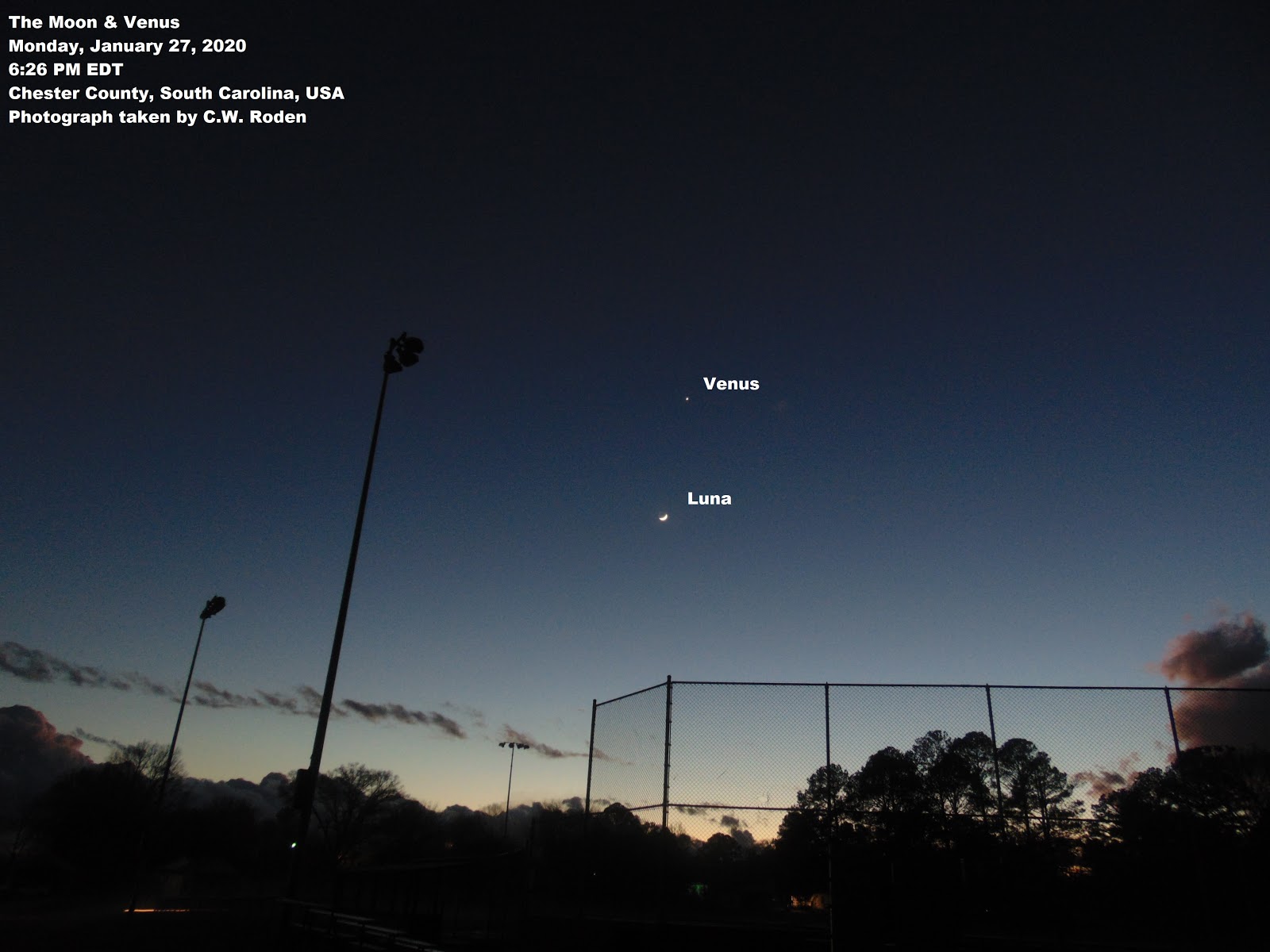
The first shot I took about 40 minutes after sunset using a local baseball field as foreground. You see see our beautiful young crescent moon just beneath bright Venus in the western sky. Unfortunately the trees blocked my view of tiny Mercury lower on the horizon following the setting sun.


My second shot was a close-up of Luna and Venus. Just barely visible as a faint ghost just above Venus is Neptune.


In my third shot, I adjusted the light filter settings on my trusty Sony DSC-H300 camera and was able to beautifully capture distant Neptune in conjunction with bright Venus. Even at maximum zoom on my 35X Optical Zoom lens, Neptune still appears quite faint in the shot. 
 

My forth shot I took of the clouds threatening to block my shot of Luna and Venus. I just thought the shot of the clouds getting between the two heavenly bodies made for a very pretty photo. 
 

While I was there, I turned my tripod and camera eastward and managed to capture a really good shot just above the trees of several of the major winter constellations and the Winter Triangle once again. Included are the constellations Orion the Hunter, Canis Minor the Lesser Dog, Leups the Hare, part of Taurus the Bull, and Eridanus the River. The bright star Sirius was just visible above the tree line, but the rest of the constellation Canis Major alas was not. Sirius combined with the stars Betelguese and Procyon make up the Winter Triangle.


Well folks, I hope y'all enjoyed my photos. Be sure to let me know what you think in the comments below.

Have a wonderful Dixie evening and as always, keep your eyes to the night skies, y'all!