Late this evening I captured this great shot of the giant planet Jupiter rising in the eastern sky with the largest stars of the Constellation Gemini stars Castor and Pollux, with all the major stars of the nearby Constellations Orion The Hunter and Taurus The Bull nearby. The planet Jupiter, the fifth planet of our Solar System,
will remain close to the bright star Pollux for the remaining months of
2025 so you won't have trouble locating it.
A very important fact for all you amateur stargazers. In the early morning hours of Tuesday, October 21st, the Orionids Meteor Shower will be at its peak and anywhere between 10 to 30 meteors can be spotted an hour. You can best spot them in the space between the Constellation Orion near Betelgeuse and the Constellation Gemini.
Thursday, October 16, 2025
Night Sky Photography -- 10-16-2025 -- Jupiter With The Twins
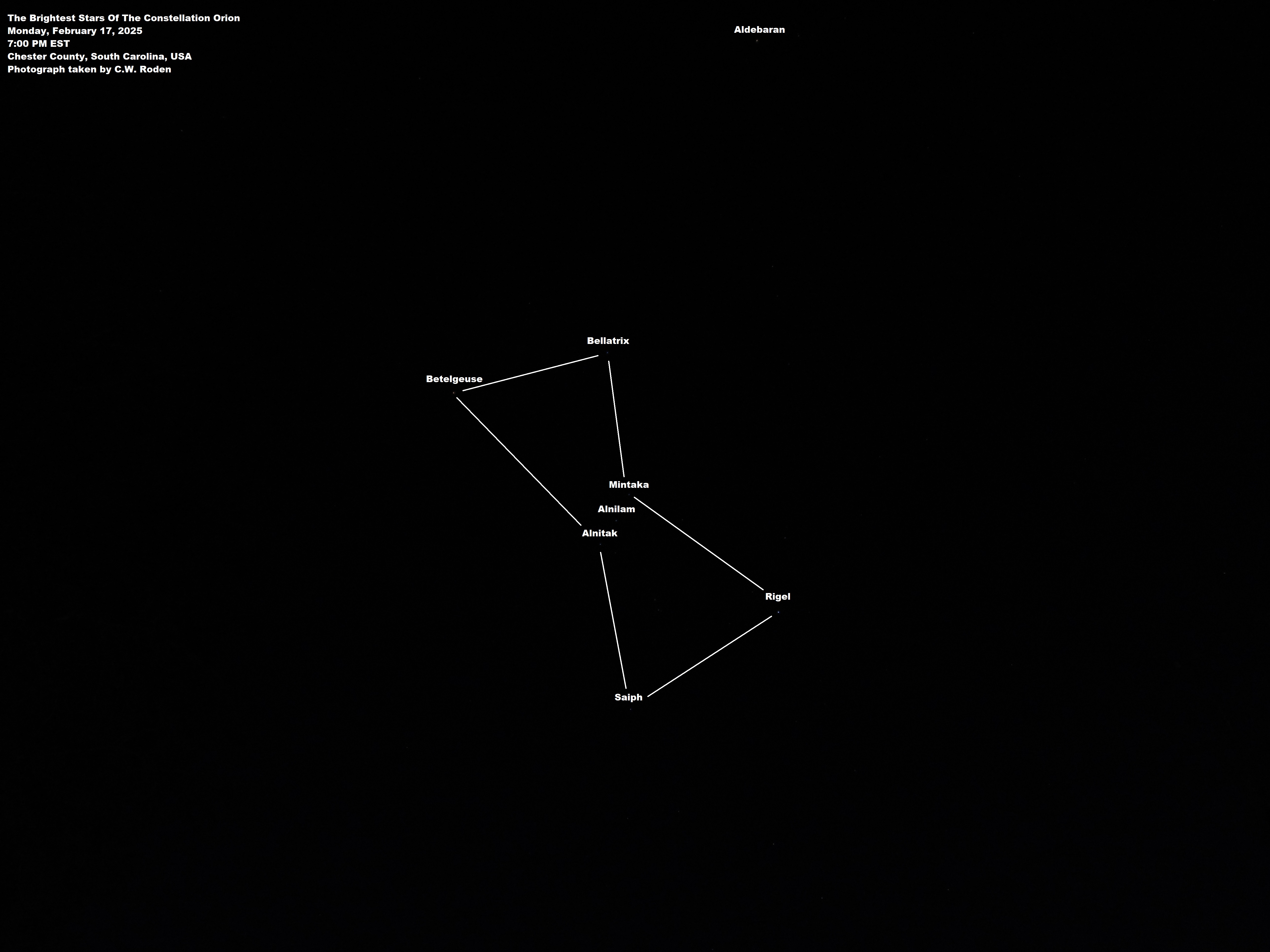
Monday, February 17, 2025
The Supergiant Stars Of The Constellation Orion
One of the most easily recognizable constellations in our night sky is Orion The Hunter, especially here in North America during the winter months.
The constellation, made up of a quadrangle of four bright stars in our evening sky shaped like an hour glass with three additional evenly spaced stars making up the center (or belt), gives Orion its distinctive look. Although they look like tiny dots of light in our evening sky here on Earth, all of them are actually much larger than our own yellow Sun.
While the G-type main-sequence star that inhabits the center of our own Solar System seems huge -- and make no mistake it is compared to the rest of the planets that orbits it -- next to the Constellation Orion stars, its relatively small in terms of scale and mass.
Here are a few fun scientific facts about each of these bright stars.
Rigel (or Beta Orionis) is generally the seventh-brightest star in the night sky and the brightest star in Orion. Rigel is a spectral type B8Ia blue supergiant (BSG) star approximately 120,000 times as luminous as our own Sun and is 18 to 24 times as massive in scale.
It is the brightest and largest component of a star system of at least four stars that appear as a single blue-white point of light to the naked eye as seen here on Earth. The three smaller stars of this system are all blue-white main-sequence stars, each three to four times as massive as the Sun.
The Rigel system is located at a distance of approximately 860 light-years (or 260 parsecs) from the Sun.
Betelgeuse (or Alpha Orionis) is a red supergiant star that is the second-brightest star in the constellation, and the tenth-brightest star in the night sky. It is also the largest star in Orion with an estimated radius between 640 and 764 times that of the Sun -- which would roughly be the distance between the center of our Sun to the somewhere between the orbits of Mars and Jupiter!
Betelgeuse lies about 642 light-years (or 197 parsecs) from our Solar System. Because Betelgeuse is a red supergiant, while it is much
larger and closer to us than Rigel, it burns less brightly due to the late stage of its
celestial lifespan.
![]() |
| Size comparison of Betelgeuse and Rigel compared to our Sun and other stars. |
Bellatrix (or Gamma Orionis) is the third-brightest star in Orion, and typically the 25th-brightest star in our night sky. Bellatrix is a B2 III-type giant star about six time the size of our own yellow Sun, and located about 244 light-years (or 75 parsecs) from the Sun, making Bellatrix the closest of the Orion constellation stars to our Solar System.
Saiph (or Kappa Orionis) is the other blue supergiant star that makes up the forth star in the constellation's main quadrangle. It is the sixth-brightest star in Orion with an estimated distance of about 650 light-years (or 200 parsecs) from the Sun.
Orion's
Belt is one of the most recognizable asterisms in the night sky and easily one of the most easily identifiable parts
of the constellation Orion consisting of three bright stars nearly equally spaced in a line in our night sky as
seen from our vantage point here on Earth. Although they appear close to
each other in the night sky, they are at varying distances some of the farthest Orion stars from our Solar System and each other.
Alnitak (or Zeta Orionis), the easternmost star in Orion's Belt, is a triple star system
approximately 1,260 light-years (or 486 parsecs) from our Solar System. The primary star, Alnitak
Aa, is a hot blue supergiant and the brightest Class O star in our night
sky. It has two companion stars: Ab and B. It's the fifth brightest star in Orion and the 31st brightest star in the night sky.
Alnilam (or Epsilon Orionis), the
central star in Orion's Belt, is a massive blue supergiant around 1,344 light-years (or 412 parsecs) making it the farthest Orion star from our Solar System. Its
the brightest of the three stars in Orion's Belt and the fourth-brightest star in the Orion
constellation. Alnilam is also the 29th-brightest star in our night sky and about 40 times the mass of our own Sun.
Mintaka (or Delta Orionis), the westernmost star, is located about 1,240
light-years (or 380 parsecs) from our Solar System and is closest to the celestial equator. It is a
multiple-star system composed of three spectroscopic components of about six stars, the main one being a Class O blue supergiant star similar to Alnitak Aa.
The
stars of Orion's Belt are several times more massive than the sun and
thousands of times brighter. Combined, the ten
stars of these three systems possess a luminosity approximately 970,000
times that of our own Sun!
![]() |
| The size of the Orion Belt stars compared to our own Sun. |
One more fun fact for all you amateur stargazers out there is that you can actually use these stars of Orion as a guide to locating other stars and nearby constellations. Please be sure to check out my previous blog post on the subject HERE.
Wednesday, January 03, 2024
Night Sky Photography -- 01-02-2024 -- Let's Talk About The Stars Of The Winter Triangle
Good evening fellow stargazers, and Happy New Year 2024!
Late last night, under beautifully clear starry skies
here in upstate South Carolina, I photographed the major stars of the
Constellations Orion The Hunter and his two dogs: Canis Major (The
Greater Dog) and Canis Minor (The Lesser Dog) highlighting the position
of the Winter Triangle that connects these three constellations.
For those of y'all who follow my night sky photography here on this blog site, you should be more than familiar with the Winter Triangle asterism. I've taken and outlined the three major stars that make up the Winter Triangle and their positions among their star constellations on several occasions.
Now that the winter season is in full swing here in North
America, this is the best time of the year to talk about the three
major stars of the Winter Triangle and some really interesting facts about these heavenly bodies.
One major fact about these stars is that all of them are much larger than our own bright yellow Sun. Two of the stars are almost double the size of the Sun and the final one is so large it would engulf half of our Solar System itself.
Let's begin with Sirius, the largest star in the Winter Triangle -- as well as the largest and brightest star visible in the night sky from here on the surface of the Earth.
Sirius (actual designation among astronomers by the Bayer designation Alpha Canis Majoris, or a Canis Majoris) is a bright bluish main-sequence star about twice the size of our own Sun and about 20 times as luminous. Its name is derived from the Greek word Seirios, meaning glowing. Sirius is nicknamed "The Dog Star" because of its position in the constellation Canis Major (The Greater Dog).
Sirius is also a binary star system, meaning there are in fact two stars. Bright Sirius A is the bright star visible here on Earth, while Sirius B is a smaller white dwarf companion that is barely visible through a good telescope. Sirius B (nicknamed "The Pup") is believed to be nearly the diameter of the Earth (7,500 miles, or 12,000 kilometers) and 10,000 times dimmer than Sirius A.
Both Sirius A and Sirius B orbit each other every 50 years at a distance of somewhere between 8.2 and 31.5 astronomical units -- roughly the distance between the planets Saturn and just between Neptune and Pluto in our own Solar System. At a distance of roughly 8.6 light-years, (or about 2.64 parsecs), the binary Sirius system is one of Earth's closest interstellar neighbors.
The next closest point of the Winter Triangle is the bright star Procyon (also known as Alpha Canis Minoris, or a Canis Minoris) in the smaller constellation Canis Minor (The Lesser Dog). The name is derived from the Greek word Prokyon, meaning "before the dog", since it seemingly precedes the "Dog Star" Sirius as it travels across the sky due to rotation of the Earth.
Procyon is relatively close to our Solar System at a distance of about 11.46 light-years (or 3.51 parsecs) from the Sun. Procyon is usually the 8th brightest star in the night
sky, with the best magnitude for brightness around the middle of January
every year.
Just like Sirius, Procyon is also a binary star system made up of two stars: Procyon A, which is a white main-sequence star; and Procyon B, which is a much smaller white dwarf star. Procyon A is estimated to be 1.4 times larger than our Sun, while Procyon B is just smaller than the Earth at about 5,300 miles (or 8,528 km). Both stars are separated by about 15 AUs -- about the distance between Saturn and Uranus in our Solar System -- and orbit each other once every 40 years.
Finally, we have the bright star, Betelgeuse, located in the upper part of the constellation Orion the Hunter. The name was derived from the Arabic phrase Yad al-Jawza' or "the hand of al-Jawza".
Betelgeuse is a red supergiant star and the 10th brightest star in the night sky visible from the Earth's surface. Also known to astronomers as Alpha Orionis, or a Orionis, its the largest star in the constellation Orion as well as the largest in the Winter Triangle. It sits at a whopping 642 light-years (or, 40.6 million AUs) distance from the Sun.
Betelgeuse's diameter is approximately 760 million miles (or about 1.2 billion km, or 8.1 AU) across
and is somewhere around 700 times as massive as the Sun. To put that in cosmic perspective, if Betelgeuse replaced our Sun in the Solar System, its circumference would engulf all of the four inner planets and the Asteroid Belt and would be just inside the orbit of Jupiter.
Despite being the largest star in the constellation, Betelgeuse is the second brightest star in Orion after the white supergiant star, Rigel, which sits near the bottom of the constellation. Although Betelgeuse is actually larger in terms of diameter, in terms of actual mass and energy output, Rigel is the king of Orion.
This huge red star is actually in the final stages of its life and is expected to become a supernova explosion at some point in the next 100,000 years.
So, when looking up at the winter constellations late at night over the next few months, really consider the size of those bright, beautiful points of light that make up the Winter Triangle.
Friday, October 20, 2023
Night Sky Photography -- 10-17/18-2023 -- The Winter Triangle Stars & Constellations In The Early Morning
Greetings fellow stargazers!
As we move past the middle of October here in South Carolina, the Winter Circle & Winter Triangle Stars and their constellations begin to return in the early morning sky.
Over the course of two mornings, Tuesday the 17th and Wednesday the 18th, about 45 minutes hour before sunrise I was able to capture some great shots of the brightest stars of the Winter Triangle constellations: Orion The Hunter, Canis Major, and Canis Minor.
On Tuesday the 17th -- just about 35 minutes, or so, before sunrise -- I captured a really great early morning shot of all the major stars of the Constellation Orion, the bright beautiful star, Sirius (Canis Major), Procyon (Canis Minor), as well as the red giant star, Aldebaran (Taurus The Bull), in my photograph.
These stars will continue to be early morning stars in autumn for at least the next month, or so, before becoming the prominent evening and nighttime stars of the winter months here in North America once again.
Wednesday, March 29, 2023
Night Sky Photography -- 03-28-2023 -- How To Use The Constellation Orion As An Astronomical Signpost
One of the coolest things about certain star constellations and asterisms that make up our evening sky dome is that they can be used to locate other nearby constellations and asterisms.
For example, in a previous post, I showed how one can use the Big Dipper to locate two of the major stars in the Spring Triangle and the Great Diamond asterisms.
This evening I took a few great photos of the major stars of the Constellation Orion the Hunter and his two dogs -- the constellations Canis Major The Greater Dog and Canis Minor The Lesser Dog.
Three of the major stars of these three separate constellations -- Betelgeuse in Orion, Procyon in Canis Minor, and Sirius in Canis Major -- form an equilateral triangle asterism in the evening sky called the Winter Triangle.
When you locate the asterism "Orion's Belt" in the sky dome, picture Orion The Hunter standing upright, with the stars Betelgeuse and Bellatrix marking out Orion's left and right shoulders, and Saiph and Rigel marking out his left and right feet.
Follow the three stars of Orion’s Belt down and to the left and draw line to find the bright star Sirius --The Dog Star -- in the Constellation Canis Major The Greater Dog.
Going back to Orion’s Belt, your next target lies up and to the right, following the line of the belt to the bright reddish star Aldebaran in the Constellation Taurus the Bull. If you keep on following this line past Aldebaran, a short distance later you’ll reach the Pleiades Star Cluster (also known as the "Seven Sisters").
Be sure to try it out and please let me know what y'all thought of this little presentation in the comments section below. As always have a wonderful evening and be sure to keep your eyes to the night skies, y'all hear.
Wednesday, March 08, 2023
Night Sky Photography -- 03-07-2023 -- The Full Worm Moon, The Hunter & His Dogs
This evening, I was blessed with clear skies and was able to capture some good shots of the March 2023 Full Moon -- or Full Worm Moon in North America -- in the evening just after 9 PM EST.
The title shot is the full moon with the foreground of the branches of the blossoming tree in my backyard. A nice little reminder that winter here in South Carolina is almost over (at least officially) and the spring equinox will be here in just two short weeks.
Here is a more clear shot of the full moon without any obstructions.
Now looking more towards the southern sky over the tree tops we can see three important winter constellations all connected by the Winter Triangle asterism: Orion The Hunter and his two dogs: "The Greater Dog" Canis Major and "The Lesser Dog" Canis Minor.
The Constellation Orion is easy to spot with the three stars of "Orion's Belt" -- Alnitak, Alnilam, and Mintaka -- forming the most easily recognizable asterism in the night sky. The Constellation Canis Major is probably the easiest to find because of the bright white star, Sirius -- the Dog Star -- shining brightly nearby.
Sirius and the star, Betelgeuse, that makes up Orion's shoulder, when joined by the other nearby bright star, Procyon, in the small Constellation Canis Minor, form a nearly perfect triangle-shaped asterism known as the Winter Triangle.
Saturday, September 17, 2022
Night Sky Photography -- 09-17-2022 -- Constellations Orion, Taurus, & Auriga With Mars & Last Quarter Moon
Good evening, fellow Stargazers!
Looking east two house after midnight, you can see the bright red planet Mars in the eastern sky between the Last Quarter Moon and the red giant star, Aldebaran -- the Eye of the Bull -- and the brightest star in the Constellation Taurus The Bull.
I was about to capture two really good wide shots of the brightest stars of three constellations: Taurus, Auriga, and Orion just above the tree lines.
As we move closer into the autumn months, these constellations, along with the other Winter Circle constellations will begin to return to the night sky.
Sunday, April 03, 2022
Night Sky Photography -- 04-03-2022 -- Constellation Canis Major "The Greater Dog" & The Winter Triangle
Good evening, fellow Stargazers!
This evening I was able to capture a really good shot of all the major stars of the Constellation Canis Major "The Greater Dog" low in the southern sky about an hour, or so, after sunset. The second photo is a great shot of the Winter Triangle asterism.
According to the stories, Canis Major and Canis Minor are the hunting dogs of Orion, and the Winter Triangle connects them.
The Winter Triangle surrounds most of the very faint Constellation Monoceros, although its brightest stars are fourth magnitude and hardly noticeable to the naked eye without a really good telescope lens.
Sunday, February 06, 2022
Night Sky Photography -- 02-05-2022 -- Constellation Monoceros The Unicorn
| Yeah folks, there really IS a Space Unicorn! |
Good evening fellow stargazers!
So tell me, how many of y'all believe in unicorns?
Would you believe me if I told y'all that you can find a unicorn in the night sky in the Northern Hemisphere? Its hard to find, but if you know where to look you can find the faint Constellation Monoceros The Unicorn inside the Winter Triangle asterism.
This evening I focused my camera hard on the Winter Triangle stars to locate the faint stars that make up Monoceros. Because this celestial unicorn contains only fourth magnitude stars its difficult to see with the naked eye. You need a really dark sky to see it.
If
y'all know exactly where to locate these particular stars, then you're one step
closer to locating the elusive unicorn.
As y'all might remember from my previous Night Sky Photography blog posts, the Winter Triangle is made up of three bright evening stars: Sirius, Procyon, and Betelgeuse. These three are the brightest stars in their respective star constellations: Orion The Hunter, Canis Major (the Greater Dog), and Canis Minor (the Lesser Dog).
My first two photographs taken from my back yard shows the three main stars of the Winter Triangle in the night sky dome this evening. I outlined the Winter Triangle and the constellations in relation to its major stars.
Tuesday, January 18, 2022
Night Sky Photography -- 01-18-2022 -- The Major Stars Of Orion & The Winter Triangle
Good evening fellow stargazers!
Tonight, I have for your viewing pleasure a couple of really good shots of all the major stars in the Constellation Orion The Hunter rising in the southeastern sky just over the treetops about 50 minutes, or so, after sunset.
As you can see, in my first shot, I outlined all the bright visible major stars that make up the constellation, as well as the nearby bright star, Aldebaran, higher overhead. In my second photograph, I listed each of the major stars in the constellation, including the famous Orion Nebula circled just beneath Orion's Belt.
Located on the celestial equator, the Constellation Orion can be seen throughout the
world and is clearly visible in the Northern Hemisphere in the night sky from about November to late February. The constellation is best recognized by the three bright stars: Alnitak, Alnilam, and Mintaka, which make up the asterism "Orion's Belt".
Two of the ten brightest stars in the night sky visible from Earth are located in the Constellation Orion: the blue-white supergiant star, Rigel, the 7th brightest star in the night sky and the brightest star in the constellation; and the reddish supergiant star, Betelgeuse, the 10th brightest star and the second brightest in Orion.
With the exception of the reddish supergiant, Betelgeuse, all of the main stars in the Constellation Orion are bright young blue-white
giants, or supergiants, ranging in distance from the closest star, Bellatrix at about 245 light-years, to the furthest star, Alnilam at about 1,342 light-years away.
The Orion Nebula
(Messier 42) appears as a slight white smudge beneath Orion's Belt and is located around 1,350 light-years away from Earth. The M42 nebula is estimated to be 24 light-years across and has a mass of about 2,000 times that of the Sun, making it one of the most visible nebulae visible to the naked eye if you know where to look.
For my final night sky offering of the evening I had to wait a couple hours to get a better shot of Orion and the two major stars: Sirius and Procyon, which along with Betelgeuse, make up the Winter Triangle asterism -- outlined in blue.
The Winter Triangle is an imaginary equilateral triangle formed by three of the brightest stars in the night sky and largest stars in three major star constellations.
Sirius (also known as the "Dog Star") is the brightest star visible from Earth in the night sky and the major star of the Constellation Canis Major (Greater Dog). Procyon (sometimes called the "Little Dog Star") is the 8th brightest star in the night sky, and the major star of the Constellation Canis Minor (Lesser Dog). Both Sirius (at about 8.6 light-years away) and Procyon (about 11.4 light-years) are close cosmic neighbors to our Sun.
In Greek mythology, both dogs accompany Orion the hunter as he tracks Taurus the Bull through the heavens.
Well I hope y'all enjoyed this evening's night sky offerings and learned something pretty interesting about our heavenly neighbors.
Thursday, January 13, 2022
Night Sky Photography -- 01-12-2022 -- The Moon, Pleiades, & Hyades Star Clusters
Good evening, y'all!
Well, my first night sky photographic offering of 2022 are ones I think y'all will thoroughly enjoy. They involve two beautiful star clusters: the Pleiades and the Hyades.
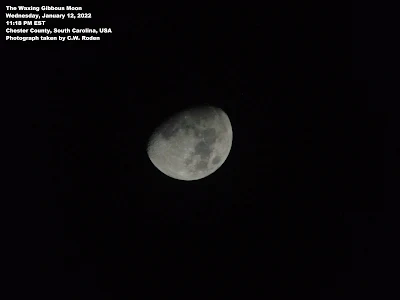
This evening several hours after sunset the Waxing Gibbous Moon could be seen with the faint Pleiades Star Cluster in the night sky.
The Pleiades (Seven Sisters) could be seen just outside of Luna's glare. I took one photo using the trunk of a tree to block out the Moon's glare and get what turned out to be a really beautiful shot of all of the major stars in the star cluster. The Pleiades are about 444 light-years away from our Sun.
My second photo is a wide shot with the tree in the foreground of the moon and Pleiades with three of the major stars of the Winter Hexagon asterism: Aldebaran, Rigel, and bright Sirius just visible in the corner of the photograph. Rigel, along with the stars Betelgeuse and Bellatrix are the three brightest in that order that make up the Constellation Orion The Hunter outlined in the photo.
The second star cluster visible with Luna in the night sky tonight is the V-shaped Hyades cluster, which makes up the "head" of the Constellation Taurus The Bull. The brightest star is Aldebaran: the Eye of the Bull. This cluster is easy to locate using the Orion's Belt asterism as a line to Aldebaran.
Although not a true member of the Hyades star cluster, the bright reddish star is a great guide to this cluster. Aldebaran is only about 65 light-years distant. The Hyades themselves are about 153 light-years distant, with Aldebaran in the light of sight between the cluster and our Sun.
In the Northern Hemisphere, both the Pleiades and the Hyades star clusters are best seen in the evening sky from around January to April. Both star clusters are made up of many more fainter stars that are not visible to the naked eye (especially closer to city lights) but can be seen with the aid of a telescope, binoculars, or a really good camera lens.
And finally, my last offering to start out 2022 is a pretty beautiful shot of our dear Luna in her Waxing Gibbous Phase.
Well folks, I hope y'all enjoyed my offerings for the evening. Tomorrow evening, in the Northern Hemisphere, the moon's path with take it close to Aldebaran. Be sure to check it out -- clear skies permitting, of course.
Until next time have a wonderful evening and be sure to keep your eyes to the night skies, y'all hear!
Monday, January 18, 2021
Interesting Facts About The Constellation Orion
Greetings fellow night sky fans!
Tonight I thought I'd share something pretty interesting tidbits
about the Constellation Orion for y'all.
Named by Western cultures for the hunter in Greek mythology, Orion is probably the most prominent constellation easily recognizable in our sky dome. In the Northern Hemisphere, Orion is most visible in the evening sky from January to March during the winter months. It lies on the celestial equator and is one of the brightest and best known constellations in the night sky.
Orion is largely made up of eight prominent stars.
The B-type blue super giant star, Rigel (Beta Orionis) and the red giant star Betelgeuse (Alpha Orionis) are the two brightest stars of the constellation respectively. Rigel is the sixth-brightest star in the night sky as seen from Earth. Rigel’s distance is estimated to be around 773 light-years, while the distance to Betelgeuse is estimated to be about 724 light-years away.
The this constellation's most distinctive feature are the three stars that make up the Orion's Belt asterism: Alnitak (Zeta Orionis), Alnilam (Epsilon Orionis), and Mintaka (Delta Orionis). The names of the three stars come from Arabic word Alnilam which means "string of pearls" Looking for Orion's Belt in the night sky is the easiest way to locate Orion.
The other prominent stars that make up Orion are: Bellatrix (Gamma Orionis), Saiph (Kappa Orionis), and Meissa (Lambda Orionis).
In Greek mythology and astrology, Orion the hunter is accompanied by his hunting dogs: the constellations Canis Major and Canis Minor, and is hunting Taurus the Bull.
One can easily find the major stars of each of these three constellation by using Orion as a starting point.
Using Orion's Belt as a straight line an amateur stargazer can easily locate the "dog star" Sirius, the brightest star in the night sky as seen from Earth, to the bottom left.
Going the opposite way, using the upper part of Orion's Belt one can make a line to Aldebaran, the "Eye of the Bull" and the brightest star in the constellation Taurus.
Finally using Betelgeuse as a starting point one can make a straight line to the star Procyon, the brighter of the two stars that make up the "lesser dog" Canis Minor.
Betelgeuse, along with the stars Procyon and Sirius, also make up the Winter Triangle asterism. These three stars are three of the ten brightest objects, as viewed from Earth, outside the Solar System.
In addition, Orion itself is also a part of and largely surrounded by an even larger asterism, the Winter Circle (or Winter Hexagon) with Orion's brightest star, Rigel, making up one of its six major stars.
![]() |
| The major stars of the Winter Triangle and Winter Circle (Winter Hexagon) as seen in the night sky with the constellation Orion in the winter months in the Northern Hemisphere. |
In the winter months one can find Orion by looking to the east an hour after sunset. The easiest way to spot it is to find Orion's Belt.
Well folks, I hope y'all enjoyed this presentation. Let me know in the comments section below.
Thursday, January 14, 2021
Night Sky Photography -- 01-12/14-2021 -- Constellations Orion & Taurus, The Winter Triangle, & The Winter Circle
Good evening, fellow Stargazers!
Over a couple of cloudless evening this month, I managed to get some really good shots of two of the winter month's most prominent star constellations: Orion The Hunter and Taurus The Bull.
The bright stars Sirius, Betelgeuse, and Procyon (the primary stars in the three constellations of Canis Major, Orion, and Canis Minor, respectively) make a triangle, which I mentioned before in previous blog posts is sometimes called the Winter Triangle asterism in the Northern Hemisphere. Betelgeuse makes up the "shoulder" of the Hunter. Follow the line of the three stars of Orion's belt to find Sirius The Dog Star. Procyon makes up the third corner of the triangle outlined in red in the photo.
Also pictured in the photo are the stars Aldebaran, Rigel, Pullox, and Castor which make up part of the larger Winter Circle (or Winter Hexagon) asterism, which I outlined in yellow. The star Capella which makes up the last star in the Winter Circle, is out of frame. Aldebaran is of course the major star of the Constellation Taurus, also known as the "Eye of the Bull".
These two constellations and the Winter Triangle and Winter Circle asterisms will remain prominent in the night sky throughout the winter months in the Northern Hemisphere. Look for them rising in the east an hour after sunset.
Have a wonderful evening and please keep your eyes on the night skies, y'all!
Friday, October 30, 2020
Night Sky Photography -- 10-30-2020 -- The Constellations Orion & Taurus with the Winter Triangle
Good morning my friends and fellow stargazers!
I woke up pretty early this morning and went into my front yard to see the stars. It was thankfully cloudless and I was able to see the major stars of the constellations Orion The Hunter and Taurus The Bull looking south and west.
As y'all can see, using one of the road lamps as foreground, I was able to capture both constellations and the three major bright stars that make up the Winter Triangle asterism: Sirius, Procyon, and Betelgeuse.
Sirius is, of course, the brightest star in the night sky and the brightest star in the Constellation Canis Major (the Greater Dog). Sirius is actually the brightest star in a binary star system, with its smaller twin (Sirius B) invisible except through a telescope.
Procyon is the brightest star in the Constellation Canis Minor, and at a distance of just around 11.5 light-years, is one of Earth's nearest celestial neighbors. Procyon is usually the eighth-brightest star in the night sky.
Finally, we have the red giant star Betelgeuse, which is usually the tenth-brightest star in the night sky and, after Rigel, the second-brightest in the Constellation Orion. Betelgeuse is one of the largest stars visible to the naked eye. To give y'all an idea of how big Betelgeuse actually is, if it were at the center of our Solar System, its surface would lie beyond the asteroid belt and it would engulf the orbits of Mercury, Venus, Earth, Mars, and possibly Jupiter. Now that's big folks!
Well, that's it for this evening folks. Be sure to come back tomorrow night for, what I hope to be, a very awesome shot of the Halloween Blue Moon of 2020. Till then, keep your eyes to the night skies, y'all!
Friday, May 08, 2020
Night Sky Photography -- 05-07-2020 -- Full Flower Supermoon & Venus With Constellation Auriga
Tonight I thought I would travel one town over to neighboring Richburg, South Carolina and get a shot of the last supermoon of 2020 rising in the east over the town.
I was able to capture three shots: the first of the moon just over SC Highway 9, the second in the same spot with the brightness adjusted to get a better shot of the surface of the moon itself, and finally one gorgeous close-up of the surface of the full moon itself.
The May full moon is also known as the Full Flower Moon, or Milk Moon.
The month of May will be the last full month that the bright planet Venus will appear in the western evening sky for the year 2020.