Showing posts with label Constellation Taurus. Show all posts

Saturday, September 13, 2025

Night Sky Photography -- 09-13-2025 -- The Moon With Uranus & The Pleiades In Late Evening Sky

Greetings & Salutations, fellow amateur stargazers!

I stayed awake pretty late yesterday evening to capture some really good photos of the Moon with the Pleiades Star Cluster (also known as the "Seven Sisters") and the very faint distant planet, Uranus, in a near triangle in the eastern sky just above the treetops.


Uranus, the 7th planet in our Solar System, is currently 1.78 billion miles (or 2.86 billion kilometers) from Earth and you really have to know where to look to spot it. Even then it only appears faintly through a good pair of binoculars, or a telescope. I was fortunate enough to catch Uranus in the close-up photo of the three heavenly bodies. In my other photos I marked the approximate place Uranus sits.

In my second photo is a close-up shot of Luna with the Pleiades where I was able to capture all of the major stars of the Seven Sisters cluster and many of their companion stars. This one came out beautifully with the Pleiades just past the bright glare of the Moon.


In my wider shots, I captured most of the nearby major stars of the Constellations: Taurus The Bull, Auriga The Charioteer, and Perseus The Hero. I caught the more open Hyades Star Cluster (the "head" of Taurus) just above the trees -- y'all can see the reddish tint of the red giant star, Aldebaran.

I labeled all the major stars of each constellation, as well as outlined the constellations themselves to put them in relation to the current positions of the Moon and Uranus in the night sky.


If any of y'all want to try and locate Uranus for yourselves, she will be close to the Pleiades for a good while since her orbit around the Sun is slow -- it actually takes about 84 Earth years for Uranus to complete a single orbit around the Sun!

Look for Uranus about one degree (or the length of the tip of your pinky finger on your outstretched arm)  southeast of the Pleiades as they rise in the eastern sky.

Another good opportunity to see all three of these beautiful night sky features together again will come next month on the morning of Friday, October 10th, when Luna will actually occult -- or cross in front of -- the Pleiades. Uranus will still be relatively close and should appear just outside of the Moon's glare.

I hope y'all enjoyed this post and as always keep your eyes to the night skies, y'all.

Monday, July 21, 2025

Night Sky Photography -- 07-21-2025 -- The Moon & Venus With Taurus The Bull Before Sunrise


About 90 minutes before sunrise this morning, I was able to capture this outstanding shot of the moon and Venus rising in the east with all the major stars of the Constellation Taurus The Bull -- including all the stars of the Hyades Star Cluster and the nearby Pleiades high overhead. I also managed to capture the nearby bright star Capella, which is the major star of the Constellation Auriga The Charioteer.

Venus is inside Taurus and will be for the rest of July. The bright red star, Aldebaran -- the Eye of the Bull -- can be seen next to Venus and marks the arrow-shaped Hyades Star Cluster.


Sunday, January 05, 2025

Planerary Photography -- 01-01-2025 -- Jupiter In Taurus With The Hunter and Dogs

Happy New Year 2025, Y'all!

I mean to actually post these the other day, however I've been feeling very under the weather with a severe cold and flu, so I apologize for the delay in posting as I'm still in recovery.

At exactly midnight here on the East Coast of the United States on Wednesday, January 1st -- the official star of New Year's Day in my little corner of Dixie -- I set up my camera and tripod and fixed it overhead into the wonderfully clear sky to capture this outstanding photo of the largest planet in our Solar System, Jupiter, inside the Constellation Taurus The Bull. I was also able to capture the brightest stars of the nearby constellations Orion The Hunter, Canis Major The Greater Dog, and Canis Minor The Lesser Dog.

I duplicated the photo so that I could outline the positions of the constellations, as well as the Winter Circle asterism in the shot.


Look for bright Jupiter overhead and you will easily be able to find the Constellation Taurus since, due to its slow orbit around the Sun, Jupiter is going to remain inside the large V of Taurus well into early May as seen here in North America when the winter constellation disappears from view to give way to the summer stars thanks to the Earth's rotation.

That's all for now, but I plan to have more night sky photography for y'all soon, good weather and clear skies permitting.

Sunday, October 13, 2024

Night Sky Photography -- 10-13-2024 -- Jupiter & Mars With Early Morning Winter Stars

Salutations once again, fellow stargazers!

Now that autumn here in North America is here, the morning skies overhead an hour before sunrise will begin to feature the stars and constellations of the Winter Circle, most of which will begin rising after about an hour before midnight the evening before.

Both the planets Mars and Jupiter can now be seen inside the Winter Circle with the Red Planet near the Constellation Gemini the Twins and Jupiter inside the Constellation Taurus the Bull.

Early this morning, I stepped outside and set up my tripod in the front yard, focusing my camera up at the two planets, as well as the brightest points of light near them, and took several very clear photographs. Because of the wonderfully clear morning sky overhead, I managed to capture not only our nearest planetary neighbors, but all the beautiful stars of four of the Winter Circle constellations -- as well as Sirius, the brightest star that can be seen from Earth.

In the first photo, I labeled both Mars and Jupiter, as well as all the major stars of the constellations around them and in the second I outlined the constellations themselves, including the location of the Winter Triangle asterism.


Looking up at those beautiful stars and planets in a clear autumn sky, its almost hard to imagine just how far away most of them are.

The closest of them, Mars, is actually over a hundred million miles from Earth at present and getting slightly closer as the planet moves in its orbit towards its opposition to Earth in January of 2025, and will appear to be getting even bigger in the early morning sky over the next couple of months. Even at its closest approach, Mars will only be about 60 million miles from Earth since this opposition puts the small planet will be near its aphelion, or the point farther away from the Sun in its orbit.

In my final photo of the post, I labeled not only the planets and the major stars and the location of the Orion Nebula, but I also added the exact distance from Earth to put into perspective just how massive our nearest galactic neighbors are. Also keep in mind most of those points of light that we see comes from light that took decades in most cases to reach our curious eyes.


With that in mind, I bid all of y'all a wonderful day. More evening photography will be coming soon, until then keep your eyes to the night skies, y'all hear.

Thursday, September 26, 2024

Night Sky Photography -- 09-24-2024 -- Last Quarter Moon & Constellations After Midnight

About one hour after midnight on Tuesday, September 24th, I captured several photos of the rising Last Quarter (Third Quarter) Moon and the planet Jupiter sitting between the Constellations Taurus The Bull and Auriga The Charioteer just over the tops of the trees. 

The first photo is a wide shot of the major stars and star clusters near Luna and Jupiter as seen from here on Earth in the sky dome. The second photo is a closer shot where I've outlined the constellations themselves. The final shot is a close-up of the Last Quarter Moon for September -- the first major Moon Phase for the autumn season here in South Carolina and the Northern Hemisphere.

The planet Jupiter can be seen inside the Constellation Taurus in the second photo, where I outlined the position on the major stars of both constellations on either side of the bright Last Quarter Moon.

The bright star, Elnath, can be seen just next to Luna. At approximately 134 light-years (or 41 parsecs) distance from our Sun, Elnath is the second-brightest star in the Constellation Taurus, and connects the bull with the Constellation Auriga.

Thursday, August 01, 2024

Night Sky Photography -- 08-01-2024 -- Planets & Morning Constellations Rising

Good morning, y'all!

Well folks, very early this morning -- at about 90 minutes before sunrise -- I went out into my backyard to capture a pair of really outstanding shots of the planets Jupiter, Mars, & Uranus as they appeared in the sky just above the trees.

In the first photo, I labeled the planets, as well as the brightest stars of the Constellations Taurus The Bull and Auriga The Charioteer, with the Waning Crescent Moon lower on the horizon. In the second photo, I outlined both constellations and all of the stars that made up both. They came out really clear in the shots. In addition to the stars of the Hyades Star Cluster, which makes up the head of Taurus The Bull, I captured the stars of the Pleiades Star Cluster just above it and marked the position of the planet Uranus.


Jupiter and Mars are both easy to spot as the two planets still remain close to the bright red giant star, Aldebaran and appear as a triangle of "stars" inside the Constellation Taurus. Both planets are moving ever closer to a conjunction on the mornings of Wednesday, August 14th and Thursday, August 15th later this month.

Uranus is slightly harder to spot unless you know precisely where to look. At the present time the position of the distant 7th planet of our Solar System can be found about two degrees, or so, to the left of the Pleiades Star Cluster. I marked the location in both photos since. If you have a good telescope, or a really good pair of binoculars, y'all should have no trouble spotting the faint planet about an hour before sunrise.

The brightest star of the Constellation Auriga is Capella, the sixth-brightest star in the night sky, and the third-brightest in the northern celestial hemisphere after Arcturus and Vega.

Although it appears to be a single star to the naked eye, Capella is actually a quadruple star system -- two binary pairs, made up of two bright-yellow giant stars, (Capella Aa and Capella Ab) both of which are around 2.5 times larger than our own Sun, and two smaller
and relatively cool red dwarf stars (Capella H and Capella L) which are around 10,000 astronomical units (AU) from the other pair. The system is relatively close to our Solar System, estimated to be about 42.9 light-years (or 13.2 parsecs) from the Sun.

Both the Constellations Auriga and Taurus are connected by the bright star, Elnath, which also happens to be the second-brightest star in both constellations. Elnath is a giant star about 134 light-years (or 41 parsecs) from the Sun. 


Well I hope y'all enjoyed my photos. I hope to have more soon, good weather permitting. Have a wonderful Dixie day, and be sure to keep looking at the skies, y'all.

Tuesday, July 16, 2024

Night Sky Photography -- 07-15-2024 -- Mars & Uranus Conjunction Before Sunrise!

Greetings fellow stargazers!

On the morning of Monday, July 15, 2024, your favorite blogger had to wake up early -- about 90 minutes before sunrise to be exact -- to drive out into the country a little and find a nice spot to capture the conjunction of the planets Mars and Uranus. I was also able to capture some wonderful shots of the planet Jupiter and the bright red giant star, Aldebaran, in the Constellation Taurus the Bull.

After setting up my tripod, I captured this first photo over the tree line facing south-southeast. I decided not to label this one so you can get an idea of how I saw it for myself.


You can see what appears to be two red points and a large bright point set in a oblong triangle in the nautical twilight as they appeared to the naked eye. The large bright spot is Jupiter, while the smaller red spots are Aldebaran positioned to the right of Jupiter and the planet Mars in the upper corner.

Using the lens as a filter to capture more points of light not quite visible to the naked eye, I captured nearly all the stars of the Hyades Star Cluster -- which make up the "face" of the Constellation Taurus the Bull -- and the nearby Pleiades Star Cluster between Mars and the current position of Uranus in the night sky as seen from the Earth's surface. The wider shot also captured the nearby stars Elnath and Capella closer to the east and coming sunrise. The close up shot shows both the Hyades and Pleiades clusters more clearly.


Mars is easy to spot due to its bright red-orange hue, though distant Uranus is impossible to see with the naked eye and requires a really good lens to spot. Thankfully I have a good 35X Sony Optical Zoom lens on my camera and, at maximum magnification, was successfully able to capture a really good close-up of the two planets together at just half-a-degree apart.


Although they appear to be "meeting" in the early morning sky from out vantage point here on the surface of the Earth; the two worlds are actually quite a distance apart.

The large ice giant planet Uranus, the 7th planetary body in our Solar System, is roughly about 1.86 billion miles (just over 3 billion kilometers, or 20.16 AUs) from our Earth at the moment, while Mars, the 4th planet and our nearest planetary neighbor, is about 155 million miles (around 250 million kilometers, or 1.67 AUs) from Earth.

Finally, I took a couple of good shots of Jupiter, now currently a part of the Constellation Taurus for at least the next month in the early mornings. The first show a close-up of Jupiter with bright red Aldebaran, the "Eye of the Bull" close by. The final show captures all the stars of the Hyades Cluster, which I highlight outlining the head of the Constellation Taurus.


The large gas giant planet, Jupiter, the 5th planet in the solar system, is currently about 532 million miles (857 million kilometers, or 5.7 AUs) from the Earth. Aldebaran is much father away at a distance of approximately 65 light-years from our Sun and is the 14th brightest star in the night sky as seen from Earth.

Later this month, on Tuesday, July 30th, the crescent moon will cross between Mars and Jupiter in the early morning sky. Over the next month both planets will continue to move closer to each other towards their own conjunction in the morning sky on Monday, August 12, 2024....which I hope to be able to photograph, God and good clear skies willing.


Well folks, I hope that y'all enjoyed my photos and to all my fellow amateur sky watchers be sure to keep your eyes to the night skies, y'all hear.

Tuesday, March 19, 2024

Night Sky Photography -- 03-18-2024 -- The Winter Triangle Constellations & Major Stars Before Spring

Last night about 50 minutes after sunset the sky was really clear and so I was able to take this really beautifully clear photo of every major star of the Constellations Orion, Canis Major (The Greater Dog), and Canis Minor (The Lesser Dog) as well as the nearby Constellation Taurus The Bull and its two largest stars: Aldebaran and Elnath.


Very soon we'll be saying goodbye to these constellations -- at least for a few months -- as they will begin to move lower towards the setting sun during the coming spring months here in the Northern Hemisphere. Spring here officially begins on Tuesday, March 19th.

Tuesday, February 20, 2024

Night Sky Photography -- 02-20-2024 -- The Moon, The Twins, & Major Winter Stars

Good evening, fellow stargazers!

On the evening of Tuesday, February 20th, I captured this really clear shot of our lovely Moon near the twin stars: Castor and Pollux -- the two main stars of the Constellation Gemini The Twins -- along with the other nearby winter stars and their constellations.

The first is the original photo taken showing Luna along with the stars and their positions in the sky dome. The second is the same photo with the star constellations of Orion The Hunter, Canis Minor "The Lesser Dog", and Taurus The Bull in relation to the bright Gemini Twins -- the stars for their constellation are unfortunately not visible due to the brightness of the Waxing Gibbous Moon phase.

The Winter Triangle stars of Procyon and Betelgeuse are all clearly visible and mark the positions of Orion and Canis Minor. Sirius, the brightest star of the Constellation Canis Major "The Greater Dog" is at the very bottom making up the final point of the Winter Triangle. Unfortunately I could not get the entire constellation itself into frame.


Luna sits right beside the giant star Pollux, the brightest star of the Constellation Gemini and the 18th brightest star in our night sky. Pollux sits about 34 light-years (or 10.4 parsecs) distance from our Sun and its the closest giant star relative to our Solar System.
Pollux is almost nine times the diameter of our sun and about 30 times the sun’s brightness in visible light.

Its "twin" Castor, the second-brightest star in Gemini, is a bit more tricky since its not one, but six stars that appear as one to the naked eye. The Castor system is organized into three binary pairs made up of two bright white A-Type stars with four smaller M-Type red dwarf stars that orbit each other. Castor sits about 51 light-years (or 15.6 parsecs) from the Sun.


Castor Aa, the main star of the system, is more than twice the
size of our own Sun.
Image via NASA/ JPL-Caltech/ Wikimedia Commons (public domain).

Thursday, February 01, 2024

Night Sky Photography -- 01-31-2024 -- The Galactic Anticenter & Winter Stars

Good evening, fellow stargazers! 

As we get ready to exit the winter month of January here in the Northern Hemisphere and start into February, overhead the Winter Circle star constellations rise high into the sky dome in late evenings and travel westward to set in the late night-early morning hours.

Looking up at the brightest of these stars inside the Winter Circle (Hexagon) you are actually looking towards the opposite end of our own Milky Way Galaxy.

In the summer months in the Northern Hemisphere, you can look towards the spot in our evening sky where our own galaxy's center is located, as seen in my previous Night Sky Photography post HERE.

The opposite can be seen in the winter months where the season's most prominent constellations show us the location of the Galactic anticenter -- the area of space that's directly opposite to the Galactic Center looking towards the far end of the galaxy as viewed from our Earth.


The actual location of the Galactic anticenter is easy to find since its very close to the bright star, Elnath (or Beta Tauri) located at the point that connects the Constellations Taurus The Bull and Auriga The Charioteer. Elnath is the second-brightest star of Taurus and is located approximately 134 light-years distance from our Sun.

My photographs for the evening show the location of the Galactic anticenter near Elnath, as well as the best way to spot it using the winter constellations as a guide.
Locate Elnath and you find the Galactic anticenter in the night sky.

The first photo shows the bright stars overhead just two hours before midnight on the last day of the month of January. In my second photo (taken just a moment later), I outlined the location of the constellations themselves, with the Galactic anticenter located right at the junction where Taurus meets Auriga next to Elnath. 


Well, I hope that y'all enjoyed my photos for the evening. Let me know what y'all think in the comments section and as always have a wonderful evening and be sure to keep your eyes to the night skies, y'all.

Wednesday, September 13, 2023

Night Sky Photography -- 09-09-2023 -- Jupiter & Uranus With Orion & Taurus Star Clusters

Salutations fellow stargazers!

Now that September is here, with the fall equinox only a few weeks away, the winter constellations are rising very early in the morning -- or really late at night depending on your perspective.

This time I was up very early, but the night time skies overhead here in my part of South Carolina were mostly clear, though storms were expected before sunrise.

Nevertheless, I was able to capture three really good photographs of two of the most well known of the constellations: Orion The Hunter and Taurus The Bull with the planets Jupiter and Uranus close by.

The first two photos are the wide shots showing the major stars of these constellations with bright Jupiter just above them. Uranus is too far away in these shots to see, so I labeled the distant outer planet's location with a star in its position between Jupiter and the Pleiades Star Cluster.


My third, and final photo, is the close-up Jupiter and Uranus (still just barely visible) with the Pleiades and the Hyades Star Cluster located in the Constellation Taurus The Bull.


At its present distance Uranus, the seventh planet in our Solar System, is approximately 1.78 billion miles (or 2.864 billion kilometers -- or 159.25 light-minutes) from our Earth. Jupiter is much closer at 401.33 million miles (or 645.87 million kilometers -- or 35.56 light-minutes) from us here on Earth.

Wednesday, March 29, 2023

Night Sky Photography -- 03-28-2023 -- How To Use The Constellation Orion As An Astronomical Signpost


Good Evening, fellow stargazers!

One of the coolest things about certain star constellations and asterisms that make up our evening sky dome is that they can be used to locate other nearby constellations and asterisms.

For example, in a previous post, I showed how one can use the Big Dipper to locate two of the major stars in the Spring Triangle and the Great Diamond asterisms.

This evening I took a few great photos of the major stars of the Constellation Orion the Hunter and his two dogs -- the constellations Canis Major The Greater Dog and Canis Minor The Lesser Dog.

Three of the major stars of these three separate constellations -- Betelgeuse in Orion, Procyon in Canis Minor, and Sirius in Canis Major -- form an
equilateral triangle asterism in the evening sky called the Winter Triangle.


The Constellation Orion is the key to locating not only two dogs, but also the constellations Taurus The Bull and Gemini The Twins; as well as the Pleiades Star Cluster by following a series of lines using Orion as a starting point.

When you locate the asterism "Orion's Belt" in the sky dome, picture Orion The Hunter standing upright, with the stars Betelgeuse and Bellatrix marking out Orion's left and right shoulders, and Saiph and Rigel marking out his left and right feet.


Follow the three stars of Orion’s Belt down and to the left and draw line to find the bright star Sirius --The Dog Star -- in the Constellation Canis Major The Greater Dog.


Draw a line from Betelgeuse -- Orion's left shoulder -- and keep going to find a solitary bright star, Procyon in the Constellation Canis Minor The Lesser Dog. This line also serves as one of the three triangular lines of The Winter Triangle.

Draw a line from Rigel -- Orion's right foot -- up past Betelgeuse and keep going until you reach the two bright stars Castor and Pollux in the Constellation Gemini The Twins.

Going back to Orion’s Belt, your next target lies up and to the right, following the line of the belt to the bright reddish star Aldebaran in the Constellation Taurus the Bull. If you keep on following this line past Aldebaran, a short distance later you’ll reach the Pleiades Star Cluster (also known as the "Seven Sisters").


If you remember these easy steps, then finding all the major constellations and asterisms near Orion in the evening sky is simple.

Be sure to try it out and please let me know what y'all thought of this little presentation in the comments section below. As always have a wonderful evening and be sure to keep your eyes to the night skies, y'all hear.

Tuesday, February 28, 2023

Night Sky Photography -- 02-27-2023 -- 1st Quarter Moon & Mars With Constellations Taurus and Orion


Good evening fellow stargazers!

After a couple of days with cloudy, dreary skies, this evening a surprisingly warm breeze for late February arrived and cleared the evening sky dome enough for your favorite blogger to capture a couple of beautiful images of the First Quarter Moon with the planet Mars a few hours after sunset.


Though the small red planet is dimming in brightness as it moves farther away in its orbit around the Sun with our Earth, Mars is still easily visible at night inside the Constellation Taurus The Bull.

Oh and speaking of Taurus and its famous hunter, the Constellation Orion The Hunter, thanks to the evening breeze and clear skies, I captured a couple of outstanding shots of all the major stars of both constellations. I labeled all of them and highlighted the constellations themselves in the next shots.


Once again my thanks to God for the beautiful clear skies and the heavenly display of the closest bright stars in our galaxy. I pray for clear skies again this Wednesday, March 1st when Jupiter and Venus will merge in conjunction in the western skies.

I hope to be able to post some beautiful shots of that meeting, but if I can't y'all can check it out for yourselves that evening just after sunset. Spotting the two "wandering stars" should not be hard.

Wednesday, November 30, 2022

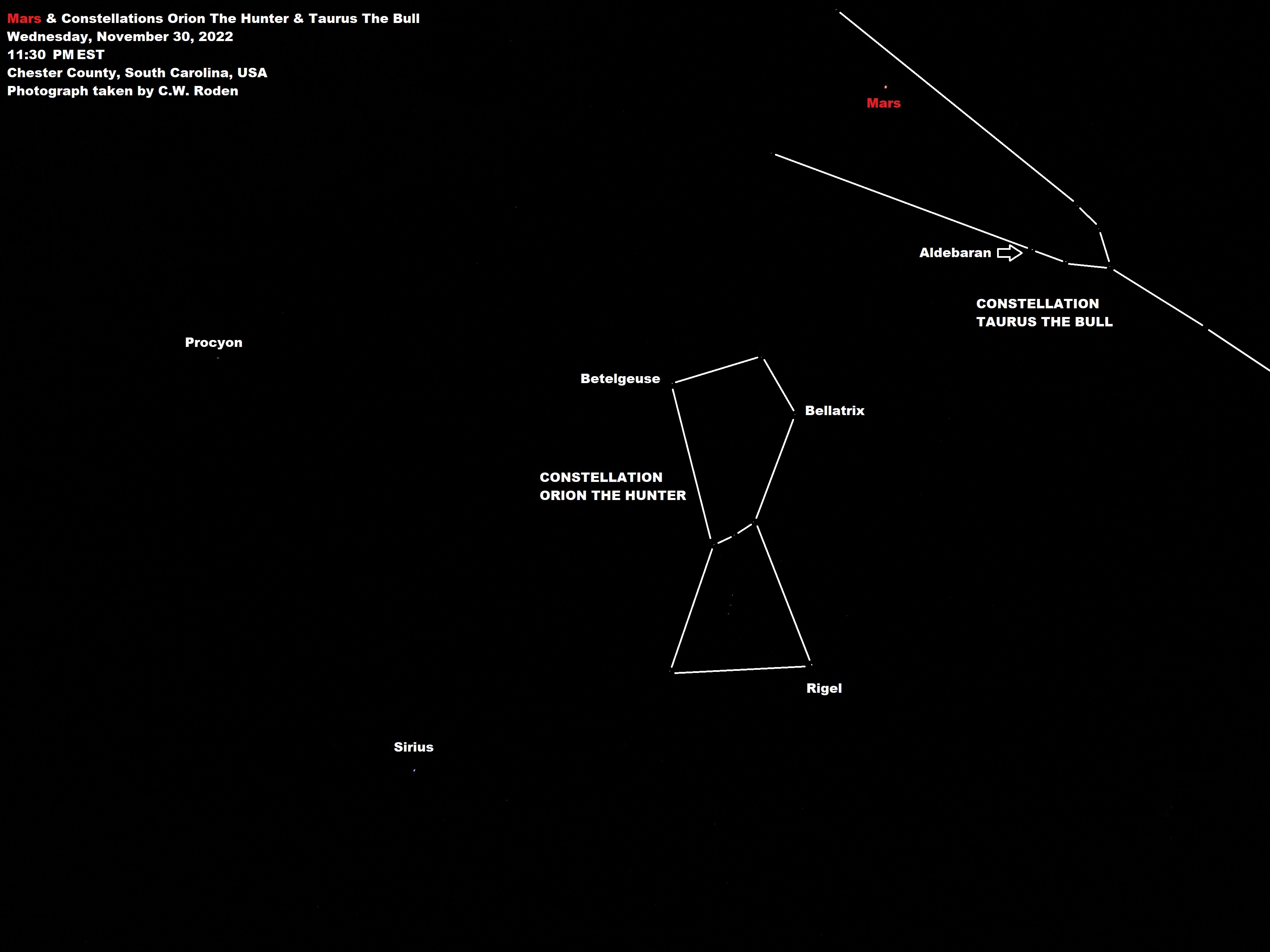
Night Sky Photography -- 11-29-2022 -- Mars Closest To The Earth Before Opposition

Good even fellow stargazers!

About every 26 months, our closest neighboring planet, Mars, reaches its opposition to Earth -- the moment that Earth is directly between a planet and the Sun. This also puts the Red Planet closer to our Earth in its orbit, making it glow slightly brighter as it approaches.

On the evening of Tuesday, November 29th and early morning of Wednesday, November 30th, Mars was at its closest to the Earth during this transition towards opposition.
At its closest approach this year, Mars was about 51 million miles (or 4.5 light-minutes) from the Earth.

Right now Mars is slightly brighter now than Sirius, the night sky’s brightest star, and it’s noticeably red-orange in color. Mars will continue to increase in brightness until its opposition on the night of December 7th - 8th, then will begin fading by the end of the month.

Mars is currently located inside the Constellation Taurus The Bull and will be for most of this month. Aldebaran, the brightest star of Taurus (also known as the "Eye of the Bull") also shares a slightly reddish color, meaning that there are two bright red evening "stars" in our night sky this month.

The following are the photos I took of Mars at its current location in the night sky compared to the brightest stars near it, as well as the Constellations Orion The Hunter and Taurus The Bull.


Hopefully I'll be able to capture a good image of our little red neighbor the night of its opposition, which won't occur again for another 26 months in January of 2025.

Saturday, September 17, 2022

Night Sky Photography -- 09-17-2022 -- Constellations Orion, Taurus, & Auriga With Mars & Last Quarter Moon

Good evening, fellow Stargazers!

Looking east two house after midnight, you can see the bright red planet Mars in the eastern sky between the Last Quarter Moon and the red giant star, Aldebaran -- the Eye of the Bull -- and the brightest star in the Constellation Taurus The Bull.

I was about to capture two really good wide shots of the brightest stars of three constellations: Taurus, Auriga, and Orion just above the tree lines.


As we move closer into the autumn months, these constellations, along with the other Winter Circle constellations will begin to return to the night sky.

Saturday, September 10, 2022

Planetary Photography -- 09-09-2022 -- Full Harvest Moon With Planets & Mars With Taurus and Auriga Rising

Good evening, fellow stargazers!

Well folks, autumn is only a few weeks away. Summer here in South Carolina is beginning to wind down, although the humidity will likely be sticking around for at least another month -- possibly till just after Halloween into November.

About an hour after midnight on Friday, September 9th, I was able to capture some really good photos of the Full Harvest Moon -- the name given to the Full Moon in September here in North America in relation to the coming autumn harvest season.

The Full Harvest Moon can be seen in my first photograph taken between the two large gas giant planets, Jupiter and Saturn. The second photo is a close-up of the Harvest Moon as it appears to us from the surface of the Earth.

Just above the tree line to the south between the planets and Luna, you can easily spot Fomalhaut, one of the brightest stars in the night sky (the third-brightest as seen from Earth), forming a sort of inverted triangle in the southeastern sky.


Looking towards the eastern sky, also just above the tree line, Mars can still be seen close to the bright red giant star, Aldebaran -- the Eye of Taurus the Bull.

In my last two photos, I captured Mars as it appears now between Aldebaran and the Pleiades Star Cluster. Mars currently sits just inside the Constellation Taurus the Bull and will remain so throughout the month of September.

The bright star, Capella, can be seen just to the side forming a triangle in the eastern sky. Capella is the brightest star of the Constellation Auriga the Charioteer.

In my final photo I outlined the major stars of the Constellations Taurus and Auriga in their relation with the "Seven Sisters" and Mars rising in the eastern sky.


All of these photos were taken an hour after midnight. If y'all are able to stay up another hour, or so, the bright stars of the Constellation Orion the Hunter will also appear above the horizon as the winter constellations will being to reappear overhead in the sky dome.

Y'all might also notice that Mars is getting brighter in the sky as our Earth is moving closer to opposition with the Red Planet -- the point where Earth will be between Mars and the Sun, which will take place on Thursday, December 8th of this year. Given the distances and the orbits of our two worlds, Mars only reaches opposition to the Earth every 26 months, or so.


Once again I hope y'all enjoyed my night time photography. If y'all live in the Northern Hemisphere, be sure to check out the visible planets of our Solar System this month.