
Showing posts with label US Memorial Day. Show all posts
Showing posts with label US Memorial Day. Show all posts
Monday, May 25, 2026

Monday, May 26, 2025
U.S. Memorial Day Is NOT Just A Three-Day Weekend
 |
| Ten U.S. Navy sailors being laid to rest at sea aboard the USS Intrepid (CV-11) following a Japanese kamikaze attack on October 27, 1944. |
 |
| Fallen U.S. soldiers from Omaha Beach following the Operation Overlord (D-Day) June 6, 1944 waiting for burial. |


Just remember while y'all are enjoying your day off today
that U.S. Memorial Day isn't just about having a three-day weekend, or
barbecues and family gatherings, or watching war movies.
Its about the men and women in those graves that fought and paid that ultimate sacrifice so y'all can have the freedom to enjoy those activities, as well as the freedoms and liberties granted to us by God, our U.S. Constitution, and by our Constitutional Republic -- all in that order.
So take time out today to remember and reflect on those lives while you enjoy your grilling and your celebration of the federal holiday honoring their memories.
Remember them. Never forget!
God Bless Y'all and Happy U.S. Memorial Day today!
Friday, May 24, 2024


Monday, May 29, 2023
Memorial Day By Joyce Kilmer -- Poem

The bugle echoes shrill and sweet,
But not of war it sings to-day.
The road is rhythmic with the feet
Of men-at-arms who come to pray.
The roses blossom white and red
On tombs where weary soldiers lie;
Flags wave above the honored dead
And martial music cleaves the sky.
Above their wreath-strewn graves we kneel,
They kept the faith and fought the fight.
Through flying lead and crimson steel
They plunged for Freedom and the Right.
May we, their grateful children, learn
Their strength, who lie beneath this sod,
Who went through fire and death to earn
At last the accolade of God.
In shining rank on rank arrayed
They march, the legions of the Lord;
He is their Captain unafraid,
The Prince of Peace...Who brought a sword.
~Joyce Kilmer (1886 - 1918)
 |
| Sergeant Joyce Kilmer, 69th New York Infantry Regiment was killed in action during the Second Battle of Marne in the last year of World War I on Tuesday, July 30, 1918. |
Never Forget!
Saturday, May 06, 2023
South Carolina Observes Two Memorial Days In May For American War Dead -- Lest We Forget
 |
| The guns have fallen silent, and may they always remain so. |
During the month of May here in South Carolina, we observe two Memorial Days: Confederate Memorial Day (May 10th) a State holiday; and U.S. Memorial Day (May 29th) a Federal holiday observed on the last Monday of the month each year -- both to honor the men and boys who served in the War Between The States (American Civil War) 1861-1865.*
South Carolina sent tens of thousands of her sons, brothers, and husbands to fight in the War Between The States. About 60,000 men and boys of all social, racial and religious backgrounds fought with the Southern Confederacy to defend the newly independent State and their homes and families from unconstitutional invasion by federal forces. Another 5,400 African-American men fought with the Union forces among the ranks of the United States Colored Troops (USCT) to defend their new individual freedom and to preserve that same freedom for their own families.
Many of those same soldiers -- Union and Confederate -- never returned home and many of them never received proper burials far from the land of their birth. Some families never learned the ultimate fate of their loved ones.
 |
| The exposed skulls and bones of unburied Confederate soldiers near the Orange Plank Road photographed in April, 1866 -- nearly two years after the Battle of the Wilderness was fought there on May 5-7, 1864. Approximately 28,700 Americans (Union and Confederate) were casualties during the battle. Image courtesy of the Library of Congress. |
Proper memorials to remember them were later built, sometimes decades after the end of the war, because of the high cost of building them in the war-damaged economy. Many others are buried in National and historic cemeteries and local church yards across South Carolina. The Confederate battle flags and United States flags these men fought under fly over these graves every year, placed there by patriotic veterans organizations, descendants of the soldiers, and thoughtful individuals that honor the memory of the dead.
It is to the memory of those sons of South Carolina, no matter their allegiances, who paid the ultimate sacrifice in that long and bloody war that this blog post is dedicated.


Never Forget!
*Writer's Note: While this blog post explains why South Carolina honors American Civil War dead during the Month of May, US Memorial Day also honors all those in the United States armed forces who died in military service in every major and minor American conflict in this country's nearly 250 year history, especially men from South Carolina -- all of whom this blogger has nothing but the highest respect for their memories and service.
Friday, May 28, 2021
What Does It Mean When You Put A Coin On A Veteran's Grave?

Have any of y'all ever visited the grave of an armed forces veteran and found coins on the headstone, or marker? If so, then please leave them be.
Unlike the loose change one might find laying around on the ground in a store, or parking lot, the coins placed on the graves of U.S. Veterans holds much more personal meaning as a way of honoring the dead.
In the United States, the tradition of leaving coins on the graves of veterans is rumored to have started during the Vietnam War (1964 - 1975) as a silent way for a veteran to communicate respect to the family of a deceased comrade during a time when the country was deeply divided.
The tradition of leaving coins is not actually sanctioned by any branch of the U.S. military, but rather serves as an unofficial token of respect by individual U.S. veterans themselves.
Each coin left actually holds a very specific and special meaning for the person who left it:
A penny means that someone stopped to visit the grave and paid their respects to the veteran.
A nickel means that someone stopped to visit the grave who went to basic training with the veteran.
A dime means that someone stopped who served together in the armed forces with the veteran.
And a quarter means that some was with the veteran in the grave when he/she was killed in battle, or passed away in the line of duty.

Coins left at National Cemeteries are usually collected and go towards keeping the grounds clean and maintaining the headstones, or to the care of living U.S. Veterans.
At the rising of the sun and at its going down
We remember them.
At the blowing of the wind and in the chill of winter
We remember them.
At the opening of the buds and in the rebirth of spring
We remember them.
At the blueness of the skies and in the warmth of summer
We remember them.
At the rustling of the leaves and in the beauty of autumn
We remember them.
At the beginning of the year and when it ends
We remember them.
As long as we live, they too will live;
for they are now a part of us
as we remember them.
When we are weary and in need of strength
We remember them.
When we are lost and sick at heart
We remember them.
When we have joy we crave to share
We remember them.
When we have decisions that are difficult to make
We remember them.
When we have achievements that are based on theirs
We remember them.
As long as we live, they too will live;
for they are now a part of us
as we remember them.
~We Remember Them by Rabbis Sylvan Kamens & Jack Riemer
Monday, May 27, 2019
The Southern Fried Origins Of US Memorial Day

Today is Memorial Day, a federal holiday in the United States for remembering and honoring people who have died while serving in the United States Armed Forces.
For some the unofficial start of the summer vacation season in the US and a time to gather with family and friends for outdoor barbecues, pool parties, or sporting events. For many others it is a solemn time to visit cemeteries and war memorials and placed US flags and flowers on the graves of loved ones who fell in defense of our nation as members of our armed services.
Every year volunteers place US flags on the graves of soldiers buried in national cemeteries across the country. Thousands of large and smaller ceremonies honoring the honored dead take place on Memorial Day, as well as the weekend leading up to it.
Memorial Day (then called Decoration Day) was observed on May 30 from 1868 until 1971 when it was officially declared a federal holiday and moved to the last Monday of the month.
Probably the most interesting thing about the Memorial Day holiday is that it originated in the aftermath of the American Civil War because of the practice of honoring the Confederate dead.
Honoring The Dead
The practice of decorating soldiers' graves with flowers is an ancient custom. Soldiers' graves were decorated in the U.S. before and during the War Between the States. Several accounts exist of the war dead being honored during the war itself.
In May of 1862, women in Savannah, Georgia decorated Confederate soldiers' graves in spring after the flowers were in full bloom. The cemetery dedication at Gettysburg, Pennsylvania on Thursday, November 19, 1863 was a ceremony of commemoration at the graves of dead soldiers and the creation of one of the first national cemeteries.
On Monday, July 4, 1864, ladies decorated Union soldiers' graves in Boalsburg, Pennsylvania. On Monday, May 1, 1865, in Charleston, South Carolina, recently freed African-American slaves held a parade of 10,000 people to honor 257 dead Union Soldiers, whose remains they had reburied from a mass grave in a nearby prison camp. Many in attendance brought flowers to decorate the cemetery. On Saturday, May 5, 1866, a year after the war ended, the town of Waterloo, New York was decorated with flags at half mast, draped with evergreens and mourning black.
The most devastating war in American military history ended in 1865 with over 600,000 American soldiers on both sides dead (more recently calculated at an estimated 750,000), nearly 2% of the American population at the time. Burial and memorializing the fallen took on a new cultural significance.
Over a dozen US cities claim to be the place where US Memorial Day originated, though none of those mentioned were responsible for setting off what would be a widespread movement to honor the American dead.
That would change on Thursday, April 26, 1866 thanks to a very special group of Southern women from Georgia.
Confederate Memorial Day
The first significant widespread movement in America to honor the dead came due in large part to the efforts of the Ladies Memorial Association of Columbus, Georgia (see my previous blog post on this movement HERE).
Mary Ann Williams, the secretary of the Ladies Memorial Association (a forerunner of the United Daughters of the Confederacy) founded in Columbus during the winter of 1866, wrote a letter that was published in March and April of that year in more than two dozen newspapers across the country. The letter reported on the association’s resolution, one year after the end of the Civil War, to "beg the assistance of the Press and the Ladies throughout the South to aid us in our effort to set apart a certain day to be observed from the Potomac to the Rio Grande and be handed down through time a religious custom of the country to wreathe the graves of our martyred dead with flowers."
Lizzie Rutherford, another member of the association, was the first to suggest April 26th as the date for Memorial Day to coincide with the anniversary of Confederate General Joseph E. Johnston’s surrender to Union Major General William Sherman. Although this was 17 days after Confederate General Robert E. Lee surrendered to Union General Ulysses S. Grant at Appomattox, Virginia, the later April date was when the war in Georgia ended and was more conducive to having fresh flowers available to decorate the graves.
This even was widely reported in newspapers across the country. The Thursday, April 12, 1866 edition of The New York Times reported, "Preparations are being made at various points throughout the South to observe the 26th of April as an anniversary in honor of the rebel dead."
The ceremony took place on Thursday, April 26, 1866 in Columbus, Georgia's historic Linwood Cemetery where the graves of the dead were decorated with spring flowers. Since the former Confederate State was now under Union occupation, Reconstruction Era military laws prohibited the display of Confederate symbols, flags were not placed on the graves during those first memorial services until just after Reconstruction ended in 1876 ten years later.
Although Columbus, Georgia is credited with being the birthplace of what would be called Decoration Day (later Confederate Memorial Day), the first of these large scale observations actually took place a day earlier on Wednesday, April 25, 1866 in Columbus, Mississippi, due in large part to a printing error in the Memphis Appeal newspaper on the exact date. The Ladies Memorial Association there laid flowers on the graves of both the Union and Confederate dead in the city's historic Friendship Cemetery.
During the War, Columbus was a hospital town, and in many cases a burial site, for both Union and Confederate casualties of the Battle of Shiloh, brought in by the trainload. And it was in that Columbus where, at the initiation of four women who met in a house on North Fourth Street, a solemn procession was made to Friendship Cemetery on that late April day in 1866 -- four years after the battle.
As the story goes, one of the women spontaneously suggested that they decorate the graves of the Union as well as the Confederate dead, as each grave contained someone’s father, brother, or son.
A lawyer in Ithaca, New York, named Francis Miles Finch read about this reconciliatory gesture and wrote a poem about the ceremony in Columbus, "The Blue and the Gray" which The Atlantic Monthly published in 1867 and can be read HERE.
 |
| Decoration Day at Friendship Cemetery, Columbus, Mississippi. |
Today some Southern States still honor Confederate Memorial Day as a State holiday separate from US Memorial Day -- largely because Confederate soldiers, while they can be considered American Veterans, are not strictly US Veterans. A subtle distinction, but one that continues to be debated to this date, and which this blogger will discuss in a future blog post.
Decoration Day
 |
| The March of Time by Canadian painter Henry Sandham. Grand Army of the Republic (GAR) veterans on parade in Boston, Massachusetts in 1890. |
Two years later on Tuesday, May 5, 1868, Union General John Alexander Logan, who was the second commander in chief (1868-1871) of the Grand Army of the Republic (GAR), launched what would become the US Memorial Day holiday that is currently observed in the entire United States today.
According to the general's wife, Mary Logan, he emulated the practices of Confederate Memorial Day having observed one of these services in Petersburg, Virginia. She wrote that Logan said: "....it was not too late for the Union men of the nation to follow the example of the people of the South in perpetuating the memory of their friends who had died for the cause they thought just and right."
Logan issued a proclamation that commanded all GAR posts across the country to decorate Union graves with flowers on May 30th. He proclaimed: "The 30th of May, 1868, is designated for the purpose of strewing with flowers, or otherwise decorating the graves of comrades who died in defense of their country during the late rebellion, and whose bodies now lie in almost every city, village and hamlet churchyard in the land."
This date was chosen as the optimal date for flowers to be in bloom in the North, rather than for any particular event that occurred on that date. In 1868, memorial events were held in 183 cemeteries in 27 States. This doubled to 336 in 1869 as the Northern States quickly adopted the Southern practice.
The May 30 holiday was commonly known as both Decoration Day and Memorial Day.
In accordance with Logan’s proclamation, on Saturday, May 30, 1868 the first large observance of Decoration Day was held at Arlington National Cemetery, across the Potomac River from Washington, D.C. in Arlington County, Virginia.
The ceremonies centered around the mourning-draped veranda of the Arlington mansion, once the home of General Robert E. Lee. Various Washington officials, including General Ulysses S. Grant, presided over the ceremonies. After speeches, children from the Soldiers’ and Sailors’ Orphan Home and members of the GAR made their way through the cemetery, strewing flowers on both Union and Confederate graves, reciting prayers and singing hymns.
 |
| Decoration Day Postcard, circa 1880. |
Other than at Arlington, Decoration Day was mainly celebrated by Union veterans and family members of Union deceased soldiers. Most former Confederate States refused to recognize the date, and many even had their own Confederate Decoration Days. Confederate states honored their dead separately until after World War I, although some the women of the Ladies Memorial Association (and later the UDC) did voluntarily take the time to mark the graves of Union dead buried near Confederate soldiers.
Starting in 1868, the ceremonies and Memorial Day address at Gettysburg National Park became nationally known. By 1870, the remains of nearly 300,000 Union dead had been re-interred in 73 national cemeteries located near major battlefields mainly in the American Southland. In 1871, the State of Michigan made "Decoration Day" an official state holiday and by 1890, every northern state had followed suit.
The GAR officially adopted the name Memorial Day at their 1882 encampment.
A National Holiday
 |
| Union & World War I veterans honoring Memorial Day in Chicago, 1920. |
Memorial Day originally honored only those lost while fighting in the American Civil War. But during World War I (1914-1918) the United States found itself embroiled in another major conflict, and the holiday evolved to commemorate American military personnel who died in all wars.
In July 1913, veterans of the United States and Confederate armies gathered in Gettysburg to commemorate the fifty-year anniversary of the Civil War's bloodiest and most famous battle. Since the cemetery dedication at Gettysburg occurred on November 19th, the weekend closest to that day has been annually designated as their own local memorial day referred to as Remembrance Day. Parades of Union and Confederate reenactors march the streets of Gettysburg then gather to honor the dead at the national cemetery.
Memorial Day continued to be observed on May 30th for a hundred years until the United States Congress passed the Uniform Monday Holiday Act on Saturday, June 8, 1968 which formally established Memorial Day as the last Monday in May in order to create a three-day weekend for federal employees; the change went into effect in 1971. The same law also declared Memorial Day a federal holiday and took effect on Friday, January 1, 1971.
 |
| Each year
on US Memorial Day, there is a national ceremony at Arlington National
Cemetery where the US President places a wreath at the grave of the Unknown Soldier. |
On Memorial Day, the U.S. flag is
quickly raised to full-staff, and then slowly lowered to half-staff,
where it stays until noon. This is done in remembrance of all who have
given their lives in service of their country. At noon, the flag is
raised back to full-staff to show that their sacrifice was not in vain
and that we will continue to fight for liberty.
This Memorial Day, towns and cities across
America will host parades featuring military veterans
and service personnel. Festivals, parties, and barbecue have also become
synonymous with the holiday. Tradition has not escaped us though, as
many will visit national cemeteries and memorials to clean and decorate
the graves of the fallen and pay their respects to those that fought and
died for our country.
This blogger would also like to offer recognition to those fallen US soldiers who are very rarely talked about in regards to their service, those veterans who come home suffering the mental and emotional traumas of war, who struggle to regain their lives beyond the battlefield, and who often die in poverty from drug and alcohol abuse -- and sometimes usually homeless on the streets, or through mismanagement by the very government institutions that are supposed to look out for them. They may not have died in battle, but they die in a hell of war at home that is often times almost as bad.
May we continue to always honor the service and memories of these men and women who served our nation and gave the ultimate sacrifice to defend the freedoms we still currently enjoy.
 |
| You will never be forgotten! |
Monday, May 28, 2018
The Blue And The Gray
The Blue And The Gray
Francis Miles Finch (1827-1907)
By the flow of the inland river,
Whence the fleets of iron have fled,
Where the blades of the grave-grass quiver,
Asleep are the ranks of the dead:
Under the sod and the dew,
Waiting the judgment-day;
Under the one, the Blue,
Under the other, the Gray.
These in the robings of glory,
Those in the gloom of defeat,
All with the battle-blood gory,
In the dusk of eternity meet:
Under the sod and the dew,
Waiting in judgment-day
Under the laurel, the Blue
Under the willow, the Gray.
From the silence of sorrowful hours
The desolate mourners go,
Lovingly laden with flowers
Alike for the friend and the foe;
Under the sod and the dew.
Waiting the judgment-day;
Under the roses, the Blue,
Under the lilies, the Gray.
So with an equal splendor,
The mourning sun-day fall,
With a touch impartially tender,
On the blossoms blooming for all:
Under the sod and the dew,
Waiting the judgment-day;
Broidered with gold, the Blue,
Mellowed with gold, the Gray.
So, when the summer calleth,
On forest and field of grain,
With an equal murmur falleth
The cooling drip of the rain:
Under the sod and the dew,
Waiting the judgment-day,
Wet with the rain, the Blue,
Wet with the rain, the Gray.
Sadly, but not the upbraiding,
The generous deed was done,
In the storm of the years that are fading
No braver battle was won:
Under the sod and the dew,
Waiting the judgment-day;
Under the blossoms, the Blue,
Under the garlands, the Gray.
No more shall the war cry sever,
Or the winding rivers be red;
They banish out anger forever
When they laurel the graves of our dead!
Under the sod and the dew,
Waiting the judgment-day,
Love and tears for the Blue,
Tears and love for the Gray.

Hailed as a national classic from the moment of its publication in 1867, this poem is perhaps the most touching and expressive of all the "reconciliation poems" written after the War's end. It was inspired by the following brief news item, which appeared in the New York Tribune: "The women of Columbus, Mississippi, animated by nobler sentiments than many of their sisters, have shown themselves impartial in their offerings made to the memory of the dead. They strewed flowers alike on the graves of the Confederate and of the National soldiers."
 |
| Francis Miles Finch (1827-1907). |
Francis Miles Finch (1827–1907), a judge, law professor,
and poet, was deeply moved by the story of the women of Columbus,
Mississippi, who in 1866 -- only a year after the end of the War Between The States -- decorated the graves of both Union and Confederate dead.
In the town of Columbus, Mississippi, a few Union soldiers killed at the battle of Shiloh were
buried in the local cemetery along with the much larger number of
Confederate soldiers. In 1866, four women from Columbus decorated the
Confederates' graves and decided to honor those of the Union soldiers as
well. They also sent notes condolence to the northern soldiers'
families. Based on this act of commemoration and conciliation, Columbus,
Mississippi considers itself as
the originator of Memorial Day -- although several other American cities also make that claim as well.
Seeing the moment as a symbol of reconciliation, Finch composed “The Blue and the Gray” as a commemoration honoring the universality of mourning in the North and South in the years preceding the war's end. through the acknowledgment of mutual sympathies, he epitomized the new national tradition of memorializing our American dead.
Seeing the moment as a symbol of reconciliation, Finch composed “The Blue and the Gray” as a commemoration honoring the universality of mourning in the North and South in the years preceding the war's end. through the acknowledgment of mutual sympathies, he epitomized the new national tradition of memorializing our American dead.
Recitals of the poem continued for years to come at Decoration Days -- Later renamed US Memorial Day -- and reunions of the aged Union and Confederate veterans.

Friday, June 10, 2016
Should US Flags Fly Over Confederate Graves?
 |
| One of the Confederate mass grave sites at the Shiloh National Military Park. |
This week a somewhat interesting topic was brought up by many of the more vocal members of the Confederate heritage community about the practice on the part of some people to put small United States flags on the graves of Confederate soldiers.
This became an issue late last month when some individual removed 163 US flags from the Confederate graves at Shiloh National Military Park in Tennessee the Saturday before Memorial Day (May 30th). Park staff discovered the flags were missing and replaced them in time for official ceremonies on Memorial Day.
The next day a custodian found the flags in a bag accompanied by a handwritten note of apology for the removal, and expressing the individual's feelings that "American flags" should not be flying over the graves of Confederate soldiers.
The Shiloh battlefield was the site of one of the bloodies battles of the Western Theater of the War Between the States (American Civil War) in April of 1862. Five burial trenches are the final resting places for thousands of the Confederate dead. Union soldiers are buried in the nearby Shiloh National Cemetery.
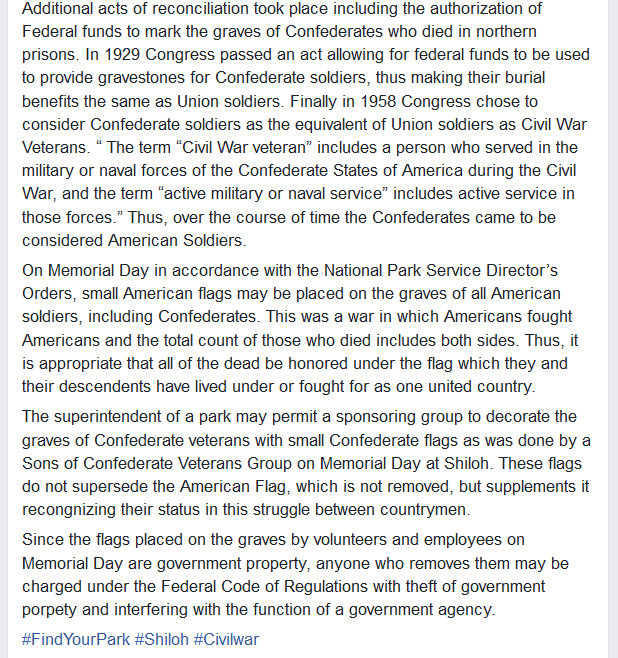
The administration of the park issued a post on the national battlefield's facebook page explaining why the US flags were placed there, emphasizing that no disrespect is intended to The post itself makes a very good case - including recognition of the Confederate soldiers buried on the battlefield as recognized American Veterans, a statement from a government-run source that probably has a certain "civil war blogger" in need of sedatives. The post makes an excellent and well-reasoned case for the display of the US flags at the mass grave sites, including a photo of United Confederate Veterans standing at the same site with US flags on the ground at the mass grave, and carrying the US flag in parade.


Overall, it is clear that the traditional display of the US flag at the site has historical precedent, and - from this blogger's point of view - was not done as a sign of disrespect to either the dead, nor the living. It was done as a sign of respect for their status as American Veterans on equal terms with US soldiers of all other conflicts.
By contrast, the removal of the flags by a misguided, yet seemingly well-meaning individual, was also not intended to be disrespectful in principal; though the removal of federal property from federal land is not acceptable, nor is robbing from a grave site under any circumstances.
Why Do Some Put US Flags On Confederate Graves
The act of putting US flags at Confederate graves is far from a new thing. The practice goes back to the end of the War itself.
At the time of the Damnyankee Occupation of Dixie (also known historically as Reconstruction) the display of Confederate banners was illegal under the rules of martial law. In those early memorial observances when the Confederate dead were honored flowers were placed on the graves without bunting of any kind.
The Union occupiers would sometimes bury their own dead at Confederate grave sites and build memorials in order to permanently get the idea across to the local population that they - by God! - were in the Union to stay. Since only the US flag could legally fly on those occasions, when the Yankees took up the practice of honoring their dead buried in Southern soil, the US flag would fly over all the graves.
When the Union soldiers finally left a decade later, the United Confederate Veterans (UCV) and United Daughters of the Confederacy (UDC) began honoring the Southern dead properly with flowers and flags. The Union graves in the South continued to be honored with US flags, often during the same services. Since the UCV and UDC were American patriotic groups, the US flag was mandatory as their functions.
By the time the Spanish-American War (1898) came around, the former Confederate Veterans and their Union counterparts patriotically united under the share title of Americans that both proudly declared themselves, even during the War Between the States itself. It was around that time of reconciliation that the practice of honoring the men of the North and the South from the War as American Veterans was largely established and both the flag of the United States and the Confederate battle flag began flying respectively over the graves of the dead.
This practice continues today in modern times, though there is controversy from both sides of a rather heated argument.
Some camps of the Sons of Confederate Veterans (SCV) and United Daughters of the Confederacy (UDC) placed both US flags and Confederate flags on the graves of the Confederate Dead and have done so for decades. These groups also traditionally put US flags on the graves of Union dead in local cemeteries out of common respect and honor for those lain to rest.
More often that not this happens on federal property, or Northern land where Confederate soldiers are buried. The best example of this are the graves of the Confederate dead buried at the site of Camp Chase Prison Camp in Columbus, Ohio. The local SCV decorates the graves with both flags on Confederate Memorial Day and US Memorial Day respectively.
In the Southland itself, the practice of putting US flags on Confederate graves is something of a mixed bag.
Some Confederate descendants see the placing of US flags on Confederate graves as an insult to the memories of the men buried their, particularly those of an ancestor who died during the War itself.
Southern nationalists in particular are critical of such displays claiming that (and folks these is actually direct quotes): "the g--d--m flag of the Yankee Empire does not belong on the grave of the Confederate soldier." Yeah folks, I also feel a headache reading stuff like that. Y'all better get the aspirin ready, because I have another one: "Don't put a Yankee rag on a Rebel grave."
The fact that many former Confederate soldiers and their descendants later fought proudly under that "Yankee rag" and the vast majority of Southerners of Confederate descent proudly claim the US flag as their own, no less important to the battle flag of the Southland respectively, is largely lost on this mindset.

Other Southerners descended from Confederate soldiers put only US flags at the graves to honor the dead ancestor, while at the same time trying to distance themselves from modern displays of the Confederate battle flag. Obviously such thinking is misguided and to some degree embarrassing. This mode of thinking is an attempt at compromising and appeasing the irrational ideals of modern-day political correctness, and are usually lost on the practitioners of that obscene paradigm.
There are also those misguided people who believe that Confederate flags should fly over the graves of Confederate soldiers buried on federal owned land, or that the Confederate soldier deserves no honor at all, but that is a topic we will discuss in a future blog post later this month.
Conclusions and Suggestions
The administration of the park issued a post on the national battlefield's facebook page explaining why the US flags were placed there, emphasizing that no disrespect is intended to The post itself makes a very good case - including recognition of the Confederate soldiers buried on the battlefield as recognized American Veterans, a statement from a government-run source that probably has a certain "civil war blogger" in need of sedatives. The post makes an excellent and well-reasoned case for the display of the US flags at the mass grave sites, including a photo of United Confederate Veterans standing at the same site with US flags on the ground at the mass grave, and carrying the US flag in parade.

Overall, it is clear that the traditional display of the US flag at the site has historical precedent, and - from this blogger's point of view - was not done as a sign of disrespect to either the dead, nor the living. It was done as a sign of respect for their status as American Veterans on equal terms with US soldiers of all other conflicts.
By contrast, the removal of the flags by a misguided, yet seemingly well-meaning individual, was also not intended to be disrespectful in principal; though the removal of federal property from federal land is not acceptable, nor is robbing from a grave site under any circumstances.
Why Do Some Put US Flags On Confederate Graves
The act of putting US flags at Confederate graves is far from a new thing. The practice goes back to the end of the War itself.
At the time of the Damnyankee Occupation of Dixie (also known historically as Reconstruction) the display of Confederate banners was illegal under the rules of martial law. In those early memorial observances when the Confederate dead were honored flowers were placed on the graves without bunting of any kind.
The Union occupiers would sometimes bury their own dead at Confederate grave sites and build memorials in order to permanently get the idea across to the local population that they - by God! - were in the Union to stay. Since only the US flag could legally fly on those occasions, when the Yankees took up the practice of honoring their dead buried in Southern soil, the US flag would fly over all the graves.
When the Union soldiers finally left a decade later, the United Confederate Veterans (UCV) and United Daughters of the Confederacy (UDC) began honoring the Southern dead properly with flowers and flags. The Union graves in the South continued to be honored with US flags, often during the same services. Since the UCV and UDC were American patriotic groups, the US flag was mandatory as their functions.
By the time the Spanish-American War (1898) came around, the former Confederate Veterans and their Union counterparts patriotically united under the share title of Americans that both proudly declared themselves, even during the War Between the States itself. It was around that time of reconciliation that the practice of honoring the men of the North and the South from the War as American Veterans was largely established and both the flag of the United States and the Confederate battle flag began flying respectively over the graves of the dead.
This practice continues today in modern times, though there is controversy from both sides of a rather heated argument.
Some camps of the Sons of Confederate Veterans (SCV) and United Daughters of the Confederacy (UDC) placed both US flags and Confederate flags on the graves of the Confederate Dead and have done so for decades. These groups also traditionally put US flags on the graves of Union dead in local cemeteries out of common respect and honor for those lain to rest.
More often that not this happens on federal property, or Northern land where Confederate soldiers are buried. The best example of this are the graves of the Confederate dead buried at the site of Camp Chase Prison Camp in Columbus, Ohio. The local SCV decorates the graves with both flags on Confederate Memorial Day and US Memorial Day respectively.
 |
| Confederate Soldiers' Monument at the Camp Chase Confederate Cemetery in Columbus, Ohio, USA. Note the US flags placed at the graves beneath, and the word: AMERICANS on the arch of the monument. |
 |
| More Confederate graves at Camp Chase Confederate Cemetery. Nearly 2300 Confederate soldiers died in prison here of diseases and other causes. |
In the Southland itself, the practice of putting US flags on Confederate graves is something of a mixed bag.
Some Confederate descendants see the placing of US flags on Confederate graves as an insult to the memories of the men buried their, particularly those of an ancestor who died during the War itself.
Southern nationalists in particular are critical of such displays claiming that (and folks these is actually direct quotes): "the g--d--m flag of the Yankee Empire does not belong on the grave of the Confederate soldier." Yeah folks, I also feel a headache reading stuff like that. Y'all better get the aspirin ready, because I have another one: "Don't put a Yankee rag on a Rebel grave."
The fact that many former Confederate soldiers and their descendants later fought proudly under that "Yankee rag" and the vast majority of Southerners of Confederate descent proudly claim the US flag as their own, no less important to the battle flag of the Southland respectively, is largely lost on this mindset.

Other Southerners descended from Confederate soldiers put only US flags at the graves to honor the dead ancestor, while at the same time trying to distance themselves from modern displays of the Confederate battle flag. Obviously such thinking is misguided and to some degree embarrassing. This mode of thinking is an attempt at compromising and appeasing the irrational ideals of modern-day political correctness, and are usually lost on the practitioners of that obscene paradigm.
There are also those misguided people who believe that Confederate flags should fly over the graves of Confederate soldiers buried on federal owned land, or that the Confederate soldier deserves no honor at all, but that is a topic we will discuss in a future blog post later this month.
Conclusions and Suggestions
Overall, despite the claims of many of the more hard-core Southern heritage folks with wild conspiracy theories, the practice of putting US flags with Confederate flags on graves is not some plot by the US government to denigrate the Confederate soldier or his descendants - though there is no denying that some individuals with warped social justice mindsets would enjoy that particular outcome and advocate for it for that reason.
The organizations and individuals who continue to do so are not entirely misguided, though I can understand and sympathize to a degree with those who feel that US flags have no place on Confederate grave markers. I would agree completely that the US flag alone should not fly at Confederate graves - particularly those of Unknown soldiers.
The organizations and individuals who continue to do so are not entirely misguided, though I can understand and sympathize to a degree with those who feel that US flags have no place on Confederate grave markers. I would agree completely that the US flag alone should not fly at Confederate graves - particularly those of Unknown soldiers.
 |
| NOPE! |
Let me explain to you a my own common sense solution when it comes to this issue.
As both an SCV member and someone who has helped take care of both Confederate and Union graves for years, I can only say with certainty about the graves I watch over on Confederate and US Memorial Days respectively.
I watch over 57 graves of soldiers who served in the War Between the States located at Elmwood Cemetery in downtown Chester. Of these are 54 are “Unknown” CSA soldiers, 2 are known Confederates (one dead during the war and one an aged veteran) and 1 Union soldier who died in late 1865 of illness.
This is the manner in which personally I handle this issue of US and Confederate flags on these graves:
On Confederate Memorial Day (May 10th in the Carolinas) I place ONLY Confederate battle flags on their graves of the 54 Unknown CSA soldiers who died in the War.
For the one Confederate Veteran after the war (who probably took the oath after the War) I put both the US flag and a battle flag on his grave.
For the Union soldier, I place a 36 star Union stick banner at his - sometimes both the historical US flag and the current 50 star flag.
On US Memorial Day (Last Monday of May) I place a pole with a Confederate Battle Flag at the Confederate gravesite and another pole of equal length with the current US flag at the Union gravesite respectively sun up to sundown.
That is my personal solution to the issue and how I honor our shared American dead using good plain old Southern Fried Common Sense.

Subscribe to:
Posts (Atom)