Showing posts with label US Flag. Show all posts

Wednesday, February 15, 2023

Sergeant Gilbert H. Bates U.S.A. (1836 - 1917) -- The Union Veteran Who Carried Old Glory Through Unreconstructed Dixie & England

Sergeant Gilbert H. Bates
(February 13, 1836 - February 17, 1917).


Perhaps there is no better story of national reconciliation and personal patriotism in the years immediately following the aftermath of the
War Between The States than the story of Sergeant Gilbert Bates, a former Union veteran who carried the flag of the United States unafraid through the then unreconstructed Deep South and then across England several years later.

Gilbert Henderson Bates was born on Saturday, February 13, 1836 in the town of Springwater, Livingston County, New York. Sometime in his late teens, Bates moved to the small town of Albion, near Edgerton, Wisconsin and became a farmer.

Bates was 25 years old when the American Civil War (1861-1865) broke out on the morning of Friday, April 12, 1861.
He answered the State of Wisconsin and his nation's call for volunteers and served in the Union Army as a sergeant in Company H of the 1st Wisconsin Heavy Artillery Regiment.

For most of the war, Company H was assigned to Fort Lyon outside Alexandra, Virginia as part of the defenses of Washington City (D.C.) guarding against possible Confederate attack against the capitol. He returned home following the end of the war and resumed his civilian occupation.

Bates married his wife, Ann E. Noe, on Wednesday, December 23, 1863 and the couple would raise four children: Hattie, Nellie, Frank, and Addie.


The First Bet

In November of 1867, a Radical Republican neighbor of Bates was telling stories about
rumors that the South would be rising once more in rebellion and that any Northerner was not safe down there. This neighbor told Bates that anti-Union feeling was so strong in the South that no representative of the United States was safe in the former Confederate States, and declared that disloyalty to the Union was still rampant in the deep South and that a man could not take the Stars and Stripes onto Southern soil without being murdered.

Sergeant Bates, who was a staunch Democrat, completely disagreed and made a wager with his Republican neighbor that he could walk the entire length of the Southern States completely unscathed while carrying the flag of the United States. He wagered a dollar a day from his neighbor for his family that he would start in Vicksburg, Mississippi and march without money and unarmed, and arrive safely in Washington City with himself unscathed and his flag unmolested on, or before the 4th of July, Independence Day. The neighbor took up his wager, thinking Bates was a complete fool.

Bates' Wisconsin neighbor was far from alone in his belief that it was not safe for anyone who supported the occupied former Confederate States. His wife was concerned for the safety of her husband as he prepared to leave home for his journey, though she offered him her full support.

Sergeant Bates feat of courage was soon the talk of the country. He took photographs of himself in his old uniform with a U.S. flag, which he autographed and offered to sell for a quarter a piece with the proceeds to be donated to charity.


Sergeant Bates' March Begins

Bates arrived in
Vicksburg, Mississippi on the evening of Friday, January 24, 1868, wearing coarse, heavy garments, cowhide boots, and a slouch hat. The city along the Mississippi River had been the scene on a great siege by Union forces in 1863, and it was thought that anti-Union sentiment would be very strong here despite several years of Union occupation.

Sergeant Bates in uniform with the
U.S. Flag he carried from Vicksburg,
Mississippi, to Washington D.C. in 1868.
Photo courtesy National Archives.
On his way South he met one Mr. Frank Howard. Upon learning of Bates' daring bet, Mr. Howard secured for him quarters at the Prentiss House (the famous home of former Mississippi U.S. Representative Sergeant Smith Prentiss) and arranged to take care of his bills.

News of his plans spread quickly throughout the city. Next morning there was a stream of visitors and well-wishers, among them the town’s most prominent citizens and a number of Union soldiers stationed in the city.
The representatives of a women’s organization called on him to announce that a U.S. flag was being made for him.

On Bates’ fourth and last day, in a ceremony at the Prentiss House, a "neat silk flag," five feet long and three wide, attached to a regulation staff was presented to him. Bates was also presented with a velvet uniform bearing his regimental insignia. The clothes and uniform, Bates would later note, had been sewn by the same hands that only years before sewn Rebel uniforms and flags.


Thus began Bates' march on Tuesday, January 28th, which would be widely reported at the time in numerous local and national newspapers.
Sergeant Bates' march through Dixie received so much notoriety at the time that it became a national news story, some of which was scornful and predicted that the brave Union veteran was setting himself up for a very rough time, or worse.


On Thursday, February 27, 1868, author and humorist Samuel Clemens (writing under his famous pen name, Mark Twain) published the following about Bates in his Territorial Enterprise:

Sergeant Gilbert H. Bates of Wisconsin is the last candidate for pedestrian notoriety. He has made a bet that he will walk, alone, unarmed, and without a cent in his pocket, and bearing aloft the American flag, through the late Southern Confederacy, from Vicksburg to Washington. He is already on his way, and the telegraph is noting his progress. The Mayor and a large portion of the population of Vicksburg ushered him out of that city with a grand demonstration. He proposes to sell photographs of himself at 25 cent apiece, all along his route, and convert the proceeds into a fund to be devoted to the aid and comfort of widows and orphans of soldiers who fought in the late war, irrespective of flag or politics.

And then, I suppose, when he gets a good round sum together for the widows and orphans, he will hang up his flag and go and have a champagne blow-out. I don't believe in people who collect money for benevolent purposes and don't charge for it. I don't have full confidence in people who walk a thousand miles for the benefit of widows and orphans and don't get a cent for it. I question the uprightness of people who peddle their own photographs, anyhow, whether they carry flags or not. In my opinion a man might as well start his name with an initial and spell his middle name out and hope to be virtuous. But this fellow will get more black eyes, down there among those unreconstructed rebels than he can ever carry along with him without breaking his back. I expect to see him coming into Washington some day on one leg and with one eye out and an arm gone. He won't amount to more than an interesting relic by the time he gets here and then he will have to hire out for a sign for the Anatomical Museum. Those fellows down there have no sentiment in them. They won't buy his picture. They will be more likely to take his scalp.

Clemens and everyone who predicted his inevitable demise turned out to be very wrong in their assessment. Although to be fair to Mr. Clemens and those who lamented the brave Union veteran could be putting himself in serious danger, those fears -- if slightly exaggerated -- were not entirely without merit.

The path that Sergeant Bates in his blue uniform and carrying his U.S. Flag was taking in his solo march would take him through places that had seen the most brutal and destructive effects of the Union invasion of the Deep South in the final years of the war.

Bates would literally be walking through a land physically devastated by the hardships of war. Through towns full of defeated surviving Confederate veterans, many of them still bearing the scars and missing limbs of their experience. Past graveyards full of the sons, fathers, and husbands of many men who'd stood opposite Bates in the war and didn't survive. Not to mention the surviving families of those same men and boys who would no doubt be less than pleased at the sight of him and his flag waving in the breeze.

During the three-month march Sergeant Bates would walk 1,400 miles across the Southern States of Mississippi, Alabama, Georgia, South Carolina, North Carolina, and Virginia, carrying his Stars and Stripes. He was granted a great deal of hospitality and goodwill all along the way. People offered him food, places to stay for the night, church bells rang at his arrival and departure for towns, and several major cities even allowed the brave Union sergeant to actually hoist his flag over important official buildings where the Confederate Stars and Bars and the Stainless Banner once flew earlier that same decade!

Sergeant Bates recorded his journey in a 35 page pamphlet which he had published in June 1868 titled: The Triumphal March of Sergeant Bates from Vicksburg to Washington. Many of the stories in his telling of his experiences are very moving.

In Tuskegee, Alabama, an eight-year-old girl named Hattie, upon hearing that Sergeant Bates also had a little daughter called Hattie, gave him her newest doll and asked him to send it home to her. At the State capital of Montgomery he was presented with a pink silk sash for his uniform which he described as: "heavily fringed with gold bullion and beautifully inscribed in gilt letters, 'Presented by the Ladies of Montgomery, Ala., Mrs. Vernon Vaughn, president, Mrs. A. L. O’Brien, secretary.'"


One story in particular stands out,
an encounter while walking through the State of Georgia that touched Bates most profoundly.

While walking on a lonely stretch of dirt road between Sparta and Augusta, he came upon a young farmer who was chopping wood. The farmer said he’d been watching for Bates and wished to extend the hospitality of his home, two miles away. On their way to the house, the men stopped at a roadside mound where the farmer’s brother, a Confederate soldier killed during the war, lay buried under a plain wooden head board marked with his name since granite headstones were hard to come by for poor people during the Reconstruction Era. The farmer stood upon one side of the grave and Bates on the other. Unconsciously both men removed their hats and bowed their heads in respect for the dead, then the farmer reached his hand over the grave of his brother and clasped Bates' hand.

Sergeant Bates and his flag were both well received throughout the so-called "unreconstructed South" where towns and communities treated him with more than generous hospitality. School children were recessed to meet him as he walked by. Women prepared him meals and people offered him the hospitality of their spare rooms, or barns to sleep for the night. Confederate veterans would travel as far as forth miles just to meet with him and shake his hand as he went by. Government officials including: judges, mayors, and even governors, greeted him and even held short speeches commending the sergeant for his efforts at fostering national goodwill.

His only real difficulties on his journey would be rainy weather and muddy roads. Throughout his journey, Sergeant Bates would encounter several more profound moments of humanity and mutual respect from his former Southern enemies and fellow Americans.


Sergeant Bates in South Carolina and Charlotte

When he crossed the Savannah River into South Carolina on Monday, March 16th, Sergeant Bates was met with good wishes from the people of the town of Hamburg (near modern-day North Augusta). He briefly stopped to shake hands with people before continuing east.

Two days later on Wednesday, March 18th, Sergeant Bates crossed the Congraee River by ferry boat and was again welcomed warmly by the mayor and people of the State capital of Columbia -- which at the time was still largely burned out (allegedly) by General William T. Sherman's invading Union soldiers only three years before. He remained there for four days before resuming his march north towards Washington City. The South Carolina State House building in Columbia still bears the marks where Sherman's cannons struck it.

In the town of Winnsboro, he was greeted by the whole town, including about 75 former Confederate soldiers who took him to the bedside of a former Confederate officer that was dying and wanted to meet and talk with Bates before he passed on. Bates would learn that the officer passed away a short time after speaking to him. 

When he reached the town of Fort Mill on the border between the two Carolinas (and where Confederate President Jefferson Davis and his cabinet held one of the last full meetings as they fled south in 1865) on Wednesday, March 25th, he was greeted by 25 Confederate veterans who had assembled in their ragged gray uniforms to give Sergeant Bates and his flag an "escort of honor" as he passed from South Carolina into North Carolina. The Confederate honor guard cheered him the way fellow soldiers cheer as the Union veteran waved them goodbye at the border.

He arrived in Charlotte later that same day where he was greeted by the city's major and town council who offered Bates their city's hospitality. Sergeant Bates remained in Charlotte for a couple of days while he was getting new shoes made as his old ones were worn out. While there he was also called on by more Confederate veterans, including some former Southern officers.

Another rather interesting event occurred during Sergeant Bates' stay in Charlotte.

On Friday, March 27th, he was visited by a young man named James Orr, another Confederate veterans who'd served in General Lee's Army of Northern Virginia. Mr. Orr presented Sergeant Bates a bundle which held a Union army flag that had previously been captured during the war and which the young man had obtained from the Confederate archives during the fall of Richmond in April, 1865. Mr. Orr told Bates that its capture by the Confederates had cost a good many lives; but that Bates had "recaptured it without firing a gun" and presented it to the sergeant in peaceful triumph.


Richmond and Washington City

Less than two weeks later, at 4 P.M. EST on the afternoon of Wednesday, April 8th, Sergeant Bates and his flag crossed
the Richmond and Danville Railroad bridge into the former capital of the Confederacy, Richmond, Virginia. An increasingly large crowd gathered to meet him and cheer him on as he made his way to the Exchange Hotel where he rested briefly and had dinner.

Afterwards he made his way to the Virginia State Capitol building and ascended to the rotunda where he waved his flag over the capital of what had been an enemy nation only a few years before and almost three years to the day of General Robert E. Lee's surrender of the Confederate Army of Northern Virginia at Appomattox Court House while people cheered him and city church bells rang.

He remained in Richmond for two days before making the final length of his trek north.


A sketch of Sergeant Bates arrival at the Virginia State Capitol in Richmond.


At 9 A.M. on the morning of Tuesday, April 14th -- seven years to the day that Fort Sumter in Charleston, South Carolina surrendered and the War Between The States began -- Sergeant Bates descended Arlington Heights to the Long Bridge and crossed the Potomac River and entered Washington City.

After a walk of 1,400 miles and crossing through six Southern States, Bates won his bet with his Radical Republican neighbor, arriving at the nation's capital completely unscathed from his journey through the still unreconstructed Southland. He accomplished his walk three months ahead of schedule in and had been met throughout by former Confederates who saluted his flag, provided hospitality, and more than demonstrated a desire for national reconciliation.


Again Bates was met by cheering crowds, as well as the Washington City Brass Band in full uniform played patriotic music. He proceeded through the city making his way though the crowds down Pennsylvania Avenue and Fourteenth Street, flanked by two military officers detailed to escort him to the White House where Sergeant Bates was greeted by U.S. President Andrew Johnson.

President Johnson is reported to have said to Sergeant Bates and the gathered throngs: "I merely desire to sincerely and cordially welcome you and your flag, with which you have traveled so many miles. I have no address or speech to make, but wish to testify my gratification at seeing you in Washington."

The president then invited him into the Executive Mansion and conducted him to the East Room where they conversed for a few moments. Johnson's daughter presented Bates with a magnificent bouquet of flowers. Three years before (again almost to the day) U.S. President Abraham Lincoln had been assassinated and had lain in state in the same room. Bates now stood in that same room after his incredible journey as a testament to the spirit of union and reconciliation.

Upon leaving the White House, Sergeant Bates made his way though the procession to the nearby Metropolitan Hotel where he would stay during his six-day visit to the capitol.
There was a brief ceremony, where Bates stood on the front balcony and U.S. Representative Charles A. Eldredge of Bates' home State of Wisconsin delivering the main speech in his honor.

The following was the conclusion to that speech:


"My friends, I cannot forget the fact that it is just seven years this day since the flag of the Republic was lowered in humility and sorrow from the battlements of Sumter. The flag that Major Anderson was then forced to take down now floats proudly over every foot of our land, respected and honored by all. And this young man, who, without money and alone, and on foot, has carried it for more than fourteen hundred miles will now plant it in glory and triumph upon the dome of the National Capitol."

Great applause followed from the crowd, after which Sergeant Bates and the members of the procession trudged eastward in the now pouring rain. The Superintendent of Public Buildings had granted permission for Bates to unfurl his flag from the dome of the Capitol, but on the east steps of that Capitol Building, he was not allowed to enter or fly his flag from the rotunda by the capitol police under orders from the Radical Republican members of Congress who disapproved of his message of reconciliation with the South.

Remember that, in April of 1868, the radical wing of the Republican Party which controlled congress and wished to impose harsh Reconstruction Era policies on the defeated Southern "rebels" was in the process of their three-month-long impeachment of President Johnson. An effort which would ultimately fall short of his removal from office. Sergeant Bates journey and message of reconciliation, which received widespread publicity and praise from much of the country, was looked upon by these men in high office with unveiled disgust.

Although Sergeant Bates was allowed to raise his flag over numerous official buildings in the South at the welcoming hospitality of former Confederates -- including the former capital of the Confederacy -- he was not granted permission to fly his flag, which had been cheered on and saluted by millions on his journey, at the Capitol of his own country.

An American flag which had not been insulted once during a walk through unreconstructed Dixie, and carried by a man who served the cause of the Union during the war; had at last been insulted in the final moments of the journey by those who held political power. If that wasn't a sign of the times, nothing else could have said it better.

Someone in the crowd suggested that Sergeant Bates should wave his flag over the nearby Washington Monument, which was still being constructed. Bates would do to more approval of the crowd and a band playing more patriotic music. It was there at the memorial to America's greatest Founding Father that Sergeant Bates first journey truly came to an end.

He returned home to his relieved wife and family, as well as to his disgruntled and completely chagrined Radical Republican neighbor, from whom he'd won a grand total of $80 dollars. 


Photo of Sergeant Gilbert Bates with his flag taken
in his full Union army uniform and war medals in
1868 just after he completed his march across the
Reconstruction Era South.
Photo courtesy of the National Archives.


An American Sergeant In England

Four years later, in 1872, Sergeant Bates would again engage in a wager involving the flag of the United States. This time his walk would take him across the Atlantic Ocean to Great Britain.


During the War Between The States, many Englishmen supported Southern independence because almost all raw cotton, so vital to the enormous British mill industry, came from the American Southern states. When the North blockaded the Confederacy cutting off the trade routes, the resulting "cotton famine" put thousands of lower class English textile workers out of work and economic hardships for the British mill industry.

Also in August of 1872, an international arbitration tribunal ordered England to pay the United States a restitution of $15 million dollars for damages does to American merchant shipping by Confederate cruisers like the CSS Alabama and CSS Shenandoah, which had both been built, registered, and equipped in British ports. 

As a result of these developments there was a widely-held general belief in the United States that dangerous anti-American feeling was rife in England.

By 1872, Sergeant Bates and his family had relocated to the town of Saybrook, Illinois. Bates made a friendly wager with a friend who was a wealthy Saybrook merchant that he could carry the Stars and Stripes through England as he had through the Southern States and that he and his flag would not be molested in any way. Bates bet the merchant $100 against his friend's $1,000 to demonstrate that Great Britain and the United States were friendly despite Britain's former support of the Confederacy and that the British people would hail him as the Southerners had in 1868 when he arrived in London.

Thus Sergeant Gilbert Bates arrived in Great Britain in November of 1872 to prove that he could walk the length of England with his flag and not even be insulted by the British people.

On Tuesday, November 5, 1872, Sergeant Bates, in his full Union Army uniform and carrying a full-sized, 6 1/2 x 6 foot United States flag on a 9 foot staff, began a 332 mile march from the Scottish border town of Gretna Green; crossing the River Sark into England to his ultimate destination: the Guildhall in London, the capital of United Kingdom.

Sergeant Bates' prediction that the English people would treat him well was again spot on. In fact it was better than even the Union war veteran could have realized as people along his march took the brave American into their hearts, and like the Southerners four years before, were welcoming in all respects. Everywhere he traveled in England he was overwhelmed by the enthusiasm and kindness of the villagers. Hoteliers refused to let him pay and people offered him meals. Newspapers across Great Britain were all unified in their praise of Sergeant Bates and his convictions.

Sergeant Bates obituary in the
Bloomington (Illinois) Pantagraph
published on
Monday, February 19, 1917.
His only serious difficulties along his journey south to London were provided by the weather. For instance when he passed the granite quarries near the village of Shap, in Cumbra County, Sergeant Bates had to travel for some miles on his knees to keep his large banner aloft in nearly gale-force wind.


When Sergeant Bates reached on Saturday, November 30th -- less than a month after he started out -- the City of London gave him a roaring reception. In fact the crowds were so great he had to be driven in an open carriage to the Guildhall, where he ceremoniously hung the unsullied Stars and Stripes next to the British Union Jack. 

While in London he was approached by a group of British showmen who offered Sergeant Bates £60 (then the equivalent of about $300) a night for five weeks of vaudeville appearances. These and other offers to exploit his national flag were politely turned down by Bates.


Even before starting the march, he had rescinded the wager; telegramming his rich Saybook friend and refusing to take the thousand dollars he had won on the grounds that the good will he had helped engender between England and America was reward enough. Bates even donated the proceeds from his book describing his English march to the Infant Orphan Asylum at Wanstead.  


Afterwards

Gilbert Bates wrote well-received books about his walks and became a famed public speaker. He appeared in William "Buffalo Bill" Cody's famous Wild West Show. In his later years, he authored letters to the editor critical of what he deemed threats to America, including immigration and labor unions.

Sergeant Bates' lone marches across the South and England were widely reported in national newspaper articles at the time, but are today largely forgotten outside of serious historical roundtables and war enthusiast circles. His efforts to foster goodwill and reconciliation are a testament to the national spirit of the American people.

Sergeant Gilbert H. Bates died on Saturday, February 17, 1917 (just four days after his 71st birthday) and is buried in Cheney's Grove Township Cemetery in Saybrook, McLean County, Illinois. 


The Union Veterans headstone of Sergeant Bates
at Cheney's Grove Township Cemetery,
Saybrook, Illinois, USA.

Monday, June 14, 2021

Ragged Old Flag -- Poems -- Honoring June 14th U.S. Flag Day

The Flag of the United States of America (USA) flying over Chimney Rock State Park, North Carolina.

Ragged Old Flag

By Johnny R. Cash


 I walked through a county courthouse square,
On a park bench an old man was sitting there.
I said, "Your old courthouse is kinda run down."
He said, "Naw, it'll do for our little town."
I said, "Your flagpole has leaned a little bit,
And that's a Ragged Old Flag you got hanging on it."

He said, "Have a seat", and I sat down.
"Is this the first time you've been to our little town?"
I said, "I think it is." He said, "I don't like to brag,
But we're kinda proud of that Ragged Old Flag.

"You see, we got a little hole in that flag there
When Washington took it across the Delaware.
And it got powder-burned the night Francis Scott Key
Sat watching it writing 'Oh Say Can You See.'
And it got a bad rip in New Orleans
With Packingham and Jackson tuggin' at its seams.

"And it almost fell at the Alamo
Beside the Texas flag, but she waved on through.
She got cut with a sword at Chancellorsville,
And she got cut again at Shiloh Hill.
There was Robert E. Lee, Beauregard, and Bragg,
And the south wind blew hard on that Ragged Old Flag.

"On Flanders Field in World War I
She got a big hole from a Bertha gun.
She turned blood red in World War II.
She hung limp and low by the time it was through.
She was in Korea and Vietnam.
She went where she was sent by her Uncle Sam.

"She waved from our ships upon the briny foam,
And now they've about quit waving her back here at home.
In her own good land she's been abused--
She's been burned, dishonored, denied, and refused.

"And the government for which she stands
Is scandalized throughout the land.
And she's getting threadbare and wearing thin,
But she's in good shape for the shape she's in.
'Cause she's been through the fire before,
And I believe she can take a whole lot more.

"So we raise her up every morning,
Take her down every night.
We don't let her touch the ground,
And we fold her up right.
On second thought I do like to brag,
'Cause I'm mighty proud of that Ragged Old Flag."

Flag Day is celebrated in the United States of America every year on June 14 commemorating the adoption of the original flag of the United States on Saturday, June 14, 1777, by resolution of the Second Continental Congress.

Ragged Old Flag is a popular patriotic song written by American country music singer John R. "Johnny" Cash in 1974, and is the title song on his 47th album of the same name.

As an American who is also mighty proud of that ragged old flag, this blogger would like to wish each and every one of y'all a Happy Flag Day today.


"I pledge allegiance to the flag of the United States of America, and to the republic for which it stands, one nation, under God, indivisible, with liberty and justice for all."

Friday, June 14, 2019

Betsy's Battle Flag

The first flag of the United States was formally adopted by the Continental
Congress on Saturday, June 14, 1777. The first flag was allegedly made by
Betsy Ross and presented by her to General George Washington.


Betsy's Battle Flag
By Minna Irving
From dusk till dawn the livelong night
She kept the tallow dips alight,
And fast her nimble fingers flew
To sew the stars upon the blue.
With weary eyes and aching head
She stitched the stripes of white and red,
And when the day came up the stair
Complete across a carven chair
Hung Betsy’s battle flag.

Like shadows in the evening gray
The Continentals filed away,
With broken boots and ragged coats,
But hoarse defiance in their throats;
They bore the marks of want and cold,
And some were lame and some were old,
And some with wounds untended bled,
But floating bravely overhead
Was Betsy’s battle flag.

When fell the battle’s leaden rain,
The soldier hushed his moans of pain
And raised his dying head to see
King George’s troopers turn and flee.
Their charging column reeled and broke,
And vanished in the rolling smoke,
Before the glory of the stars,
The snowy stripes, and scarlet bars
Of Betsy’s battle flag.

The simple stone of Betsy Ross
Is covered now with mold and moss,
But still her deathless banner flies,
And keeps the color of the skies.
A nation thrills, a nation bleeds,
A nation follows where it leads,
And every man is proud to yield
His life upon a crimson field
For Betsy’s battle flag!


The author of this poem, Minna Irving was born on May 17, 1865 in Tarrytown, New York. She died on July 4, 1940 at the age of 86, and is buried in the Sleepy Hollow Cemetery.

Friday, September 01, 2017

Should We Surrender On The Flag Issue?

Should We Surrender On The Flag Issue?

By C.W. Roden

What I am about to tell you will come as a terrible shock to many of you whom in the last few years have followed my words, but it is with a heart heavy with sadness and regret that I, C.W. Roden ~ The Man Deniers Fear The Most ~ must accept that for the last couple of decades of my life have been wasted defending a terrible lie and engaging in some serious self-deception regarding a flag that I and many Southern-born Americans today honor very dearly. 

Yes, ladies and gentlemen of Dixie, I am afraid I have to turn in my official Flag Defender License and abandon what I have now come to realize is a hopeless and futile cause. 

This is not a decision I have come to lightly, but one made after many years of continued opposition on all sides by the NAACP, the Southern Poverty Law Center, the Anti-Defamation League, various other Left-leaning social groups, a number of Righteous Cause Apologist bloggers, Black Confederate Deniers, scalawags, and other lower individuals of all sorts over the course of two decades of active heritage defense in regards to symbols honored by Southerners including those of Confederate descent. 

You could say that the collective voices of all of these people have finally opened up my heart to the truth of their arguments regarding a certain flag that I now find I cannot bear to name due to the pain of regret I feel. 

For years I have been deaf to the arguments made, turned a blind eye to the pain and suffering caused by the sight of a banner that the worst racists in America flash often as a sign of their intolerance, their bigotry, and their malicious attitudes towards people who are not of their own kind. 

Yes I know some of you will call me a traitor for this -- if not a number of worse and uglier names -- but I have stood against those who condemned this banner for its ugliness and its racism for so long and endured so much from them too. 

Now though, I find that once I really listened to the arguments made by those who oppose this flag, looked into my heart and examined what I found there, I found my own arguments in its defense very much wanting. 

Indeed now find they offend even me, especially in the manner in which I have fought in vain to defend this flag. 

I have argued that those who engaged in the battle against this certain flag that many Southerners hold so dear were the same as those who misuse it as a symbol of racism, if not worse because they knew the "truth" as I saw it and ignored it. 

I have even argued that these same people conspired with these same racists at times to see the struggle to defend this certain flag's good name defeated. 

Before I offer a formal statement of apology, let me tell everyone who is reading this, no matter if they are for or against this certain flag honored by many Southerners today, the arguments made that finally convinced me to open my eyes and my heart to the truth....a truth many of you on this page refuse to hear. 

Let me be the one to lead you to that truth now, and I urge you not to turn your back on it before I finish. 

We have been told that those of us who honor this flag that I now see as representing all of the ugliness and intolerance, in our efforts to glorify this certain banner and the heritage it stands for, do not acknowledge the painful history of this symbol.

We do not acknowledge or recognize the pain it brings to the sight of so many who lived through some of that ugly history.
 
We disregard those feelings in favor of the more self-glorifying view of that flag's history.

We turn a blind eye to the fact that symbols mean things, that in our efforts to live in our own glorified view of history, we subject those who will never view this flag as anything more than a symbol of slavery and racial hatred to almost daily pain and agony of the soul. 

We ignore the fact that this once proud banner is forever stained with the scars of American racism and the defense of African slavery. 

We do not think about the fact that this flag may well have been the last sight that so many last saw as they were lynched by an angry mob of hateful racists for petty offenses. 

We forget that this flag is a symbol of treason to government authority originally. 

We pretend that this once sacred banner has been hijacked by racist groups who support white supremacist bigotry, display it at all of their rallies, and use it as a code to say: "You're not wanted here, go back where you came from" to Americans of color. 

May of us are well content to ignore all of those fact and continue to salute this flag of ignorance and prejudice for all of its good and positive aspects, while at the same time conveniently ignoring the negative aspects and those effected by them on a personal level. 

Well, that's not for me, ladies and gentlemen. 

Not anymore. 

I can no longer pretend that I do not hear the pain in the voices of so many fellow Southerners of color, and fellow descendants of Confederate soldiers who have awakened to the truth: this flag is everything our opposition has claimed for the last 20 - 30 years. 

In fact, here are several photos of that flag being used as described by our opponents. Be warned though, these images are deeply disturbing:


Okay, I honestly hope I did not give some of y'all heart attacks with that, but I do hope that for all of those reading this who oppose efforts to defend and preserve the honor of the Southern Cross of Dixie (the Battle Flag ANV and the Confederate Naval Jack) will recognize the outright ignorance and moral bankruptcy of their many claims regarding the noble banner of the South. 

Remember that all claims made about the Dixie Cross also apply historically and in modern terms to Old Glory itself, a flag many Southerners really do honor as much as the flag of the Southland. In fact, all of the arguments made would apply to the current US flag many times over compared to the Dixie Cross. 

Flags are not inherently evil -- and certainly not Old Glory or the Dixie Cross -- only those who carry them with the intent to intimidate and discriminate can make them so. It is only in the hands of those of us who honor these flags that they mean anything positive at all. It is up to us as Southerners and Americans to continue to defend their honor. 

This blogger pledges to do just that now until the day the Lord calls me home. No argument made by those who accept hatred -- either the hate practiced by the Alt-Right, or the Alt-Left -- will change that fact. 

Friday, June 10, 2016

Should US Flags Fly Over Confederate Graves?

One of the Confederate mass grave sites at the Shiloh National Military Park.

This week a somewhat interesting topic was brought up by many of the more vocal members of the Confederate heritage community about the practice on the part of some people to put small United States flags on the graves of Confederate soldiers. 

This became an issue late last month when some individual removed 163 US flags from the Confederate graves at Shiloh National Military Park in Tennessee the Saturday before Memorial Day (May 30th). Park staff discovered the flags were missing and replaced them in time for official ceremonies on Memorial Day. 

The next day a custodian found the flags in a bag accompanied by a handwritten note of apology for the removal, and expressing the individual's feelings that "American flags" should not be flying over the graves of Confederate soldiers. 

The Shiloh battlefield was the site of one of the bloodies battles of the Western Theater of the War Between the States (American Civil War) in April of 1862. Five burial trenches are the final resting places for thousands of the Confederate dead. Union soldiers are buried in the nearby Shiloh National Cemetery.

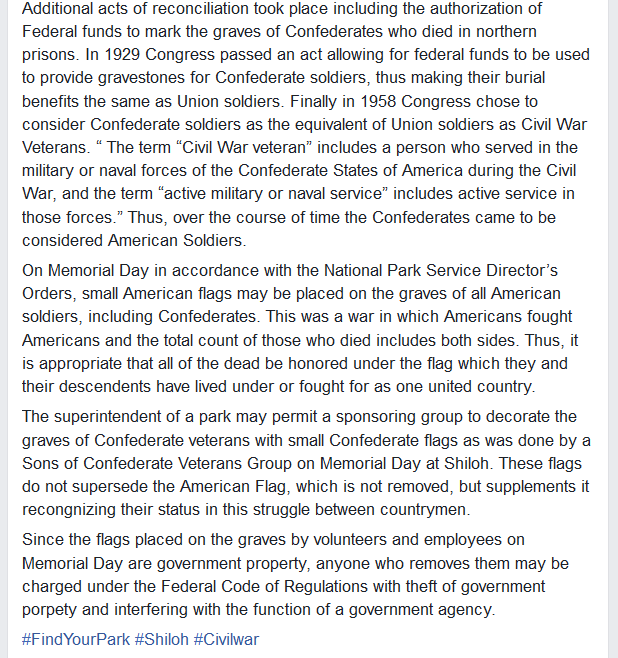
The administration of the park issued a post on the national battlefield's facebook page explaining why the US flags were placed there, emphasizing that no disrespect is intended to The post itself makes a very good case - including recognition of the Confederate soldiers buried on the battlefield as recognized American Veterans, a statement from a government-run source that probably has a certain "civil war blogger" in need of sedatives. The post makes an excellent and well-reasoned case for the display of the US flags at the mass grave sites, including a photo of United Confederate Veterans standing at the same site with US flags on the ground at the mass grave, and carrying the US flag in parade.


Overall, it is clear that the traditional display of the US flag at the site has historical precedent, and - from this blogger's point of view - was not done as a sign of disrespect to either the dead, nor the living. It was done as a sign of respect for their status as American Veterans on equal terms with US soldiers of all other conflicts. 

By contrast, the removal of the flags by a misguided, yet seemingly well-meaning individual, was also not intended to be disrespectful in principal; though the removal of federal property from federal land is not acceptable, nor is robbing from a grave site under any circumstances. 

Why Do Some Put US Flags On Confederate Graves 

The act of putting US flags at Confederate graves is far from a new thing. The practice goes back to the end of the War itself. 

At the time of the Damnyankee Occupation of Dixie (also known historically as Reconstruction) the display of Confederate banners was illegal under the rules of martial law. In those early memorial observances when the Confederate dead were honored flowers were placed on the graves without bunting of any kind. 

The Union occupiers would sometimes bury their own dead at Confederate grave sites and build memorials in order to permanently get the idea across to the local population that they - by God! - were in the Union to stay. Since only the US flag could legally fly on those occasions, when the Yankees took up the practice of honoring their dead buried in Southern soil, the US flag would fly over all the graves. 

When the Union soldiers finally left a decade later, the United Confederate Veterans (UCV) and United Daughters of the Confederacy (UDC) began honoring the Southern dead properly with flowers and flags. The Union graves in the South continued to be honored with US flags, often during the same services. Since the UCV and UDC were American patriotic groups, the US flag was mandatory as their functions. 

By the time the Spanish-American War (1898) came around, the former Confederate Veterans and their Union counterparts patriotically united under the share title of Americans that both proudly declared themselves, even during the War Between the States itself. It was around that time of reconciliation that the practice of honoring the men of the North and the South from the War as American Veterans was largely established and both the flag of the United States and the Confederate battle flag began flying respectively over the graves of the dead. 

This practice continues today in modern times, though there is controversy from both sides of a rather heated argument. 

Some camps of the Sons of Confederate Veterans (SCV) and United Daughters of the Confederacy (UDC) placed both US flags and Confederate flags on the graves of the Confederate Dead and have done so for decades. These groups also traditionally put US flags on the graves of Union dead in local cemeteries out of common respect and honor for those lain to rest. 


More often that not this happens on federal property, or Northern land where Confederate soldiers are buried. The best example of this are the graves of the Confederate dead buried at the site of Camp Chase Prison Camp in Columbus, Ohio. The local SCV decorates the graves with both flags on Confederate Memorial Day and US Memorial Day respectively. 

Confederate Soldiers' Monument at the Camp Chase Confederate Cemetery in Columbus, Ohio, USA.
Note the US flags placed at the graves beneath, and the word: AMERICANS on the arch of the monument.
More Confederate graves at Camp Chase Confederate Cemetery.
Nearly 2300 Confederate soldiers died in prison here of diseases and other causes.

In the Southland itself, the practice of putting US flags on Confederate graves is something of a mixed bag. 


Some Confederate descendants see the placing of US flags on Confederate graves as an insult to the memories of the men buried their, particularly those of an ancestor who died during the War itself.

Southern nationalists in particular are critical of such displays claiming that (and folks these is actually direct quotes): "the g--d--m flag of the Yankee Empire does not belong on the grave of the Confederate soldier." Yeah folks, I also feel a headache reading stuff like that. Y'all better get the aspirin ready, because I have another one: "Don't put a Yankee rag on a Rebel grave." 

The fact that many former Confederate soldiers and their descendants later fought proudly under that "Yankee rag" and the vast majority of Southerners of Confederate descent proudly claim the US flag as their own, no less important to the battle flag of the Southland respectively, is largely lost on this mindset. 


Other Southerners descended from Confederate soldiers put only US flags at the graves to honor the dead ancestor, while at the same time trying to distance themselves from modern displays of the Confederate battle flag. Obviously such thinking is misguided and to some degree embarrassing. This mode of thinking is an attempt at compromising and appeasing the irrational ideals of modern-day political correctness, and are usually lost on the practitioners of that obscene paradigm.

There are also those misguided people who believe that Confederate flags should fly over the graves of Confederate soldiers buried on federal owned land, or that the Confederate soldier deserves no honor at all, but that is a topic we will discuss in a future blog post later this month. 

Conclusions and Suggestions

Overall, despite the claims of many of the more hard-core Southern heritage folks with wild conspiracy theories, the practice of putting US flags with Confederate flags on graves is not some plot by the US government to denigrate the Confederate soldier or his descendants - though there is no denying that some individuals with warped social justice mindsets would enjoy that particular outcome and advocate for it for that reason. 

The organizations and individuals who continue to do so are not entirely misguided, though I can understand and sympathize to a degree with those who feel that US flags have no place on Confederate grave markers. I would agree completely that the US flag alone should not fly at Confederate graves - particularly those of Unknown soldiers. 

NOPE!

Let me explain to you a my own common sense solution when it comes to this issue. 
 
As both an SCV member and someone who has helped take care of both Confederate and Union graves for years, I can only say with certainty about the graves I watch over on Confederate and US Memorial Days respectively. 

I watch over 57 graves of soldiers who served in the War Between the States located at Elmwood Cemetery in downtown Chester. Of these are 54 are “Unknown” CSA soldiers, 2 are known Confederates (one dead during the war and one an aged veteran) and 1 Union soldier who died in late 1865 of illness. 

This is the manner in which personally I handle this issue of US and Confederate flags on these graves:

On Confederate Memorial Day (May 10th in the Carolinas) I place ONLY Confederate battle flags on their graves of the 54 Unknown CSA soldiers who died in the War.

For the one Confederate Veteran after the war (who probably took the oath after the War) I put both the US flag and a battle flag on his grave. 

For the Union soldier, I place a 36 star Union stick banner at his - sometimes both the historical US flag and the current 50 star flag.

On US Memorial Day (Last Monday of May) I place a pole with a Confederate Battle Flag at the Confederate gravesite and another pole of equal length with the current US flag at the Union gravesite respectively sun up to sundown. 

That is my personal solution to the issue and how I honor our shared American dead using good plain old Southern Fried Common Sense. 


Wednesday, July 29, 2015

Hiking And Flagging The Tallest Peak East Of The Mississippi

At the summit of the highest peak in the American Southland with both my United States Flag and Dixie Cross.
The black ribbon tied at the top of the US Flag bears the names of the five US Servicemen tragically murdered on
July 16th of this year in Chattanooga, Tennessee.

To someone who lives outside of the American Southland, the Appalachian Mountains may not seem all that impressive. In terms of their sheer size, the tallest of the Appalachia's rounded peaks (over 5000+ feet) certainly do not compete with the 10-15,000+ foot peaks of the Rocky Mountains in western North America, or the Alps in Europe; and compared to the 20,000+ foot Andes in South America, or the high jagged peaks of the Himalayas in Asia, the Appalachians would probably not even register as medium sized hills.   

The Appalachians themselves are the remnants of a very ancient mountain range - the Central Pangaean Mountains - that once stood as tall as the Andes or Himalayas and cut through the middle portion of the supercontinent Pangaea during the Triassic Period over 250-200 million year ago. The mountains themselves were formed when the continents themselves moved together between 475-250 million years ago.

What impresses me the most about the Appalachians is not their height. What awes me about them is imagining the incredible forces beneath the earth that it took to push billions of tons of earth and rocks thousands of feet into the air, and then millions of years for nature to smooth them out again. The idea of something so old that it existed from a time just before the rise of the dinosaurs of the Jurassic Period to the present day, let alone standing on those ancient peaks, is enough to remind this simple country writer from South Carolina just how small and insignificant we human beings really are compared to this grand old Earth of ours, as well as how short a period of time we as a species have been here.

As I mentioned before in my previous post on July 23rd, I was advised against taking certain actions out of concern for my well being by family and friends. It was advise I decided to take, and opted instead to listen to another calling; one that I had been longing to do a month or so before my birthday the month before, but had to put off for several weeks due to financial issues that were more important and needed to be dealt with.

So on Saturday, July 18th, your humble blogger - after weeks of feeling the mountains calling out to me - took the three hour trek from my home in South Carolina to the Southern Highlands and the Blue Ridge Parkway. My destination: Mt. Mitchell State Park in Yancey County, North Carolina.

At an elevation of 6,684 feet (2,037 m) above sea level, Mt. Mitchell is the highest peak in the Appalachian Mountains and the highest point east of the Mississippi River - literally the very top of Dixie (with the exception of several mountains in Texas). 

The following are some of the photos I took along the Blue Ridge Parkway.
Passing through several tunnels along the Parkway.
A quick summer storm can be seen coming up fast in the mountains.

It was close to noon when I finally arrived at Mt. Mitchell State Park in the Pisgah National Forest.


Mt. Mitchell Mini Museum & Gift Shop.
Here I am ready to take on the mountain trail.
At this point I was already a mile above sea level.
The summit of Mt. Mitchell.
Highest peak in the eastern part of North America. 
The Summit Observation Tower And The Grave of Rev. Elisha Mitchell.
Rev. Elisha Mitchell (August 19, 1793 – June 27, 1857) was a Presbyterian minister and professor at The University Of North Carolina At Chapel Hill. He was credited with measuring the exact height of the mountain. Mitchell fell to his death tragically at nearby Mitchell Falls. Both the mountain and the falls are named in his memory.
On the way to the summit, I began to notice these small back bugs all over the place.
A notice back at the mini museum and gift shop informed visitors that they were Weevils.

These are the photos I took of the views in all four compass directions from the observation tower itself.

You are here.


After taking photos and sitting down to enjoy the wonderful breezy weather at the top of the mountain  - a good 15 degrees cooler than the 90+ down at sea level - and enjoying the turkey and cheese sandwich and bottled water I had for lunch, I then unpacked and unfurled my two American banners and posed while another traveler took several photos. One one of which actually caught both flags open at the same time. 

I was of course asked about the flags by a couple of curious bystanders, particularly about why I choose to display the Dixie Cross banner. My answer was simply the truth. I brought both banners because I consider them both representative of my heritage and identity as an American and a Southerner by birthright. I also explained that I carry two banners with me whenever I conquer a trail and display them at any mountain peak I reach in victory. 

I also had to confess that in this case I brought both banners and displayed them in solidarity with the tens of thousands of real Southern heritage advocates across Dixie who were taking stands at a hundred flag rallies in protest of the recent elevated attacks on symbols of Southern heritage, and in defense of the rights of individuals to honor who they are and where they came from without being judged or labeled for it. 

I am pleased to report that my explanations were received in a positive way - particularly by a pair of aged Vietnam Veterans, both of whom knew men who carried the Dixie Cross banner with them overseas. They also offered my flags a salute, particularly the US flag with the black ribbon I tied around the top with the names of the five recently murdered US servicemen from Chattanooga, Tennessee a few days before. As always I shook their hands and thanked them for their services to the defense of our nation. 

On my way back down the mountain to the gift shop I picked up a pair of souvenirs: a hiking medallion for my walking stick, and a new bumper sticker for my car. I on the way home at a service station getting a refill, I found a somewhat nifty little nick-knack for my collection that somehow seemed most appropriate.

My hat and walking stick. Note the collection of hiking medallions that designate the mountain peaks from across several Southern States where I've hiked to the summit.
Hiked It. Liked It. My new bumper sticker....along with an older one.
One of the enduring symbols of the Appalachians,
a black bear, holding a Dixie Cross - another enduring
symbol of the American Southland in spite of
everything done to dishonor and do away with it.

Overall, I found the experience of traveling to the Appalachian Mountains once again and conquering it's tallest peak - not to mention holding those two noble American banners out of both a sense of accomplishment and to send a positive message of solidarity with fellow Southerners and Americans - to have been a very rewarding one on a number of levels. 

Standing up there at the highest point east of the Mississippi River and looking out at the amazing view of the remains of what was the first mountain range in this old world of ours, one feels a sense of awe that is hard to put into specific words. It's a connection that one feels on a deeply spiritual level that's a part of the land and a part of ourselves.

I do believe that finding that feeling and experiencing it while standing on the summit was worth the journey, and not just because the mountain was there to be hiked - although I have to admit the "because it's there" excuse is a pretty darned good one too. 

Well, I hope y'all enjoyed this blog post. Be sure to write a comment below and as always safe travels, y'all!