 |
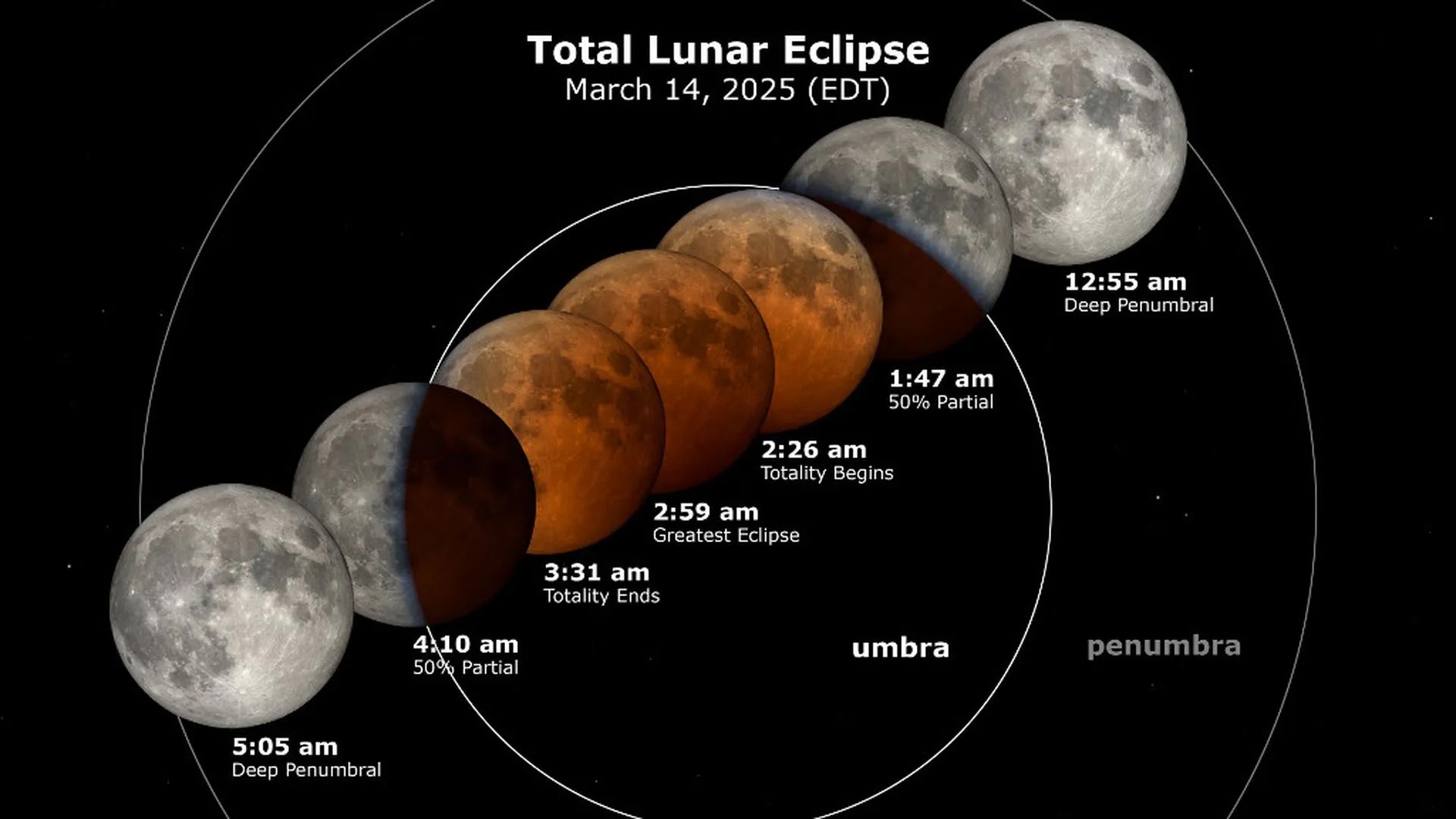
| Map showing the course of the Total Lunar Eclipse of 2025 as seen here on the eastern part of North America. Image courtesy of NASA. |
Greetings and Salutations, Y'all!
Tonight I would need to either stay up really late, or get up really early, to capture today's photographs for y'all to enjoy: the Total Lunar Eclipse of 2025 here in North America.
This Lunar Eclipse falls on the first full moon of March -- also known as the Full Worm Moon here in North America, which falls on the morning of Thursday, March 13th. This will also be the last full moon before the 2025 spring equinox on Thursday, March 20th. So long winter!
I've mentioned this in other blog posts, but just as a reminder to some of y'all, during a Lunar Eclipse the Sun passes between the Earth and the Moon casting the Earth's shadow over the surface of the moon.
There are two parts to a Lunar Eclipse: the first part when the Earth's shadow begins to cross the lunar surface known as the Penumbra (the lighter outer shadow) and then the Umbra (or deeper inner shadow) when the darkest part of the Earth's shadow covers the Moon.
This evening -- or early morning depending on how y'all look at it -- is a Total Lunar Eclipse, with the darkest part of the Earth's umbra shadow fully crossing Luna's face and giving our beautiful full Moon a dark red, almost blood-like color.
A Total Lunar Eclipse is referred to as a Blood Moon by astronomers, making this year's full moon the Full Blood Worm Moon!
It was my hope that God would permit beautifully clear skies, or at least few clouds, to give a clear view of this beautiful night sky event. Sure enough my prayers were answered.
Partial Eclipse began at about 12:55 a.m. EDT on Friday, March 14th here in South Carolina when the Full Worm Moon would begin to darken slightly, with the shadow slowly darkening from the left side of the "Man In The Moon" as viewed from here on Earth. This would continue for another 50 minutes until at about 1:45 a.m. EDT when the partial eclipse would begin showing the moon getting steadily darker and redder as Luna began entering the deeper umbra shadow.
Total Eclipse began at approximately 2:26 a.m. EDT once Luna fully entered the umbra shadow and continued until 3:32 a.m. EDT -- a total of an hour and five minutes. The Full Blood Worm Moon reached its peak illumination at 2:55 a.m. EDT during the height of total eclipse. Maximum Eclipse occurs at approximately 2:58 a.m. EDT.
In total the Full Blood Worm Moon (from the beginning of penumbra until the Earth's shadow completely crossed the lunar surface) lasted from 12:55 a.m. EDT till 5:05 a.m EDT -- a total of four hours and 10 minutes.
The following are the photos I took of this outstanding cosmic event from the beginning showing the Full Worm Moon to the greatest totality of the Full Blood Worm Moon.


I stayed up very late -- or very early depending on how one looks at it -- to capture these glorious shots for y'all to enjoy; especially for those of you who were unable to see the Total Lunar Eclipse because: (a) cloudy skies, (b) living outside North and South America, or (c) y'all simply couldn't stay awake so late.
As always I'm very happy to bring the night skies to y'all. Have a wonderful evening and be sure to keep your eyes to the night skies, y'all hear!


