|
| Artwork from a sketch taken by a Union observer showing the destructive aftermath of the explosion of the Petersburg mine beneath Elliott's Salient in the early morning hours of Saturday, July 30, 1864 prior to the failed Union assault to exploit the breach in the Confederate lines. Image courtesy of the Library of Congress. |
In
the early morning hours of Saturday, July 30, 1864, at about 4:40 A.M.
EST, Confederate defenders of the earthworks near the city of
Petersburg, Virginia at the Blandford Church were mostly still asleep; with the exception of some pickets observing the Union lines
opposite their position. Both opposing lines were only about 130 yards apart.
These men included two regiments of South Carolina volunteer infantry and elements of a third regiment from the brigade commanded by Confederate Brigadier General Stephen Elliott Jr. and a four gun battery of Virginia artillerymen assigned to an earthwork fortification known as Elliott's Salient.
Less than five minutes later, over 300 of these men would be instantly killed and many others severely wounded.
Unknown to these Southern men, for the last several weeks, Union army engineers -- mainly Pennsylvania coal miners -- had been busy digging a T-shaped mine shaft that ran 512 feet from the Union lines directly beneath their position. Two days before, these same Union engineers placed 320 kegs of black gunpowder -- approximately 8,000 pounds (4 tons) -- in two passages no more than about 20 feet below Elliott's Salient, setting the stage for what would be one of the better known events during the entire 292-day Siege of Petersburg (Thursday, June 9, 1864 -- Saturday, March 25, 1865).
These men included two regiments of South Carolina volunteer infantry and elements of a third regiment from the brigade commanded by Confederate Brigadier General Stephen Elliott Jr. and a four gun battery of Virginia artillerymen assigned to an earthwork fortification known as Elliott's Salient.
Less than five minutes later, over 300 of these men would be instantly killed and many others severely wounded.
Unknown to these Southern men, for the last several weeks, Union army engineers -- mainly Pennsylvania coal miners -- had been busy digging a T-shaped mine shaft that ran 512 feet from the Union lines directly beneath their position. Two days before, these same Union engineers placed 320 kegs of black gunpowder -- approximately 8,000 pounds (4 tons) -- in two passages no more than about 20 feet below Elliott's Salient, setting the stage for what would be one of the better known events during the entire 292-day Siege of Petersburg (Thursday, June 9, 1864 -- Saturday, March 25, 1865).
Several good books have been written about the events leading up to the Battle of the Crater telling in detail about the construction of, and the detonation of the mine and creation of the Petersburg crater; and about the subsequent Union military blunders and Confederate defensive actions that took place following the breach in the Southern lines.
Yet often overlooked is the story of the South Carolina men from Elliott's Brigade who were standing post at the fortifications directly over the site where the mine was exploded early that fateful morning. Many of these men died while they still slept, and others killed instantly when the ground beneath their feet erupted into one of the largest non-nuclear, human-made blasts of the war.
When the dust settled, on the spot where Elliott's Salient had stood mere moments before, a massive crater approximately 170 feet long, 120 feet wide, and 30 feet deep scarred the landscape. A total of 353 South Carolina Confederates and Virginia artillerymen were instantly killed by the blast. Two of those regiments -- the 18th and 22nd South Carolina Volunteer Infantry Regiments -- would lose more soldiers killed and wounded in that one single blast and the subsequent than at any other point in the entire war.
Many of these men and boys were from companies in three particular regiments recruited from this writer's corner of South Carolina, from counties located in the Piedmont and Upstate regions.
Yet often overlooked is the story of the South Carolina men from Elliott's Brigade who were standing post at the fortifications directly over the site where the mine was exploded early that fateful morning. Many of these men died while they still slept, and others killed instantly when the ground beneath their feet erupted into one of the largest non-nuclear, human-made blasts of the war.
When the dust settled, on the spot where Elliott's Salient had stood mere moments before, a massive crater approximately 170 feet long, 120 feet wide, and 30 feet deep scarred the landscape. A total of 353 South Carolina Confederates and Virginia artillerymen were instantly killed by the blast. Two of those regiments -- the 18th and 22nd South Carolina Volunteer Infantry Regiments -- would lose more soldiers killed and wounded in that one single blast and the subsequent than at any other point in the entire war.
Many of these men and boys were from companies in three particular regiments recruited from this writer's corner of South Carolina, from counties located in the Piedmont and Upstate regions.
The following are the company breakdowns of each of the three regiments involved in the Petersburg mine explosion.
17th South Carolina Volunteer Infantry Regiment, CSA
Company A - Chester County, Richburg area.
Company B - (York Rangers) Fairfield County.
Company C - (Defenders of Right or the Broad River Light Infantry) York County.
Company D - (Palmetto Rifles or the Palmettoes) Chester & Fairfield Counties.
Company E - (Indian Land Rifles) Western York & Lancaster County, Indian Land area.
Company F - (Carolina Rifles) York County.
Company G - Barnwell County.
Company H - Barnwell County.
Company I - (Lancaster Tigers) Lancaster County.
Company K - (Lacy Guards) York County.
Company A - Chester County, Richburg area.
Company B - (York Rangers) Fairfield County.
Company C - (Defenders of Right or the Broad River Light Infantry) York County.
Company D - (Palmetto Rifles or the Palmettoes) Chester & Fairfield Counties.
Company E - (Indian Land Rifles) Western York & Lancaster County, Indian Land area.
Company F - (Carolina Rifles) York County.
Company G - Barnwell County.
Company H - Barnwell County.
Company I - (Lancaster Tigers) Lancaster County.
Company K - (Lacy Guards) York County.

18th South Carolina Volunteer Infantry Regiment, CSA
Company A (Unionville Rifles) - Union County.
Company B (Union Volunteers) - Union County.
Company C (Cross Keys Company) - western Union and southern Spartanburg Counties.
Company D - Anderson County.
Company E - Spartanburg, Union, Laurens, and Greenville Counties.
Company F - Union, York, and Spartanburg Counties.
Company G (Mountain Guards) - York and Spartanburg Counties.
Company H (Catawba Light Infantry) - many men from York County.
Company I (Darlington Rifles) - Darlington County.
Company K (Broad River Guards) - Spartanburg County.
Company A (Unionville Rifles) - Union County.
Company B (Union Volunteers) - Union County.
Company C (Cross Keys Company) - western Union and southern Spartanburg Counties.
Company D - Anderson County.
Company E - Spartanburg, Union, Laurens, and Greenville Counties.
Company F - Union, York, and Spartanburg Counties.
Company G (Mountain Guards) - York and Spartanburg Counties.
Company H (Catawba Light Infantry) - many men from York County.
Company I (Darlington Rifles) - Darlington County.
Company K (Broad River Guards) - Spartanburg County.

22nd South Carolina Volunteer Infantry Regiment, CSA
Company A - (Edgefield Rifles or Edgefield Riflemen) Edgefield County.
Company B - (Cedar Hill Guards) Spartanburg County.
Company C - (Chapel Guards) Spartanburg County.
Company D - (Hopewell Guards and Walhalla State Guards) Pickens County.
Company E - (Lancaster Guards) Lancaster County.
Company F - (Hagood Guards) Pickens County.
Company G - Anderson, Pickens, and Abbeville Counties.
Company H - Greenville and Pickens Counties.
Company I - Lexington, Orangeburg, and Barnwell Counties.
Company K - Pickens County.
Company A - (Edgefield Rifles or Edgefield Riflemen) Edgefield County.
Company B - (Cedar Hill Guards) Spartanburg County.
Company C - (Chapel Guards) Spartanburg County.
Company D - (Hopewell Guards and Walhalla State Guards) Pickens County.
Company E - (Lancaster Guards) Lancaster County.
Company F - (Hagood Guards) Pickens County.
Company G - Anderson, Pickens, and Abbeville Counties.
Company H - Greenville and Pickens Counties.
Company I - Lexington, Orangeburg, and Barnwell Counties.
Company K - Pickens County.

 |
| Brigadier General Stephen Elliott Jr. CSA (1830-1866) commanded the South Carolina brigade that was largely decimated by the Petersburg mine explosion and subsequent Battle of the Crater. General Elliott would be severely wounded as he rallied his remaining troops and would ultimately die as a result of those wounds less than a year after the end of the war. Photo courtesy of Library of Congress. |
General Elliott himself survived the initial explosion, having been asleep in a bunker near the line and shaken awake by the blast. He would be seriously wounded in the chest and left arm while leading his remaining regiments of his shattered brigade in the counterattack against the Union assault. Colonel Fitz W. McMaster of the 17th South Carolina Infantry Regiment took temporary command of Elliott's brigade after the general was wounded, with his second in command, Major John R. Culp, taking temporary command of the regiment.
General Elliott would later be replaced as the brigade commander by Colonel William H. Wallace of the 18th South Carolina Infantry Regiment after the battle. Wallace's second in command, Lieutenant Colonel William B. Allison, would take over command of the regiment. Elliott would later return to duty and survive the war, surrendering with Johnston's Confederate Army of Tennessee in North Carolina in late April, 1865; but would ultimately die of his wounds -- which never fully healed -- less than a year later in February of 1866 in Aiken, South Carolina.
The 18th and 22nd South Carolina Regiments both lost about 278 soldiers in the initial blast and from mortal wounds as a result of the explosion (the 18th lost 82 and the 22nd lost 170 in the blast itself), while the 17th South Carolina Regiment lost 135 men from the explosion and later from fatal wounds in hospital from the battle that followed.
Twenty-two Virginia artillerymen from Pegram's Battery assigned to their cannons were lost in the explosion within hundreds of yards from the homes where they were born and raised.
The heaviest casualties from the mine explosion and subsequent military action came from the 22nd South Carolina Infantry Regiment, which lost 216 men killed and wounded -- 170 officers and men were lost instantly in the mine explosion, including Colonel David G. Fleming, whose body was never recovered. William G. Burt was promoted to colonel and command of the regiment.
The 18th South Carolina Infantry Regiment lost seven of its officers in the explosion, including two
Captains: John McCormick of Company A and W.P. Bridges of Company K;
and five Lieutenants: Samuel H. Wolfe of Company A, W.M. Lawsom of
Company C, John
G. Bryant of Company D, John Anderson of Company E and John Foster of
Company F.
To
give y'all an idea of how badly these South Carolina regiments were decimated, at the
end of the day only one man answered roll call from Company A, 18th S.C.
Infantry, and only two from Company B, and three from Company C of the
22nd S.C. Infantry.
The Roll Call for the 22nd South Carolina Infantry Regiment two days before on July 28th numbered 329 officers and men. On August 1st, two days after the battle, the same roll call numbered only 86 officers and men.
It
was the most tragic and devastating day for a single brigade of South
Carolina soldiers. These
units experienced immediate and devastating losses -- most of them men and
boys from Spartanburg County who would lose more men in this one single
day of the war.
The Battle of the Crater would ultimately go on to be a military disaster for the attacking Union forces due to several significant blunders and the strong defense by the Confederate forces. The end result would be the deaths and wounding of over 5,000 American soldiers (3,800 Union and 1,500 Confederate casualties) in an inconclusive battle that failed to accomplish anything significant for either side and cost so many more lives.
The Siege of Petersburg would stubbornly continue into the fall and winter of 1864-1865 with many more Americans on both sides dying from the horrible conditions of the trench warfare.
The remains of the crater from the mine explosion can still be seen today at Petersburg, Virginia. The Blandford Church located near the site of the crater and the Confederate lines served as a field hospital following the battle and serves as a memorial for those Confederate soldiers who died defending the city during the long siege.
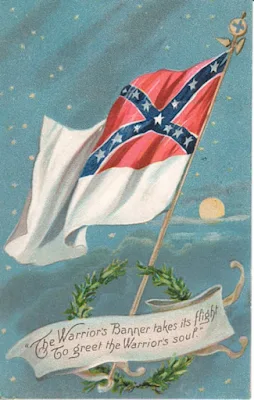
The Adam Washington Ballenger Camp #68 of the South Carolina Division Sons Of Confederate Veterans erected a large flag pole on private property along I-85 in Spartanburg County in 2022 for the purpose of remembering those men of the 18th and 22nd South Carolina Infantry Regiments who were killed in the mine explosion and the battle.
This blog post is dedicated to those sons of South Carolina who did not return home, but will always be remembered so long as there are those who are determined never to forget their memory.
 |
| The gravestone of Colonel David George Fleming (1832-1864) 22nd South Carolina Volunteer Infantry CSA at Oakwood Cemetery in Spartanburg, SC. His body was never recovered following the explosion of the Petersburg mine. Image courtesy of findagrave.com. |
The Battle of the Crater would ultimately go on to be a military disaster for the attacking Union forces due to several significant blunders and the strong defense by the Confederate forces. The end result would be the deaths and wounding of over 5,000 American soldiers (3,800 Union and 1,500 Confederate casualties) in an inconclusive battle that failed to accomplish anything significant for either side and cost so many more lives.
The Siege of Petersburg would stubbornly continue into the fall and winter of 1864-1865 with many more Americans on both sides dying from the horrible conditions of the trench warfare.
The remains of the crater from the mine explosion can still be seen today at Petersburg, Virginia. The Blandford Church located near the site of the crater and the Confederate lines served as a field hospital following the battle and serves as a memorial for those Confederate soldiers who died defending the city during the long siege.
The Adam Washington Ballenger Camp #68 of the South Carolina Division Sons Of Confederate Veterans erected a large flag pole on private property along I-85 in Spartanburg County in 2022 for the purpose of remembering those men of the 18th and 22nd South Carolina Infantry Regiments who were killed in the mine explosion and the battle.
This blog post is dedicated to those sons of South Carolina who did not return home, but will always be remembered so long as there are those who are determined never to forget their memory.