Showing posts with label South Carolina History. Show all posts

Monday, August 18, 2025

The Battle Of Fishing Creek: "Blood Ban" Tarleton Routes Sumter -- August 18, 1780

Tarleton's British Legion Cavalry attacking Sumter's men at Catawba Ford along the Catawba River
in Chester County, SC.

 The Battle of Fishing Creek
"Bloody Ban" Tarleton Routes Sumter
Friday, August 18, 1780 

By: C.W. Roden 


(Part 10 of a 15 part series)

Heading north along the western bank of the Catawba River at a leisurely pace, Brigadier General Thomas Sumter was unaware of the disastrous outcome at Camden, unaware that Major General Horatio Gates, the so-called "Hero of Saratoga" had abandoned his own army and retreated into North Carolina to avoid being captured. 

It wasn't until the evening of Wednesday, August 16th that a dispatch rider, 13-year-old Andrew Jackson, from Major William Richardson Davie informed Sumter of the disaster at Camden and the disgraceful retreat of General Gates -- whom Davie had encountered only hours before.

Despite this alarming news, Sumter did not increase his pace.

Among Sumter's force were about 700 mounted militia and 100 Maryland Continentals and two artillery pieces detached to his force by Gates only a few days before. Traveling with Sumter's force were also fifty wagons full of captured British supplies and about 250 prisoners of war. The latter was severely slowing Sumter's usual quick progress.

Unwilling to abandon his captured plunder, Sumter and his men continued to move slowly north along the river towards Charlotte and safety.


The Pursuit of Sumter

In the immediate aftermath of his decisive victory just north of Camden, Lieutenant General Charles Lord Cornwallis gave orders to the Loyalist British Legion commander Lieutenant Colonel Banastre Tarleton to pursue Sumter's backcountry militia and recapture the prisoners and supplies taken by the Patriot leader.

Lord Cornwallis considered Sumter such an annoyance that he called him one of his "great plagues" -- an accurate description given the work that Patriot militia under his command had accomplished disrupting British outposts in the backcountry over the course of the summer. He gave Tarleton orders to capture, or kill, Sumter if possible.


The British Legion had just returned to camp following their pursuit and slaughter of routed Patriot militia and Continentals following the retreat from Camden. Tarleton
was more than eager to take up his mission and immediately set out up the eastern bank of the Catawba River with about 350 men -- including a detachment of the 71st Regiment of Foot (Fraser's Highlanders) riding double with the Legion cavalry.

The proud English aristocrat sought revenge for the defeat of a detachment of his own British Legion under Captain Christian Huck at Williamson's Plantation the month before at the hands of Patriot militia from Sumter's command. It had been a blow to the reputation of his Legion as a force to be feared in the backcountry. 


By the evening of Thursday, August 17th, Sumter had crossed the rover and only moved as far as Rocky Mount, setting up camp in the open along the riverbank not far from the now abandoned British outpost. From the other side of the river, Tarleton could easily spot the partisan camp, seeing their cooking fires in the darkness. To keep his own position secret, Tarleton ordered his own men not to build fires.
Crossing over the next morning and moving with characteristic speed, he reached the site of Sumter's camp, once again finding that Sumter had already moved on. Picking around 160 dragoons from his Legion and leaving the infantry to cover his rear and follow at their own pace, Tarleton continued the pursuit.

The stifling 90F degree August heat and the difficult conditions continued to slow Sumter's progress. About noon, after an eight-mile march, Sumter halted his force near Catawba Ford (in modern-day Chester County), where Fishing Creek feeds into the Catawba River.


In spite of warnings he had received, Sumter took no special security precautions, save for a few sentries posted along the road. Most of his men were using the halt in the march for rest and recreation. They stacked arms and relaxed, many taking the opportunity to swim and bathe in the creek, while others, including Sumter himself, decided to take a nap in whatever shade they could find. Sumter rested underneath one of the captured wagons.


Fishing Creek in Chester County, South Carolina as it would
have appeared in mid-to-late August in the summer of 1780.


The Battle


Tarleton's dragoons finally caught up to Sumter that afternoon, overwhelming the posted sentries before they could raise the alarm. He quickly formed them for attack. Despite being outnumbered about four-to-one, Colonel Tarleton and the British Legion dragoons charged into the Patriot camp, catching the militia and Sumter completely by surprise and quickly gaining control of the stacked arms.

The Patriot militia, many of which were caught literally with their pants down, were completely routed. Sumter woke from underneath the wagon as the green-coated Legion cavalry swept into the camp. Unable to get to his own horse, he cut the harness of a draft horse from the wagon and, riding bareback, tried to rally his panicked men. Ultimately, this proved futile as the Patriots were routed; each man for himself in the escaped. General Sumter fled into the nearby woods half-dressed, leaving behind his hat, coat, and boots; barely escaping capture himself.
Sumter was picked up by Captain John Steele and carried to another horse. Riding nonstop, Sumter reached the American Major William Richardson Davie’s camp at Charlotte, North Carolina two days later.

The British Legion cavalry virtually decimated the militia and Continentals. The losses were one-sided and severe. The Patriots lost about 150 men killed and wounded, and more than 300 prisoners were taken. The Legion also freed the 250 captured British prisoners and captured all of Sumter's supplies and captured war material, including: 800 horses, 1,000 individual weapons, and his two artillery pieces. Tarleton himself only lost 16 men killed and wounded.

Perhaps the only positive story to come of the affair for the Patriots was the daring escape of militia officers Lieutenant Colonel Henry Hampton and Colonel Thomas Taylor. Both officers had been taken prisoner by Tarleton, but managed to cut through their rope-tied hands with a pocketed knife and flee into the swamp.

Not long after the battle, the rest of the British Legion infantry and the detachment of Highlanders that had been left behind arrived to help take charge of the prisoners and recaptured supplies.


"Blood Ban" Tarleton and his British Legion had their vengeance.


Aftermath

Two days later, following the battle at Fishing Creek (also known as the Battle of Catawba Ford) Sumter arrived in Charlotte and joined up with Major Davie's militia. He was a brigadier general without servant, soldiers, or baggage. He would soon gather another force of upcountry militia for the coming campaign that many of them now dreaded. Many of the Patriot militiamen from the District Between the Broad and Catawba Rivers who'd avoided capture by Tarleton's Legion would continue to resist the Loyalist militias and their British allies on their own over the course of the next couple of months.


The defeat of Gates at Camden and the routing of Sumter at Fishing Creek were terrible blows to the morale of the upcountry partisans. Lord Cornwallis, on the other hand, was jubilant. The news of the twin defeats would reach London, making the earl the toast of the capital. When the Comte de Vergennes, King Louie XVI's foreign minister, learned of the defeats, he believed that the American cause was lost. He floated a peace feeler based on uti possidetis ("as you possess") that would have left South Carolina and Georgia as British colonies.

Tarleton himself believed that the defeat of Sumter would be enough to eliminate any further organized resistance to the Crown in the upcountry. Lord Cornwallis himself was not as certain of that since Sumter himself had not been captured, or killed. None-the-less, the British general now felt that the time was right to begin the next step in the conquest of the American South -- the invasion of North Carolina.

However, all was not lost to the upcountry South Carolina Patriots. Help would soon come from an unexpected ally from the North Carolina Appalachians and the British Southern strategy would find itself coming to a grinding halt -- the beginning of which will be discussed in detail in the next chapter of this series.


Monument near the site of the Battle of Fishing Creek
(also known as the Battle of Catawba Ford) near Great Falls,
SC in Chester County.

For more information about the Battle of Rocky Mount and its significance to American history please consult the following sources that were used to help with this blog post:
 Partisans & Redcoats: The Southern Conflict That Turned The Tide of the American Revolution  
by Walter Edgar (2001) ISBN 0-308-97760-5

Saturday, August 16, 2025

The Battle Of Camden: Cornwallis Defeats Gates -- August 16, 1780

The Maryland Continental Line fighting against the 71st Regiment of Foot "Frazer's Highlanders" at the
Battle of Camden, August 16, 1780. 
 
The Battle of Camden
Cornwallis Defeats Gates
Wednesday, August 16, 1780 

By: C.W. Roden 


(Part 9 or a 15 part series)

In April of 1780, General George Washington, responding to the call for reinforcements by General Benjamin Lincoln in Charleston, South Carolina, sent two Maryland Line regiments and the Delaware Line regiment supported by the 1st Continental Artillery Regiment with 18 guns to the southern theater. These men were under the command of Major General Baron Johann de Kalb.

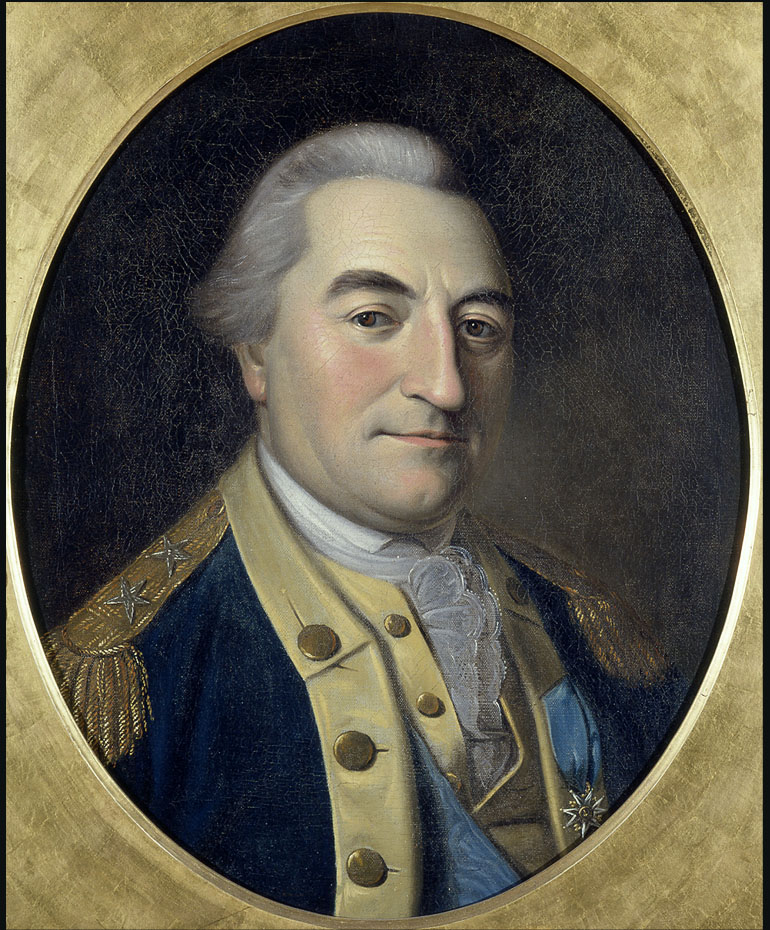
Portrait of Baron Johann de Kalb
by Charles Wilson Peale.

Baron de Kalb was perhaps one of the more interesting personalities that supported the American cause.


He was born in 1721 in Hüttendorf, a village near Erlangen, Principality of Bayreuth (modern-day Bavaria, Germany) and later earned a military
commission as a lieutenant in the Loewendal German Regiment of the French Army in 1743. He trained in the military school of Marshall Maurice de Saxe -- called “the Professor of all the generals of Europe” by Frederick the Great. A veteran of the War of the Austrian Succession (1740-1748) and the Seven Years' War (1756-1763), Baron de Kalb was promoted to lieutenant colonel and won the Order of Military Merit in 1763, and was elevated to the nobility with the title of baron.

When the American States declared their formal independence from Britain, Baron de Kalb sailed with eleven other European officers on the ship fitted out by the
Marquis de Lafayette. They arrived in Philadelphia, Pennsylvania in July 1777 and joined the Continental Army. He was appointed to the rank of major general on Friday, September 5, 1777. Baron de Kalb would spend the winter of 1777-87 at Valley Forge and serve in the Northern campaign against the British and fought at the Battle of Monmouth on Sunday, June 28, 1778.

De Kalb preferred to march on foot with his men rather than riding and hike up to 30 miles a day. He drank only water and was always a completely sober and controlled person. He would sleep by a camp fire with is soldiers, wrapped in his horseman's cloak. A perfect example of a classical field officer, he was well loved and respected by the men under his command.

These reinforcements departed New Jersey on Sunday, April 16, 1780, but were unable to reach Charleston before the city surrendered after a six week siege by British forces on Friday, May 10th.

General de Kalb remained with his troops in Granville County, North Carolina. It was hoped that the presence in the area of the Continentals would boost Patriot morale and entice recruitment after the disasters at Charleston and the Battle of the Waxhaws. Unfortunately, during those early months, very few recruits appeared.


The Continentals also experienced several hardships with campaigning in the South in late spring and early summer -- particularly an infestation of chiggers (Redbugs) and ticks that infested their camps, as well as mosquitoes that breed near the rivers and swampy areas. It must have been a miserable time for the Maryland and Delaware Continentals being covered in severe bites and suffering diseases contracted from the bugs. 

Short of proper food and with many his men sickening and suffering from the unaccustomed heat, bugs, and poor diet. Major General de Kalb moved his troops to camp near Buffalo Ford on the Deep River, 30 miles south of Greensboro, North Carolina, in July.

It would be here that his new commanding officer, Major General Horatio Gates arrived in camp near the end of the month.


"The Hero Of Saratoga"

Baron de Kalb was an excellent soldier, but as a foreigner did not have very much influence with the Continental Congress, where decisions of command were ultimately made -- for better, or worse.


General Horatio Gates, on the other hand, was widely admired by most of the Congress, largely for his supposed role in the major American victory at the Battle of Saratoga in 1777 -- a battle that was largely won because of the efforts of the field officers, notably: Benedict Arnold, Enoch Poor, Benjamin Lincoln, John Stark and Daniel Morgan. The battle was instrumental in winning the French over to the cause of American independence. Because he was in overall command of the soldiers, the title "Hero of Saratoga" was bestowed upon Gates by the Continental Congress.
General Horatio Gates in a 1794 portrait
by Gilbert Stuart.

Horatio Gates was born in
Maldon, Essex, Great Britain in 1727.  In 1745, Gates obtained a military commission with financial help from his parents and political support from the Duke of Bolton. Gates served with the 20th Regiment of Foot in Germany during the War of the Austrian Succession. Later he arrived in Halifax, Nova Scotia under Edward Cornwallis (uncle of British General Lord Charles Cornwallis, against whom he would later fight) and later was promoted to captain in the 45th Regiment of Foot the following year.

During the French and Indian War (1754-1763), Gates served with British General Edward Braddock in America. In 1755, he accompanied the ill-fated Braddock Expedition in its attempt to control access to the Ohio Valley. This force included other future Revolutionary War leaders such as: Thomas Gage, Charles Lee, Daniel Morgan, and George Washington. Gates was severely injured early in the action, among many other British soldiers. His experience in the early years of the war was limited to commanding small companies, but he apparently became quite good at military administration, and achieved the rank of major.


Later he would resign his commission in the British Army due to frustration with achieving higher rank from his lack of connections and settle in Virginia. When the American Revolutionary War broke out in 1775, he volunteered to serve in the newly formed Continental Army where he found himself at odds with Washington. Later he would become a major figure in the infamous Conway Cabal, which sought to replace Washington for Gates as commander in chief of the Continental Army.

When General Lincoln surrendered Charleston in May of 1780, the Continental Congress assigned Gates to take command in the Southern theater. Washington himself was never even consulted, though his low opinion of General Gates was well known.
If Washington would have had his way, command in the South would have gone to Major General Nathaniel Greene, the quartermaster general of the Continental Army and one of Washington's best field officers. Greene would later get the job in the late fall of 1780, but not until after the tragic events that would soon transpire for the Patriots in South Carolina under the dubious command of Gates.

With Gates' appointment begins the tragic story of a series of mistakes and bad judgments that would lead to one of the worst disasters in American military history. 


Gates Marches Into South Carolina

Horatio Gates and Baron de Kalb met at camp near the Deep River on Tuesday, July 25, 1780. Gates was greeted with all proper ceremony -- including a 13-gun salute as he took command of the entire Southern Department. Major General de Kalb was confirmed in his leadership of the Maryland and Delaware Continentals and made second in command. 


The "Grand Army" as Gates called it, was not much of an army at this point. It consisted of de Kalb's Continental infantry, three companies of artillery with 8 guns -- de Kalb had been forced to leave behind 10 of his 18 cannons in Granville County due to a lack of proper horses -- and Colonel Charles Armand's Legion of 60 dragoons and 60 foot soldiers. 

Baron de Kalb's original plan was to march southwest through Salisbury, North Carolina, taking advantage of the strong support for the Continental Army in that area and the rich farmland for provisions, then march on to Camden, South Carolina

However, Gates did not approve of taking the longer route. Instead, two days later on Thursday, July 27th, against the advise of his officers, including de Kalb and Colonel Otho Holland Williams of the Maryland Line, the "Hero of Saratoga" decided to march the army from Deep River directly on to Camden.

Although this route was fifty miles shorter than the one proposed by Baron de Kalb, it traversed the poor and somewhat barren Carolina Sandhills region. Gate's route also ran through the Cross Creek country, one of the Carolina's most pro-Loyalist areas, meaning the Patriots would find no local help with supplies as they struggled along the roads and through the creeks and swamps. What little food they found -- usually the occasional peach orchard, green corn, or small herds of sickly cows -- made the men sick as they were mercilessly pushed hard by their commanding general.

All of the troops had been short of food since arriving at Deep River, so once the army finally reached the Pee Dee River, they found crops of green corn which was harvested and eaten by the hungry men, with unhealthy consequences.


The "Grand Army" was soon joined by cavalry dragoons under Colonels William Washington and Anthony White, both of whom had taken refuge with their remaining men in North Carolina after both had been badly beaten by Tarleton's Legion at Moncks Corner and Lenud's Ferry back in May. They rode into camp expecting to join forces for the attack on Camden.

General Gates informed them that he did not want their help because he erroneously believed that cavalry was not useful for the southern field. A bizarre view given the successes of the mounted partisan bands operating in South Carolina since the fall of Charleston.

As military historian Henry Lumpkin explained in his
1981 book From Savannah to Yorktown: The American Revolution in the South:

"The South was especially well adapted to use of cavalry because of its wide reaches of open pine barrens, broad savannas, great distances, wild forests and swamps for concealment, and year-round natural forage for horses. Francis Marion, William Davie, Thomas Sumter, and Elijah Clarke -- all the great partisans on both sides -- were to prove time and time again the value of fast-moving, heavily armed, well mounted men in southern warfare."


The people in the South were natural horse soldiers, practically raised in the saddle, but this fact was apparently dismissed by Gates.
The fact that William Washington was second cousin to Gates' rival General George Washington might also have been a huge factor in his decision. Gates' foolish pride and his uninformed decision would deprive his army of essential troops in the coming battle.

Other partisans came forward to meet with Gates, including General Francis "Swamp Fox" Marion, who offered his services, as Washington and White had. Gates however had little use for Marion and his men, despite their successes in the Lowcountry against the British and Loyalists -- especially the hated "Bloody Ban" Tarleton. Gates had little use for militia, his view of them largely clouded due to experiences in the North with undisciplined guerilla bands like Ethan Allen's Green Mountain Boys, and treated Marion and his men with utter contempt.

Fortunately for the State of South Carolina and the future United States of America, Gates ordered Marion to leave his camp and move into the coastal regions to observe and harass the enemy there.


On Thursday, August 3rd, Lieutenant Colonel Charles Porterfield, an officer with an excellent record as a captain in the Continental Army, arrived at Gates' camp with 100 Virginia troops. The half-starved army then crossed the Pee Dee River and continued its ill-advised march through the sparsely populated enemy country.
Brigadier General Francis Lord Rowdan of the
Volunteers of Ireland.

The arrival of Gates' "Grand Army" did not go unnoticed by the British. General Francis Lord Rawdon was watching the approaching Patriots from the other side of the Little Lynches River with a strong reconnaissance force consisting of Loyalists from his Provincial Volunteers of Ireland
. As he watched the Americans approach, Rawdon ordered his forces and those stationed at Rugely's Mill, 15 miles north of Camden, to fall back to a post called Log Town, a mile above Camden. Despite de Kalb's advise to outflank Lord Rowdan by a forced night march, Gates pushed forward in broad daylight.

On Sunday, August 6th, General Richard Caswell arrived with 2,100 North Carolina militia, which now doubled Gates' army.  At Rugely's Mill Gates halted and was soon joined by an additional 700 Virginia militia under the command of General Edward Stevens.

During this time the upcountry Patriots under the command of Brigadier General Thomas Sumter had been operating on the British supply line to Charleston. He sent a courier (possibly young Andrew Jackson) to Gates requesting reinforcements to attack a British wagon train bringing supplies and ammunition to Camden.


For some reason, in spite of his dismissal of Marion, Gates seems to respond to Sumter favorably. Despite the fact a major battle was in the offering the closer he reached Camden, Gates somehow saw merit in Sumter's plan. Against the advice of his officers, he sent 100 of his Maryland Continentals and 300 North Carolina militiamen with two cannons to assist Sumter. This reduced his artillery to seven guns (an additional gun had come in with Caswell's militia).

For his part, Sumter wasted little time in implementing is plan. This time he hit a small outpost on the Wateree River below Camden. A garrison of 30 men defended a makeshift fort at a ferry crossing -- a vital link in the British communications chain. A detachment of Sumter's band commanded by militia Colonel Thomas Taylor took the outpost by surprise and captured the entire garrison and thirty-six wagons full of war supplies. In questioning his prisoners, Taylor discovered that a wagon convoy was en route from the British outpost at Ninety Six. Taking advantage of this intelligence, Taylor planned and executed a successful ambush of the convoy. 


Sumter informed Gates of the capture of the crucial ferry crossing and said that he would defend it until he received instructions to the contrary. No sooner had he sent the report than the British Army began crossing the Wateree River in large numbers below the ferry. Without hesitation, Sumter withdrew his men and moved his command ten miles up the river in order to protect his captured prisoners and supplies. 

Gates, anxious to score more praise from Congress for himself in the South, had pushed his now starving army to the point of exhaustion. At one point the miserable soldiers came close to mutiny. Totally oblivious to the condition of his men, the "Hero of Saratoga" pressed on, anxious to force a confrontation with Cornwallis.

He wouldn't have much longer to wait.


The British Response And Line of Battle


Lieutenant General Charles Lord Cornwallis, having been informed by courier of Gates' advance on Camden, rode from Charleston to Camden in four days. He also detached four companies of light infantry on a forced march from Ninety Six to Camden.

Lieutenant General Charles Lord Cornwallis,
British commander of the Southern Campaign
in the Carolinas 1780-81 from a painting
by Thomas Gainsborough.

The combat elements of the British forces included: three companies of the 23rd Regiment Royal Welsh Fusiliers, the 33rd Regiment of Foot, five companies of the 71st Regiment of Foot (Frazer's Highlanders), the Royal North Carolina Regiment, Lord Rawdon's Volunteers of Ireland, Tarleton's Legion of horse and foot, 170 men of the royal artillery with four 6-pounders and two 3-pounders, as well as an additional 300 South Carolina Loyalist militia.
Cornwallis and Rawdon now had around 2,200 men, mostly British regulars and highly trained provincials, some of the best men in the British Army.

Meanwhile Baron de Kalb's Maryland and Deleware Continentals had been reduced to 900 men by sickness, desertion, and the 100 soldiers that Gates sent to aid Sumter. Armand's Legion consisted of 60 horsemen and 60 foot soldiers. Lieutenant Colonel Porterfield commanded 100 Virginia light infantry, while Stevens and Caswell both led a combined 2,800 Virginia and North Carolina militia. Also included were about 70 South Carolina militia and 100 artillerymen with seven guns. Gates' "Grand Army" totaled around 4,100 Continental regulars and militia, but only 3,000 of which were fit for duty due to sickness caused by poor rations.

With an army composed primarily of untrained militia, Gates
ordered a night march to commence at 10 PM on Tuesday, August 15th. A night march in column is a difficult and complicated maneuver even for well-trained regular soldiers to perform, let alone for militia. Armand's 60 dragoons had been assigned the task of leading the army. Gates ignored the protests of Armand that cavalry had no place in the lead because of the noise the horses hooves made over great distances.

To make matters worse for the Patriot forces, beef, corn meal, and molasses that had been served for the evening rations. These had been procured locally in adequate quantities and the men prepared them hastily over fires before the march began. These men had been half-sick from a diet of green apples and corn, combined with bad water and the long march in hot and muggy August weather. The hastily cooked supper unfortunately
acted as a purgative causing severe stomach cramps and diarrhea. While they marched many of the men had to stop and go to the woods to relieve themselves all night long.

Apparently Gates planned on building defensive works a few miles north of Camden in an effort to force British abandonment of that important town. Gates told his aide Thomas Pinckney he had no intention of directly attacking Cornwallis with an army consisting mostly of militia, despite having the British outnumbered.


According to tradition, as Gates watched the column of his army file by, he is said to have boasted to his aides that he would have breakfast the next morning with Cornwallis as his prisoner and guest at his table.

Unknown to Gates however, Cornwallis' army was also commencing a night marching north on the road from Camden with Tarleton's dragoons at the lead of the British column, intent of fighting Gates just outside of the town.


The Battle

The first encounter between the two forces happened when Armand's horsemen ran into Tarleton's dragoons around 2 AM on the morning of Wednesday, August 16th. After some pistol firing in the dark, the aggressive Tarleton ordered a saber charge and smashed Armand's cavalry back on the leading elements of the American infantry commanded by Porterfield and Armstrong. In the confused night skirmish, Porterfield fell mortally wounded by a stray bullet as he swung his light infantry out of the woods and caught Tarleton's dragoons in an enfilading fire, forcing them to withdraw under the support of British infantry.


It was then, for the first time, that Gates discovered that he had literally stumbled into Cornwallis. 

With an army composed largely of inexperienced and undisciplined militia, most of them sick from the poor rations, and his plan to fortify and let Cornwallis come to him in ruins, Gates once again made another military gaffe. Against the advise of the Maryland Line's veteran Colonel Otho H. Williams -- who believed rightly that the best strategy would have been to retreat, find a good defensive position, and await the British attack -- Gates instead took the advise of the Virginia militia commander who insisted it was too late to retreat and that the army must fight. Gates concurred and ordered the army into a line of battle.

The battle was fought astride the road between the Waxhaws and Camden with a narrow, open forest of pine trees almost free of undergrowth on both sides. Flanking both sides were swamps impassable by wagons. Gates held a better position on slightly rising ground with a clear escape route behind him.

Gates formed his troops just before first light. Mordecai Gist's 2nd Brigade of three Maryland and one Delaware Continental regiments were stationed to the right of the road. On the left from the road Caswell's North Carolina militia and Steven's Virginia militia stood with the now leaderless Virginia light infantry on the flank and Armand's small legion in support. Smallwood's 1st Maryland Brigade was held in reserve behind the 2nd Maryland, and the seven artillery pieces were placed on the road in front of the center and between Caswell and Stevens. Baron de Kalb was given the place of honor, command of the right wing, while Gates and his staff took position some 600 yards to the rear of the line.

In the very early morning, Colonel Williams, riding along the waiting American line, saw the British advancing up the road. He summoned Captain Singleton of the artillery who estimated the enemy to be about 200 yards away. Williams ordered him to open fire. The British promptly unlimbered their advance field guns and replied.

The main battle was now joined. 

Colonel Williams rode back and reported to General Gates that the enemy were deploying from column into battle lines and that if he attacked them before they were fully formed he could throw them into confusion. Gates ordered Stevens and de Kalb to attack -- it was the last recorded order Horatio Gates gave in the battle.


Opposing Gates, Cornwallis quickly formed his line of battle with the Royal North Carolina Regiment, the infantry of Tarleton's Legion, and Lord Rawdon's Volunteers of Ireland from the left of the road, with Bryan's North Carolina Volunteers a short distance behind them on the left flank. Command of the left flank was given to Lord Rawdon. On the right were detachments of the 23rd Welsh Fusiliers and 33rd Regiment of Foot with the 4th Light Infantry company hugging the right flank. The right was commanded by Lieutenant Colonel James Webster. The five companies of the 71st Highlander Regiment were held in reserves behind the center with two 6-pounder field guns. Two more 6-pounders and two 3-pounders were placed in the front of the British center. Tarleton's dragoons waited in the rear of the battle line, ready to exploit any retreat by the enemy. 


A detailed map of the Battle of Camden.
Image courtesy of American Battlefield Trust.


At the same time both commanders order their armies to attack. The outcome of the battle was no contest, as Gates would make his final -- and ultimately fatal -- gaffe of the entire campaign.
 

A British Soldier of the 33rd
Regiment of Foot.
Being a former member of the British army, Gates followed British military tradition to the letter, including placing the best soldiers in the "position of honor" on the right flank in any major deployment. The problem here was that Cornwallis followed the same military tradition and did the exact same thing in his own deployment for the battle. Meaning that Gates' less experienced troops -- the inexperienced Virginia and North Carolina militiamen (most of them still suffering the ill-effects from their poor rations) -- were now facing the battle-hardened Welsh Fusiliers and the 33rd Regiment of Foot, some of Cornwallis' best and most disciplined soldiers; all of whom were far from unfit for duty that day.

Williams dismounted and called for volunteers, leading some 80 or so men within 40 yards of the deploying British, taking cover behind trees, and delivering harassing fire at close range. Cornwallis ordered Webster to counter-charge.

The 800 strong 33rd Fusiliers and 23rd Regiment closed ranks, fixed bayonets, and drove forward on the double quick, shoulder-to-shoulder. The 2,500 Virginia and North Carolina militia heard the deep British "Huzzah!" and saw the red coated line advancing on them with bayonets towards them in perfect order. They hesitated, a few of them firing and a few of the British soldiers dropped. This was the first time that most of these militiamen had been in battle or seen a real line of enemy soldiers, and a dreadful fear of those cheering soldiers and their steel-tipped muskets gripped the entire line.

A Virginia militiaman.

The entire left wing of Gates' "Grand Army" collapsed as the Virginia militia broke and ran. A moment later the North Carolinians on their flank also fled, many of them without even firing a shot, throwing down their still-loaded muskets and rifles. The Virginians fled so fast that they suffered only 3 wounded. The North Carolinians fled all the way back to Hillsborough, North Carolina. The fleeing militia broke through the 1st Maryland Brigade stationed in reserve behind the line, throwing the Continental unit into confusion. Tarleton's dragoons chased many of these men down, their sabers inflicting many casualties on the retreating Virginians and North Carolinians -- a number of them unarmed.


Seeing half of his army break and run from the British, the now-panicked Horatio Gates, the "Hero of Saratoga" and the darling of the Continental Congress, mounted his horse believing the day was lost, turned and raced away, deserting the remainder of his army at full gallop to their fate. He did not stop until he reached Charlotte sixty miles away, and only then to procure a fresh horse and gallop off another 120 miles to Hillsboro to put as much distance between him and Cornwallis' victorious army as he could.
A Continental soldier of the
Delaware Line.

General de Kalb and Mordecai Gist with the American right wing and the 1st Maryland Brigade still held the field. One regiment of North Carolina militia under the command of Colonel Henry Dixon did not join in the rout of the other militia on the left and fell back linking up with the Delaware Continentals. De Kalb called for the reserves, and Otho Williams, finding that Smallwood had also fled the battle, tried to bring the regulars to the left of the 2nd Brigade and Dixon's militia to form an L-shaped defensive line. However they could end up getting no closer than several hundred feet. Elements of the British 23rd and 33rd Regiments and already had advanced between the two American brigades and the gap could not be closed. Instead of ordering a pursuit of the routed militia, Cornwallis sent in Webster and his regulars against the 1st Marylanders. They fought, retreated, rallied around their colors and then finally broke completely, some of them escaping to safety through the swamps along the nearby Wateree River.


Now only the 2nd Maryland Brigade, the Delaware Regiment, and Henry Dixon's North Carolina militia continued to struggle against Cornwallis -- about 600 Continentals and militia against 2,000 British and Provincial regulars. The numbers now favoring the redcoats.

Twice Radwon's wing of the British army attacked the Continentals with bayonet charges, only to be driven back. The Continentals had even managed to take a few prisoners.
The Continental troops then launched a counterattack which came close to breaking Rawdon's line, which began to falter. Cornwallis rode to his left flank and steadied Rawdon's men. For another hour both sides charged, reformed, then charged again. De Kalb led his men personally on foot and with sword in hand, his horse having been killed early in the battle. Despite being wounded by a saber cut and being urged by his officers to withdraw while they still could, de Kalb refused to consider retreat. 

Baron de Kalb himself led one more charge, killing at least one British soldier opposing him, until finally being brought down mortally wounded after sustaining 11 wounds (the saber cut, 2 bullet wounds, and 8 bayonet cuts). His men closed ranks and repelled another bayonet attack courageously. By this point Tarleton had returned with his green-coated dragoons and attacked the American rear. The last remnant of the 2nd Maryland Brigade, the Delawares, and Dixon's militia stood and fought for a few moments, then broke and ran.
However, Gist was able to move 100 Continentals in good order through a swamp, where the cavalry could not follow. Additionally, about 60 Maryland and Delaware Line Continentals, under the leadership of Major Archibald Anderson, Colonel John Gunby, Lieutenant Colonel John Eager Howard, and Captain Robert Kirkwood, were able to retreat in good order from the battle through the surrounding woods in a compact fighting group. 

The rest of Gates' "Grand Army" were either killed, wounded and captured, or scattered throughout the forests and swamps being pursued by Tarleton's Legion.

The Battle of Camden lasted just barely over an hour. 


Scene depicting the fallen Baron de Kalb being protected by his aide-de-camp at the Battle of Camden. 
 Engraving from painting by American historical painter Alonzo Chappel.


The Aftermath


When British soldiers ran up to finish off Baron de Kalb, who lay mortally wounded on the field where he fell, his aide-de-camp and friend,
Charles-Francois du Buysson (a cousin of the Marquis de Lafayette), put his own body between the fallen general and the enemy bayonets shouting out de Kalb's name and rank. The wounded general was then propped up against a wagon wheel by the British soldiers and sat there until Cornwallis rode up seeing de Kalb and recognizing him.
 
Cornwallis told him, "I am sorry, sir, to see you, not sorry that you are vanquished, but sorry to see you so badly wounded." The British general then ordered Baron de Kalb carried on a litter to Camden to be given proper medical treatment. It is reported that Cornwallis supervised as de Kalb's wounds were dressed by his own surgeons.

As he lay dying, de Kalb was reported to have said to a British officer, "I thank you sir for your generous sympathy, but I die the death I always prayed for: the death of a soldier fighting for the rights of man."

Baron Johann de Kalb's grave in front of the
Bethesda Presbyterian Church in Camden.


According to legend, Cornwallis ordered this after he discovered that de Kalb was also a fellow Freemason. While this is likely, it was also customary in the 18th century for wounded captured officers to be given proper -- sometimes preferential -- treatment.


The brave Baron Johann de Kalb died with great courage and dignity three days later. Cornwallis had him buried with full military and Masonic honors in the churchyard of the Bethesda Presbyterian Church. Cornwallis, Lord Rawdon, and all the British and Loyalist officers attended the funeral.

Years later, after the war, George Washington himself would visit the grave of General de Kalb. He was reported to have said: "
So, there lies the brave de Kalb. The generous stranger, who came from a distant land to fight our battles and to water with his blood the tree of liberty. Would to God he had lived to share its fruits!"

The British casualties at Camden were 68 officers and men killed, 18 officers and 245 enlisted personnel wounded, and 11 men missing -- a total of 342 casualties. American losses were never fully reckoned, but 3 officers were killed in action with another 30 captured. From the 3,000 men Gates had at Camden, around 700 - 900 were killed or wounded, and another 1,000 were captured by the British.

The defeated Patriots -- those who were able -- fled north towards Charlotte, relentlessly pursued by Tarleton's Legion. Charles Steadman, an American Loyalist officer in Cornwallis army, reported the aftermath of the battle:


"The road for some miles was strewed with the wounded and killed, who had been overtaken by the legion in their pursuit. The number of dead horses, broken wagons, and baggage, scattered on the road, formed a perfect sense of terror and confusion: knapsacks and accoutrements found were innumerable: such was the terror and dismay of the Americans."


Patriot Major William Richardson Davie, who'd been on detached duty from General Sumter's brigade escorting wounded from the attack at Hanging Rock just over a week before to the field hospital at Charlotte, was riding back to join Sumter and possibly Gates' army, when he first received information of the disaster at Camden from one of the militia deserters. The tragic news of the defeat was soon confirmed by the sudden appearance of General Gates himself, shouting to Davie as he rode by that Tarleton and his dragoons were not far behind them. When Davie inquired if he and his men should ride to Camden and bury the American dead. Gates is reported to have told Davie that retreat was the only possible course of action -- that the dead could bury the dead. Gates did not stop any longer and continued his retreat.

The Battle of Camden ended in utter disgrace for the Continental Army. Despite having Cornwallis outnumbered, the many blunders made by Gates: marching his army through barren and hostile territory, the lack of proper provisions, ignoring the advise of his officers and men like Francis Marion and William Washington, and finally his tactical errors in the battle itself; all of which contributed to the costly defeat of the Southern Continental Army -- the second major defeat in three months. The tactical genius and expert skill of the experienced General Lord Cornwallis and Lord Rowdan were also factors. The only redeeming actions by the Americans were the steadfast courage of Baron de Kalb and his Continentals, as well as Dixon's North Carolina militia.


The story of Gates abandoning his command completely destroyed his reputation. Many in the Continental Congress were prepared to place Gates before a board of inquiry and a possible court-marshal for his actions. Fortunately for Gates, his previous efforts at Saratoga were enough to give his allies in Congress the room to allow him to simply retire from the army. Gates never held another command for the rest of the war. 


Even more fortunately for American independence, the disgrace of Horatio Gates gave George Washington the opening to recommend to Congress that his original choice, General Nathaniel Greene, should be given command of the Southern Department. This time the Congress was willing to listen to the commanding general and approved Greene's appointment. 

In the meantime, the Patriot forces in South Carolina were once again on their own, and just two days following the disaster at Camden, General Thomas Sumter and his men would find themselves facing off against Lieutenant Colonel Banastre Tarleton and his British Legion, which will be detailed in the next chapter of this series.


For more information about the Battle of Camden and its significance to American history please consult the following sources that were used to help with this blog post:

 Partisans & Redcoats: The Southern Conflict That Turned The Tide of the American Revolution  
by Walter Edgar (2001) ISBN 0-308-97760-5
   From Savannah to Yorktown: The American Revolution in the South by Henry Lumpkin (1981) ISBN0-87249-408-X
South Carolina's Revolutionary War Battlefields: A Tour Guide by R.L. Barbour (2002) ISBN 1-58980-008-7

Wednesday, August 06, 2025

The Battles Of Hanging Rock: Patriot Victory In Lancaster County -- August 6, 1780

The Hanging Rock near Heath Springs, South Carolina, site of
a major Patriot victory in the
Southern Campaign of the
American Revolutionary War.

The Battle of Hanging Rock
Patriot Victory In Lancaster County 
Sunday, August 6, 1780

By: C.W. Roden
 
(Part 8 of a 15 part series)

On Saturday, August 5, 1780 following his aborted attempt to capture the British outpost at Rocky Mount, General Thomas Sumter and his backcountry partisans again joined up with Major William Richard Davie and his Patriot troops at Land's Ford on the Catawba River to discuss strategy.

Still smarting from his repulse at Rocky Mount, General Sumter was determined to strike at one of the British outposts. Both he and Davie weighed the strengths and weaknesses of each. Although the garrison at Rocky Mount was smaller, its defenses were formidable. There were more British and Loyalists at Hanging Rock, but there were largely camped in an open field. 
  

Because of the initial success that Davie's men had days before, it was decided that the combined Patriot force of just over 600 would attack the British and Loyalists at Hanging Rock.

On the evening of Saturday, August 5th, the force set out under the moonlight across the Catawba River towards Hanging Rock.  


The name Hanging Rock is somewhat misleading. The large boulder doesn't hang, it is firmly planted and is more accurately described as an overhang formed as though a triangular slice had been taken out of the bottom leaving a peaked roof above. The opening is large enough to shelter over 50 men from the elements.

M
ore than 1,400 British troops, including the 500 man Prince of Wales American Volunteer Regiment, a Provincial unit of the British Army, local Loyalist militia, and some dragoons from the British Legion were stationed there. These forces were under the overall command of Provincial Major John Carden.
Colonel Thomas Brown's regiment was also there -- both camped at the center of the line, in and around some houses. The Prince of Wales' American Regiment secured the right side. The left side, separated from the center by some trees, was held by North Carolina Loyalists. Part of this unit had been cut to pieces by Davie's forces days before. The entire front of the camp was covered by an excellent natural defense -- a deep ravine and creek.


The Battle

Sumter halted his men around midnight on Saturday August 5th within two miles of the enemy camp and began marching his men at daylight the next morning. Using the information that Davie had on the layout of the British defenses, he decided on a plan to assault the camp by dividing his command into three columns, each planning to attack the corresponding enemy unit on the left, center, and right. Davie disagreed with the plan, though Sumter's will prevailed.

The attackers had to negotiate Hanging Rock Creek and the steep ravine in order to reach the camp. It could have proven a disaster, however
in avoiding enemy pickets, the guides became confused and the entire command struck the Loyalists on the left side of the camp at the weakest sector of the British defenses early in the morning.

Major Richard Winn commanding his Fairfield Regiment and Major Davie's men completely routed Loyalist militia Colonel Samuel Bryan's troops. Captain McCulloch's company of the British Legion, after presenting a volley, was also routed by Sumter's riflemen.
These immediately broke and ran to the center, hotly pursued by Patriots. The Legion infantry and some of Colonel Brown's men tried to make a stand, but they were over-run and soon joined the fleeing Loyalists.

Other companies of Colonel Brown's regiment took advantage of the trees between the center and the Loyalist camp and worked around to the flank of the Patriots and offered deadly fire. The Patriot riflemen concentrated on officers and within minutes none were left to give any orders. By this time, many of the Provincials had also fallen and the remainder, being offered quarter, surrendered.


The Prince of Wales Regiment also came under heavy fire and suffered very severe losses. Part of the Prince of Wales Regiment then came up, and having cleverly deployed themselves in some woods, checked the rebel assault with a surprise crossfire. This allowed the Provincials on the right to form a square in the center of the cleared ground, and to further protect themselves with a two three-pound field pieces which had been left by some of Rugeley's Camden militia. 


A detailed map of the Battle of Hanging Rock.
Image courtesy of American Battlefield Trust.


In the heat of the battle, Major Carden lost his nerve and surrendered his command to one of his junior officers. This was a major turning point for the Americans. At one point, Captain Rousselet of the British Legion Infantry led a bayonet charge that forced many of Sumter's men back. The battle raged for just over three hours without pause, causing many men on both sides to faint from the heat and thirst.


Lack of ammunition made it impossible for Sumter to completely knock out the British. His men were out of range and refused to cross into the line of fire from the cannons. A group of Sumter's Patriots looted the Loyalist camp and came across a storage of rum. Some became so intoxicated they could not be brought back into the battle, to the mortification of Major Davie.

Sumter then decided to withdraw, having received Carden's surrender. He gave orders to look the camps of anything needed, take the paroles of the officers, and then prepare the litters for the wounded. Prisoners were also gathered up.

Under the watchful eyes of the squared Provincials, Sumter's men began a leisurely retreat with their captured prisoners and booty back towards the Catawba River.

At the end, the British Provincials and Loyalists lost an estimated 192 men killed and wounded with 73 taken prisoner. Sumter and Davie's Patriot forces lost around 40 men killed and 41 wounded.


Aftermath

The Battle of Hanging Rock is seen as a victory by the upcountry Patriots, though an indecisive victory because Sumter, Davie and their men withdrew before destroying the entire Loyalist force. 
Marker for the Battle of Hanging Rock at the site
of the battle near Heath Springs, SC.

   
Historian Lyman C. Draper wrote, "Cornwallis was heard to say that no battle fell heavier on the British, considering the numbers engaged, the battle of Bunker Hill excepted."

The Prince of Wales' American Regiment suffered heavy casualties and was no longer considered an effective fighting force, having been virtually wiped out.
In addition, Major Carden was disgraced by resigning his command in the heat of battle. The British Legion had sixty-two of their men killed and wounded. Many of the Loyalists militia simply fled from the field. The British prisoners and wounded were taken to Charlotte to keep them out of striking distance of the British Regulars.

Major Davie later wrote that his corps, "suffered much while tying their horses under a heavy fire from the Tories." Also, despite his respect for Major Winn, Davie vowed he would never again serve under the arrogant Thomas Sumter.


One tragic loss in the battle stands out among others. Captain John McClure, the man who led the first act of defiance against the British occupation of the South Carolina upcountry at Alexander's Old Field two months before, was mortally wounded in the battle at Hanging Rock. He was taken to Charlotte, where he died two weeks later and buried in an unknown grave. He was posthumously promoted to the rank of major for his service.

Soon General Sumter and his men would be back in the saddle again, this time offering their assistance to the new Southern Continental Army commanded by General Horatio Gates as they marched from North Carolina towards the British post at Camden, South Carolina
in their ill-fated campaign to liberate South Carolina which we will be covered in greater detail in the next chapter of this series.


SC highway marker to the Battle of Hanging Rock on August 1/6,
1780. The marker is located on the intersection of SC Hwy 15 and
US Hwy 521 in the town of Heath Springs in Lancaster County.


For more information about the Battle of Rocky Mount and its significance to American history please consult the following sources that were used to help with this blog post:
 Partisans & Redcoats: The Southern Conflict That Turned The Tide of the American Revolution by Walter Edgar (2001) ISBN 0-308-97760-5
South Carolina's Revolutionary War Battlefields: A Tour Guide by R.L. Barbour (2002) ISBN 1-58980-008-7

Friday, August 01, 2025

The Battle of Rocky Mount: Sumter Goes On The Offensive -- August 1, 1780


A simple granite marker on the spot where the
British outpost at Rocky Mount sat in 1780-81
marks the site of the battle of Rocky Mount on
Thursday, August 1, 1780.
The marker is located on SR 20 2.4 miles from
HWY 21 in Fairfield County, just south of the
town of Great Falls, SC.
 
The Battle Of Rocky Mount
Sumter Goes On The Offensive
Tuesday, August 1, 1780

By: C.W. Roden 


(Part 7 or a 15 part series

In the aftermath of Huck's Defeat at Williamson Plantation, General Thomas Sumter received word from his camp at Old Nations Ford near Charlotte, North Carolina that Major General Horatio Gates "The Hero of Saratoga" had arrived in North Carolina, and assumed command of the Southern Department from Major General Johann de Kalb. Gate's Southern Army now consisted of around 1,200 Maryland and Delaware Continentals, 120 dragoons, and three artillery companies.

Intelligence gathered by Sumter's partisans showed that the British army stationed at Camden had only around 700 soldiers. Gates would soon begin a campaign to invader and take back the State of South Carolina from the British occupation.

Sumter, now with a brigade of around 600 Patriot militia under his command, was eager to start his own campaign to drive the British and Loyalist forces from their northern outposts at Rocky Mount and Hanging Rock. His home had been burned down by elements of Tarleton's Legion cavalry back in May and Sumter was ready to repay the British and their Loyalist allies back.

Sumter's forces consisted of the militia from the upper Broad and Catawba River district (Chester County) were commanded by now Colonel John McClure, while Colonels Andrew Neel and William "Billy" Hill commanded the reconstituted New Acquisitions District (York County). Colonel William Bratton now commanded a smaller battalion of volunteers formed from the congregations of Bethesda, Beersheba, and Bullock's Creek churches. Also joining Sumter's forces were 35 Catawba Indians led by General New River, with General Billy Ayers and Major Jacob Ayers. 

Sumter had learned from a spy that the defenses might be susceptible to small arms fire, a clear benefit since Sumter lacked any sort of field artillery. While the latter was certainly true, the former it turned out was misinformation and the spy might well have been a double-agent working for the British commander of Rocky Mount, Lieutenant Colonel George Turnbull of the New York Volunteers.

On Friday, July 28th, he broke camp and moved his brigade down to Land's Ford (now Landsford Canal State Park) an important crossing on the Catawba River between modern-day Chester and Lancaster Counties, where he was joined by Major William Richardson Davie and his dragoons, along with additional North Carolina militia from Mecklenburg, Rowan, and the Waxhaws area at their camp at Waxhaw Presbyterian Meeting House.

Two months before Virginia Continental soldiers wounded during the Battle of the Waxhaws (Buford's Massacre) were brought to Waxhaw Presbyterian Meeting House where some died and are still buried in the historic cemetery on the site of the modern-day Historic Waxhaw Presbyterian Church.

Born into a Scottish family in Cumberland, England in 1756, William Richardson Davie emigrated with his family to America in 1764 and grew up from age nine in South Carolina.
He was named for his maternal uncle, William Richardson, a prominent local Presbyterian minister, and when Richardson died, Davie always used his full name to honor his uncle.

Because he carried out his civil and political life in North Carolina and later in life retired to Lands Ford (Landsford) on the Catawba River in South Carolina, Davie is claimed by both States. Among other achievements after the war, Davie would become governor of North Carolina and the founder of the University of North Carolina.

In 1779, Davie was commissioned a Captain in the North Carolina Light Dragoons Regiment and was seriously wounded at the Battle of Stono Ferry on Sunday, June 20, 1779. He returned home to recover, after which he was then promoted to Major under Colonel Robert Irwin and Colonel Caleb Phifer in the Mecklenburg County Regiment of Militia.

After the fall of Charleston, Major Davie was given command of his own Independent Corps of Light Horse with the mission to harass British communications between their posts at Hanging Rock and Camden. His cavalry was often reinforced by South Carolina Militia under Major Robert Crawford (Turkey Creek Regiment), thirty-five Catawba warriors under their Chief General Newriver, and a part of the Mecklenburg County Regiment of Militia commanded by Lieutenant Colonel John William Hagan.


During the summer and fall of 1780, Davie used his own funds to raise and equip his own force of cavalry and mounted infantry. Noted for his dash and courage, as well as his excellent swordsmanship, by the end of the war Davie was reputed to have killed with his own saber more of the enemy than any other officer in the American army.

Also among Major Davie's militia was 13-year-old boy
Andrew Jackson, the future 7th President of the United States of America and resident from the Waxhaws who'd previously witnessed the bloody results of Buford's Massacre. Jackson served as a courier for Davie's militia and often had to deliver dispatches through hostile backcountry territory in the summer and fall of 1780.

Major Davie and his men had been doing their job of harassing British supply lines, capturing a convoy of supplies at Flat Rock on Thursday, July 20th and had been involved in a small skirmish at Beaver Creek Ford (both in modern-day Kershaw County) on the same day.

Meeting there along the banks of the Catawba River on the afternoon of Sunday, July 30th that Sumter made the plans for the campaign. His forces would attack the Rocky Mount outpost, while Davie's militia would move towards Hanging Rock and later be joined by Sumter once Rocky Mount was secure. 


The Battle

Rocky Mount itself sat on a hill overlooking the Catawba River and consisted of three logs buildings surrounded by wooden and earthen abatis as fortification against attacks. The buildings themselves were wooden clapboard siding on the outside, but another wall had been built on the inside to fortify them better against rifle fire.

Since learning the news of Huck's defeat, Colonel Turnbull predicted that the rebels would soon pay him a visit and made efforts to strengthen his defenses against an attack by Patriot militia. He had in his garrison about 150 British Provincials, including the remaining members of Huck's unit of the British Legion cavalry and New York Volunteers that escaped the disaster at Williamson Plantation, along with some local Loyalist militia that he no longer held any confidence in. He also sent a messenger to Camden requesting reinforcements.

Sumter's force of 600 Patriot militia arrived at Rocky Mount early on the morning on Tuesday, August 1st.
The newly promoted Major Richard Winn, with his Fairfield Regiment leading Sumter’s advance, first ran off 100 Loyalists camped outside the fort, many leaving their horses which were captured by the Patriots.

Believing that the intelligence he received that the wooden buildings of Rocky Mount were of flimsy construction Sumter ordered a bold frontal attack. Sumter's force had no cannons, and attempted to penetrate the abatis and the buildings with rifle fire. 

Colonel William Hill later wrote: "This was made under the impression that the enemy was in a large framed house; the walls of which were only thin clapboards, and we supposed that our balls have the desired effect by shooting through the wall…but the enemy…had placed small logs about a foot from the inside of the wall and rammed the cavity with clay…we injure them in no way, but by shooting in their port holes."

With their riflemen providing cover, the patriots under Lieutenant Colonel Andrew Neel charged twice more towards the fortifications with the intent to cut through the abatis. What brief success came with breaking through the tangled obstructions came at a price as Neal, two militiamen, and their Catawba Indian guide were killed. Neel was shot through the hip and fell from his horse dying close to the Loyalist position.

Planning to continue his assault, Sumter sent a message off asking for Turnball’s surrender of the fort. The shooting ceased for an hour before Turnball rejected Sumter’s request by stating, "Duty and inclination induce me to defend this place to the last extremity."

Over the next eight hours, there were several repeated attempts by the Patriots to break through the abatis, or destroy the buildings. Sumter found to his dismay that the intelligence about the strength of the fort was wrong.

A final plan was hatched where two men would cross over open ground under cover fire from their comrades, get behind a large rock near the buildings and attempt to set the buildings on fire with torches and smoke out the Loyalists.

Colonel William Hill himself volunteered for the desperate venture along with a young soldier, Sergeant Jemmy Johnson. Hill and Johnson raced the 100 yards of open ground to the bolder under intense fire from the three houses. Before they could ignite and hurl their firebrands, the Loyalists rushed out of the house and drove the two men back to the Partisan lines with their bayonets. The two volunteers tried again, this time protected by a heavy covering fire from an advanced screen of riflemen. The two men again reached the rock, lit the brands, then threw them onto the shingles of the smaller log house.

The plan seemed to work, despite Johnson being seriously wounded in the action. The roof of the smaller house began to smoke, and then a small blaze began. However one of the South's infamous summer downpours occurred shortly afterwards and extinguished the fire before it could do serious damage.

Completely frustrated in his failure to storm the post, Sumter was then forced to accept defeat and ordered his men to withdraw, suffering eight dead and several wounded. After leaving Rocky Mount, Sumter moved his men back to Lands Ford and his planned rejoining with Davie's forces.

Major Richard Winn wrote that on Wednesday, August 2nd the Rocky Mount garrison was reinforced with "eight hundred men and two field pieces." These troops were the Prince of Wales American Regiment, a Loyalist Provincial force under the command of Major John Carden, which had marched from the British base at Camden to reinforce Hanging Rock. 


The Hanging Of William Stroud Jr.

Sumter was unable to move his campsite until Thursday, August 3rd, due to the high water at Rocky Creek caused by all the rain. At 11 a.m. that morning Sumter crossed the creek with his force, and halted. The partisans "turned out their horses and scattered about in search of roasting ears and green peaches." This was all the men had to eat at the time.

While they were searching for food an alarm was sounded that Carden’s force was less than a mile away, and they had two pieces of artillery. Carden had stopped at Rocky Mount prior to continuing his march to Hanging Rock. Sumter was caught in the open and decided wisely not to fight the Loyalists.
Granite marker honoring the memory of young
William Stroud Jr.,
a sharpshooter in Colonel Edward
Lacey’s Rocky Creek Militia, hanged on
Thursday, August 3, 1780 about
 two miles
from Hanging Rock battlefield. 


He ordered Major Winn to take 100 men and delay Carden until they could all withdraw. Winn sent two men ahead, while he gathered the first 100 men who reached their horses. The two men that Winn sent ahead was a Captain Coleman from Georgia and young William Stroud Jr. of Chester County. These two men ventured too close to the British and were captured. The Loyalists had them striped and immediately hung by the side of the road.

According to oral history, Stroud's body was left to hang for six weeks as travelers rode by as a warning. His mother Sarah Stroud, sister Nancy Morris, and Colonel Edward Lacey himself, later cut him down and buried him beneath the tree from which he was hung on a dark, moonless night.

The two sides exchanged long-range fire, but did not get close enough to become engaged in a major skirmish. Major Carden did not anticipate finding hundreds of mounted partisans, and withdrew down the road back to Rocky Mount. Winn pursued them at a distance, but broke off as they neared Rocky Mount. The day after the skirmish Colonel Hawthorne was sent under a flag of truce to bury Colonel Neel.


Diversionary Engagement At Hanging Rock

At the same time as Sumter's assault on Rocky Mount, Major Davie with his force of less than 100 mounted infantry and dragoons planned a diversionary attack 15 miles east at Hanging Rock.

Davie knew his force was too small to take on the and British Provincials and Loyalist militia at the post, but he did find three companies of North Carolina Loyalists under Colonel Samuel Bryan at a farmhouse some distance from, but still in view of, the main camp at Hanging Rock.

Taking advantage of the fact the neither the Patriot or Loyalist militia wore uniforms, only their common farmer and civilian attire, Davie sent half of his men past the sentries and the house. They were not stopped, or even questioned at all.
They rode unchallenged past the Loyalist sentinels, dismounted in a lane near the buildings, and opened fire. The other half waited until their comrades opened fire, catching the surprised Loyalists in a deadly crossfire.

The Loyalists fled toward the other end of the lane, but Major Davie had sent his dragoons on a circular path through the woods in anticipation. Cut off at both ends, the Loyalists tried the middle, but Major Davie also predicted that move and sent a small number of dragoons to close that escape route.

The Loyalists were cut to pieces within sight of their companions in the main camp. Before the main Tory force could be organized, Major Davie's troops remounted and withdrew from the scene back towards Lands Ford. Loyalist casualties are not recorded. Major Davie did not lose a man.


Aftermath

The final toll of the battle and subsequent skirmishes were 12 Patriots and 20 Loyalists killed and wounded -- all Americans as was the tragedy of the bloody civil war in the South Carolina backcountry in that dreadful summer and autumn of 1780.

The failed attack on Rocky Mount cost the backcountry Patriot militia one of their best militia commanders in Colonel Andrew Neel, though the destruction against the Loyalists inflicted by Davie near Hanging Rock made up somewhat for the loss.

Sumter was now moving to join up with Major Davie a few days later and their combined strength would be enough to take on the main British forces at Hanging Rock on Sunday, August 6, 1780, which will be explored in the next chapter in this series.

Colonel Andrew Neel is buried with his two brothers and father
at the Historic Bethel Presbyterian Church Cemetery in York County,
South Carolina -- all died in service during the
American Revolutionary War's Southern Campaign.


For more information about the Battle of Rocky Mount and its significance to American history please consult the following sources that were used to help with this blog post:
The outstanding books: The Day It Rained Militia by Michael C. Scoggins (2005) ISBN 1-59629-015-3
 Partisans & Redcoats: The Southern Conflict That Turned The Tide of the American Revolution by Walter Edgar (2001) ISBN 0-308-97760-5
South Carolina's Revolutionary War Battlefields: A Tour Guide by R.L. Barbour (2002) ISBN 1-58980-008-7