|
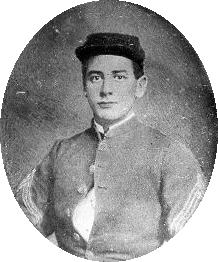
| Louis Leon (1841-1919) pictured in his United Confederate Veterans (UCV) uniform. |
Louis Leon was born on November 27, 1841 in Sheffield, South Yorkshire, England, U.K. to German-born Jewish parents Abraham Leon (1898-1878) and Eva Hirsch Leon (1800-1874). The family immigrated to America and settled in New York City, then sometime around 1858, at the age of 16, Louis moved to Charlotte, North Carolina and settle into the small Jewish community in Mecklenburg County, finding work as a clerk in a clothing store.
When the State of North Carolina seceded from the Union on May 20, 1861, Leon -- then 19 years-old -- joined the "Charlotte Grays" Company C of the 1st North
Carolina Volunteers Regiment under Captain Egbert Ross, and began his tour of duty on May 21, 1861 in
Richmond, Virginia, one day after North Carolina seceded from the Union.
His tour of duty through Virginia lasted six months, during which time
he participated in the Battle of Big Bethel on June 10, 1861. The 1st North Carolina Regiment was commanded in the battle by then Colonel Daniel Harvey Hill. This was also the battle where the war's first enlisted Confederate soldier -- 19 year-old Private Henry Lawson Wyatt -- was killed, the only Southern soldier to die that day.
The regiment disbanded
shortly after, and he returned to Charlotte.
On April 14, 1862, Leon would again join the service of his new country and become a private in Company B, 53rd North Carolina Infantry Regiment. The regiment was mustered into Confederate service at Camp Magnum in Raleigh, North Carolina on April 30, 1862 and sent to Virginia to serve in General Robert E. Lee's Army of Northern Virginia throughout the war.
Leon kept a diary of his wartime experiences as a private soldier through the war and later as a prisoner of war when he was captured along with other members of his regiment at the Battle of the Wilderness on May 6, 1864. Leon would remain a POW at the infamous Elmira Prison in New York until the end of the war when he would take the Oath of Loyalty to the Union upon learning of General Lee's surrender. Once he was released, he visited his parents in New York City, then returned to Charlotte to resume his career as a store clerk.
After the war and the Reconstruction Era, Leon became a Major in the North Carolina United Confederate Veterans (UCV) becoming very active in that organization both locally and nationally, and was known locally in Charlotte a "Major Leon" in honor of his service. Leon was also instrumental in helping to erect Charlotte's Mecklenburg Declaration of Independence Monument on May 20, 1898.
He married Sarah Levy (1850-1909) of New York and the couple had three children: Rebecca Leon DeLane (1874-1920), Henry L. Leon (1876-1943), and Clarence Leon (1886-1955).
His youngest son, Clarence, would serve in the United States Army in the American Expeditionary Forces as a Private in World War I. There is a photo showing the aged United Confederate Veterans at the State Capitol in Raleigh, North Carolina welcoming home North Carolina's American Veterans from Europe in early 1919 -- both father and son were in attendance.
 |
| North Carolina UCV members welcoming home North Carolina's "Doughboys" from the European Western Front at the NC State Capitol in Raleigh in early 1919. Image courtesy of the NC Department of Archives and History. |
In 1913 at the age of 72, Louis Leon published his Diary of a Tar Heel Confederate Soldier
with Stone Publishing Company in Charlotte, North Carolina. At the time
when most first-hand accounts of the War Between The States were
written by officers, Leon wanted to show the war from the point of view
of the private Confederate soldier. The diary, which he kept throughout
his military service and his time as a prisoner of war, shows the
grizzly reality and horror of war up close and personally.
The following are the excerpts of Leon's account of the Gettysburg Campaign including the three days of fighting at the Battle of Gettysburg (July 1-3, 1863) and aftermath:
June 25 -- Marched
on, passed through Leesburg, Canada, Hockinsville, and Centerville, all
small villages. We got to Carlisle, Pa., at sundown. Marched 21 miles
to-day. This city is certainly a beautiful place. It has 8,000
inhabitants, and we were treated very good by the ladies. They thought
we would do as their soldiers do, burn every place we passed through,
but when we told them the strict orders of General Lee they were
rejoiced. Our regiment was provost guard in the city, but were relieved
by the 21st Georgia Regiment, and we went to camp at the U. S. barracks.
So far we have lived very good in the enemy’s country. “We
stayed here until the 30th, when we took the Baltimore pike road,
crossed South Mountain at Holly Gap, passed through Papertown and
Petersburg. We then left the Pike and took the Gettysburg road – 17
miles to-day. This has been a hard day for us, as we were the rear guard
of the division, and it was very hot, close and very dusty, and a
terrible job to keep the stragglers up.
July 1 -- We left camp at 6 A.M., passed through Heidelsburg and Middleton. At the
latter place we heard firing in the direction of Gettysburg. We were
pushed forward after letting the wagon trains get in our rear. We got to
Gettysburg at 1 P.M., 15 miles. We were drawn up in line of battle
about one mile south of town, and a little to the left of the Lutheran
Seminary. We then advanced to the enemy’s line of battle in double quick
time. We had not gotten more than 50 paces when Norman of our company
fell dead by my side. Katz was going to pick him up. I stopped him, as
it is strictly forbidden for anyone to help take the dead or wounded off
the field except the ambulance corps. We then crossed over a rail
fence, where our Lieutenant McMatthews and Lieutenant Alexander were
both wounded. That left us with a captain and one lieutenant. After this
we got into battle in earnest, and lost in our company very heavily,
both killed and wounded. This fight lasted four hours and a half, when
at last we drove them clear out of town, and took at least 3,000
prisoners. They also lost very heavily in killed and wounded, which all
fell into our hands. After the fight our company was ordered to pick up
all straggling Yankees in town, and bring them together to be brought to
the rear as prisoners. One fellow I took up could not speak one word of
English, and the first thing he asked me in German was “Will I get my
pay in prison?” After we had them all put up in a pen we went to our
regiment and rested. Major Iredell, of our regiment, came to me and
shook my hand, and also complimented me for action in the fight. At dusk
I was about going to hunt up my brother Morris, when he came to me.
Thank God, we are both safe as yet. We laid all night among the dead
Yankees, but they did not disturb our peaceful slumbers.
July 2 -- Our division was in reserve until dark, but our regiment was supporting a
battery all day. We lost several killed and wounded, although we had no
chance to fire — only lay by a battery of artillery and be shot at. The
caisson of the battery we were supporting was blown up and we got a big
good sprinkling of the wood from it. Just at dark we were sent to the
front under terrible cannonading. Still, it was certainly a beautiful
sight. It being dark, we could see the cannon vomit forth fire. Our
company had to cross a rail fence. It gave way and several of our boys
were hurt by others walking over them. We laid down here a short time,
in fact no longer than 10 minutes, when I positively fell asleep. The
cannonading did not disturb me. One of the boys shook me and told me
Katz was wounded by a piece of a shell striking him on the side, and he
was sent to the rear. We went on to the Baltimore Turnpike until 3 in
the morning of the 3d.
July 3 -- When under a very heavy fire, we were ordered on Culps Hill, to the
support of Gen. A. Johnson. Here we stayed all day — no, here, I may
say, we melted away. We were on the brow of one hill, the enemy on the
brow of another. We charged on them several times, but of course,
running down our hill, and then to get to them was impossible, and every
time we attempted it we came back leaving some of our comrades behind.
Here our Lieutenant Belt lost his arm. We have now in our company a
captain. All of our lieutenants are wounded. We fought here until 7
P.M., when what was left of us was withdrawn and taken to the first
day’s battlefield. At the commencement of this fight our Brigade was the
strongest in our division, but she is not now. We lost the most men,
for we were in the fight all the time, and I have it from Colonel Owens
that our regiment lost the most in the Brigade. I know that our company
went in the fight with 60 men. When we left Culps Hill there were 16 of
us that answered to the roll call. The balance were all killed and
wounded. There were 12 sharpshooters in our company and now John Cochran
and myself are the only ones that are left. This day none will forget,
that participated in the fight. It was truly awful how fast, how very
fast, did our poor boys fall by our sides — almost as fast as the leaves
that fell as cannon and musket balls hit them, as they flew on their
deadly errand. You could see one with his head shot off, others cut in
two, then one with his brain oozing out, one with his leg off, others
shot through the heart. Then you would hear some poor friend or foe
crying for water, or for “God’s sake” to kill him. You would see some of
your comrades, shot through the leg, lying between the lines, asking
his friends to take him out, but no one could get to his relief, and you
would have to leave him there, perhaps to die, or, at best, to become a
prisoner. Our brigade was the only one that was sent to Culps Hill to
support General Johnson. In our rapid firing today my gun became so hot
that the ramrod would not come out, so I shot it at the Yankees, and
picked up a gun from the ground, a gun that some poor comrade dropped
after being shot. I wonder if it hit a Yankee; if so, I pity him. Our
regiment was in a very exposed position at one time to-day, and our
General Daniels ordered a courier of his to bring us from the hill. He
was killed before he got to us. The General sent another. He was also
killed before he reached us. Then General Daniels would not order any
one, but called for volunteers. Capt. Ed. Stitt, of Charlotte, one of
his aides, responded, and he took us out of the exposed position.
July 4 -- We laid on the battlefield of the first day, this the fourth day of
July. No fighting to-day, but we are burying the dead. They have been
lying on the field in the sun since the first day’s fight; it being
dusty and hot, the dead smell terribly. The funny part of it is, the
Yankees have all turned black. Several of our company, wounded, have
died. Katz is getting along all right. The battle is over, and although
we did not succeed in pushing the enemy out of their strong position, I
am sure they have not anything to boast about. They have lost at least
as many in killed and wounded as we have. We have taken more prisoners
from them than they have from us. If that is not the case, why did they
lay still all today and see our army going to the rear? An army that has
gained a great victory follows it up while its enemy is badly crippled;
but Meade, their commander, knows he has had as much as he gave, at
least, if not more. As yet I have not heard a word from my brother
Morris since the first day’s fight.
July 5 -- Left this morning a 5 o'clock. Only marched ten miles to-day. The enemy being in our rear, and skirmishing very strong.
Major Louis Leon, at the age of 78, died in his sleep on June 28, 1919 in New York City, New York while visiting relatives. He is buried with is wife in the Hebrew Cemetery in Charlotte, North Carolina.
 |
| The grave of Confederate veteran Louis Leon & his wife, Sarah at Hebrew Cemetery, Charlotte, North Carolina. |
I would like to add an important caveat to this story.
In doing research on the life of Private Louis Leon, I found that there was a granite marker at the Charlotte Hebrew Cemetery near the old chapel honoring Leon along with 12 other Jewish men from Mecklenburg County who served in the Confederate military. In addition to photographing Private Leon's grave site, I was going to add a photo of that marker as well.
However, I was informed by cemetery employees that the marker had since been removed at some point by staff around 2017 out of "fears of vandalism" following the dishonorable purge of Confederate symbols and markers around that time.
Out of respect for the South's dead, I will list the names of those Jewish Confederates buried there:
Captain Julius Roessler, 13th Regiment NC Troops
1st Lieutenant Edward B. Cohen, 1st Regiment NC Volunteers
2nd Lieutenant Solomon A. Cohen, 1st Regiment NC Volunteers
Sergeant Major Aaron Katz, 53rd Regiment NC Troops
Corporal Henry Wertheim, 53rd Regiment NC Troops
Corporal Phillip Schiff, 44th Regiment GA Infantry
Private Louis Leon, 53rd Regiment NC Troops
Private Charles S. Liberman, 13th Regiment, NC Troops
Private Jonas Engel, 53rd Regiment NC Troops
Private Jacob Donau, 53rd Regiment NC Troops
Private I.C. Levi, 1st Regiment NC Volunteers
Private Sam Oppenheim, 1st Regiment NC Volunteers
Private Jacob Katz, 1st Regiment NC Volunteers
"Shema Yisrael, Adonai Eloheinu, Adonai Echad."
("Hear, O Israel, the Lord our God, the Lord is one.")
In blessed and eternal memory of those Southern men of Jewish faith who answered the call to defend Dixie 1861-1865.
May their names continue to live on as a blessing to their heritage and community.
Deo Vindice.
.svg.png)
Source for the quotes come from the Diary of a Tar Heel Confederate Soldier, North Carolina Collection, Wilson Library, University of North Carolina at Chapel Hill. ISBN-13: 978-0692288214. Pages 33-38.