(This article was reposted from March of 2017 -- and still remains relevant today.)
March 4th is recognized throughout the American Southland as Confederate Flag Day.
It was on this day in 1861 that the First Confederate National Flag "The Stars and Bars" became the national banner of the Confederate States of America and was raised above what was then the Confederate Capitol in Montgomery, Alabama; one month before the beginning of the War Between The States (American Civil War 1861-1865) on Friday, April 12th of the same year.
 |
First Confederate National Flag "Stars & Bars"
(Monday, March 4, 1861 - Saturday, May 2, 1863).
By the end of 1861 the flag would have 11 stars,
and then 13 by early 1862. |
There are several important points that should be noted about this particular flag.
For
first point is that the flag is a lovely banner, and quite striking as a
national flag and largely patterned after the original Betsy Ross Flag
of the original 13 independent and united States of America during the American Revolutionary War (1775-1783).
The designed was largely made due to sentimental attachment to Old
Glory that continued to exist even after the secession of the first
seven Southern States.
The man credited with designing the Stars and Bars
was Mr. Nicola Marschall, a Prussian artist who lived in Montgomery
Alabama at the time, though another Southern man, Mr. Orren Randolph
Smith of North Carolina would make the same claim, having submitted a
similar pattern.
The
second point that should be made is that while the flag itself is
considered the first formal banner of the Confederacy, it was not formally voted on and adopted as the Confederate national banner by the Provisional Confederate Congress.
In
the hurry to have the flag's design adopted and prepared to be hoist on
the afternoon of Monday, March 4th, the Confederate
Congress neglected to formally enact an official flag law. The
congressional journal reflects the report of the Committee on Flag and
Seal, but indicates nothing regarding an official vote. Nor do the
statute books of the Confederate States contain a Flag Act of 1861.
Despite official use for over two years as the 1st Confederate National Flag, the "Stars and Bars" was never formally established as the Confederate Flag
by the laws of the land.
No doubt this bit of historical trivia would
come as a shock to modern-day anti-Confederate flag advocates who
mockingly claim in largely misinformed propaganda that the 1st CSA
National Flag is the actual Confederate flag rather than the traditional Confederate (Dixie Cross) battle flag.
The final point concerning the 1st Confederate National Flag is the use of the nickname "Stars and Bars"
which is often wrongly given to the Confederate Army of Northern Virginia battle
flag. This is a mistake often widely made by Southern-born Confederate
heritage opponents and even by some Confederate heritage preservationists
alike.
For the record, the Stars and Bars is not the St. Andrew's Cross-patterned Confederate Battle Flag ANV and it never was.
 |
11-Star version of the 1st Confederate National Flag "Stars & Bars"
(March 4, 1861 - May 2, 1863). |
 |
The Dixie Cross Banner (or Southern Cross)
Based on the Confederate Battle Flag Army of
Northern Virginia Pattern.
This rectangular version was used as the Naval Jack of the
Confederate Navy and a battle flag pattern for the
Confederate Army of Tennessee in the later half of the
War Between the States. |
The Stars & Bars would later be retired by the Confederate Congress due to the flag's similarity to the flag of the United States, which lost much of its nostalgia following two years of bloody conflict. It would be replaced formally on Saturday, May 2, 1863 by the 2nd Confederate National Flag "The Stainless Banner" designed largely by the Committee on Flag & Seal. This design incorporated the Southern Cross pattern of the battle flag of General Robert E. Lee's Confederate Army of Northern Virginia.
Contrary to some modern-day anti-Confederate heritage propaganda, the Stainless Banner was not in fact designed by William T. Thompson, a Savannah newspaper editor who did in point of fact fact refer to the new flag in an editorial promoting the redesign as "the white man's flag".
The flag itself was designed largely by the Flag and Seal Committee appointed by the Confederate Congress, with the final details of the flag's design actually being attributed to Confederate Congressmen Peter W. Gray of Texas and Alexander R. Boteler of Virginia.
Ironically, what Thompson wrongly called the flag of "the white man" was first put into official use by the Confederate Congress to cover the coffin of Confederate Lieutenant General Thomas J. "Stonewall" Jackson, a man noted for founding and organizing Sunday school classes in Lexington, Virginia for the children of slaves and free black Southerners to learn to read the Bible -- a violation of what was then Virginia's State law barring the education of African-American slaves. The Stainless Banner was then after referred unofficially during the later half of the War by Confederate soldiers and veterans themselves as Jackson's Flag, despite the fact that Jackson himself never officially served under it and died after being mortally wounded at the Battle of Chancellorsville on the very day the Confederate Congress approved its formal use as a national banner.
 |
The Second Confederate National Flag "The Stainless Banner"
Also referred to by Confederate soldiers as "Jackson's Flag"
(May 2, 1863 - March 4, 1865). |
Like the Stars and Bars, this flag would also have its share of problems, not the least of which was the large white field that was often times mistaken wrongly for a flag of truce, or surrender at a distance by both Union and Confederate forces alike. To solve this problem, local Confederate officers would minimize the white field so that the Dixie Cross would show more predominately from a distance.
Finally, on Saturday, March 4, 1865 -- four years after the first Stars and Bars banner flew over the Alabama State Capitol -- the Confederate Congress adopted a final Third Confederate National Flag, which incorporated a red bar on the fly end of the Stainless Banner and reduced the length of the flag itself. This final pattern was adopted about one month before the surrender of Lee's ANV at Appomattox, Virginia on April 9th and Johnston's Confederate Army of Tennessee on April 13th in Durham, North Carolina. Few examples of this flag exist today as barely a handful were produced before the collapse and dissolution of the Confederate government on Friday, May 5, 1865.
This flag is often referred to Confederate heritage supporters today as the "Blood Stained Banner", a modern name for this flag that throws a nod toward the red bar at the end of the flag which stands for the blood of those Southern men and boys who died in defense of homeland and Southern independence.
 |
The Third Confederate National Flag "The Bloodstained Banner"
(Saturday, March 4, 1865 - Friday, May 5, 1865). |
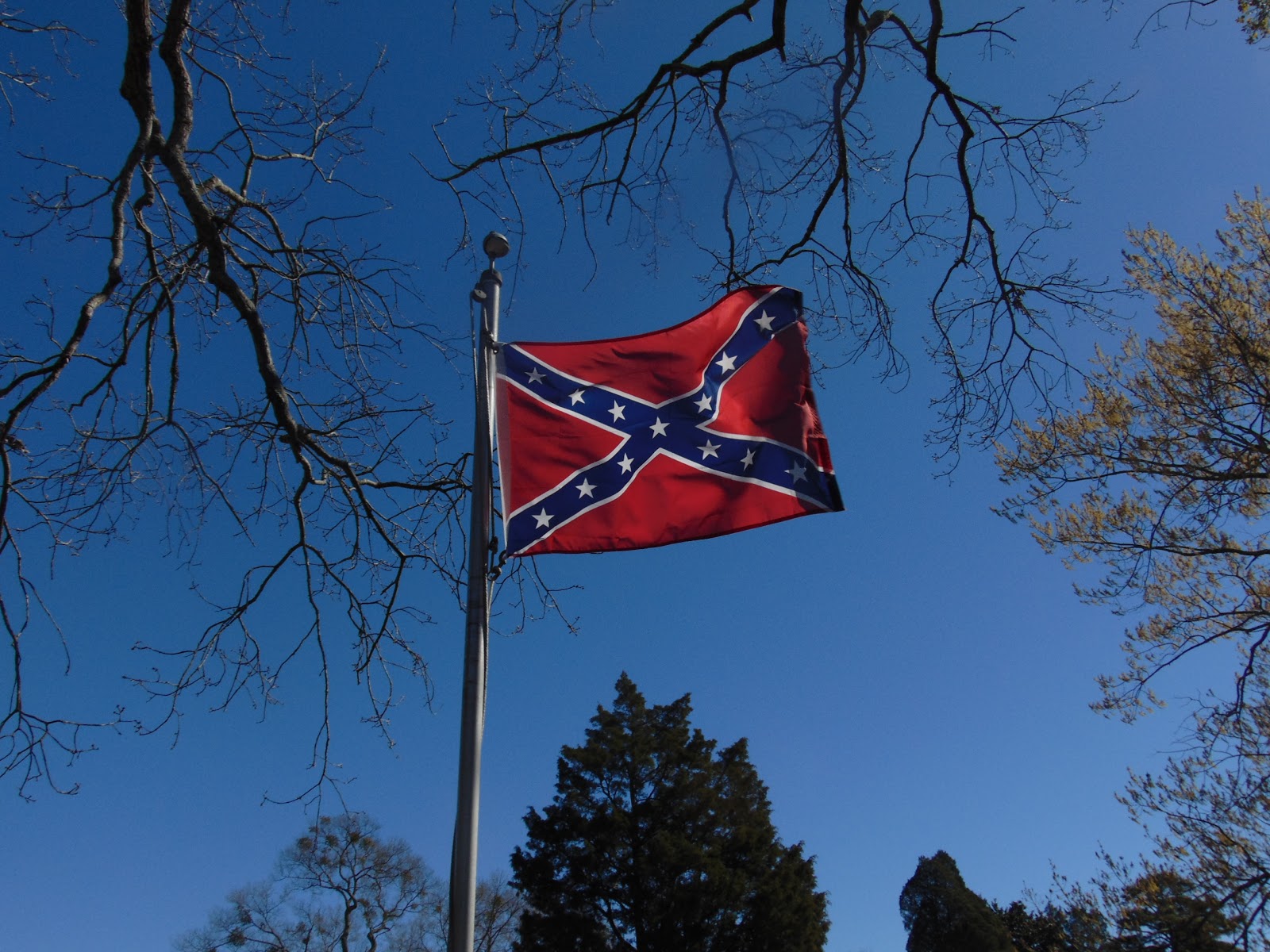
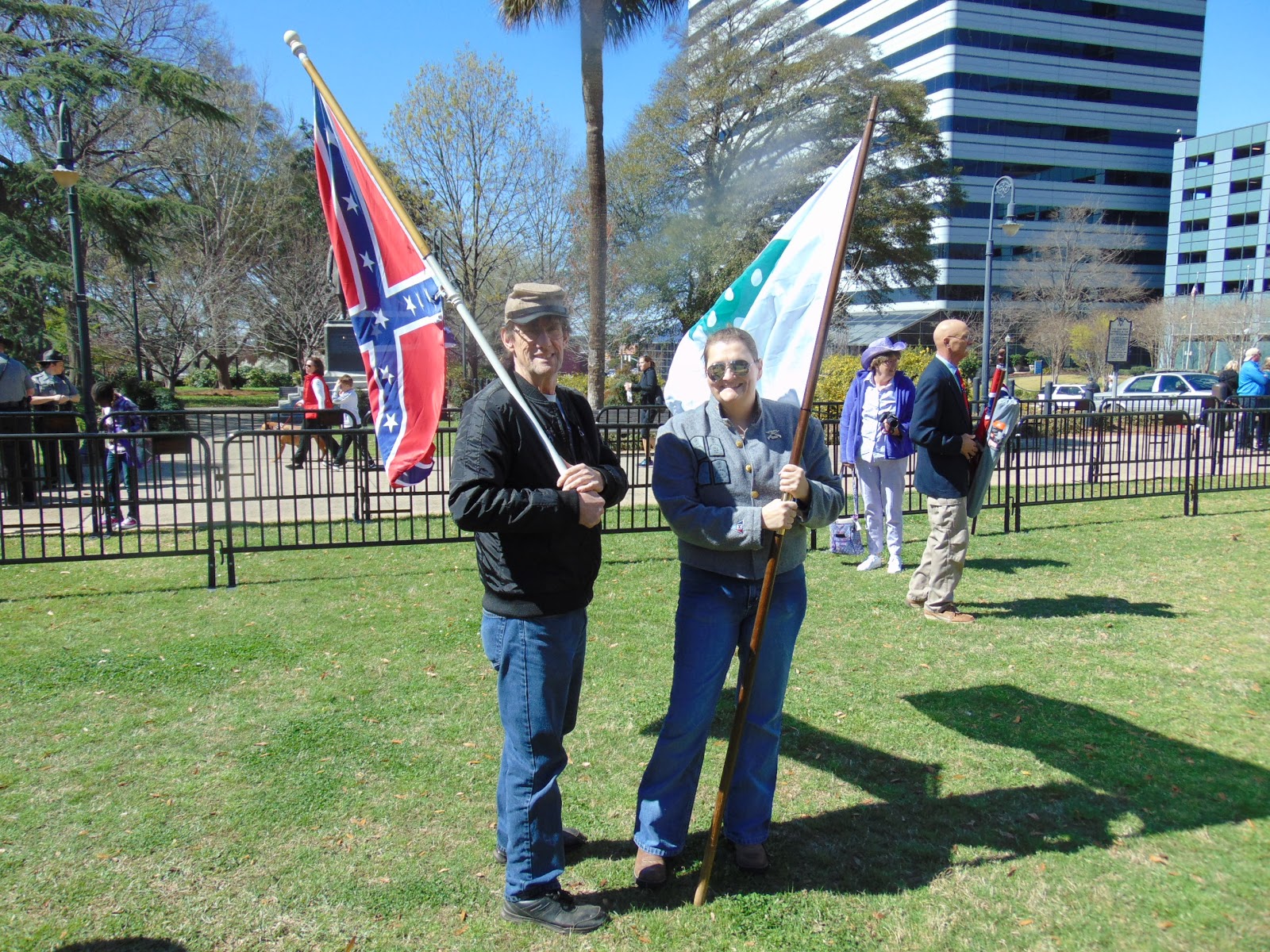
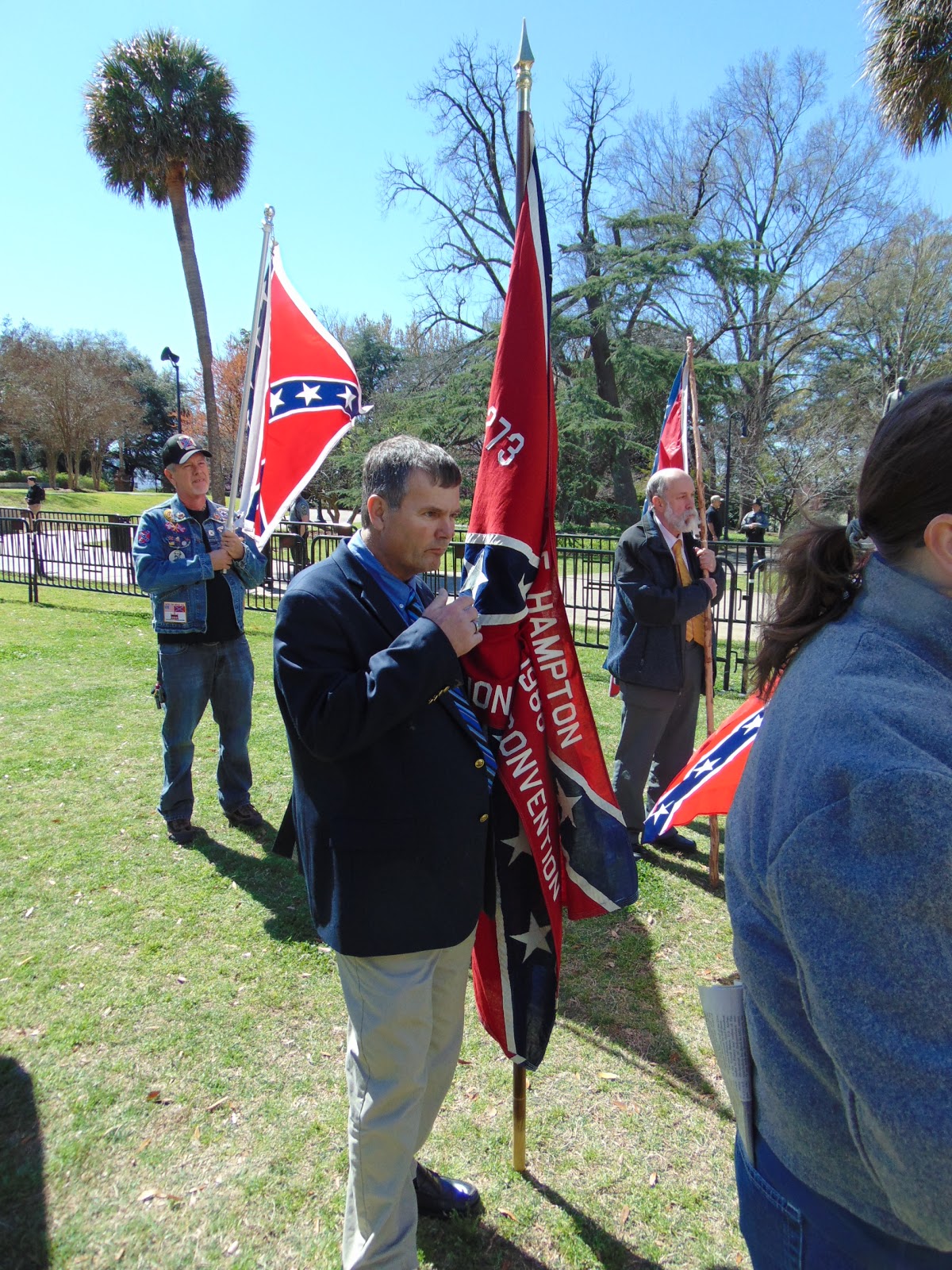
Today Confederate heritage supporters across the American Southland remember these flags and the men who served under them in time of war with hundreds of small celebrations and rallies.
On March 4th every year, the State of North Carolina honors Confederate Flag Day by flying the Stars and Bars flag above its capitol at half-staff beneath the NC State flag.
 |
The Stars & Bars flies beneath the NC State flag on top
of the NC Capitol Building in Raleigh every March 4th.
(Photo courtesy of the NC Division SCV.) |
Read more here: http://www.newsobserver.com/news/politics-government/state-politics/article25369417.html#storylink=cpy
Though Confederate Flag Day began with the Stars and Bars, this unofficial holiday honors all of the various flags -- both government and battle standards -- that were carried into battle by the Confederate citizen soldier.
As a descendant of one of those soldiers -- and probably more than just one -- I honor this day by flying the battle flag my great-great grandfather served under while fighting with Generals Lee and Jackson. Of course, I display a Dixie Cross banner daily anyhow, but still it is the thought that counts. I don't do this so much for the government of the Confederacy, nor the causes of Southern independence as I do for the men who fought and died to defend their home and personal independence underneath those flags; many of whom died carrying those same flags. For them and them alone I honor Confederate Flag Day.
Deo Vindice.
Have a Happy Confederate Flag Day, Y'all!