


No hate needed, nor wanted....only love.
Beautiful shots of two Northern Cardinals (Cardinalis cardinalis) -- one male and one female -- eating from my backyard suet feeder. These photos were taken on the same day in late August. The female is grey-brown and the male is bright red and black.


Beautiful shots that I took this evening of the First Quarter Moon in the evening sky.


Good evening, fellow stargazers!
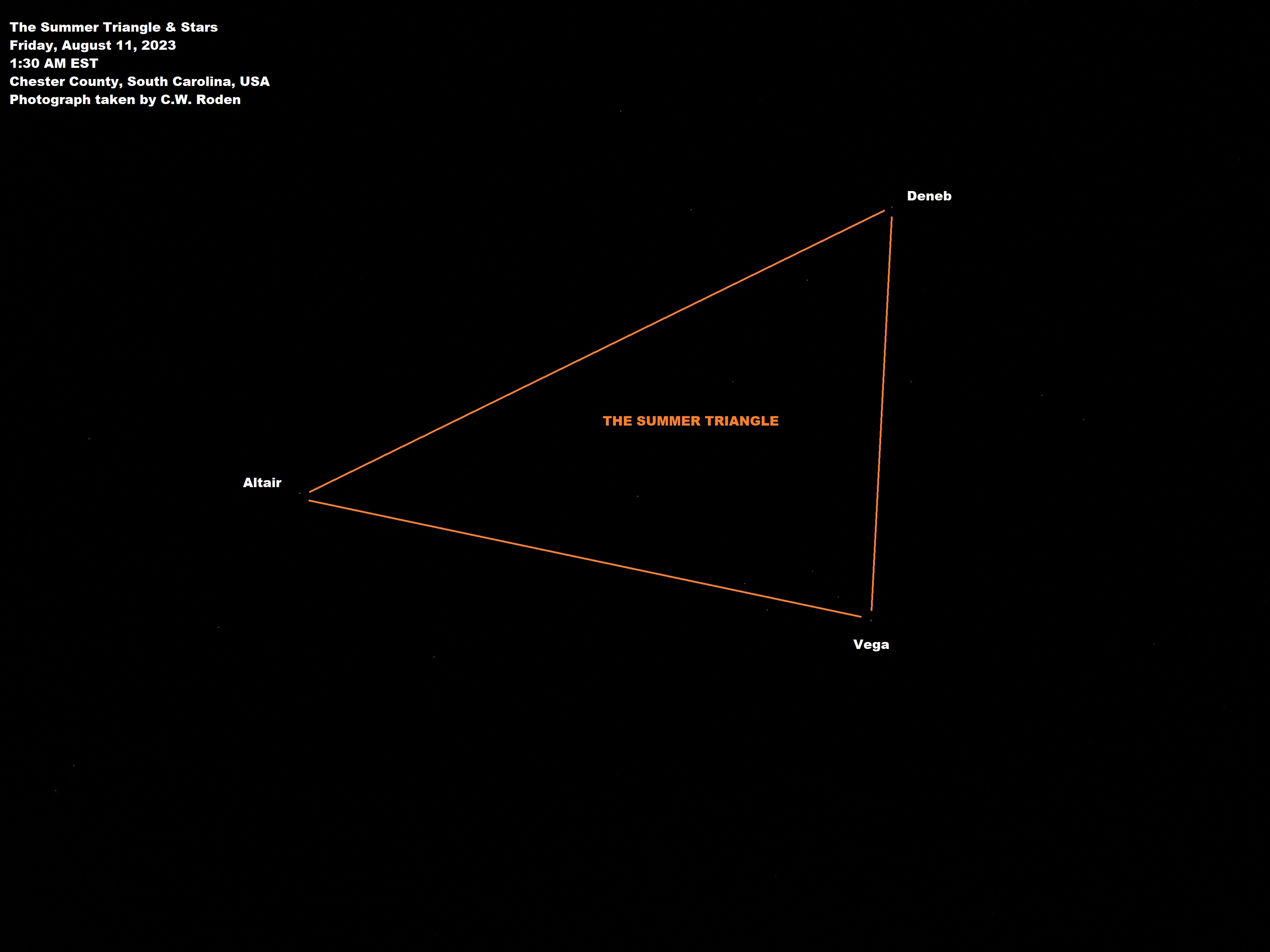
Now that we're well into summer here in the Northern Hemisphere, the three bright stars that make up the Summer Triangle asterism can easily be spotted overhead late in the evenings.
The three bright first-magnitude stars: Vega, Deneb, and Altair are all easily visible to the naked eye and make up the brightest stars of their respective star constellations. Vega is the brightest star of the small Constellation Lyra the Harp. Deneb is the brightest in the Constellation Cygnus the Swan. Altair is the brightest star in the Constellation Aquila the Eagle.
I
captured a good pair of shots outlining the bright stars that make up
the vertices (or corners) of the Summer Triangle, as well as the major
stars of the three star constellations that make up the asterism. I highlighted the constellations as well as the two asterisms that make up both the Summer Triangle and the Northern Cross respectively.


Later this month, on the night of August 30-31, 2023, there will be a Super Blue Moon -- the second Supermoon of August in fact. Luna (aka Earth's Moon) will be very close to the Earth and appear along with the planet Saturn. It will also be the last Full Moon of the summer season of 2023.
How rare are Blue Moons? Well, the classic phrase "once in a Blue Moon" referring to a rare occurrence aside, Blue Moons take place in years when there are 13 Full Moons in a calendar year. The Full Moon phase occurs every 29.5 Earth days. Because of this Blue Moons occur about once every two to three years on average, although sometimes they can occur in the next year during leap years -- as will be the case in 2024, which will also have a Blue Moon in the month of August.
Although the term Blue Moon nominally refer to the second Full Moon of a single calendar month, there are actually two types of Blue Moons: a monthly Blue Moon and a seasonal Blue Moon.
The monthly Blue Moon meets the traditional definition of the second Full Moon in a single calendar month, while a seasonal Blue Moon is the third Full Moon in a season that has four Full Moons.
The Blue Moon of August 30th will be a monthly Blue Moon, since there will only be three Full Moons in summer of 2023. The next Blue Moon will take place next year -- a leap year -- on the night of August 19-20, 2024, will be a seasonal Blue Moon since there will be four Full Moons during that year's summer season: June 21st (on the summer solstice), July
21st, August 19th, and September 18th.
Finally, the term Blue Moon does not actually refer to the color of the Lunar surface itself. Moons that appear blue (such as the one in the photo above) are incredibly rare and have nothing to do with the calendar or the Moon's phases. Such coloring is usually a result of certain atmospheric conditions: smoke, dust, or even water droplets in the atmosphere from certain types
of clouds can all contribute to a Full Moon taking on a blue shade on
rare occasions.
Fun Full Moon Fact: The month of February will never
experience a monthly Blue Moon as it only has 28 days in a common year
and 29 in a leap year. Sometimes February doesn't have a Full Moon at
all and this is known as a Black Moon -- which will not happen again till February of 2037.

This afternoon and early evening we had some more of those hit-and-run thunderstorms that our little corner of Dixie is famous for in the summer months, as well as cloud cover, which thankfully cleared up just after midnight.
I was up kinda late and was able to capture some outstanding late night photos of the Last Quarter Moon in the night sky, along with the planet Jupiter and its four largest moons about 90 minutes after moonrise in the eastern sky.
As you can see from my first photo, the position of the Last Quarter moon with the Earth's shadow across the half of the beautiful Lunar surface is almost perfectly in line with the position of Jupiter just below and to the right of our view here on Earth. In the second close-up photos you can see the details of our lovely Luna's surface evenly covered by the Earth's shadow across the face of the Man-In-The-Moon.


