An excerpt from a letter home written by Corporal Taliaferro N. "Talley" Simpson (1839-1863), Company A, 3rd S.C. Infantry Regiment, C.S.A. on the evening of Tuesday, December 2, 1862 in camp outside Fredericksburg, Virginia.
Source: Far, Far From Home: The Wartime Letters of Dick and Tally Simpson, Third South Carolina Volunteers. Oxford University Press; 1st edition (June 9, 1994). Edited by Guy R. Everson and Edward W. Simpson, Jr. ISBN-10:
0195086643 ISBN-13:
978-0195086645.
Sunday, December 14, 2025
A Soldier's Life -- From A Confederate Soldier's Letter Home
Sunday, January 28, 2024
The Life And Legacy Of Astronuat Dr. Ronald E. McNair (1950 - 1986)
![]() |
| Dr. Ronald E. McNair. (October 21, 1950 - January 28, 1986) |
Ronald Erwin McNair was born on Saturday, October 21, 1950 in Lake City, Florence County, South Carolina, one of three children of Mr. Columbus Carl McNair (1923 - 1992) and Mrs. Pearl Helena Montgomery McNair (1926 - 1993).
Even at a very early age, Ronald McNair was fascinated by science and took every opportunity to study it.
Ronald was close with his two brothers, Eric and Carl -- in particular his younger brother, Carl, who was born about 10 months
apart from him. The two were practically inseparable their whole lives. Ronald and his brothers were all
born during the segregation era in South Carolina; a fact that resulted
in one of the more interesting stories of his life.
In late 1959, at the age of nine, Ronald McNair went into the -- then segregated -- Lake City Library because he was looking for more advanced books on science.
Carl accompanied his younger brother and described what happened next in his autobiography: In the Spirit of Ronald E. Mcnair, Astronaut, An American Hero about the life of his brother. He writes:
Ronald just sat on the counter until his mother and the police arrived. Upon being told what the disturbance was, the police officer simply asked, "Why don't you just give him the books?" to which the angry lady behind the counter reluctantly did. Ronald politely told the woman, "Thank you, ma'am" after he got the books -- which he returned a week later in the same good condition he checked them out in.
McNair graduated Carver High School in 1967 as valedictorian. Carver High School was incidentally one of the first schools in South Carolina to become integrated following the 1954 Brown Vs. Board of Education of Topeka U.S. Supreme Court case formally outlawing school segregation.
In 1971, Ronald McNair received a Bachelor of Science degree in engineering physics, magna cum laude, from the North Carolina Agricultural and Technical State University in Greensboro, North Carolina. In 1976, he received a PhD degree in physics from the Massachusetts Institute of Technology (MIT), becoming nationally recognized for his work in the field of laser physics. That same year, McNair won the AAU Karate gold medal and would subsequently win five regional championships and earn a fifth degree black belt in karate. McNair received four honorary doctorates, as well as a score of fellowships and commendations. He became a staff physicist at the Hughes Research Lab in Malibu, California and applied to join the NASA Astronaut Corps.
McNair was also a member of the Omega Psi Phi Fraternity and became a member of the Bahá'í Faith. McNair was an accomplished saxophonist.
In January of 1978, McNair was selected as one of 35 applicants from a pool of 10,000 for the NASA astronaut program. He was one of three African-American astronauts recruited by Star Trek actress Nichelle Nichols (1932 - 2022) as part of a NASA special projects effort to increase the number of minority and female astronauts.
After he completed a one year training and evaluation period, Dr. McNair was placed for assignment as mission specialist astronaut on Space Shuttle flight crews. He flew as a mission specialist aboard the space shuttle Challenger (Mission STS-41-B) from Friday, February 3 - Saturday, February 11, 1984, becoming the second African-American in space as well as the third person of African descent in space, after fellow U.S. Astronaut Guion "Guy" Bluford and Cuban Cosmonaut Arnaldo Tamayo Mendez.
On what would have been Dr. McNair's second space flight, he was again chosen as a mission specialist aboard the ill-fated space shuttle Challenger (mission STS-51-L) on Tuesday, January 28, 1986. Ronald McNair, along with six fellow astronauts -- Ellison Onizuka, Christa McAuliffe, Gregory Jarvis, Judith Resnik, Michael Smith, and Richard Scobee -- lost their lives in the violent explosion that destroyed the Challenger nine miles above the North Atlantic Ocean near Cape Canaveral, Florida, just 73 seconds after liftoff.
He was just 35 years old.
Following his tragic death, McNair was initially buried at Rest Lawn Memorial Park in Lake City, South Carolina. In 2004, his remains were disinterred and moved to the Ronald E. McNair Memorial Park, also located in Lake City.
A variety of public places are named in Dr. Ronald McNair's honor, including a crater on the Moon.
Perhaps in the most fitting legacy honoring his values and dedication to living his life against what was then defined as societal norms, on Saturday, January 29, 2011 -- approximately 25 years following his death -- the building that formally housed the Lake City Public Library where then 9-year-old Ronald was nearly denied books was officially rededicated as the Ronald E. McNair Life History Center, a museum dedicated to his life and memory.
![]() |
| Dr. Ronald E. McNair memorial in his hometown, Lake City, South Carolina. |
![]() |
| The tomb on Dr. Ronald McNair, Lake City, South Carolina. |
~Inscription on Dr. Ronald E. McNair's tomb.
This article is written in respect to the everlasting memory of this son of South Carolina and American space explorer.
Sunday, June 05, 2022
Top 20 Best Advice For Anyone Wanting To Move To South Carolina
Tuesday, February 15, 2022
Visiting The Memorials At John D. Long Lake
| John D. Long Lake in Union County, South Carolina in mid-November 2021. |
Located about 3 miles west of the town of Lockhart, South Carolina, John D. Long Lake in Union County is an 80-acre manmade lake built in the 1970s and used for recreational fishing.
The lake was created in the 1970s on the initiative of then South Carolina state senator John David Long III (1930-2005) and named for his father, John David Long II (1901-1967), also a former South Carolina state senator.
I visited the lake back in November of last year, mostly because in spite of living about 20 miles from the place I'd never been there before, though I had driven by the area many times on SC Highway 49 between Lockhart on the mighty Broad River and the town of Union. In a way it was a spur of the moment decision on my part, but I also felt like there was something I needed to do.
You can't really see the lake from the main road. Once you see the sign for the lake there is a short dirt road through the thick copse of trees that takes you from the main highway to the lake.
Standing there alone by the secluded, placid lake with late autumn foliage in the background, I felt very vulnerable and scared. Aside from the few birds in the trees, the place was eerily quiet. Not even the catfish in the deep lake were jumping. Even though there were fewer leaves left on the trees, the sun was having a hard time shining through. The place was dark and spooky.
Its not very hard to imagine some monster similar to the creature from the Black Lagoon crawling out of that lake, or (far more likely) a bear lunging out of nowhere and going right for you.
What drew me there wasn't the view of the lake -- at least not entirely. My attention turned away from the lake to the two beautifully carved granite memorials near the woods dedicated to two young boys who lost their lives on the lake over a quarter of a century ago.
I was 18 years old and less than a year away from graduating high school when, on Tuesday, October 25, 1994, a woman named Susan Smith from neighboring Union County, South Carolina, reported her car had been stolen along with her two young sons Michael Daniel (age 3) and Alexander Tyler (14 months old) by a black man.
The story of the reported carjacking and kidnapping of the two boys would become a national story with Smith and her then husband making emotional appeals to the alleged kidnapper for the safe return of their children.
At the time I remembered being really worried for those kids. Not because of the reported kidnapping (though a part of me continued to hope that they would be found alive) but the small sick feeling that I felt when my grandmother Carolyn (God rest her soul) watched the live television news conference with Smith crying and flat out said, "She's lying."
As usual, it turned out my dear Maw Maw was right, as she tended to be -- well, about 95% of the time anyhow.
Ten days later, on Tuesday, November 3, 1994, Susan Smith confessed to the police that she drowned both of her two sons still strapped in their car seats in John D. Long Lake and made up the carjacking story, turning a national story into a national tragedy with terrible implications.
This was a real life horror story, and it happened about 25 miles from where I lived.
Even now, after over two-and-a-half decades after the event, I can remember the sense of outrage and anger local people felt. Even to this day some people still get angry whenever the subject is brought up.
The fact that she blamed an African-American man for the crime was a terrible throwback to times in our nation's past where similar incidents led to horrible racial issues and reactions; something that many of us at the time believed that our little section of the country was well beyond. Smith's story and accusation showed that many of us still have a long way to go.
Probably the worst part are the mental images one can come up with just standing there next to that lake and imagining the day that car slowly sank with two children in the backseat. It was something I tried very hard not to think of while I was standing by that lake.
There may not be a lake monster living in the depths, but on a fall day like the one I was visiting on, there was a monster there. One far scarier than anything an author like Stephen King could come up with in his worst nightmares.
Susan Smith was found guilty of her heinous crime and sentenced to life imprisonment. She still remains in prison as of the writing of this article. Nothing more needs to be said of her.
Though a whole generation has been born since that terrible incident, the lake still carries with it a sense of foreboding. Since that time at least seven other people (including four members of a family group) have tragically drowned in that lake when the vehicle they were in went off the boat ramp and into the lake -- ironically while visiting the memorials themselves. The old boat ramp itself has since been demolished.
Although I do hold some belief in the supernatural beyond what my Christian faith tells me about the afterlife for various reasons both scientific and based on a couple of personal experiences, I have a hard time accepting that places can be cursed.
Still, in spite of the fact that people still go fishing in the lake (and likely other things too if the old condom wrapper I'd found was any indication -- some folks can get antsy anywhere I suppose) I couldn't help but hurry up and do what I came to do and get back on the road.
I went to the two granite memorials for Michael and Alex to get the photos I wanted to share with y'all.
As you can see one of the memorials is a simple granite memorial and the other is a beautifully carved black granite monument with the images of the two boys, forever young, smiling back at visitors.
Its heartwarming to know that, even after all these
years, people still take the time to pay tribute to these young lives by
leaving toys and other gifts on the site. It should be noted that
neither of the boys are actually buried on the site. Sadly there's no
memorial for the visitors who drowned afterwards. The site is well
maintained.
I went into the armrest of my car and found a small
toy that I left at the memorials, along with a couple of coins. Then I
got in my car and thirty seconds of driving later I was back on the main
road and thankfully in the sunshine again.
I can think of no
better way to conclude this article than with my final photo of the
small plaque on one of the memorials and the inscribed message it leaves.
Wednesday, February 17, 2021
The Hunley And The Sinking of the USS Housatonic -- February 17, 1864
![]() |
| The Final Mission by American Artist Mort Kunstler (2005) |
His crew knew the drill well. The first men to board stowed several canteens under the crew bench and checked to make sure they were carrying enough provisions. Dixon was last to board. Southern troops from nearby Battery Marshall always saw the sub off and gave it a push for momentum.
High tide has crested and the tide was shifting seaward again. With orders not to dive the submersible, the Hunley turned into Breach Inlet, where the current propelled it out past the breakers into Charleston Harbor. The men at Battery Marshall watched as the sub cut through the water, it continued to churn through the swells and disappeared into the darkness.
They would never see the Hunley again.
Armed with a spar torpedo -- a small metal canister full of gunpowder fitted with a spar and mounted to a rod extending out from her bow -- the Hunley crew's mission was to try and lift the Union blockade of Charleston, South Carolina.
Their target was the Union sloop-of-war, USS Housatonic, a 205 foot long, 1,240 ton vessel with an armament of twelve large cannons, stationed at the entrance of Charleston Harbor roughly five miles off the coast. The Housatonic was commanded by Captain Charles W. Pickering and had a crew of about 150 men.
The Hunley began her approach at about 8:45 PM EST.
Within two minutes of the first sighting, the Confederate submarine rammed her spar torpedo into Housatonic's starboard side, forward of the ship's mizzenmast. Then as the Hunley's crew began to back their small craft away, the torpedo exploded jolting both ships. The 135 pounds of black powder ignited instantly, blasting a hole ten feet wide into the Union ship's hull and killing five of the sailors aboard, wounding an unknown number of others.
The Housatonic went down in less than five minutes, most of its surviving crewmen hanging onto the ship's masts until rescue came nearly an hour later.
The eight member crew of the Hunley were all killed instantly, possibly due to the shockwave of the explosion.
![]() |
| The Confederate submarine Hunley was the first submarine to successfully sink an enemy warship, the USS Housatonic, on the night of Wednesday, February 17, 1864 in Charleston harbor. |
Thus ended the first successful submarine attack on an enemy warship in the annals of naval history. While their accomplishment would become legendary, the fate of the submarine and its crew became a mystery until it was discovered on Wednesday, May 2, 1995 by a National Underwater and Marine Agency (NUMA) team led by New York Times Best Selling Author Clive Cussler.
The submarine was raised from the ocean on the morning of Tuesday, August 8, 2000, seeing sunlight for the first time in 136 years. She was brought to the Warren Lasch Conservation Center in North Charleston and placed in a 75,000 gallon steel tank filled with chilled, fresh water to help protect and stabilize the submarine. The lab facility was specifically designed to excavate and conserve the vessel.
First Lieutenant George Dixon
Seaman Joseph Ridgaway
Seaman Arnold Becker
Seaman C. Lumpkin
Seaman Frank Collins
Corporal Johan Frederik Carlsen
Seaman Augustus Miller
Boatswain’s Mate James A. Wicks
![]() |
| The 1864 painting of submarine H. L. Hunley by Conrad Wise Chapman. |
Sunday, August 30, 2020
Sons Of Confederate Veterans And The Eddy Lake Cemetery Cleanup
![]() |
| Mr. Kevin Mishoe and SC Division Commander Jamie Graham who helped arrange the Eddy Lake Cemetery Cleanup. |
Greetings and Salutation, Y'all!
At one time during the second half of the 19th Century, the area now known as Bucksport was formally known as Bucks Township Bucksville was the third largest port in South Carolina. Bucksport was part of the mill on the Waccamaw River that built the clipper ship Henrietta, the largest wooden ship ever constructed in South Carolina. That ship was launched from Bucksville on Thursday, April 29, 1875. Eddy Lake was part of that area and was reportedly where many of people who worked at the mill lived.
Bucksport was named for its founder, Mr. Henry Buck of Maine who settled in South Carolina in 1828.
Henry Lee Buck, Sr. was the middle son of Henry Buck and the older brother of George Olney Buck and the half-brother of
William L. Buck -- who would later inherit their father's lumber mill after the War Between The States.
He was mustered into Confederate service on
On Saturday, March 25, 1865, Henry was captured by Union troops while bearing the regimental flag in advance of Fort Steadman and beyond the captured lines during the final stages of the Siege of Petersburg, Virginia. The color-bearer, Private Samuel J. Reid, had been knocked down by the explosion of a shell and the colors were taken up by Captain Buck. He was captured in the battle and then sent to Old Capital Prison in Washington, D.C. on Monday, March 27, 1865 then later moved to Fort Delaware, on Pea Patch Island in the Delaware River where he finished out the last month of the war.
Finding Eddy Lake Cemetery can be attributed to Miss Mary Ann Owens, a longtime Bucksport resident and self-proclaimed historian for the community. Her search for the long lost cemetery where her great-great grandparents are buried lead to the remarkable uncovering of centuries of Horry County history.
As a child she heard stories about the Eddy Lake Cemetery but no one could ever tell her where it was located. For decades, memories shared of Eddy Lake Cemetery started to become more like folklore.
"As a young girl growing up in this area, I often listened to what elder people were talking about. As matter of fact, I would go to their porch and sit on the edge of their porch just so I could hear what they were talking about," said Owens. "Often they would talk about Eddy Lake and how their parents worked at the sawmill."
She knew that her grandparents were both buried there and she made it her mission to locate the cemetery. The
cemetery itself was largely unknown to many people, and it stood tucked
away behind the Grand Strand Water and Sewer plant near Bucksport. A recent road construction project stirred up the urgent need to find the cemetery, located off Bucksport Road.
There are only 23 visible headstones, but dozens of indentations and depressions in the ground indicate that there are others without headstones who were buried in homemade wooden boxes with their graves marked by things like conch shells and farm implements.
Owens turned to Mr. Kevin Mishoe, a local educator, to help her launch a major effort to reclaim the cemetery.
Their first move was to contact Grand Strand Water and Sewer whose officials quickly gave them the okay to move forward. Workers with Horry County Planning and Zoning were instrumental in helping identify some of the sites, marking them with orange flags. Horry County Councilman Orton Bellamy has also become involved in the project, working on an historical marker for the site.
They are sure that at least one of the graves dates back to 1887, but they aren’t sure if there are some that are older.
In order to receive help from historic preservation organizations and archaeologists, Mishoe said the community first needs to clear and remove the initial brush and debris at the site. He set up a GoFundMe page set up to raise funds for the project.
However, the efforts were proving slow and local interest in helping with the project was disappointing low.
Mishoe was then contacted by Mr. Jamie Graham, president of the South Carolina Division Sons of Confederate Veterans, an an old high school friend. Graham volunteered his help and those of the SCV because its members realize that Bucksport isn’t a rich community and he knew they were having trouble trying to raise enough money for the cleanup and renovation.
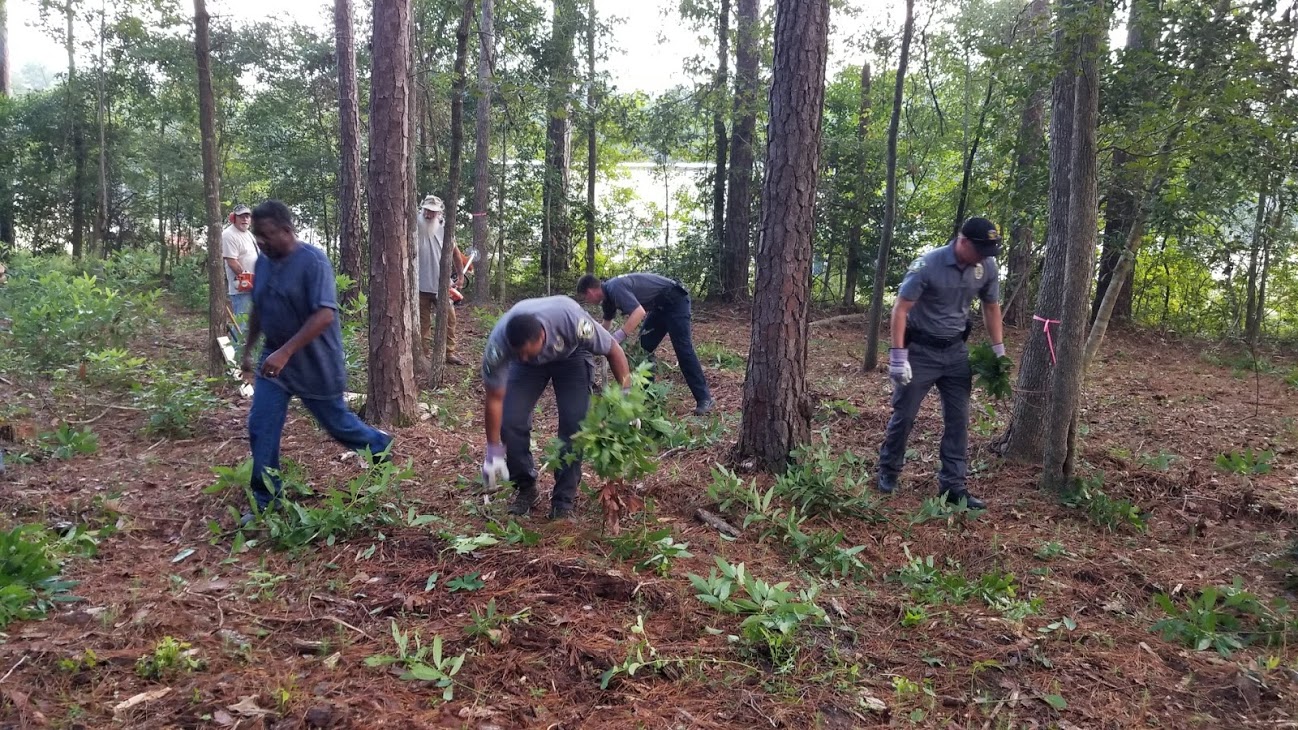
In addition to volunteers from the 7th Brigade -- largely from members of the Horry Rough And Readys Camp #1026 -- were volunteers from the Horry County Police Department also pitched in to help with the cleanup of the cemetery and reclaim it from the woods. Mr. Mishoe's son is a Horry County police officer and helped pitch the idea to his coworkers.
Mishoe himself was one of the volunteers who helped with the clean up. Graham, who has significant expertise in grave stone restoration, was able to repair several of the stones that were broken and crumbling from age.
Eddy Lake Cemetery is now on the historic register, and with permission from Grand Strand Water & Sewer Authority, the cemetery was recovered and restored.
The following are photographs taken of the cleanup of Eddy Lake Cemetery.


![]() |
| Before the cleanup. |

![]() |
| After the cleanup. |


![]() |
| A special thanks to all those who came together to help make this noble endeavor possible. Well done, y'all! |
This is why I am proud to call myself a member of the South Carolina Division Sons of Confederate Veterans, and why I continue to support their efforts in honoring all of our Southern history.
To learn more about the SC SCV and what they do please check out the link on the main page.
Y'all have a wonderful Dixie day folks!