Showing posts with label South Carolina Nature. Show all posts

Thursday, April 09, 2026

Loki Found A Snake!

Greetings & Salutations, Y'all!

Well, as the title of this post has pointed out, my backyard buddy, Loki (aka Mr. Kitteh) found a visitor to my backyard....and not one of the feathered variety that I usually post about.

Earlier this morning I was looking out of my kitchen window when I spotted Loki starring at something in the grass. That something turned out to be a nearly three-foot long juvenile Eastern Kingsnake (lampropeltis getula). I quickly collected my trusty Sony DSC-H300 camera and captured these two shots of the encounter: the first with Loki and the snake from the kitchen window, and the other a close-up of the Kingsnake from the backyard in all its lovely black and white glory.

Don't worry about either of them. Loki kept his distance and retreated to the back door once I poured some dry cat food for him. Neither the kitty nor the snake were harmed in the making of this blog post and both ended up going their own ways after the encounter.


The Eastern Kingsnake is actually quite common in my little corner of Dixie, with a range that spans from eastern Maryland down through the Carolinas, Georgia, and Florida. They can also be found in the southern Appalachian regions.

The normal color pattern of the Kingsnake consists of a glossy black, blue black, or dark brown ground color, overlaid with a series of beautiful white, or yellow, chain-like rings. Variation is found in their patterns across geographic ranges. Kingsnakes from the coastal plains have wider bands, while those found in mountainous areas have thinner bands, or may be completely black.

As you can see in my photograph, this particular variety of Eastern Kingsnake has thinner bands consistent with the Piedmont region of the Carolinas where I live.


If you were to encounter one, don't worry. The Eastern Kingsnake is non-venomous and actually preys on venomous snakes common in the American Southland such as the Eastern Copperhead, Cottonmouth Water Moccasin, and even Eastern Diamondback Rattlesnakes. So if you ever run into one of these outstanding Colubridaes, its best to leave them alone and let them go about their business.

My thanks to Loki for his sharp kitty eyes and finding this lovely beauty to photograph and share with all of y'all.

Friday, August 11, 2017

The Beautiful Luna Moth

Y'all check out this beauty I found in my front yard early this morning! Amazing!


The beautiful Luna Moth (Actias luna), one of the largest members
of the subfamily Saturniinae in North America.

The lime green Luna Moth (Actias luna) is one of the largest saturniides in North America. 

Native to eastern and central North America, the Luna Moth can be found as far north as Sackatchewan, Quebec, and Nova Scotia in Canada to as far south as Chihuahua, Mexico. In the United States they can be found as far west as the Great Plains States and Texas, and are quite common in the New England States, Great Lakes States, and Dixie

The Luna Moth thrives in the United States, producing two generations a year, the first of which appear in April and May, and the second group can be seen approximately nine to eleven weeks later. In the South, there can be as many as three generations. These are spaced every eight to ten weeks beginning in February. The female Luna Moths lay as many as 400–600 eggs, 4–7 eggs at a time, on the underside of leaves, and they incubate for eight to thirteen days. At adulthood, the Luna Moth only lives about a week, and are usually only seen at night.

With a wingspan that averages 4 - 5 inches, the Luna Moth is one of the largest moths in North America. They are noted by their lime green coloring and the distinctive eyespots on their wings.  

Sunday, November 06, 2016

My Trip To The Forty Acre Rock Heritage Preserve

Autumn has finally fully matured here in Upstate South Carolina, and with it comes the beautiful fall foliage as the trees turn wonderful shades of orange, browns, reds, and golds....with some evergreens mixed into the warm colors. 

November in this part of the American Southland is the best time to take great photographs of the fall leaves.

So on Saturday, November 5th, I got in my 2008 Dodge Caliber and drove east across the Catawba River to neighboring Lancaster County in order to get photos of perhaps one of the best local sites for viewing the autumn colors in an breathtaking natural setting. 

The Forty Acre Rock Heritage Preserve is perhaps one of the most diverse natural habitats in Upstate South Carolina. The place is designated as a National Natural Landmark and covers a radius of 2,267 acres. The preserve is managed by the South Carolina Department of Natural Resources

The main attraction of the preserve is a large granite flatrock that gives the place its name. Though actually only about 14 acres, it is still a breathtaking site. The view of the Piedmont region that stretches out from the granite rock at the peak of the preserve gives the 14 acre rock an illusion of being much bigger. 

The site is a great spot for avid trail hikers. During the spring, water collects in depressions which provides a habitat to a variety of specialized plants such as lichens, mosses, and even the endangered pool sprite, attracting botanists and naturalists of all kinds to the site. 

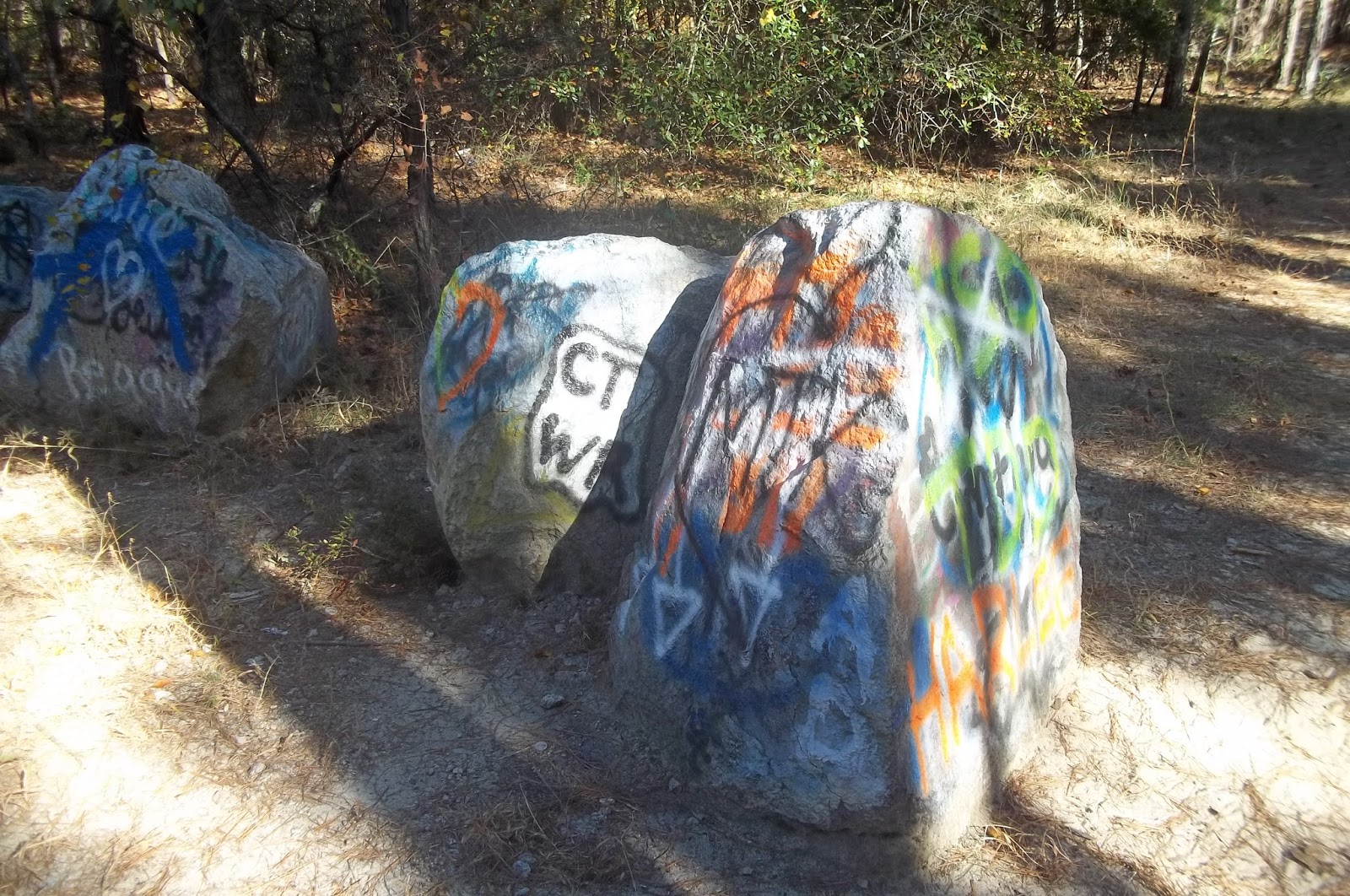
Unfortunately, the site is also used notably as a canvas for taggers and young people who gather illegally after-hours to build bonfires and smash glass bottles. It is advisable to wear good climbing books with thick treads when visiting the site.

I arrived at the upper parking lot located closer to the rock itself and took the nearly mile hike from the parking area to the great granite rock. I stayed about an hour enjoying the sites and views (this was my third official visit to the place) and getting some very outstanding photographs. 

The following are the pictures I took of my visit.


Rocks leading to the entrance of Forty Acre Rock tagged with graffiti.
The small depressions in the granite where mosses of various
types grow also make good natural fire pits for some likely
illegal overnight parties or camping.
Almost like being on the surface of the moon -- that is if Luna had
moss, graffiti and broken beer bottles dotting it.
Graffiti tags of all types cover some parts of the rock itself.
As I have mentioned before, the conservationist in me
cringes at this sort of thing.
Yeah...I'll have to take your word for it, pal.
This looks like a good spot for a human sacrifice, huh?
Look up from the bottom of the rock.

Finally, the the last two shots -- the first one taken by a helpful fellow hiker -- me and my shadow standing on top of Forty Acre Rock, just enjoying the view. 

As always I hope y'all enjoyed my photographic journal. I hope to have more shots of the amazing autumn colors at local sites of interest later this month, weather permitting.


Driving Directions To Forty Acre Rock: Starting from the intersection of US 601 and SC 903 (about 7 miles north of Kershaw, South Carolina), drive north on US 601 for about 1.5 miles. Take a left onto Nature Reserve Road. The lower parking lot is about .5 miles on the left. This parking lot is near the beaver pond. To reach the upper parking lot, drive north on Nature Reserve Road for 2.5 miles then take a left onto Conservancy Road. Follow Conservancy Road to the end. This parking area is closest to the actual rock.