Showing posts with label Opposition. Show all posts

Tuesday, January 14, 2025

Night Sky Photography -- 01-13-2024 -- The Full Wolf Moon Occults Bright Mars


Greetings and Salutations, fellow stargazers!

Tonight, your favorite blogger has a very special night sky offering for y'all to enjoy -- photos I took over a four-hour period showing the first full moon of the year occulting -- or passing in front of -- the bright planet Mars just days before its two-year close opposition to Earth!

The January full moon is traditionally known here in North America as the Full Wolf Moon. Luna officially achieved her full moon status this afternoon at about 5:30 p.m. EST here on the east coast of the United States.

Mars, like Luna, is also in opposition between the Earth and the Sun -- the Red Planet will officially reach opposition on the evening of Wednesday, January 15th when it will be the largest and brightest it will appear in the night sky for the next two years.

Mars will continue to remain in the vicinity of the Constellation Gemini The Twins until mid-April of this year and will continue to remain a bright orange-yellow "wandering star" for several months before its wider orbit will take our closest planetary neighbor further away from our Earth and it begins to dim again till the next opposition in February of 2027.

The brilliance of Luna during her full moon phase compared to Mars at its brightest makes witnessing this occultation easy enough in the hours before and after the event. Since the Full Wolf Moon will outshine our little red neighbor by around 40 thousand times, you would need a good telescope, or binocular lenses to see it in the moon's brilliant glare in the minutes before and after occultation.

I set up my camera and tripod in my backyard on this cold January evening and trained my sights on the heavenly spectacle. God granted beautifully clear skies (aside from one instance of clouds that wasn't really much of an obstacle) and all I had to do was wait.

The first shots were taken at 7:00 p.m. EST -- about 2 hours before the occultation -- with a wide shot showing how the Full Wolf Moon and Mars appeared in the eastern sky with the twin stars Castor and Pollux nearby. Then I took a close-up shot along with a filtered show of the first full moon of the year 2025.


An hour later -- about 70 minutes before the occultation -- I took photos showing the progress of the Full Wolf Moon as it slowly moved towards the east and Mars in its orbit.


In my part of South Carolina and the United States, the occultation of Mars by the Full Wolf Moon began at approximately 9:10 p.m. EST and lasted until 10:20 p.m. EST seventy minutes later. These are the photos I took of Mars disappearing and then reappearing behind Luna in the night sky.


Well my friends, once again I hope y'all enjoyed my photographs of this rare night sky event as much as I enjoyed taking them and posting them here for everyone.

I look forward to bringing y'all more night sky photography in the future, but until then keep your eyes to the night skies, y'all.


Thursday, November 02, 2023

Night Sky Photography -- 11-01/02-2023 -- Jupiter Closest To Earth For 2023

Late yesterday evening I was able to capture a pair of great shots of the Planet Jupiter and its four largest moons, along with the Constellation Aries the Ram.

Jupiter’s perigee -- or its closest point to the Earth for 2023 -- comes on the night of Wednesday, November 1 & Thursday, November 2 when the distance between our Earth and the largest planet in our Solar System will be approximately 370 million miles (or 595 million kilometers, or 33.10 light-minutes) apart.

Less than 24 hours later at about 1 a.m. EST on the night of Friday, November 3, 2023, Jupiter will reach its opposition to Earth when our planet's smaller orbit takes it between the Sun and Jupiter. At opposition, Jupiter will shine as the 4th-brightest object in the sky, after the sun, the moon and the planet Venus.

In my first photo, you can see the close-up of the four largest moons of Jupiter --
Callisto, Io, Europa, and Ganymede. In the second photo, you can see a wider shot of bright Jupiter  and its just visible moons beneath the four brightest stars of the Constellation Aries The Ram -- in addition to the small Constellation Triangulum The Triangle and the nearby Pleiades Star Cluster.


These are just the first of what I hope are going to be several more beautiful night sky offerings as viewed from my corner of South Carolina for the month of November. Stay tuned.

Thursday, December 08, 2022

Night Sky Photography -- 12-07-2022 -- Mars At Opposition With The Full Cold Moon

Mars -- 4th planet of our Solar System.
Image courtesy of NASA.


Good evening, fellow stargazers!

Well folks, my night sky photos this evening showing the December Full Moon with the bright planet Mars in its direct opposition to Earth were taken in a partly to mostly cloud-covered sky just hours before foggy overnight conditions would have made it impossible.

To be honest, I was worried that nothing would show up given the denseness of the cloud cover. But thankfully with a little patience your favorite blogger was able to capture both our lovely Luna and little Mars together during breaks in the clouds and through lighter places where outlining the features on the lunar surface were captured better than they would have been without cloud cover at all.

The distance shots with the bare tree branches in the foreground turned out really well, but it was the close-ups that really showed Mars in all its bright red glory just below the Full Cold Moon -- the name of the December Full Moon in North America.

The following are the outstanding results, a couple of which show off Mars' bright reddish color standing out in the moon glare. A couple of the close-ups between the moving clouds give the appearance of Luna and Mars inside a beautiful aurora.


I hope y'all enjoyed my photos of the last full moon of 2022 and the opposition of Mars -- which unfortunately won't happen again for about 25 more months till January of 2025. Mars will remain one of the brightest objects in the night sky for a couple more months as it begins to move away in its orbit from Earth and dim in brightness.

Wednesday, November 30, 2022

Night Sky Photography -- 11-29-2022 -- Mars Closest To The Earth Before Opposition

Good even fellow stargazers!

About every 26 months, our closest neighboring planet, Mars, reaches its opposition to Earth -- the moment that Earth is directly between a planet and the Sun. This also puts the Red Planet closer to our Earth in its orbit, making it glow slightly brighter as it approaches.

On the evening of Tuesday, November 29th and early morning of Wednesday, November 30th, Mars was at its closest to the Earth during this transition towards opposition.
At its closest approach this year, Mars was about 51 million miles (or 4.5 light-minutes) from the Earth.

Right now Mars is slightly brighter now than Sirius, the night sky’s brightest star, and it’s noticeably red-orange in color. Mars will continue to increase in brightness until its opposition on the night of December 7th - 8th, then will begin fading by the end of the month.

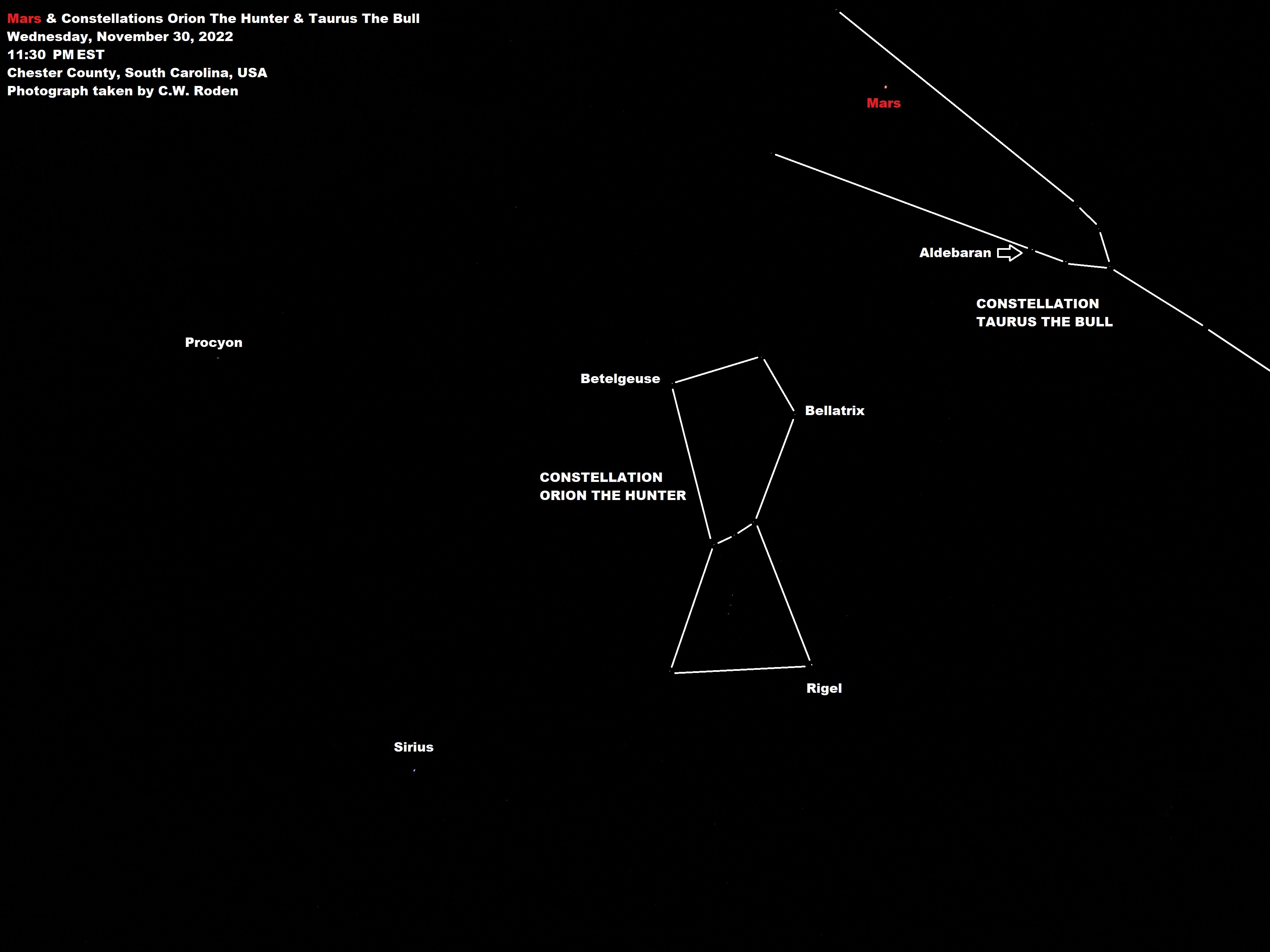
Mars is currently located inside the Constellation Taurus The Bull and will be for most of this month. Aldebaran, the brightest star of Taurus (also known as the "Eye of the Bull") also shares a slightly reddish color, meaning that there are two bright red evening "stars" in our night sky this month.

The following are the photos I took of Mars at its current location in the night sky compared to the brightest stars near it, as well as the Constellations Orion The Hunter and Taurus The Bull.


Hopefully I'll be able to capture a good image of our little red neighbor the night of its opposition, which won't occur again for another 26 months in January of 2025.

Sunday, September 18, 2022

Night Sky Photography -- 09-17-2022 -- Neptune In Opposition

Photograph of Neptune taken by NASA's Voyager 2 in 1989.


Good evening, fellow Stargazers!

This evening our Earth will sweep between the Sun and the eighth planet in our Solar System, the gas giant planet Neptune on the evening of Friday, September 16th and morning of Saturday, September 17th, 2022, placing the distant planet in opposition in our sky.

Because of its blue color, its impossible to see Neptune in the night sky with the naked eye. This world is about five times fainter than the dimmest star you can see on a moonless night under a dark sky dome.

If y'all know right where to look, you can find it with a good pair of binoculars, or a telescope -- and even with those optical aids, at nearly 3 billion miles away, it would only look like a small, faint disk at best.

At the present time Neptune is between Jupiter and Saturn in the night sky along the ecliptic, closer to Jupiter in front of the faint Constellation Aquarius.

Sadly, capturing Neptune with the 35X Optical Zoom Lens of my camera, even at full magnification, is virtually impossible. So in my photo, I marked the approximate location of Neptune in the sky in relation to Jupiter during the time of its opposition using the Flag of the United States on my porch in the foreground for scale. 


At opposition when the Earth and Neptune are at their closest in the orbit around the Sun, Neptune’s distance from us is a whopping 2.7 billion miles (or about 28.90 AUs) -- about 240 light-minutes Earth!

Named for the
Roman god of the sea, Neptune is the fourth largest planet in our Solar System and (officially) the farthest of the eight main planets -- not counting Pluto which is STILL A &%$#@! PLANET!

The planet was first observed at the Berlin Observatory by astronomers Johann Gottfried Galle and Heinrich Louis d'Arrest on Wednesday, September 23, 1846.

Neptune has 14 known moons, the largest of which is Triton.

Even though its the smallest of the giant gas planets in the Solar System, Neptune has a diameter of 34,503 miles (or 55,528 kilometers). To give y'all an idea of just how big that is, around 57 Earths could fit inside of Neptune's radius.

At its far-flung distance, the planet Neptune orbits the Sun once every 165 Earth years at an average distance of around 30.1 AU (about 2.8 billion miles, or 4.5 billion kilometers).

Because Neptune’s orbit around the sun is so huge, Neptune’s yearly opposition date with the Earth comes only a few days later each year. The next opposition of Neptune to Earth is on Tuesday, September 19, 2023.


Neptune is not the only planet to come into opposition with Earth this month. Jupiter will also be in opposition to Earth on Monday, September 26th. Until then, y'all keep your eyes to the night skies, ya hear?

Wednesday, August 17, 2022

Night Sky Photography -- 08-14-2022 -- Saturn At Opposition With Constellation Capricornus

Good evening fellow stargazers!

On the night of Sunday, August 14th, Saturn reached its opposition (or nearest point) to Earth in its rotation around the sun coming to within
823 million miles (or 1.32 billion km). That's pretty close in terms of the Solar System in general, but to put it in astronomical terms: 73 light-minutes -- or about 8.8 astronomical units (AU).

In the night sky, at its closest approach, Saturn, the second-largest planet in our Solar System, appears to us here on Earth as a faint magnitude 0.3 star. At the present time it can be found close to the faint summer Constellation Capricornus the Sea-Goat -- which I kinda outlined in the photo I took, although the stars are far too faint and the sky wasn't nearly as clear as I'd liked.


Though it appears as a faint star in the night sky, the sixth planet of our Solar System is actually around 10 times the diameter of Earth at about 72,400 miles (116,500 km) across -- and that's not counting the planet's famous ring system that circle the gas giant. Including the rings themselves, you could sit about 21 Earth's across the entire length of the planet!

Unfortunately its next to impossible to view this rings from Earth without a good telescope, and a very clear sky. Though at full magnification, with a good pair of binoculars Saturn appears to be more oval-shaped.