Showing posts with label Lunar Eclipse. Show all posts

Friday, August 28, 2026

Night Sky Photography -- 08-28-2026 -- The Near-Total Lunar Eclipse (Full Blood Corn Moon)


The near-total lunar eclipse began the previous evening about 9:30 PM Eastern Time when the outer part of the Earth's shadow (Penumbra) began crossing the Full Corn Moon (or Full Sturgeon Moon) as its called her in North America.

An hour later at about 10:35 PM ET the darker part of the Earth's shadow (Umbra) begins crossing the face of the Moon giving the reddish-orange color to the "Blood Moon" -- this is due to the way the Earth's atmosphere scatters light from the Sun. 

The near-total lunar eclipse reached its peak here in South Carolina at around 12:15 AM Eastern Time when 96% of the lunar surface was covered by the Earth's deep shadow. 

I was worried due to the cloud cover from the summer storms we've been getting in late August that I would be unable to capture any good shots of the Lunar Eclipse this time, however God answered my prayers for a break in the mostly cloudy sky and between the gaps in the cloud cover I was able to capture some shots of the Full Blood Corn Moon at the peak of its beautiful glory.

All of these shots were taken during a three-minute window between breaks in the overcast sky between 12:14 AM to 12:16 AM ET. 


I hope y'all enjoyed my photos of the near-total lunar eclipse and hopefully I'll be blessed with clear skies for upcoming night sky events coming up in September that I can hopefully bring to all of y'all.

Friday, March 14, 2025

Night Sky Photography -- 03-14--2025 -- Total Lunar Eclipse In North America (Full Blood Worm Moon)

Map showing the course of the Total Lunar Eclipse of 2025 as seen here on the eastern part of
North America.
Image courtesy of NASA.


Greetings and Salutations, Y'all!

Tonight I would need to either stay up really late, or get up really early, to capture today's photographs for y'all to enjoy: the Total Lunar Eclipse of 2025 here in North America.

This Lunar Eclipse falls on the first full moon of March -- also known as the Full Worm Moon here in North America, which falls on the morning of Thursday, March 13th. This will also be the last full moon before the 2025 spring equinox on Thursday, March 20th. So long winter!

I've mentioned this in other blog posts, but just as a reminder to some of y'all, during a Lunar Eclipse the Sun passes between the Earth and the Moon casting the Earth's shadow over the surface of the moon.

There are two parts to a Lunar Eclipse: the first part when the Earth's shadow begins to cross the lunar surface known as the Penumbra (the lighter outer shadow) and then the Umbra (or deeper inner shadow) when the darkest part of the Earth's shadow covers the Moon.

This evening -- or early morning depending on how y'all look at it -- is a Total Lunar Eclipse, with the darkest part of the Earth's umbra shadow fully crossing Luna's face and giving our beautiful full Moon a dark red, almost blood-like color.

A Total Lunar Eclipse is referred to as a Blood Moon by astronomers, making this year's full moon the Full Blood Worm Moon

It was my hope that God would permit beautifully clear skies, or at least few clouds, to give a clear view of this beautiful night sky event. Sure enough my prayers were answered.

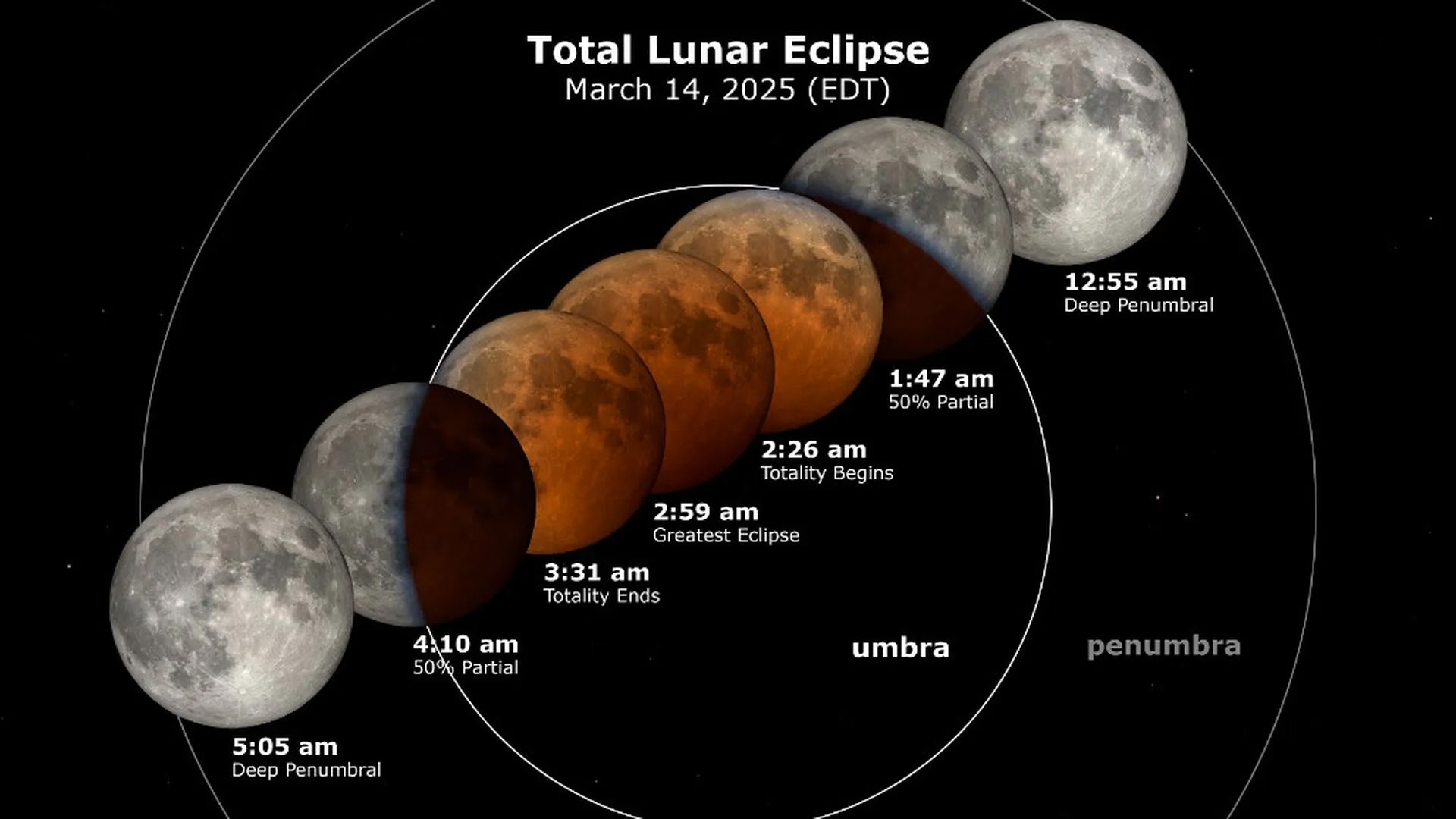
Partial Eclipse began at about 12:55 a.m. EDT on Friday, March 14th here in South Carolina when the Full Worm Moon would begin to darken slightly, with the shadow slowly darkening from the left side of the "Man In The Moon" as viewed from here on Earth. This would continue for another 50 minutes until at about 1:45 a.m. EDT when the partial eclipse would begin showing the moon getting steadily darker and redder as Luna began entering the deeper umbra shadow.

Total Eclipse began at approximately 2:26 a.m. EDT once Luna fully entered the umbra shadow and continued until 3:32 a.m. EDT -- a total of an hour and five minutes.
The Full Blood Worm Moon reached its peak illumination at 2:55 a.m. EDT during the height of total eclipse. Maximum Eclipse occurs at approximately 2:58 a.m. EDT.

In total the Full Blood Worm Moon (from the beginning of penumbra until the Earth's shadow completely crossed the lunar surface) lasted from 12:55 a.m. EDT till 5:05 a.m EDT -- a total of four hours and 10 minutes.

The following are the photos I took of this outstanding cosmic event from the beginning showing the Full Worm Moon to the greatest totality of the Full Blood Worm Moon.


I stayed up very late -- or very early depending on how one looks at it --  to capture these glorious shots for y'all to enjoy; especially for those of you who were unable to see the Total Lunar Eclipse because: (a) cloudy skies, (b) living outside North and South America, or (c) y'all simply couldn't stay awake so late.

As always I'm very happy to bring the night skies to y'all. Have a wonderful evening and be sure to keep your eyes to the night skies, y'all hear!


Monday, March 25, 2024

Night Sky Photography -- 03-24/25-2024 -- Full Worm Moon & Penumbral Lunar Eclipse

Good evening, fellow stargazers!

The first full moon of spring 2024 her in the Northern Hemisphere rose this evening into a somewhat clear night sky with only a few small clouds.

The March full moon -- also known as the Full Worm Moon in North America -- is the second smallest (most distant) full moon from the Earth in 2024 at around 251,900 miles (or 405,394 kilometers) away.

The Full Worm Moon of 2024 also takes place during a Penumbral Lunar Eclipse -- when the outer part of Earth's shadow covers the full moon when Luna is on the opposite side of the Earth from the Sun. The Penumbra is the outer lighter part of the Earth's shadow as opposed to the darker inner part of the Earth's shadow, the Umbra.

Luna began to cross the Earth's penumbra shadow as viewed here in South Carolina at about 12:54 a.m. Eastern Standard Time and would reach peak eclipse at around 3:12 a.m. EST when the Full Worm Moon would cover roughly 90% of the lunar surface.

Since the Moon would only travel inside the lighter part of the Earth's shadow, Luna won't appear to have a dark bite taken out of her, but rather appear slightly darker to the naked eye.

The Penumbral Lunar Eclipse ended at 5:35 a.m. EST, but by then your favorite blogger had long since returned to bed.


The following are the photos I took of this late evening night sky event. One shows the Full Worm Moon in the eastern sky with the bright star Spica lower towards the horizon. Spica and Luna will appear next to each other over the next couple nights as the Moon moves past it towards the east. The second is a clearer shot of the surface of the Full Worm Moon prior to the lunar eclipse and the third and final photo shows the slightly darker moon now fully in the Earth's penumbra shadow. 


I hope y'all enjoyed my photos for the evening and, until next time -- be sure to keep your eyes to the night skies, y'all hear!

Tuesday, November 08, 2022

Night Sky Photography -- 11-08-2022 -- Uranus Near Opposition During Full Beaver Blood Moon


Good morning, fellow stargazers!

Late last night and very early this morning, with blessedly clear skies, I was able to capture some really outstanding photos of the November Full Moon and the distant planet Uranus both before and during the last full Lunar Eclipse visible in North America until March 23-24, 2024.

As many of y'all might recall from my previous night sky blog post in May during the Full Flower Blood Moon of 2022, I explained in detail about how a Lunar Eclipse happened when our lovely Luna travels inside the Earth's shadow between our planet and the Sun.

There are two parts to the Earth's shadow: the penumbra
(the lighter part) and the umbra (the darker part).

This Lunar Eclipse took place during the November Full Moon in the early morning hours of Tuesday, November 8, 2022. The November Full Moon is known as the Full Beaver Moon in the Northern Hemisphere, making this the Full Beaver Blood Moon.

The moon reached full total eclipse inside the Earth's umbra shadow at about 5:15 a.m. Eastern Standard Time (EST) and lasted about 85 minutes. Here in South Carolina, the full totality of the Lunar Eclipse occurred about an hour before moonset in the west.

The overall Lunar Eclipse took about 5 hours and 53 minutes in total.

The following are photos I took of the Full Beaver Blood Moon between 5:18 a.m. and 5:35 a.m. EST.


The gas giant planet, Uranus, seventh planet of our Solar System, is just barely visible at full magnification about 2 degrees above and to the left of Luna. As you can see in both photos, Uranus appears as a barely visible 5.6 magnitude star alongside the Full Beaver Blood Moon both before and during the Lunar Eclipse.


Uranus appears more visible with Luna in the Earth's shadow blocking out the moonlight, although even then spotting the planet would require the aid of a good camera lens, or pair of binoculars.

Orbiting at 1.8 billion miles (or 2.9 billion kilometers) from the Sun at its closest and 1.89 billion miles (or 3 billion km) away at its farthest, Uranus takes about 84 Earth years to complete one orbit around the Sun.

Right now Uranus is at its opposition -- its closest approach to Earth in its orbit around the Sun -- at about 1.6 billion miles (or 2.6 billion km) distance, or about 155 light-minutes from Earth.


Opposition is actually one of the best time of year to visibly see our Solar System's outer planets. From now until Thursday, December 1, 2022, Uranus will be at its brightest and can be seen just to the east of the Pleiades Star Cluster. Tonight (November 8-9th) the Waning Gibbous Moon will lie between both in the sky dome.

The planet will remain visible in the evening sky through March of 2023, although after this month it will begin to dim just a little so you have to know exactly where to look. Here's a link to a really good sight to help y'all with that. 

Monday, May 16, 2022

Full Flower Supermoon Lunar Eclipse 05-15/16-2022


A very good evening and salutations to y'all!

Tonight is a glorious night for us amateur stargazers and night sky enthusiasts with the arrival of the Lunar Eclipse here in North America. This will be an extra special treat since tonight's full moon is a supermoon!

A supermoon happens when the moon reaches its perigee -- or closest point to the Earth in a month -- coinciding with either the Full Moon or New Moon.
Tonight our beautiful Luna is approximately 225,015 miles (362,127 km) from the Earth in its orbit.

There will actually be four Full supermoons this year beginning in May and continuing throughout the summer months. The closest of these supermoons will take place on the evening of Wednesday, July 13, 2022 when the moon will be approximately 222,089 miles (357,418 km) from Earth in its orbit.

May's full moon is known in North America as the Full Flower Moon, making tonight's lunar eclipse the Full Flower Supermoon Lunar Eclipse.

I was a bit concerned about cloud cover since it was partly cloudy all day today, but thankfully as the evening and night progressed the skies began to clear up -- thank you Lord!


Graphic depicting the Earth's shadows during the Lunar Eclipse.


The lunar eclipse began here in South Carolina at exactly 9:32 PM EST when the lighter part of the Earth's shadow began to cross over the Moon.
This part is known as the Penumbra Eclipse. The penumbra is the partial shadow of the Earth across the Moon and its so light that its barely noticeable to the naked eye.


At exactly 10:28 PM EST, our lovely Luna then crossed into the umbra -- the darker part of the shadow of the Earth across the Moon. This is when the darkening of the Moon's surface becomes noticeably visible.


For the next hour the dark shadow of the Earth continued to cross the face of the Moon until reaching totality at about 11:30 PM EST. The following are the photos I took of the progressive darkening and then reddening of the Moon.


The Full Lunar Eclipse reached its peak at 12:12 AM EST on Monday, May 16th with the darkest center part of the Earth's shadow completely covering the face of the Moon blocking out all reflecting sunlight. This is referred to at the totality of the eclipse, which lasted about 85 minutes from 11:30 PM EST to 12:54 AM EST.


The Full Flower Supermoon Lunar Eclipse began at about 9:30 PM EST and ends at 2:50 AM EST on Monday, May 16th; a total time of about 5 hours and 20 minutes. It was a wonderful heavenly show to behold and I was thankful to be able to share the experience with y'all this evening.

Have a wonderful night and be sure to keep your eyes to the night skies, y'all hear.

Sunday, November 21, 2021

Night Sky Photography -- 11-19-2021 -- Partial Lunar Eclipse, The Pleiades, & Bright Constellation Stars

Good evening fellow stargazers!

I have a really good set of photos for y'all to enjoy tonight, the first couple of which involves the Partial Lunar Eclipse of the November Full Beaver Moon.
Other names for November’s full moon include: the Digging Moon, the Whitefish Moon, and the Frost Moon.

Lunar eclipses can only occur during full moons when the moon is at its brightest.

What made this Partial Lunar Eclipse special is that it was the longest lunar eclipse since the year 1440 AD, and will be the longest Lunar Eclipse until 2669 AD -- needless to say I was thankful to God for clear skies and the chance to capture it on camera this time around.

At 1:02 AM our beautiful Luna entered the penumbra -- the outer part of the Earth's shadow -- and the Moon begins to dim very subtly over the next couple of hours. Two hours later at around 2:18 AM, the Moon begins to enter Earth’s umbra -- the darkest part of the planet's shadow -- and the partial eclipse begins. At this point, it looks to the naked eye like a huge bite is being taken out of the Moon.


Graphic showing a Lunar Eclipse in relation to the Earth's shadow effect.
Image courtesy of Google.


The part of the Moon inside the umbra appears very dark red. Because the Earth has an atmosphere, its shadow is not black. This is the same phenomenon that causes early morning sunrises and evening sunsets to glow a dull red color. That’s why lunar eclipses are sometimes called blood moons.

The peak of the Eclipse occurred at exactly 4:02 AM when about 97% of the Moon's surface was darkened red, leaving only the slightly silvery-white curve. As you can see in my photo, the white of the lunar surface in the far left with Tycho Crater clearly visible inside the lighter part of the umbra.


Ironically, what actually made this eclipse so long was the fact it was a partial one, because the Moon had to travel farther through the Earth's shadow as opposed to a full eclipse when the Moon would move directly through the penumbra and umbra. Also because the moon was currently at apogee (the farthest point in its orbit from Earth) it was also moving at its slowest speed as it passed through the Earth's shadow, taking over 100 minutes from the time of first umbra contact to the time of greatest eclipse and then till exiting the umbra.

Overall, the Partial Lunar Eclipse began at 1:02 AM EST and ended at 7:04 AM EST, approximately 6 hours and 2 minutes from entering to existing the Earth's shadow.

However, in case you feel bummed out for missing this one, not to worry. Next year there will be two Lunar Eclipses! The first one taking place on Monday, May 16th and the other on Tuesday, November 8th.

Because of the Partial Lunar Eclipse there was little moonlight to block out some of the closest stars, including the nearby Pleiades Star Cluster and some of the brighter stars of the Constellations Taurus The Bull and Orion The Hunter. In fact nearly all of the stars of both constellations were clearly visible.

Here, I highlighted the positions of the stars and the lines of the constellations, as well as the three bight stars: Sirius, Procyon, and Betelgeuse that make up the Winter Triangle asterism.


Well folks, I hope y'all enjoyed my photos for this evening. Please let me know in the comments below and I will see y'all next time. Till then keep your eyes to the night skies, y'all hear!