Showing posts with label Blood Moon. Show all posts

Friday, August 28, 2026

Night Sky Photography -- 08-28-2026 -- The Near-Total Lunar Eclipse (Full Blood Corn Moon)


The near-total lunar eclipse began the previous evening about 9:30 PM Eastern Time when the outer part of the Earth's shadow (Penumbra) began crossing the Full Corn Moon (or Full Sturgeon Moon) as its called her in North America.

An hour later at about 10:35 PM ET the darker part of the Earth's shadow (Umbra) begins crossing the face of the Moon giving the reddish-orange color to the "Blood Moon" -- this is due to the way the Earth's atmosphere scatters light from the Sun. 

The near-total lunar eclipse reached its peak here in South Carolina at around 12:15 AM Eastern Time when 96% of the lunar surface was covered by the Earth's deep shadow. 

I was worried due to the cloud cover from the summer storms we've been getting in late August that I would be unable to capture any good shots of the Lunar Eclipse this time, however God answered my prayers for a break in the mostly cloudy sky and between the gaps in the cloud cover I was able to capture some shots of the Full Blood Corn Moon at the peak of its beautiful glory.

All of these shots were taken during a three-minute window between breaks in the overcast sky between 12:14 AM to 12:16 AM ET. 


I hope y'all enjoyed my photos of the near-total lunar eclipse and hopefully I'll be blessed with clear skies for upcoming night sky events coming up in September that I can hopefully bring to all of y'all.

Friday, March 14, 2025

Night Sky Photography -- 03-14--2025 -- Total Lunar Eclipse In North America (Full Blood Worm Moon)

Map showing the course of the Total Lunar Eclipse of 2025 as seen here on the eastern part of
North America.
Image courtesy of NASA.


Greetings and Salutations, Y'all!

Tonight I would need to either stay up really late, or get up really early, to capture today's photographs for y'all to enjoy: the Total Lunar Eclipse of 2025 here in North America.

This Lunar Eclipse falls on the first full moon of March -- also known as the Full Worm Moon here in North America, which falls on the morning of Thursday, March 13th. This will also be the last full moon before the 2025 spring equinox on Thursday, March 20th. So long winter!

I've mentioned this in other blog posts, but just as a reminder to some of y'all, during a Lunar Eclipse the Sun passes between the Earth and the Moon casting the Earth's shadow over the surface of the moon.

There are two parts to a Lunar Eclipse: the first part when the Earth's shadow begins to cross the lunar surface known as the Penumbra (the lighter outer shadow) and then the Umbra (or deeper inner shadow) when the darkest part of the Earth's shadow covers the Moon.

This evening -- or early morning depending on how y'all look at it -- is a Total Lunar Eclipse, with the darkest part of the Earth's umbra shadow fully crossing Luna's face and giving our beautiful full Moon a dark red, almost blood-like color.

A Total Lunar Eclipse is referred to as a Blood Moon by astronomers, making this year's full moon the Full Blood Worm Moon

It was my hope that God would permit beautifully clear skies, or at least few clouds, to give a clear view of this beautiful night sky event. Sure enough my prayers were answered.

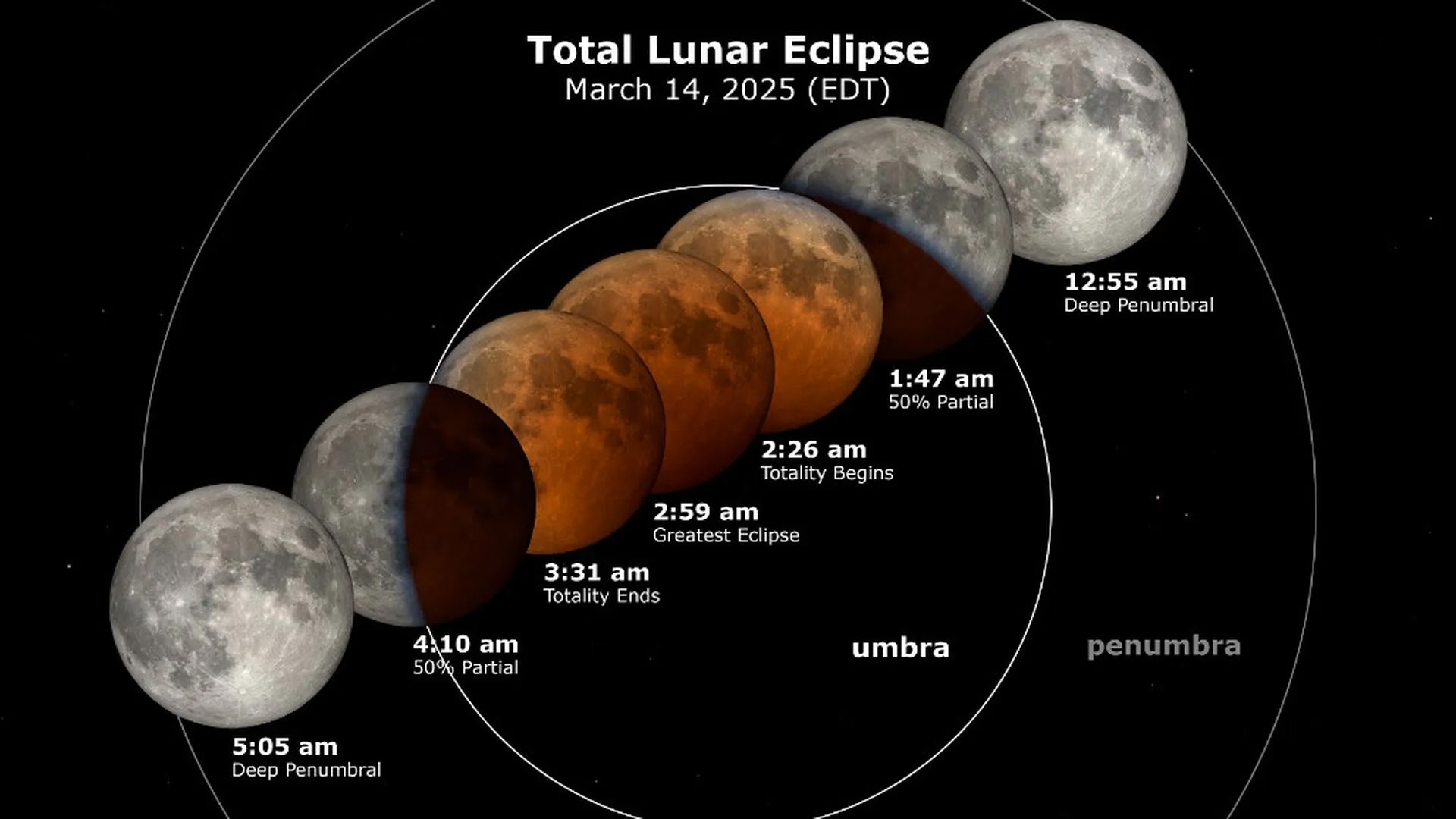
Partial Eclipse began at about 12:55 a.m. EDT on Friday, March 14th here in South Carolina when the Full Worm Moon would begin to darken slightly, with the shadow slowly darkening from the left side of the "Man In The Moon" as viewed from here on Earth. This would continue for another 50 minutes until at about 1:45 a.m. EDT when the partial eclipse would begin showing the moon getting steadily darker and redder as Luna began entering the deeper umbra shadow.

Total Eclipse began at approximately 2:26 a.m. EDT once Luna fully entered the umbra shadow and continued until 3:32 a.m. EDT -- a total of an hour and five minutes.
The Full Blood Worm Moon reached its peak illumination at 2:55 a.m. EDT during the height of total eclipse. Maximum Eclipse occurs at approximately 2:58 a.m. EDT.

In total the Full Blood Worm Moon (from the beginning of penumbra until the Earth's shadow completely crossed the lunar surface) lasted from 12:55 a.m. EDT till 5:05 a.m EDT -- a total of four hours and 10 minutes.

The following are the photos I took of this outstanding cosmic event from the beginning showing the Full Worm Moon to the greatest totality of the Full Blood Worm Moon.


I stayed up very late -- or very early depending on how one looks at it --  to capture these glorious shots for y'all to enjoy; especially for those of you who were unable to see the Total Lunar Eclipse because: (a) cloudy skies, (b) living outside North and South America, or (c) y'all simply couldn't stay awake so late.

As always I'm very happy to bring the night skies to y'all. Have a wonderful evening and be sure to keep your eyes to the night skies, y'all hear!


Monday, January 21, 2019

Night Sky Photography -- 01-20/21-2019 -- Full Super Blood Wolf Moon Lunar Eclipse

The Full Super Blood Wolf Moon Lunar Eclipse at full umbra (Earth's shadow)
at 12:40 PM EST on Monday, January 21st, 2019.


On the night of Sunday, January 20th - Monday, January 21st, we had the first full moon of 2019, and the first lunar eclipse of 2019 -- A Full Super Blood Wolf Moon Lunar Eclipse. The lunar eclipse could be viewed from North and South America, Greenland, Iceland, Europe, northern and western Africa, plus the Arctic region of the globe.

The total eclipse of the moon lasted a little more than one hour. It was followed by another partial umbral eclipse, each time persisting for over an hour. The whole umbral eclipse from start to finish had an overall duration of nearly 3 1/3 hours. 


Graph showing the transition of the moon through the shadow of the Earth during the lunar eclipse.
Graphic courtesy of Space.com
 
On Sunday, January 20, 2019 at around 9:30 PM EST Luna began to enter the penumbra (the shadow of the Earth). At around 10:32 PM EST, it moved into the umbra (the darkest part of the shadow). The moon was completely in the umbra at around 11:40 PM EST, which officially started the total lunar eclipse. It was at this point that Luna begin to take on that reddish-orange Mars-like color. The greatest eclipse took place at 12:12 AM EST on Monday, January 21, 2019, when the moon is midway through the umbra. 

The following are the photos this blogger took of the Full Super Blood Wolf Moon Lunar Eclipse between 9 PM EST to 12:45 PM EST. It was truly a wondrous sight to behold.


The eclipse is the first of three straight full supermoons, meaning the moon will be nearly at its closest to Earth for this January, as the eclipse takes place. 

The January Full Moon is often called the Wolf Moon. Other names include Old Moon, Ice Moon, and Snow Moon, although this name is usually attributed to the February Full Moon. While the farmer's almanac states that Wolf Moon is a Native-American name, other sources claim that it has Anglo-Saxon origins. In Anglo-Saxon culture, the January Full Moon was also called the Moon after Yule, which is the time of the ancient festival celebrating the Winter Solstice around December 22.

This will be the last total lunar eclipse to grace Earth’s sky until Wednesday, May 26, 2021. 

Wednesday, January 31, 2018

Night Sky Photograhy -- 01-30/31-2018 -- The Super Blue Blood Moon

Well folks, this month ends on a high note when it comes to astronomical events -- a Super Blue Blood Moon. 

On the evening of Tuesday, January 30th, the second Full Moon of the month rose just over the treetops. The second of two full moons in a calendar month is referred to as a Blue Moon, even though the moon does not technically change color. The January 31 full moon is also the third in a series of three straight full moon supermoons, or super-close full moons that I mentioned in a previous post. It’s the first of two Blue Moons in 2018, the next one will appear on March 31st.

These are the shots I took of the Super Blue Moon. I was able to get some good details, including the "Man in the Moon" and the larger craters.


On an interesting note, the month of February this year will have NO FULL MOON!

Luna was then partially eclipsed early the next morning on Wednesday, January 31st by the Earth's shadow across its surface. A Lunar Eclipse is also referred to as a Blood Moon, because of the deep red shadow effect across the surface. 

This trifecta of a supermoon, a blue moon, and a blood moon, are referred to as a rare Super Blue Blood Moon. 

In South Carolina, we could only see part of the Lunar Eclipse because of the position of the moon and sun, however I did manage to get a couple of pretty good shots of what we did see here in Chester County and the rest of the upstate. Only the upper left of the moon is covered in deep Earth shadow.


Folks, once again I am thankful to the Good Lord for clear skies and pleased to share these outstanding photos for y'all to enjoy. Please let me know what y'all think in the comments section below. Until next time, keep your eyes to the night skies, y'all.