Showing posts with label Southern Unionists. Show all posts

Sunday, December 29, 2024

The Life & Death Of Captain George Daniel Wallace (1849-1890)

Captain George D. Wallace (1849-1890)
taken sometime in the 1880s while he was a
member of the U.S. 7th Cavalry.
Photo courtesy of the U.S. Dept. of Archives.
 

George Daniel Wallace was born on Friday, June 29, 1849 in York County, South Carolina, the youngest son of South Carolina State House of Representative and later Republican U.S. Congressman Alexander Stuart Wallace (1810-1893) and Nancy Lee Ratchford Wallace (1810-1883).  

The Wallace family immigrated from County Tyrone (Modern-day Northern Ireland, U.K.) in 1773.
George Wallace's grandfather, McCasland Wallace (1773-1862), had been born on the boat ride on the North Atlantic. The family, like many other Irish and Ulster-Scots families, migrated to what was then the British North American Southern colonies via the Great Wagon Road just prior to the outbreak of the American Revolutionary War (1775-1783) and settled on a farm along Turkey Creek in modern-day York County, South Carolina.

His father, Alexander Wallace, served several terms in the South Carolina State House of Representatives (1852-1855, 1858-1859), but resigned when South Carolina seceded from the Union in December of 1860. Being a staunch Unionist, he vehemently opposed secession despite himself being a slaveowner (he apparently owned at least four slaves according to 1850 census records). Alexander Wallace retired to his farm in York County until the end of the War Between The States (1861-1865).

His oldest son, Robert McCaslan Wallace (1837-1902), would serve in the Confederate army in the Western Theater and achieve the rank of Colonel. Another family member, James Wylie Ratchford (1840-1910), would become a Major and serve on the staff of C.S. Generals Daniel Harvey Hill and Stephen D. Lee. The younger George Wallace was 11 years old when the war began and would not serve.

In April of 1865, at the age of 15, young George Wallace witnessed the flight of Confederate President Jefferson Davis and his escort through York County from the front porch of his family's home and the end of the bloody struggle.

Following the end of the War, Alexander Wallace was again elected to the S.C. House from 1865-1866. He would run for the U.S. House of Representatives as a Republican in 1868 and was elected four times, serving until the end of the Reconstruction Era in 1877 when he again retired to his farm.

It was during this time that young George Wallace, now 19-years-old, was accepted to the U.S. Military Academy at West Point, New York on Tuesday, September 1, 1868. He would graduate 9th in his class of 57 fellow cadets (Class of 1872) on Friday, June 14, 1872, just over two weeks shy of his 22nd birthday.

Upon graduation and being commissioned a U.S. Army 2nd Lieutenant,
Wallace would begin his military career by joining Company G of Lieutenant Colonel George Armstrong Custer's famed U.S. 7th Cavalry which was then serving occupation duty and enforcing martial law in  Laurens County, South Carolina.

Not long after, Lieutenant Wallace and Company G of the 7th Cavalry were sent out west to Fort Abraham Lincoln in the Dakota Territory  (Modern-day U.S. State of North Dakota) to serve during their Yellowstone Expedition (Friday, June 20 - Tuesday, September 23, 1873).


A year later, 2nd Lieutenant Wallace would be appointed command of Indian Scouts during the 7th Cavalry's Black Hills Expedition (Thursday, July 2 - Sunday, August 30, 1874). He would then be stationed on detached duty in New Orleans, Louisiana from 1874 to 1876. 

Wallace would return to Fort Lincoln in May of 1876 and would participate with Custer and the 7th Cavalry in the Great Sioux War (or Black Hills War) of 1876. Lieutenant Wallace served in Company G under the command of Major Marcus A. Reno during Custer's campaign into the Black Hills. He would become Regimental Adjutant during this campaign.

Lieutenant George D. Wallace as a member
of the 7th U.S. Cavalry in 1872.

Photo courtesy of findagrave.com.

At only a few days shy of his 27th birthday, Wallace was present with the 7th Cavalry when the Battle of the Little Bighorn took place on Sunday, June 25, 1876 where Custer and three companies of his men (approximately 261 members of the 7th Cavalry) were outnumbered and subsequently slaughtered by the Lakota Sioux and Cheyenne. Wallace was with Major Reno several miles away, although Reno and his men were involved in their own running firefight with the Cheyenne at the time. Wallace survived the battle and was promoted to 1st Lieutenant and given command of Company G following the death of its previous commander, 1st Lieutenant Donald McIntosh.

First Lieutenant Wallace would later participate in the Nez Perce War of 1877
where Wallace was briefly involved in the pursuit of the Nez Perce tribe as they unsuccessfully fled toward Canada, and the Northern Cheyenne Campaign of 1878-1879.

Wallace would also testify at the Reno Court of Inquiry in Chicago, Illinois in January, 1879 convened by U.S. President Rutherford B. Hayes on the conduct of Major Reno during the Little Bighorn Campaign. His testimony and those of other officers present helped to officially exonerate Reno of the charges of "cowardice" and abandoning Custer to his fate.

Some of the enlisted men in the 7th Cavalry suggested that the officers (Wallace included) coerced them to give a positive report of Reno at the time. Years later, Major
Charles DeRudio (then 1st Lieutenant of Company A, 7th Cavalry) told historical researcher Walter Mason Camp "that there was a private understanding between a number of officers that they would do all they could to save Reno." Reno would always remain the object of public scorn by those who admired Custer.

The official record of the court of inquiry can be read HERE.


Lieutenant Wallace then served at the newly established Cavalry School in Fort Leavenworth, Kansas in 1880 where he commanded Company K of the 7th Cavalry.


At 33 years old, Lieutenant George Wallace married then 22 year old Miss Caroline "Carrie" Mix Otis (1860-1942) on Thursday, October 12, 1882 in Minneapolis, Minnesota. The couple would have two children -- a daughter that died in childbirth in 1883 and a surviving son, Otis Alexander Wallace (1889-1955) who would later serve as a U.S. Army Captain of artillery when the United States entered World War I in 1917.

On Wednesday, September 23, 1885, George Wallace was promoted and appointed Captain of Company L and would later take command of Company K in September of 1890.

In his final service with the 7th U.S. Cavalry, Captain Wallace was commanding Company K during what would be known to history as the Wounded Knee Massacre (or Battle of Wounded Knee) on Monday, December 29, 1890.

On the morning of December 29th U.S. troops led by Colonel James W. Forsyth
of the 7th Cavalry surrounded a Lakota Sioux camp at Wounded Knee Creek (modern-day Pine Ridge Indian Reservation in Oglala Lakota County, South Dakota) and went in with orders to disarm the Native Americas. During the process, a deaf Lakota tribesman named Black Coyote was reluctant to give up his rifle, claiming he had paid a lot for it. Black Coyote's rifle went off at that point accidentally and the troopers -- who had already been on edge -- began firing into the Lakota camp. The Lakota warriors fought back, but by that point many had already been disarmed.

At least 153 confirmed people of the Lakota tribe were killed and 51 wounded (4 men and 47 women and children, some of whom died later from their wounds). Some estimates placed the overall number of dead as high as 300. Twenty-five U.S. cavalrymen also were killed and 39 were wounded -- six of the wounded later died.


The burying of the Lakota dead in a common grave following the Wounded Knee Massacre on
December 29, 1890. At least 153 men, women, and children were slaughtered along with 25 U.S. soldiers.
Photo courtesy of the U.S. Library of Congress.

Of the 25 U.S. soldiers killed during the massacre Captain George D. Wallace was the only officer killed, having reportedly been shot in the stomach and the side of the head in the official records. He was 41 years old.

Some accounts suggested that Wallace might have been killed as a result of friendly fire (Company B and K were apparently deployed badly on the field when the firing started), while others maintain he was shot in the stomach and then hit over the head by an Indian "war club" with the latter being the fatal wound. He was reportedly found dead with his Colt revolver in his hand along with nine other fallen men from Company K and the bodies of several Lakota Sioux warriors.

Captain Wallace's body was sent to Fort Riley, Kansas in a wooden casket covered with the flag of Company K. From there was returned by train to South Carolina 
escorted by his brother, Colonel Robert Wallace, where he was buried with full military honors in the family plot at historic Rose Hill Cemetery in York on Tuesday, January 6, 1891.

He is buried beneath a beautifully carved headstone with a U.S. flag and crossed swords between the larger grave monuments of his parents and his older brother, the Confederate veteran, in the family plot.

His widow, Carrie, died on Thursday, April 9, 1942 in Bronxville, Westchester County, New York.
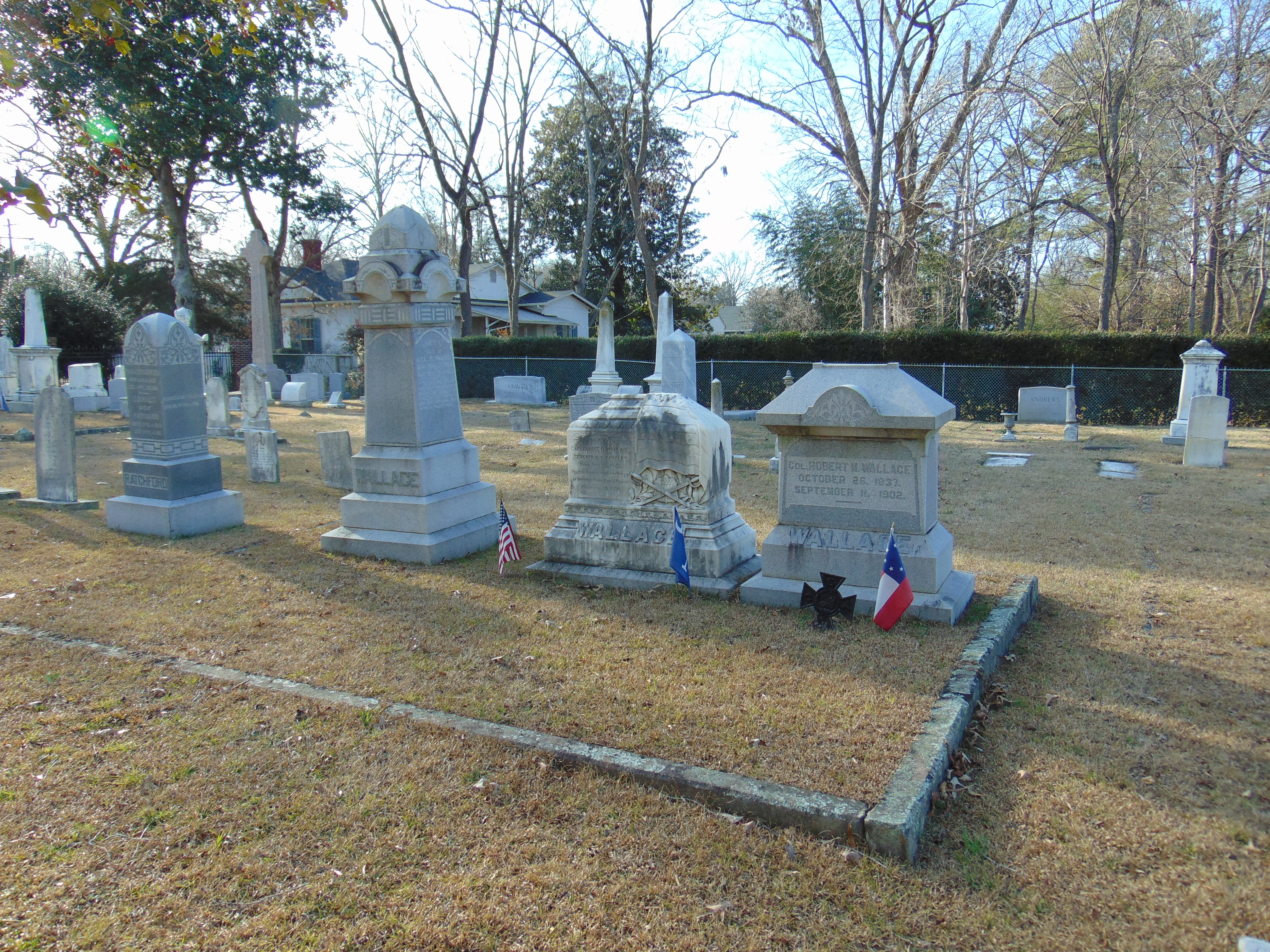

The Wallace Family Plot at Rose Hill Cemetery, York, South Carolina.
Included are the graves of Captain George D. Wallace in the center, his parents U.S. Representative
Alexander Wallace and Nancy Wallace on the left and his brother, C.S.A. Colonel Robert M. Wallace
on the right with Confederate Iron Cross marker.


The following sources of information were used for this article:

Custer's Southern officer: Captain George D. Wallace, 7th U.S. Cavalry by John D. MacKintosh (2002); ISBN-10 0615120520, ISBN-13 978-0615120522.

"Custodians of the Flag: The People Turn Out En-masse to do Honor to the Late Capt. George D. Wallace -- Eloquent Eulogies on the Flag, and on its Defender." Yorkville (South Carolina) Enquirer Wednesday, April 22, 1891, Pg. 1.

The South Carolina Department of Archives & History.

Find a Grave Memorial ID 5816415.

Friday, April 03, 2015

Common Sense On Honoring Southern Unionists


Common Sense On Honoring Southern Unionists 
 Do They Deserve To Be Honored?

By C. W. Roden


This blog post is dedicated to those men from the South who choose to remain loyal to the Union, or who - like their fellow Pro-Confederate Southerners - simply wanted to be left alone. It is to their memory and those of their descendants and the descendants of their fellow Southerners loyal to Dixie and our shared Southern Heritage.


Earlier this month there was a somewhat interesting exchange of thoughts online about Southern heritage and how some view remembering certain individuals from the parts of the American Southland who served in the War Between The States (1861- 1865).

This debate was not about those who wore the hallowed gray and butternut of the Confederate soldier - at least not directly - rather it was about the little-told story of Southern-born men and boys who wore the Union blue uniform of the United States and fought against their "rebellious" neighbors -- and in many cases their own family.

The debate began with THIS article dated March 28th. 

The article titled: Romance of the Confederacy written by one Josh Gelernter, starts out with the odious tagline: It's time the South dropped it in favor of a batter part of its heritage. 

Mr. Gelernter starts out by discussing a court case concerning license plates in Texas and then pointing out his own Confederate ancestry and pedigree as justification for his case against the Dixie Cross banner. Not the first Southern-born supporter of the Righteous Cause Myth to do such a thing by and means, and sadly he won't likely be the last, but I digress.

Moving on to the second paragraph of the article, Mr. Gelerner is quoted:

"That war killed about three-quarters of a million Americans, and the Stars and Bars are the symbol of the men responsible — regardless of its having also been a symbol of men who were just trying to defend their homes."

Let's begin with the obvious mistake here. He uses the term "Stars and Bars" to identify the Confederate flag -- a fact which belies his claims of understanding and education since it has been noted that informed people know that the Stars and Bars is not the Dixie Cross banner. I pointed that fact out myself several times on this blog. As for the first part, where he mentioned the war killed three-quarters of a million Americans....Um, I think he overlooked the fact that of those numbered about forty percent of those Americans were in fact the same men who carried the Confederate battle flag into battle.

I take it you folks are beginning to see the obvious here?

After that -- while attempting to sound reasonable rather than condescending, which he fails at miserably - Mr. Gelerner proceeds to talk about how over 110,000 Southern men fought for the Union. Or as he puts it, how one in ten Southerners fought against slavery rather than for it.

Then Mr. Gelerner makes the suggestion directly to Southerners who honor their Confederate ancestry (again as he claims to continue doing so). He points out that he understands the inclination of Confederate soldier's great-great-grandchildren to glorify their great-great-grandfathers -- and yes folks, he thinks folks actually accept that statement at face value. 

The magnanimous bastard even goes on to concede an obvious point: that Confederate soldiers were not Nazis. Uh....duh! That face is pretty much obvious to anyone else with even a rudimentary understanding of history who isn't a complete Leftist ideologue, or an utter brain-numbed moron.

Mr. Gelerner -- after offering up some brief details on the service of Southern Unionists -- conclude his piece with:

"But every few years, when a battle breaks out over the Confederate flag, I can’t help thinking that it’s time that the South, en bloc, abandoned the Confederacy and embraced the heritage of southern Unionists. Your average adult southerner today has between 128 and 256 ancestors who were alive during the Civil War. Statistically, it’s very likely that some of those ancestors were...." 

Well folks, at this point he starts reciting campfire songs about justifications for the destruction and plunder of a wide stretch of Southern Georgia and the article ends on that low note.

Let me pause here to go empty my bowels.

Okay, I'm back. 

Now then, a few days after Mr. Gelerner's article about picking and choosing one aspect of Southern heritage in favor of some aspects over another came THIS article in response, dated March 31st.

This article, written by Thomas DiLorenzo, begins with a simple question: "Should the Polish people memorialize fellow Poles who collaborated with the Soviets?"  

The answer to which is plainly obvious -- at least to Mr. DiLorenzo.

The rest is a rather well-written rebuttal that pretty much destroys Mr. Gelerner's suggestions and points out their obvious failings. He also throws in some modern views of the War and some of his own personal political bends into the story. Regardless, it was well written.

Still, rather than let Mr. DiLorenzo completely off the hook, I would like to go back to his opening statement, an obvious comparison between Polish collaborators who sided with the invading Soviet who stayed long after liberating Poland from Nazi occupation and installed their own puppet government, and Southern Unionists. He argues against honoring Southern Unionists.

In this case, Mr. DiLorenzo is in error much like Mr. Gelerner was in his assertions that the heritage of Southern Unionists should replace Confederate heritage, but for entirely different reasons.

Allow me to explain why.


So Who Were These Pro-Southern Unionists?

Before the War Between The States broke out, before the Southern States actually seceded, the issues that divided America likewise divided the people of America, and not always along the Mason-Dixon Line.

Slavery certainly caused much of the problem, both morally and in terms of political power between the North and the South. That has been well documented in terms of several territorial acts after the War of 1812, US Supreme Court cases like: DredScott vs Sandford (1857), "Bleeding Kansas" and John Brown's raid on Harper's Ferry in 1859.

Also certainly the differences between the North and South were likewise caused over the issue of how both saw federal power and State sovereignty. Some believing that only local government can understand local issues. Some believing that the union itself was made up of sovereign and independent States and a federal government that was limited by the US Bill of Rights, no different than the original Articles of Confederation after the American Revolutionary War. Others believing that in order for the United States to maintain its place as a free and powerful nation it must have a strong government like other world powers.

Ultimately those two main causes fueled a fire that finally exploded on April 12, 1861 when the newly formed Confederate States exerted what it perceived its sovereign authority to drive away a foreign occupation of Fort Sumter in Charleston harbor. The US government, which continued to see Fort Sumter as Federal property, retaliated by calling for 75,000 volunteers to put down a "rebellion" in the South.

Naturally views on how individual Americans saw duty, loyalty and honor were just as divided, and geography was not always a determining factor.

Even today, many people still believe the idea that people in the Northern and the Southern States both followed the loyalties of the side each State choose to support. This is far from the truth.

In the North, particularly in Southern Illinois and various places along the Ohio River Valley, many northern-born Americans actively supported the Confederate States, even joined Confederate military units in Kentucky and Tennessee. The States of Kentucky, Missouri, Western Virginia, Maryland and Delaware were all heavily divided, and sent soldiers to both Union and Confederate armies.

In several Southern States loyalties were very divided in the Appalachian regions of Western North Carolina, Eastern Tennessee, and some parts of Northern Alabama. Some of these people - particularly people German and some Scots-Irish descent - remained loyal to the US government, much like American Loyalists a generation earlier remained to the British Empire during the American Revolutionary War. 

One of the Union's most brilliant generals, Major General George Henry Thomas, was a Virginian who stayed with the Union because he supported the idea of a strong federal government - a decision that would ultimately lead to his family disowning him during and after the War ended. 

Certainly a large number of black Southerners joined the ranks of the Union army. An estimated 178,000 black Americans overall were a part of the United States Colored Troops (USCT). This fact is well documented today. 

Among white Southerners, the numbers of men who served in the Union military come close to around 100,000. These are the estimates of that number from each Confederate State: 

Alabama: 3,000
Arkansas: 10,000
Florida: 3,500
Georgia: 400
Louisiana: 7,000
Mississippi: 545
North Carolina: 25,000
Tennessee: 42,000 
Texas: 2,200
Virginia & West Virginia: 22,000 


What Motivated Pro-Union Southerners?

The question of loyalty to either cause depended on the mindsets of the time.

America was a vastly different place in the 1860s. People then were much like people today, but we must be careful not to attribute the same specific desires and attitudes of today.

In the American Southland, mostly small rural communities with negligible government interference and policing, they were often more responsible for their own security and safety. Based on their social structure, Southerners lived by a clear and simple moral code. Concepts like right, wrong, and kinship were certainly much stronger then than they are today in America.

Those who followed the Confederacy, for the most part, were fiercely independent minded individuals, who regarded loyalty and duty to home and close kin more strongly than duty to State, or government. To these men and boys they saw the North and the Union as literally a foreign entity very far away wanting to impose the will of the leaders on the people, while their personal code of honor would never accept that.

Those Southerners who followed the Union believed strongly in national identity, in a rule of law that was less a form of anarchy that their Confederate neighbors and family accepted. Or, in some cases, such as the Southern Unionists in the Appalachian regions, they were so fiercely independent that they saw the Confederate government as a closer and more intrusive threat to their individual liberties than the far-off Union government in Washington D.C. Many of these people simply declared their neutrality and remained so until the Confederate State governments imposed conscription.

Slavery was sometimes a factor, though a small number of pro-Union Southerners were themselves slaveowners, while a number of pro-Confederate Southerners from the same region were not. Many of these Southern Unionist's slaves continued to remain slaves until the end of the war because the Emancipation Proclamation did not specifically apply to their cases. Others were freed willingly by their owners only after the proclamation went into effect in 1863. Including many members of the United States Colored Troops, some of those same Unionist slaves served side-by-side with their Southern Unionist masters in the war, little different that the slaves and freemen who served in the Confederate army....a topic we will explore in detail at a later date.  

These Southerners who remained loyal to the Union often times suffered brutally at the hands of their Confederate neighbors for their allegiance. The best example of this being the infamous Shelton Laurel Massacre. This is not to say that these Southern Unionists were all angels of virtue either. Southern Unionists likewise committed their fair share of war crimes against their pro-Confederate brothers and sisters. Incidents such as the Wilson Massacre and the Huntsville Massacre are testament to the fact that during the War Between The States neither side walked away entirely as the pillars of honor and virtue. 

Indeed, many of y'all might recall from a previous blog post that several of my own family and Confederate ancestors were themselves murdered in cold blood by some of these Southern Unionist. 

Some of these Southern Unionists were in fact former Confederate soldiers who deserted for various reasons. Some of them simply to protect their own homes from what they began to see as a Confederate government that was more intrusive than the far away Union government, particularly in terms of conscription. Others because they were disgusted with the fact that the Confederate government exempted rich plantation owners and their families from service. It should be noted in their defense however that both sides had exemptions and "substitute policies" and that many Union soldiers likewise deserted the army because they were disgusted with such policies. The "rich man's war and poor man's fight" class warfare argument was universal throughout the conflict. 

Then there were those Confederate prisoners of war held in Northern prisons like Camp Douglass and Elmira Prison who swallowed the dog and took the Oath of Loyalty to the Union. These men were offered the choice of remaining in prison till the end of the war, or to join the Union army out west to fight the Native American populations and maintain the US outposts in the Dakotas and Wyoming. Many of these men did, becoming what are termed as "Galvanized Yankees" to escape the harsh and brutal conditions imposed on Confederate prisoners of war. Knowing what I know of those conditions, this blogger could not find fault with their decisions, not everyone can be a diehard rebel. 

A Common Sense Solution 

Following the end of the War Between The States and the Reconstruction Era, the memory of these Southern Unionists largely began to fade away, or were overlooked except in local folklore. In an ironic way, the memory of these Southern loyalists was little different than the memory of those Black Confederates who served in the War, until the last couple of decades. Although unlike some of these Black Confederates who actually remained honored and well respected by some of the former white Confederate Veterans in spite of the rise of Jim Crow racism in America, Southern Unionists found themselves completely edited out of the region's history, with few exceptions.

More than anyone else, I have a huge justification for wanting to hate the memory of those Southern Unionists given my family history.

Yet, I do not.

Largely because I do not believe in the "sins of the fathers" concept, nobody is their ancestor. I respect my own Confederate great-great-grandfather; but while I honor the person he was and those aspects of him that are a part of my genetic makeup, I am not him. I cannot personally claim any honor he earned for himself, or for any hypothetical crime he may have committed during his lifetime. As such I could never condemn, or hate the descendants of those Union soldiers and the Southern Unionists that fought against him either. 

I do not agree that these people should be edited out of Southern history anymore than I support calls for the removal of Confederate monuments and the condemning of Confederate symbols. If anything I see them as two sides of the same coin, and I am disgusted with the suggestion that either deserves their memory condemned. 

Southern Unionists are as much a part of out shared and diverse Southern heritage as Confederate soldiers, Scots-Irish Patriots of the American Revolutionary War, Nat Turner, grits, Coca-Cola, sweet iced tea, kudzu, ect. To ignore that is disingenuous.

One cannot omit any piece of Southern heritage -- either positive or negative -- and claim a love for it. This is the argument that those of us who honor the Confederate heritage part of that heritage promote. We condemn those who seek to destroy the memory of the Confederate soldier or erase his memory to promote an unsavory modern-day politically correct agenda. But in doing so, we cannot cherry pick Southern heritage as a whole and condemn the memories of others, even those who fought against our Confederate ancestors. 

I agree and support the idea that Southern Unionists should be honored, but only for the right reasons. At the same time I reject the idea that Confederate statues should be sacrificed in order to make room for monuments to others, simply to promote the national sin of political correctness. There is more than enough room on our city squares, courthouses, state capitols and other places for monuments, or plaques to Southern-born Union veterans without having to damn the memory of other honored Southern heroes and American veterans.

Sunday, March 22, 2015

The Buck Island Massacre -- A Roden Family History & Tragedy

 
The Buck Island Massacre 
A Roden Family History & Tragedy

By: C.W. Roden

The following tragic story is a true account of the slaughter of members of the Roden family - some of my own ancestors - during the latter half of War Between the States (American Civil War).

Buck Island is located on the Tennessee River between the towns of Guntersville and Claysville, in Marshall County, Alabama.

On Saturday, December 26, 1863, a band of Southern Unionists led by a notorious Tennessee Valley outlaw and Union scout named "Captain" Benjamin R. Harris, captured four members of the Roden family -- two civilians and two Confederate soldiers on holiday leave recovering from wounds -- were captured there along with two other men. These men were led to the river and then summarily executed.

Harris was born in Alabama in 1823 and moved from place to place with his family from southeastern Madison County to Arkansas and then to Louisiana.

When the War Between the States broke out in 1861, Harris hired himself out as a scout for the Union Army, giving himself the unofficial rank of captain. He led a band of 30 or so men who later became notorious foragers/pillagers in Northern Alabama in the fall of 1863 till his death.

The following is an account taken from the autobiography of Dr. John A. Wyeth titled: With Sabre and Scalpel (New York: Harper & Bros., 1914), pg. 314-15. The story was also written in the Confederate Veteran magazine, Vol. VI, page 523 and reads as follows: 

Northern Alabama had paid dearly for the devotion of her people to the cause of the South. Nowhere in the Confederacy had such ruin been wrought, save in the path of desolation along which the march to the sea was made, or perhaps in the valley of Virginia, in obedience to the order to leave it so desolate that "a crow flying over would have to carry its rations." Our county of Marshall had suffered in a double sense, being overrun for the last year and a half of the war by bands of marauders who robbed the defenseless people of the little the two armies had left. The story of their forays would make a bloody record. The narration of one tragedy which was enacted on a small island in the Tennessee River may give an idea of the awful conditions which prevailed. Buck Island was then almost wholly covered with dense cane. Hither five men, non-combatants, had fled for a hiding-place, and had taken with them the few cattle which had escaped impressment. In the depths of the cane-brake they had constructed a pole cabin for shelter. A Confederate soldier named C. L. Hardcastle, wounded and on furlough, a relation or friend and neighbor, slipping in to visit his family, came to stay all night with the refugees. Toward morning they were aroused from sleep to find their cabin surrounded and themselves in the hands of the notorious Ben Harris and his band, who had learned of their retreat and had come for their cattle. Being a far-sighted man and well known to the Rodens and their guest, Harris gave them five minutes for prayer, after which he made them stand in a row along the riverbank, and, to make sure of a clean job, with his six-shooter he put a bullet through the hearts of five of the six and thought he had done the same with the sixth man. This man was Hardcastle, who told me that as Harris came down the line, placing the muzzle close to the left side of the chest of each victim as he fired, he made up his mind to drop quickly a little before he was shot, which he did, and the ball missed a vital spot. Feigning death, he was dragged with the other five bodies and thrown into the river, the current of which washed them down-stream as they were sinking. Holding his breath, he floated under some driftwood lodged against a fallen tree and concealed himself behind a log. The bullet had struck a rib and taken a superficial course. When the murderers walked off to round up the cattle he crawled out and into the cane, and in this way made this marvelous escape from death. I knew the men who were killed.

During all of 1864 and the spring of 1865 Marshall County was the scene of active hostilities, not only between scouting parties of regular soldiers of the Union and Confederate armies, but between bands of Tory marauders, who paraded in Federal uniforms, and small squads of Confederate Home Guards under partisan leaders. Some few of the Tories had been Union men all along, but were wise enough to keep discreetly quiet until the Federals occupied the country. Most of them were poor whites who had dodged conscription by hiding out in the mountains near their cabins when the Confederates were in control, and came into view as soon as the Federals appeared. Some few were deserters from our army, but all were united now in their love of country by the cohesive strength of a desire to plunder the helpless. As these men of the two sides had known one another before the war, it may be imagined that what is described as "feeling" ran about as "high" between them as it could run. Toward the last it was considered a waste of time to surrender, even if cornered without hope of escape. The recognized practice was to sell out as dearly as possible and keep shooting as long as a trigger could be pulled. 

Ben Harris had led off in a practice of extermination which put Cromwell to the blush. The conqueror of Ireland knocked only every tenth prisoner on the head, but Captain Ben overlooked none, and just to be sure that no detail was omitted he was his own executioner.


The gravestones of Roden family patriarch Mr. Benjamin Roden; his son, Mr. Portland Roden;
Benjamin Roden's nephew, Confederate Sergeant James Roden, Co. G, 48th Alabama Infantry;
and James' son, Private Felix Roden, Co. G, 4th Alabama Cavalry. 
All of these men were the victims of the Buck Island Massacre.
The graves are located at Roden Cemetery, Marshall County, Alabama, USA. RIP


Those members of the Roden family that were murdered in cold blood by Harris were recovered from the river and lain to rest with other family members -- including this blogger's paternal great-great-grandfather and Confederate ancestor Sergeant Jackson S. Roden, Company A, 48th Alabama Infantry Regiment -- at Roden Cemetery in Marshall County. Their friend and Confederate soldier, Charles Hardcastle, would survive his wound and live well after the War ended.

As for the Southern Union Loyalist and infamous Tennessee Valley outlaw Ben Harris, he died on Sunday, March 5, 1865 from natural causes after a couple of years of terrorizing Southern civilians, burning homes and crops -- sometimes also including those with Union loyalties according to some accounts.

In reward for his questionable service, Harris is buried in Chattanooga National Cemetery
under his presumed rank of "captain" despite lack of formal commission by Union authorities. He lies buried there among Union dead killed in battle like proper soldiers facing their enemy like men. His grave is decorated with a U.S. Flag every U.S. Memorial Day and U.S. Veterans Day placed there by the National Parks Service.

The Buck Island Massacre is mentioned prominently on the granite Confederate Monument in front of the Marshall County Courthouse in Guntersville, Alabama, along with other war related events and skirmishes that took place in the area.


Confederate Monument at the Marshall County Courthouse grounds, Guntersville, Alabama.

(Yet another account of the Buck Island massacre can be found in The Sword of "Bushwhacker" Johnston, Charles S. Rice, ed., which details a first-hand account of events in Jackson, Marshall, DeKalb and Madison Counties by Rev. Milus E. Johnston. The book was published in Huntsville, Ala., by Flint River Press in 1992. Johnston's story and Rice's notes appear in chapter 6, "Acts of the Invaders", pp. 26-31.)