Saturday, June 18, 2016

Night Sky Photography - 06/18/2016 - Luna, Saturn & Mars

As we near the summer solstice the waxing gibbous moon overhead has two travelers close by in the southern sky. Saturn can be seen close to Luna's brightness, while Mars is further west.

I took the photo at exactly 11 PM EST when the three heavenly bodies were high overhead. 


Sunday, June 12, 2016

Rocky Shoals Spider Lillies At Landsford Canal State Park

Despite living about 20 miles from the place, I have very rarely ever visited Landsford Canal State Park in the summertime. This is largely due to the abundance of snakes (particularly poisonous ones like the Cottonmouth Water Moccasin and Eastern Copperhead) along the Catawba River in the late spring and summer months. 

My personal hang-ups about certain reptiles aside, the summer months by the river are very hot and muggy here in South Carolina. I usually like to take trips to Lansford Canal in the late fall as the leaves have turned. That is when the place is at it's most picturesque. I plan to return in early, or mid November to get some photos of the river and the fall colors. 

The Rocky Shoals Spider Lily
(Hymenocallis coronaria).
I did have a particular mission on this late spring trip. To photograph the abundant -- and quite rarely seen -- Rocky Shoals Spider Lillies (Hymenocallis coronaria) that bloom in late May - June on the river. 

Landsford Canal State Park hugs the last free-flowing stretch of the Catawba River between Lake Wylie in York County and the Cedar Creek Dam at Great Falls. Along the site of historic Landsford Canal on the river are a large stretch of rocky shoals so close together that one can actually walk across the length of this shallow section of the river on them at certain times when the current is slow. It is on these shoals that the largest known stand of the beautiful Shoals Spider Lily bloom, blanketing that stretch of the river in an absolutely stunning display of white and green. 

The Shoals Spider Lily -- which can be found in both Carolinas, Georgia, and Alabama -- requires clean free-flowing water with an uneven rocky bottom to root. Unfortunately, most of the free-flowing shoals on the Catawba River have largely vanished. This is primarily because of the hydroelectric dams built along the rocky elevation drops to take advantage of the natural water power. 

The Rocky Shoals Spider Lily has likewise become rare and endangered.  

Thankfully due to wise management in public, private and corporate groups working together in conservation and preservation efforts with the SC State Parks management, the spider lillies still have a place to grow and be appreciated by naturalists like myself. 

So on this trip I brought along my sister's little boys, both of whom had already run out of ideas for summer vacation and needed to get away from their online game systems for awhile -- though not because they wanted to, their mom made them go. Still they did have a good time and afterwards were treated to McDonalds. Yours truly abstained from the fast food. 

I hope that y'all appreciate the photos I took. I am sorry I could not get closer than the overlook at the end of the trail, but I wasn't about to go out on slippery rocks with two younger kids who's mom would kick my ass if either of them got snake bit walking on my watch while along the plants. That and the park rules make that area off limits to anyone but people going through on kayaks. 

Please enjoy the photos. 

Landsford Historical Marker.
If you look closely in the water you can see a
Whooping Crane (Grus americana)
standing in the
water looking for a meal.
One of the locks of the old canal.
There are more of them but I am saving that and the story of the canal for my fall trip.
My nephews Caleab and Tyler Morris.
Found this little fella on the path. Have no idea what species
of moth this harry little guy will turn into.
We moved him to the nearby bushes and continued on.
At last we arrive at the shoals!
Tyler and Caleab make a new friend.

Friday, June 10, 2016

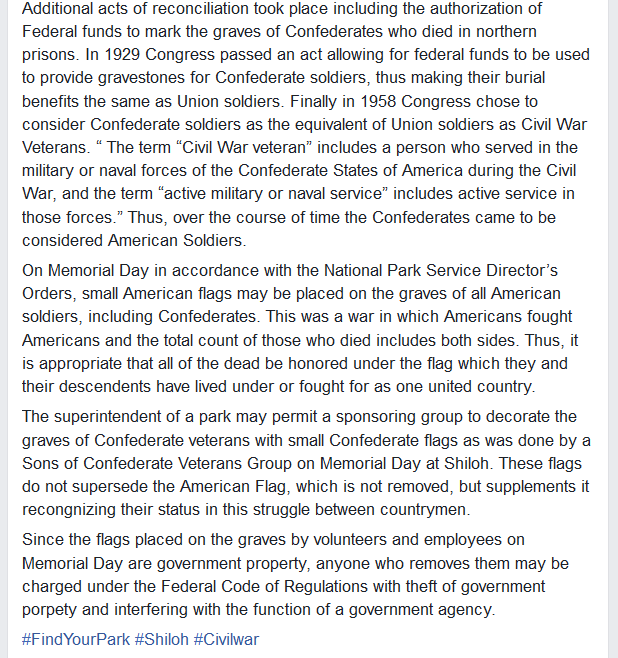
Should US Flags Fly Over Confederate Graves?

One of the Confederate mass grave sites at the Shiloh National Military Park.

This week a somewhat interesting topic was brought up by many of the more vocal members of the Confederate heritage community about the practice on the part of some people to put small United States flags on the graves of Confederate soldiers. 

This became an issue late last month when some individual removed 163 US flags from the Confederate graves at Shiloh National Military Park in Tennessee the Saturday before Memorial Day (May 30th). Park staff discovered the flags were missing and replaced them in time for official ceremonies on Memorial Day. 

The next day a custodian found the flags in a bag accompanied by a handwritten note of apology for the removal, and expressing the individual's feelings that "American flags" should not be flying over the graves of Confederate soldiers. 

The Shiloh battlefield was the site of one of the bloodies battles of the Western Theater of the War Between the States (American Civil War) in April of 1862. Five burial trenches are the final resting places for thousands of the Confederate dead. Union soldiers are buried in the nearby Shiloh National Cemetery.

The administration of the park issued a post on the national battlefield's facebook page explaining why the US flags were placed there, emphasizing that no disrespect is intended to The post itself makes a very good case - including recognition of the Confederate soldiers buried on the battlefield as recognized American Veterans, a statement from a government-run source that probably has a certain "civil war blogger" in need of sedatives. The post makes an excellent and well-reasoned case for the display of the US flags at the mass grave sites, including a photo of United Confederate Veterans standing at the same site with US flags on the ground at the mass grave, and carrying the US flag in parade.


Overall, it is clear that the traditional display of the US flag at the site has historical precedent, and - from this blogger's point of view - was not done as a sign of disrespect to either the dead, nor the living. It was done as a sign of respect for their status as American Veterans on equal terms with US soldiers of all other conflicts. 

By contrast, the removal of the flags by a misguided, yet seemingly well-meaning individual, was also not intended to be disrespectful in principal; though the removal of federal property from federal land is not acceptable, nor is robbing from a grave site under any circumstances. 

Why Do Some Put US Flags On Confederate Graves 

The act of putting US flags at Confederate graves is far from a new thing. The practice goes back to the end of the War itself. 

At the time of the Damnyankee Occupation of Dixie (also known historically as Reconstruction) the display of Confederate banners was illegal under the rules of martial law. In those early memorial observances when the Confederate dead were honored flowers were placed on the graves without bunting of any kind. 

The Union occupiers would sometimes bury their own dead at Confederate grave sites and build memorials in order to permanently get the idea across to the local population that they - by God! - were in the Union to stay. Since only the US flag could legally fly on those occasions, when the Yankees took up the practice of honoring their dead buried in Southern soil, the US flag would fly over all the graves. 

When the Union soldiers finally left a decade later, the United Confederate Veterans (UCV) and United Daughters of the Confederacy (UDC) began honoring the Southern dead properly with flowers and flags. The Union graves in the South continued to be honored with US flags, often during the same services. Since the UCV and UDC were American patriotic groups, the US flag was mandatory as their functions. 

By the time the Spanish-American War (1898) came around, the former Confederate Veterans and their Union counterparts patriotically united under the share title of Americans that both proudly declared themselves, even during the War Between the States itself. It was around that time of reconciliation that the practice of honoring the men of the North and the South from the War as American Veterans was largely established and both the flag of the United States and the Confederate battle flag began flying respectively over the graves of the dead. 

This practice continues today in modern times, though there is controversy from both sides of a rather heated argument. 

Some camps of the Sons of Confederate Veterans (SCV) and United Daughters of the Confederacy (UDC) placed both US flags and Confederate flags on the graves of the Confederate Dead and have done so for decades. These groups also traditionally put US flags on the graves of Union dead in local cemeteries out of common respect and honor for those lain to rest. 


More often that not this happens on federal property, or Northern land where Confederate soldiers are buried. The best example of this are the graves of the Confederate dead buried at the site of Camp Chase Prison Camp in Columbus, Ohio. The local SCV decorates the graves with both flags on Confederate Memorial Day and US Memorial Day respectively. 

Confederate Soldiers' Monument at the Camp Chase Confederate Cemetery in Columbus, Ohio, USA.
Note the US flags placed at the graves beneath, and the word: AMERICANS on the arch of the monument.
More Confederate graves at Camp Chase Confederate Cemetery.
Nearly 2300 Confederate soldiers died in prison here of diseases and other causes.

In the Southland itself, the practice of putting US flags on Confederate graves is something of a mixed bag. 


Some Confederate descendants see the placing of US flags on Confederate graves as an insult to the memories of the men buried their, particularly those of an ancestor who died during the War itself.

Southern nationalists in particular are critical of such displays claiming that (and folks these is actually direct quotes): "the g--d--m flag of the Yankee Empire does not belong on the grave of the Confederate soldier." Yeah folks, I also feel a headache reading stuff like that. Y'all better get the aspirin ready, because I have another one: "Don't put a Yankee rag on a Rebel grave." 

The fact that many former Confederate soldiers and their descendants later fought proudly under that "Yankee rag" and the vast majority of Southerners of Confederate descent proudly claim the US flag as their own, no less important to the battle flag of the Southland respectively, is largely lost on this mindset. 


Other Southerners descended from Confederate soldiers put only US flags at the graves to honor the dead ancestor, while at the same time trying to distance themselves from modern displays of the Confederate battle flag. Obviously such thinking is misguided and to some degree embarrassing. This mode of thinking is an attempt at compromising and appeasing the irrational ideals of modern-day political correctness, and are usually lost on the practitioners of that obscene paradigm.

There are also those misguided people who believe that Confederate flags should fly over the graves of Confederate soldiers buried on federal owned land, or that the Confederate soldier deserves no honor at all, but that is a topic we will discuss in a future blog post later this month. 

Conclusions and Suggestions

Overall, despite the claims of many of the more hard-core Southern heritage folks with wild conspiracy theories, the practice of putting US flags with Confederate flags on graves is not some plot by the US government to denigrate the Confederate soldier or his descendants - though there is no denying that some individuals with warped social justice mindsets would enjoy that particular outcome and advocate for it for that reason. 

The organizations and individuals who continue to do so are not entirely misguided, though I can understand and sympathize to a degree with those who feel that US flags have no place on Confederate grave markers. I would agree completely that the US flag alone should not fly at Confederate graves - particularly those of Unknown soldiers. 

NOPE!

Let me explain to you a my own common sense solution when it comes to this issue. 
 
As both an SCV member and someone who has helped take care of both Confederate and Union graves for years, I can only say with certainty about the graves I watch over on Confederate and US Memorial Days respectively. 

I watch over 57 graves of soldiers who served in the War Between the States located at Elmwood Cemetery in downtown Chester. Of these are 54 are “Unknown” CSA soldiers, 2 are known Confederates (one dead during the war and one an aged veteran) and 1 Union soldier who died in late 1865 of illness. 

This is the manner in which personally I handle this issue of US and Confederate flags on these graves:

On Confederate Memorial Day (May 10th in the Carolinas) I place ONLY Confederate battle flags on their graves of the 54 Unknown CSA soldiers who died in the War.

For the one Confederate Veteran after the war (who probably took the oath after the War) I put both the US flag and a battle flag on his grave. 

For the Union soldier, I place a 36 star Union stick banner at his - sometimes both the historical US flag and the current 50 star flag.

On US Memorial Day (Last Monday of May) I place a pole with a Confederate Battle Flag at the Confederate gravesite and another pole of equal length with the current US flag at the Union gravesite respectively sun up to sundown. 

That is my personal solution to the issue and how I honor our shared American dead using good plain old Southern Fried Common Sense


Tuesday, May 31, 2016

Honoring The 236th Anniversary of the Battle of the Waxhaws

Greetings my friends and fellow travelers. 
 
On Saturday, May 28th, my US Memorial Day weekend travels took me next door to Lancaster County, South Carolina.

Most people in South Carolina spent the weekend enjoying the sunshine at beautiful Myrtle Beach a couple hours away (or at least just Saturday because of the wet weather brought ashore by Tropical Depression Bonnie effecting the rest of the weekend). Some had cookouts at family reunions. 

Yours truly spent the morning and early part of Saturday afternoon of US Memorial Day weekend with roughly 60 or so people -- many of them well past their 50s -- honoring fallen American soldiers. 

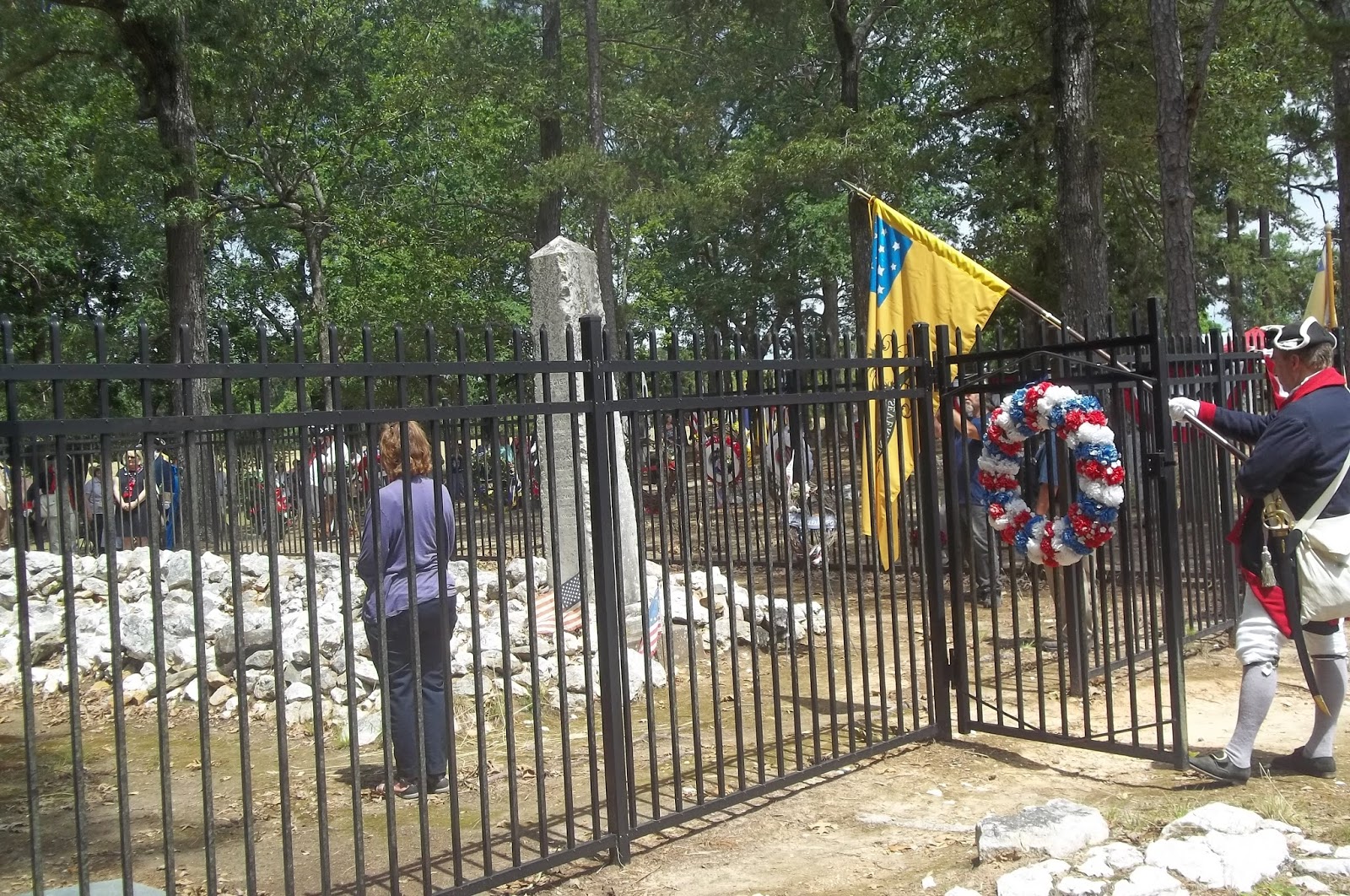
It was my honor to attend the 236th Anniversary commemoration of the Battle of the Waxhaws, also better known locally as Buford's Massacre, sponsored by the South Carolina Society Sons of the American Revolution.  

God blessed us with good weather as we showed our respect to the men being honored that morning -- the Virginian soldiers of Colonel Abraham Buford's command that were mercilessly slaughtered in a largely one-sided 15 minute battle on that site on the afternoon of Monday, May 29, 1780 by the British Legion under the command of Lt. Colonel Banastre Tarleton. At the site of the battle 84 of the 113 Continentals killed on the battlefield are buried in a mass grave.

Perhaps one of the most touching moments of the service was the scattering of Virginian soil on the mass grave by two descendants of a Virginian Continental soldier buried at the site. A reminder that our shared Southern heritage and the love we hold for those who came before us runs deep.

The following are some of the great photos I managed to get that day before my camera died -- I kinda forgot to take spare batteries, but luckily the ones I had survived till the end of the service.


The site of the Battle of the Waxhaws was added to the National Register of Historical Places in 1990 and is maintained today by the good work of the Friends of Buford Massacre Battleground...which this blogger is proudly a member.

The site of the battle and the mass grave are located 9 miles east of Lancaster, SC, at the corner of SC 9 and Rt. 522 in Lancaster County.