Showing posts with label American Veterans. Show all posts

Saturday, February 03, 2024

Two Confederate Veterans In Honor Of Black History Month


Pictured in this photograph are two Confederate Veterans at a reunion of the United Confederate Veterans taken near the battlefield at Brice Crossroads near Baldwyn, Mississippi in July of 1921.

On the left is Joe Wiley, then 90 years old, who served in Company A, 7th Georgia Infantry Regiment, CSA. On the right is Howard Divinity, then 91 years old, who served in Company A, 12th Mississippi Infantry Regiment CSA.

This month of February, designated as Black History Month in the United States, this blogger honors their service, and that of all African-Americans who served honorably in America's wars.

Tuesday, December 07, 2021

Honoring Pearl Harbor Day -- Remember December 7th!

 
Today, the United States of America honors National Pearl Harbor Remembrance Day, marking the anniversary of the attack on the US Naval Station at Pearl Harbor, near Honolulu, Hawaii on Sunday, December 7, 1941 by what was then the Empire of Japan.

This day honors the memories of over those killed and wounded during the attack including: 
2,403 US military personal killed, 1,178 wounded. 
68 Hawaiian and US civilians killed, 35 wounded. 
64 Japanese military personal killed.
 
To honor of the memories of those American military personal who died that day and those veterans who survived the Pacific Theater of World War II (December 1941 - September 1945) this blogger proudly remembers National Pearl Harbor Remembrance Day.

God Bless America! 


Thursday, January 28, 2021

In Memory Of The 35th Anniversary Of The Challenger -- A Tribute To The Fallen Pioneers Of Space Travel

The crew of the space shuttle Challenger honored us by the manner in which they lived their lives. We will never forget them, nor the last time we saw them, this morning, as they prepared for their journey and waved goodbye and "slipped the surly bonds of earth" to "touch the face of God." 
                                  ~ U.S. President Ronald Reagan addressing the nation on January 28, 1986 

Space shuttle Challenger (OV-099) Mission STS-51-L crew:
(front row left to right) Michael J. Smith, Dick Scobee, Ronald McNair;
(back row left to right) Ellison Onizuka, Christa McAuliffe, Gregory Jarvis, Judith Resnik.
Photo courtesy of NASA/ 1986.


Today marks the 35th anniversary of the deadly accident that took the lives of the crew of the NASA space shuttle orbiter Challenger (OV-099)

I was nine years old and home from school on the morning of January 28, 1986. I was playing a game of some sort with my sister in the family living room when my dad came into the room stunned and told everyone present that the space shuttle Challenger exploded on television. 

I remember feeling a little bit of cold in my stomach at the news. My grandparents quickly turned on the television set to the breaking news story. One of the reasons that me and my sister were home that day was school being let out for teachers work day, and the launch of the space shuttle mission -- which was to have included what should have been the first civilian school teacher into orbit. In fact, I recall that we were assigned homework to write a report on the launch. 

My sister, Olivia, was in probably worse shock than I was over the news. She was in complete denial at the time that the crew died in the explosion (later it would be learned that the crew did in fact survive for a short time following the breakup of the shuttle). I will never forget my teary-eyed seven year old sister saying, "No, teachers can't die! They're teachers!" I too was somewhat disillusioned to learn at such a young age that teachers were not invincible. To me educators were tough (and at times grumpy) people, but regardless people who seemed to be above concepts like being moral human beings. 

There were two things other than these moment that stood out for me on that terrible day in American history: the constant replay of the explosion itself, the fireball and smoke trails; and the address to the nation given by President Ronald Reagan. 

Even as a child, the words Reagan spoke about the importance of the space program and the crew of the space shuttle and others before them as the first pioneers into the next great frontier for humanity stuck with me. He spoke of the tragedy, of the dedication of the men and women lost in the disaster, and quoted from the poem High Flight by John Gillespie McGee Jr. He also reaffirmed that mankind would continue to move forward to conquer space.

The loss of the seven crew members was a shock to the nation, and would delay the US space program for several years. Yet just as the past sacrifices of the first great pioneers of space travel inspired those seven brave American men and women; the memory of the sacrifices made by the crew of the Challenger lives on today in the dedication of those who continue to serve as astronauts, technicians and engineers designing the crafts that will someday take humanity beyond our pale blue dot and into the solar system, and possibly beyond in some distant day. 

This blog post is dedicated to the honored memories and sacrifices of those pioneers of humanity's space program tragically killed while helping to advance humanity's scientific knowledge of the universe. Their noble sacrifices to that service will be remembered as human pioneers continue our march into space in the decades, centuries, and possibly the  millennium to come.


In Honored Memory

Valentin Bondarenko (Ukraine, USSR) 
Killed in an altitude trainer accident on March 23, 1961.

Killed in a training jet crash on October 31, 1964. 

Gemini 9 Crew
Killed in a training jet crash on February 28, 1966. 

Apollo 1 Crew
Killed in a spacecraft test accident on January 27, 1967. 

Vladimir Komarov (Russia, USSR)
Soyuz 1 Commander
Killed on impact from re-entry parachute deployment failure on April 24, 1967. 

Killed in training jet crash on October 5, 1967. 

X-15 Flight 3-65-97
Killed in training flight crash on November 15, 1967. 

Killed in training jet crash on December 8, 1967.

Yuri Gagarin (Russia, USSR)
Vladimir Seryogin (Russia, USSR)
Soyuz 3 Crew
Killed in training jet crash on March 27, 1968. 

Georgi Dobrovolski (Ukraine, USSR) 
Viktor Patsayev (Kazakh, USSR - modern-day Republic of Kazakhstan)
Vladislav Volkov (Russia, USSR)
Soyuz 11 Crew
Killed by decompression in space on June 30, 1971. 

Ronald McNair (USA) 
Space Shuttle Challenger (OV-099) Crew
Killed during explosion during the mission launch over the Atlantic Ocean on January 28, 1986.

Sergei Vozovikov (Russian Federation)
Killed during water recovery training on July 11, 1993. 
  
Ilan Ramon (Israel)
Space Shuttle Columbia (OV-102) Crew
Killed in vehicular disintegration upon re-entry of Earth's atmosphere on February 1, 2003. 

Killed in spacecraft flight test crash on October 31, 2014.

You Will Not Be Forgotten!


Monday, May 28, 2018

The Blue And The Gray

The Blue And The Gray
  
Francis Miles Finch (1827-1907)


By the flow of the inland river,
Whence the fleets of iron have fled,
Where the blades of the grave-grass quiver,
Asleep are the ranks of the dead:
Under the sod and the dew,
Waiting the judgment-day;
Under the one, the Blue,
Under the other, the Gray.


These in the robings of glory,
Those in the gloom of defeat,
All with the battle-blood gory,
In the dusk of eternity meet:
Under the sod and the dew,

Waiting in judgment-day
Under the laurel, the Blue
Under the willow, the Gray.


From the silence of sorrowful hours
The desolate mourners go,
Lovingly laden with flowers
Alike for the friend and the foe;
Under the sod and the dew.
Waiting the judgment-day;
Under the roses, the Blue,
Under the lilies, the Gray.

So with an equal splendor,

The mourning sun-day fall,
With a touch impartially tender,
On the blossoms blooming for all:
Under the sod and the dew,

Waiting the judgment-day;
Broidered with gold, the Blue,
Mellowed with gold, the Gray.


So, when the summer calleth,
On forest and field of grain,
With an equal murmur falleth
The cooling drip of the rain:
Under the sod and the dew,

Waiting the judgment-day,
Wet with the rain, the Blue,
Wet with the rain, the Gray.


Sadly, but not the upbraiding,
The generous deed was done,
In the storm of the years that are fading
No braver battle was won:
Under the sod and the dew,
Waiting the judgment-day;
Under the blossoms, the Blue,

Under the garlands, the Gray.

No more shall the war cry sever,
Or the winding rivers be red;
They banish out anger forever
When they laurel the graves of our dead!
Under the sod and the dew,
Waiting the judgment-day,
Love and tears for the Blue,
Tears and love for the Gray.


Hailed as a national classic from the moment of its publication in 1867, this poem is perhaps the most touching and expressive of all the "reconciliation poems" written after the War's end. It was inspired by the following brief news item, which appeared in the New York Tribune: "The women of Columbus, Mississippi, animated by nobler sentiments than many of their sisters, have shown themselves impartial in their offerings made to the memory of the dead. They strewed flowers alike on the graves of the Confederate and of the National soldiers."


Francis Miles Finch (1827-1907).
Francis Miles Finch (1827–1907), a judge, law professor, and poet, was deeply moved by the story of the women of Columbus, Mississippi, who in 1866 -- only a year after the end of the War Between The States -- decorated the graves of both Union and Confederate dead. 

In the town of Columbus, Mississippi, a few Union soldiers killed at the battle of Shiloh were buried in the local cemetery along with the much larger number of Confederate soldiers. In 1866, four women from Columbus decorated the Confederates' graves and decided to honor those of the Union soldiers as well. They also sent notes condolence to the northern soldiers' families. Based on this act of commemoration and conciliation, Columbus, Mississippi considers itself as the originator of Memorial Day -- although several other American cities also make that claim as well. 

Seeing the moment as a symbol of reconciliation, Finch composed “The Blue and the Gray” as a commemoration honoring the universality of mourning in the North and South in the years preceding the war's end. through the acknowledgment of mutual sympathies, he epitomized the new national tradition of memorializing our American dead. 
 

Recitals of the poem continued for years to come at Decoration Days -- Later renamed US Memorial Day -- and reunions of the aged Union and Confederate veterans. 


Saturday, April 15, 2017

Union Soldier's Graves in Rose Hill Cemetery

The entrance to Rose Hill Cemetery in downtown York, SC.

Located in the Southeastern corner of Rose Hill Cemetery in downtown York, South Carolina, are eight graves that seem to be noticeably set apart from the others beneath a tall tree. Its as if the occupants of those graves were buried away from the rest due to some religious objection, or were the victims of some vile and incurable 19th century disease. 


These eight lonely graves belong to Union soldiers. Members of two units of US troops who occupied York County and the surrounding area during the Reconstruction Era (1865 - 1877) who died during that time due to illness, or possibly violence from local resistance to federal enforcement of Radical Reconstruction policies that barred ex-Confederates from voting, holding office, or meeting in groups -- including funerals and church services -- without federal soldiers present.

Some of these men, members of Lieutenant Colonel George A. Custer's 7th US Cavalry under the command of Major Lewis Merrill, were present in York County in 1871 during the height of violent activities involving the first Ku Klux Klan. Their efforts led largely to the suppression of violence against former slaves and those who worked to ensure their equal treatment under the law.  

Eight Union soldiers, members of the local occupation forces
who died during the Reconstruction Era.

No matter their reason for being in York County at that particular time, these eight men sadly died in another State far from their homes and families who never saw them again. No matter if they are a Confederate soldier from Georgia buried in Pennsylvania, or a young Union man from Maine who died of pneumonia in South Carolina. They deserve to be remembered and respected for their individual lives as any other American veteran of the War Between the States (1861 - 1865) who fell far from home. 

For that reason this blogger honors them by placing the flags they served under at their graves and present to you readers the names of these Union soldiers. 

Private Thos Quinton
Co. C 18th US Infantry
Private G.H. Whitemore
Co. L 7th US Cavalry
Private Samuel Brown
Co. L 7th US Cavalry
Private Patrick Walsh
Co. C 18th US Infantry
Private Adolphus Cash
Co. D 7th US Cavalry
Private G.W. Windsor
Co. C 18th US Infantry
Private Jno Shea
Co. C 18th US Infantry
Sergeant Patrick Garr
Co. C 18th US Infantry

 We've been fighting today on the old camp ground,
Many are lying near;
Some are dead, and some are dying,
Many are in tears.

Many are the hearts that are weary tonight,
Wishing for the war to cease; 
Many are the hearts look for the right, 
To see the dawn of peace. 

A popular Union Civil War song.

As always I hope you enjoyed this blog post. Have a wonderful Dixie day, and y'all come back now, ya hear?

Friday, June 10, 2016

Should US Flags Fly Over Confederate Graves?

One of the Confederate mass grave sites at the Shiloh National Military Park.

This week a somewhat interesting topic was brought up by many of the more vocal members of the Confederate heritage community about the practice on the part of some people to put small United States flags on the graves of Confederate soldiers. 

This became an issue late last month when some individual removed 163 US flags from the Confederate graves at Shiloh National Military Park in Tennessee the Saturday before Memorial Day (May 30th). Park staff discovered the flags were missing and replaced them in time for official ceremonies on Memorial Day. 

The next day a custodian found the flags in a bag accompanied by a handwritten note of apology for the removal, and expressing the individual's feelings that "American flags" should not be flying over the graves of Confederate soldiers. 

The Shiloh battlefield was the site of one of the bloodies battles of the Western Theater of the War Between the States (American Civil War) in April of 1862. Five burial trenches are the final resting places for thousands of the Confederate dead. Union soldiers are buried in the nearby Shiloh National Cemetery.

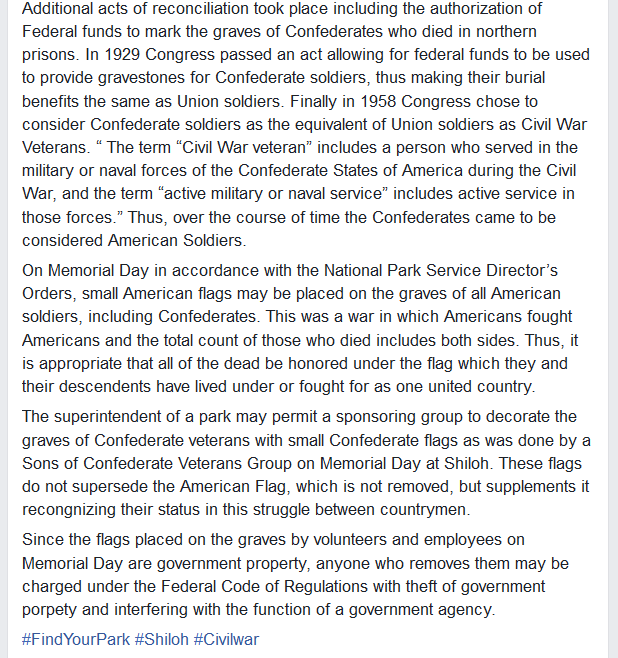
The administration of the park issued a post on the national battlefield's facebook page explaining why the US flags were placed there, emphasizing that no disrespect is intended to The post itself makes a very good case - including recognition of the Confederate soldiers buried on the battlefield as recognized American Veterans, a statement from a government-run source that probably has a certain "civil war blogger" in need of sedatives. The post makes an excellent and well-reasoned case for the display of the US flags at the mass grave sites, including a photo of United Confederate Veterans standing at the same site with US flags on the ground at the mass grave, and carrying the US flag in parade.


Overall, it is clear that the traditional display of the US flag at the site has historical precedent, and - from this blogger's point of view - was not done as a sign of disrespect to either the dead, nor the living. It was done as a sign of respect for their status as American Veterans on equal terms with US soldiers of all other conflicts. 

By contrast, the removal of the flags by a misguided, yet seemingly well-meaning individual, was also not intended to be disrespectful in principal; though the removal of federal property from federal land is not acceptable, nor is robbing from a grave site under any circumstances. 

Why Do Some Put US Flags On Confederate Graves 

The act of putting US flags at Confederate graves is far from a new thing. The practice goes back to the end of the War itself. 

At the time of the Damnyankee Occupation of Dixie (also known historically as Reconstruction) the display of Confederate banners was illegal under the rules of martial law. In those early memorial observances when the Confederate dead were honored flowers were placed on the graves without bunting of any kind. 

The Union occupiers would sometimes bury their own dead at Confederate grave sites and build memorials in order to permanently get the idea across to the local population that they - by God! - were in the Union to stay. Since only the US flag could legally fly on those occasions, when the Yankees took up the practice of honoring their dead buried in Southern soil, the US flag would fly over all the graves. 

When the Union soldiers finally left a decade later, the United Confederate Veterans (UCV) and United Daughters of the Confederacy (UDC) began honoring the Southern dead properly with flowers and flags. The Union graves in the South continued to be honored with US flags, often during the same services. Since the UCV and UDC were American patriotic groups, the US flag was mandatory as their functions. 

By the time the Spanish-American War (1898) came around, the former Confederate Veterans and their Union counterparts patriotically united under the share title of Americans that both proudly declared themselves, even during the War Between the States itself. It was around that time of reconciliation that the practice of honoring the men of the North and the South from the War as American Veterans was largely established and both the flag of the United States and the Confederate battle flag began flying respectively over the graves of the dead. 

This practice continues today in modern times, though there is controversy from both sides of a rather heated argument. 

Some camps of the Sons of Confederate Veterans (SCV) and United Daughters of the Confederacy (UDC) placed both US flags and Confederate flags on the graves of the Confederate Dead and have done so for decades. These groups also traditionally put US flags on the graves of Union dead in local cemeteries out of common respect and honor for those lain to rest. 


More often that not this happens on federal property, or Northern land where Confederate soldiers are buried. The best example of this are the graves of the Confederate dead buried at the site of Camp Chase Prison Camp in Columbus, Ohio. The local SCV decorates the graves with both flags on Confederate Memorial Day and US Memorial Day respectively. 

Confederate Soldiers' Monument at the Camp Chase Confederate Cemetery in Columbus, Ohio, USA.
Note the US flags placed at the graves beneath, and the word: AMERICANS on the arch of the monument.
More Confederate graves at Camp Chase Confederate Cemetery.
Nearly 2300 Confederate soldiers died in prison here of diseases and other causes.

In the Southland itself, the practice of putting US flags on Confederate graves is something of a mixed bag. 


Some Confederate descendants see the placing of US flags on Confederate graves as an insult to the memories of the men buried their, particularly those of an ancestor who died during the War itself.

Southern nationalists in particular are critical of such displays claiming that (and folks these is actually direct quotes): "the g--d--m flag of the Yankee Empire does not belong on the grave of the Confederate soldier." Yeah folks, I also feel a headache reading stuff like that. Y'all better get the aspirin ready, because I have another one: "Don't put a Yankee rag on a Rebel grave." 

The fact that many former Confederate soldiers and their descendants later fought proudly under that "Yankee rag" and the vast majority of Southerners of Confederate descent proudly claim the US flag as their own, no less important to the battle flag of the Southland respectively, is largely lost on this mindset. 


Other Southerners descended from Confederate soldiers put only US flags at the graves to honor the dead ancestor, while at the same time trying to distance themselves from modern displays of the Confederate battle flag. Obviously such thinking is misguided and to some degree embarrassing. This mode of thinking is an attempt at compromising and appeasing the irrational ideals of modern-day political correctness, and are usually lost on the practitioners of that obscene paradigm.

There are also those misguided people who believe that Confederate flags should fly over the graves of Confederate soldiers buried on federal owned land, or that the Confederate soldier deserves no honor at all, but that is a topic we will discuss in a future blog post later this month. 

Conclusions and Suggestions

Overall, despite the claims of many of the more hard-core Southern heritage folks with wild conspiracy theories, the practice of putting US flags with Confederate flags on graves is not some plot by the US government to denigrate the Confederate soldier or his descendants - though there is no denying that some individuals with warped social justice mindsets would enjoy that particular outcome and advocate for it for that reason. 

The organizations and individuals who continue to do so are not entirely misguided, though I can understand and sympathize to a degree with those who feel that US flags have no place on Confederate grave markers. I would agree completely that the US flag alone should not fly at Confederate graves - particularly those of Unknown soldiers. 

NOPE!

Let me explain to you a my own common sense solution when it comes to this issue. 
 
As both an SCV member and someone who has helped take care of both Confederate and Union graves for years, I can only say with certainty about the graves I watch over on Confederate and US Memorial Days respectively. 

I watch over 57 graves of soldiers who served in the War Between the States located at Elmwood Cemetery in downtown Chester. Of these are 54 are “Unknown” CSA soldiers, 2 are known Confederates (one dead during the war and one an aged veteran) and 1 Union soldier who died in late 1865 of illness. 

This is the manner in which personally I handle this issue of US and Confederate flags on these graves:

On Confederate Memorial Day (May 10th in the Carolinas) I place ONLY Confederate battle flags on their graves of the 54 Unknown CSA soldiers who died in the War.

For the one Confederate Veteran after the war (who probably took the oath after the War) I put both the US flag and a battle flag on his grave. 

For the Union soldier, I place a 36 star Union stick banner at his - sometimes both the historical US flag and the current 50 star flag.

On US Memorial Day (Last Monday of May) I place a pole with a Confederate Battle Flag at the Confederate gravesite and another pole of equal length with the current US flag at the Union gravesite respectively sun up to sundown. 

That is my personal solution to the issue and how I honor our shared American dead using good plain old Southern Fried Common Sense


Monday, May 09, 2016

Confederate Memorial Day 2016 In Columbia, SC

On Saturday, May 7th, this blogger once again traveled to beautiful Columbia, South Carolina to take part in the annual celebration of Confederate Memorial Day; an event sponsored by the South Carolina Divisions of the Sons of Confederate Veterans (SCV), the United Daughters of the Confederacy (UDC), Children of the Confederacy, Military Order of the Stars & Bars (MOSB) and the Order of the Confederate Rose (OCR).

This celebration is the largest of its kind in the State of South Carolina with hundreds gathering to honoring the Confederate Memorial Day State Holiday (May 10th). Other smaller observances take place across the state; from Charleston and Greenville, to Myrtle Beach and North Augusta, and over two dozen smaller towns between and attract anywhere from a few dozen to a couple hundred people in their own right.


My attendance this year marks the fifteenth year in a row since May of 2001 -- the same year that I joined the Sons of Confederate Veterans. Every year it has been both my pleasure and my honor to attend and share the love of my Southern-Confederate historical heritage and ancestry in fellowship with other proud Confederate descendants.  

The Confederate Memorial Day events officially begin with the Reading of the Roll of the Dead when volunteer members of the South Carolina Division SCV, UDC, MOSB, and OCR take turns reading the names of the 18,000+ men and boys from South Carolina who died during the War Between The States. This takes place from the Friday morning before and goes on through the day and night with members of both organizations taking turns. The final ten names are read the next day during the actual memorial service at the State Capitol.

The first service begins at the Confederate Soldiers Section of Elmwood Cemetery with a 10:00 A.M. memorial service sponsored by the Mary Boykin Chestnut Chapter #2517 South Carolina Division United Daughters of the Confederacy. 

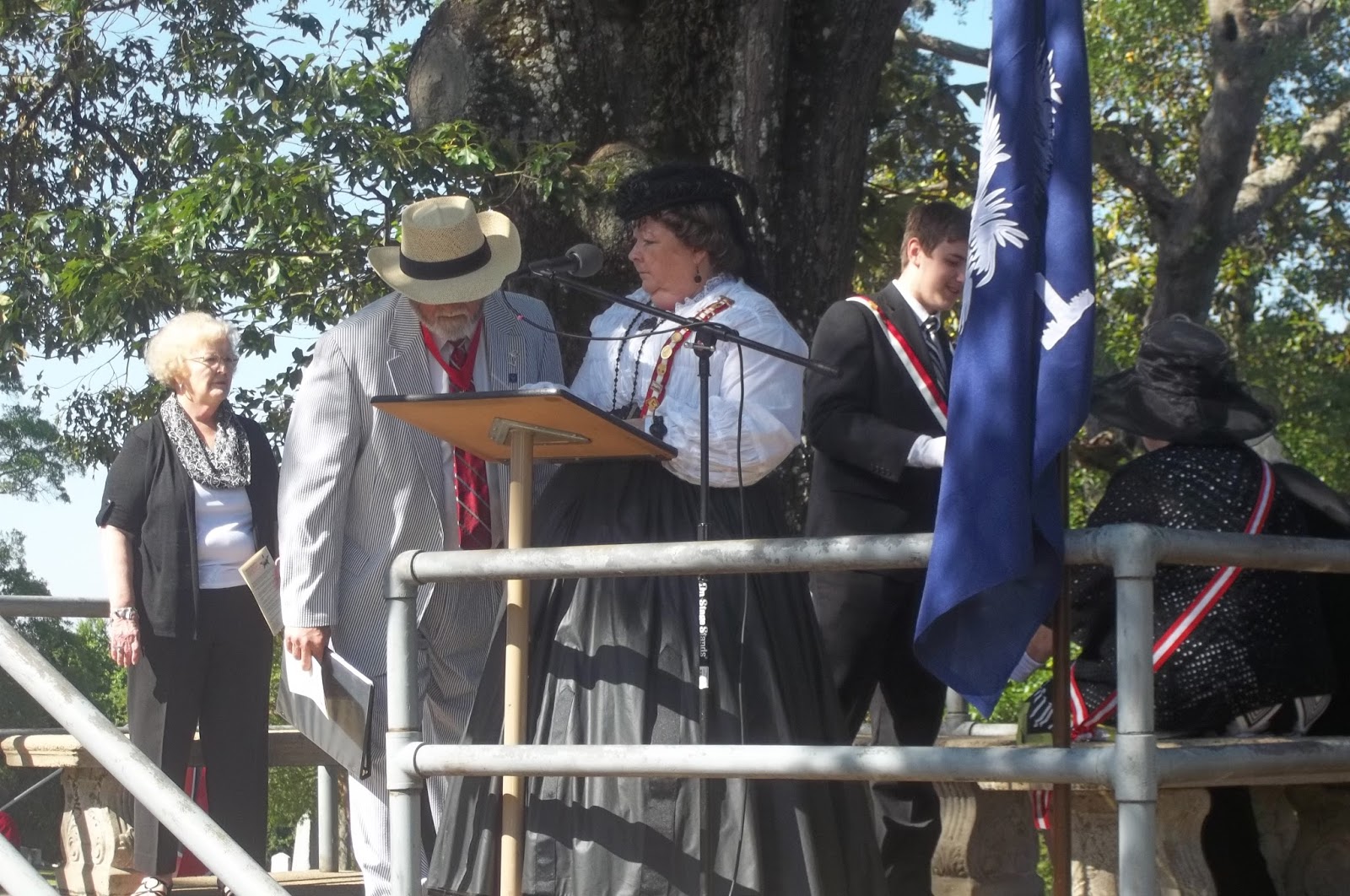
All UDC and SCV services begin with the Call to Order and greetings from the president of the President of the Mary Boykin Chestnut Chapter UDC followed by the presentation of the colors and the reciting of: the Pledge of Allegiance to the US Flag, the Salute to the South Carolina Flag, and the Salute to the Confederate Flag. This is preformed by living history re-enactors of the Palmetto Battalion.

Following the presentation of the colors an invocation is preformed with the reading of the Lord's Prayer followed by reciting the prayer written over a century ago by former Confederate General and Bishop Ellison Capers.

After the prayers are concluded comes the recognition and introduction of guests which include members and leaders of the SC Division UDC, Children of the Confederacy, Sons of Confederate Veterans, Military Order of the Stars & Bars, the Palmetto Battalion, and the Society of the Black Rose. This is followed by the introduction of the keynote speaker and address. 

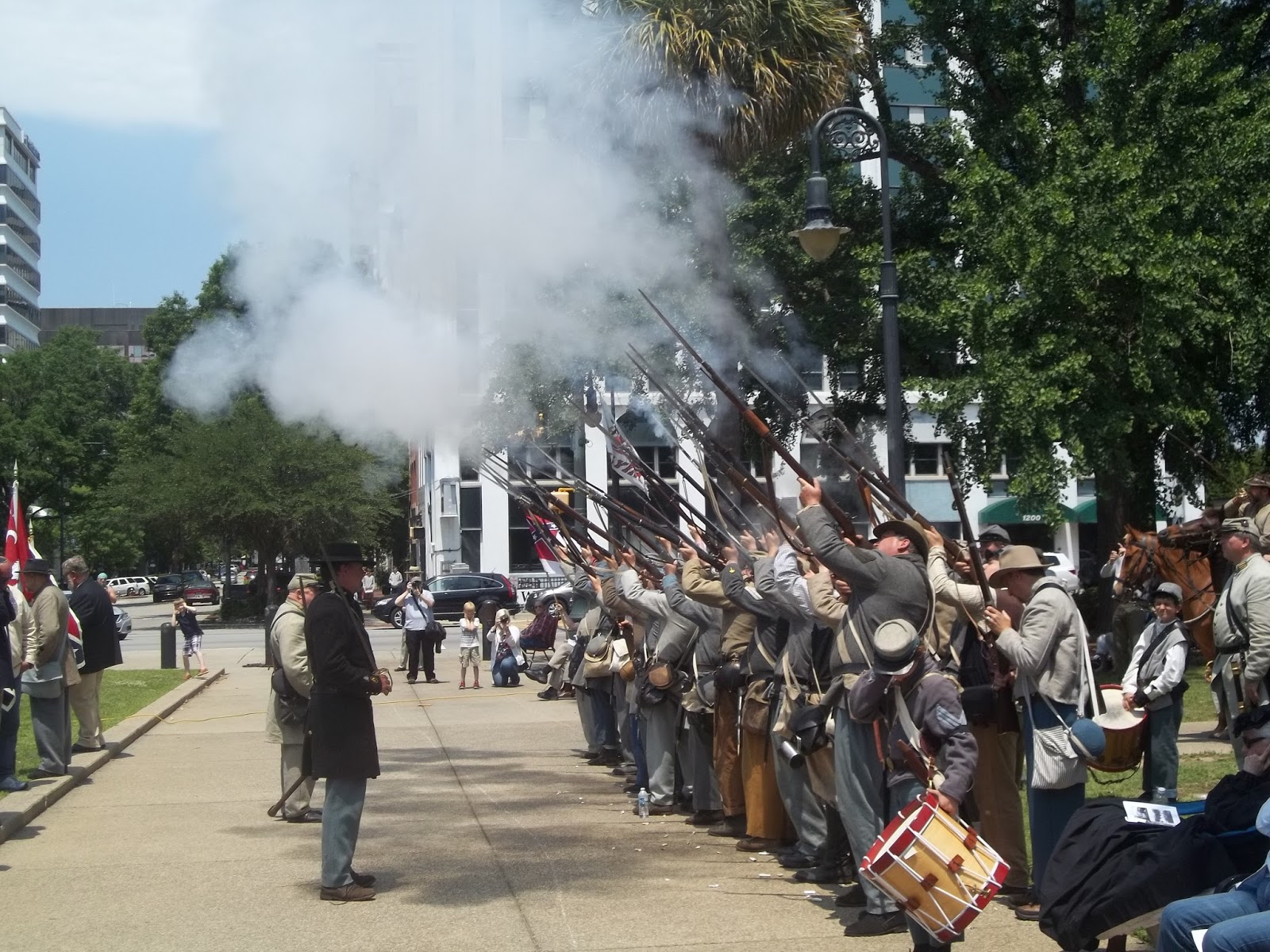
The cemetery ceremony is then concluded with the Placement of the Wreath at the soldier's graves monument, a military rifle salute and cannon salute by the Palmetto Battalion, the playing of *Taps, the singing of Dixie, and finally the closing prayer.  
(*On an interesting historical note, the tune for "Taps" was actually written by a Union General named Daniel A. Butterfield. The tune itself was used by both sides during the War Between The States and is still used by the US Military today.) 

The following photos were taken during the South Carolina Division UDC Confederate Memorial Day services at Elmwood Cemetery.


"Gone but not forgotten"
Those words more than any explain why we honor Confederate Memorial Day.

Following the UDC Memorial Service at Elmwood Cemetery, the participants line up for a three mile parade through downtown Columbia to the South Carolina State Capitol grounds for the noonday  memorial service sponsored by the South Carolina Division Sons of Confederate Veterans (SCSCV). 
This video - filmed by this blogger - shows the parade as it leaves the cemetery grounds. The 16th SC Color Guard and the members of the Palmetto Battalion lead the way, followed by the Camp Colors of the State SCV Camps and attendees.

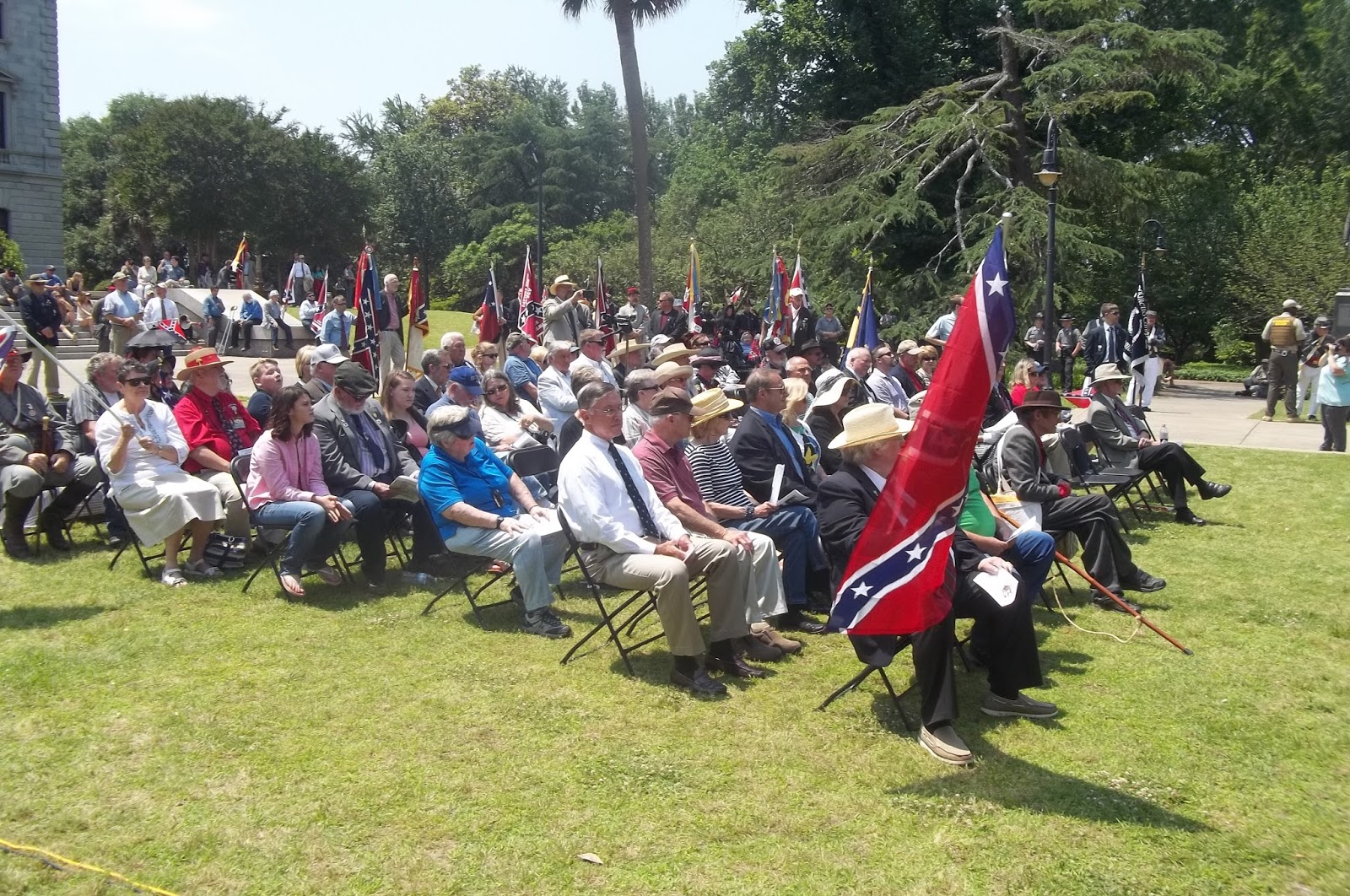
After the three mile parade from Elmwood Cemetery those who attended the UDC memorial service arrive at the southside of the South Carolina Statehouse grounds greeted warmly by more descendants for the noonday SCV memorial service. 

Like the service at the cemetery, this service begins with a Call To Order and the presentation of the colors by the 16th SC Color Guard and the various camp colors. Then the reading of the SCV Charge. This is followed by the introduction of the guests. 

Next comes the reading of the last ten names chosen from the Roll of the Dead and the pinning of the new SCV Guardians. As I mentioned in last year's post about this annual Confederate Memorial Day service, Guardians are members of the SCV who dedicate personal time to clean and take care of Confederate graves and markers. This blogger is also a Guardian. It is a service that I take great pride in undertaking several times a year. 

After the music and the keynote speaker delivering an address on the importance of remembering the dead and honoring their living heritage in modern times, a three volley military salute by the Palmetto Battalion re-enactors and cannon salute is preformed, followed by the singing of Dixie. The service concludes with a benediction by the SC Division SCV Chaplain and a retiring of the colors. 

These are the photos I took of the parade from Elmwood Cemetery and the SC Division SCV service. 


During the Federal occupation of Columbia in February of 1865, Union soldiers of Sherman's Army knocked over this statue of George Washington, breaking off the bottom part of the cane. The plaque at the bottom of the statue commemorates this event.
The bronze stars on the side of the South Carolina State Capitol mark the spots where Union cannonballs struck the building - then under construction. The old capitol building was burned to the ground in the fire set by Union soldiers in February of 1865.
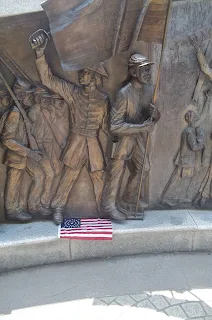
The only monument to Southern-born Union soldiers on the South Carolina State Capitol grounds is part of the African American History Monument in a bronze engraving depicting Black Union Soldiers of the 1st South Carolina Volunteer Infantry Regiment. This regiment formed in 1863 was largely made up of former slaves from around Beaufort, South Carolina then under Federal occupation. Though their ancestors and ours were foes on the battlefield, a US flag (circa 1863) honoring these men was placed at the base of the bronze depiction by Confederate descendants out of respect for fellow South Carolinians.
Members of the 16th SC Color Guard and ladies stand at the Confederate Soldiers Monument at the end of the Confederate Memorial Day 2016 services.

I am pleased to report that both services and parade were done in good weather and were all well received by the general public. One person even drove by the Statehouse and blew a horn that played Dixie - to the cheers of everyone there. Several tourists even came by to take photos with some of us. 

It was a wonderful day in Columbia, South Carolina to honor the Confederate dead and to honor the positive and honorable attributes of our shared Southern-Confederate historical heritage. Once again I was proud to attend and to share this experience with other proud Confederate descendants and fellow Southerners.

I'm already looking forward to next year.