Showing posts with label Moon. Show all posts

Wednesday, August 30, 2023

Earth Is A Bright Evening "Twin Star" As Seen From Mars

Earth and the Moon as seen in the Martian night sky photographed by NASA's Curiosity rover at Gale Crater
on Friday, January 31, 2014 about 80 minutes after local sunset
during its 529th day on the Martian surface.
The Moon is only barely visible just below the bright Earth in close-up.

Image courtesy of NASA/JPL.


Imagine you were a human settler living on the planet Mars, the forth planet in our Solar System, in possibly as few as a couple hundred years from the present day.

You're walking outside the pressurized habitats built by the first and second generations born on Mars -- or possibly even domed terrariums as the first stages of the long process of terraforming the Red Planet are just beginning -- and stand out on the surface looking up at the evening sky.

Its about an hour following the beautiful blue Martian sunset in the crimson sky over the slightly closer horizon of the vast rust-colored desert planet and the first of the brightest objects appear overhead.

First would be the two moons: the larger, potato-shaped Phobos, and the smaller bright Deimos (both of which are also visible during the daylight hours). After these would come the first bright spots low in the evening sky -- our own planet Earth and its faint companion, our bright, beautiful Moon. 

On average the distance between Earth and Mars is about 140 million miles (or 225 million kilometers). From the surface of Mars, a hypothetical Martian would see our Earth the same way that we Earthlings view the planet Venus: as an inner planet, because Earth is in a closer and faster orbit to the Sun. Because of this, Earth, as seen from Mars, appears as a bright morning or evening "star" as Venus does here on Earth.

Also, from the surface of Mars, our lovely Luna (Moon), though appearing very faint, can actually be seen with the naked eye (or more likely through the safety glass plate of a pressure suit).

Because our Moon only averages a distance of about
238,855 miles (or 384,400 kilometers) in its orbit around our Earth, from the surface of Mars looking up into the night sky dome, Earth and the Moon would only appear to be separate by less than a degree (or, roughly just under the length of your pinky finger held at arms length) most of the time. So close together that the two heavenly bodies appear to be constantly in conjunction with one another, appearing to be a "twin star" in the evening and morning Martian skies.

A hypothetical Martian would also be able to see the Moon orbit the Earth, even see both heavenly bodies transit each other (pass in front of, or behind, the other) at certain times of the long Martian year in their orbit.

Thanks to modern science, we are able to view that magnificent sight or our home planet from another world right here from Earth via photographs taken from the surface of Mars by exploration rovers sent by us humans to study the possibility of human exploration (and possible future colonization) of our closest planetary neighbor -- as shown in the photo used for this article.

Through the yes of these robotic explorers we can see our own Earth and its beautiful Moon in a way that early humans looking up at the night sky could never have imagined; that only God, and perhaps maybe non-human intelligence beyond our Solar System, could ever have seen humanity's home before.

All the same, maybe someday soon Earth-born explorers in the coming decades -- and perhaps future generations of Martian-born humans hundreds of years from now -- will see that beautiful sight of our lovely Earth and Moon from the surface of the Red Planet with their own eyes with that same sense of wonder that us night sky observers here on Earth view the other planets in our Solar System? 

Friday, December 02, 2022

Night Sky Photography -- 12-01-2022 -- The Moon & Jupiter With Galilean Moons

Good evening fellow stargazers!


Earlier this evening a couple hours after sunset, I was able to capture the Waxing Gibbous Moon and Jupiter, along with the four visible moons of the largest planet in our Solar System. The photos came out beautifully and captured all of the heavenly bodies perfectly.


The largest planet of our solar system, Jupiter, has about 80 known moons in total. Of these about 57 are officially named with the further 23 awaiting confirmation and naming by the International Astronomical Union.


These moons orbiting Jupiter form a satellite system which is called the Jovian System.

The largest of these moons are the four Galilean moons: Io, Europa, Ganymede, and Callisto, which were independently discovered on January 8, 1610 by European astronomers Galileo Galilei and Simon Marius and were the first celestial objects found to orbit a body that was neither the Earth or the Sun.

A composite image of photographs of the four Galilean Moons shows (from left to right):
Io, Europa,
Ganymede, and Callisto.
Image courtesy of NASA/JPL/DLR.

The four Galilean Moons are Jupiter's inner moons with regular orbits, while the rest of the smaller outer moons are on irregular orbits. The Galileans are also round moons, while the other Jovians have irregular shapes -- some of them possibly captured asteroids rather than true moons.

All the other smaller Jovian moons measure at less than 160 miles (250 kilometers) in diameter, with about 60 of the smaller satellites measuring less than 6.2 miles (10 kilometers) in diameter making them virtually invisible from the surface of the Earth even with a good telescope.  

Io is the innermost Galilean moon with a diameter of 2,260 miles (3,640 km) and a rotation period of 1.8 days around Jupiter at a distance of 262,200 miles (422,000 kilometers).

Europa is the smallest of the Galilean moons with a diameter of 1,940 miles (3,100 km) and a rotation period of 3.6 days around Jupiter at a distance of 417,000 miles (671,000 kilometers).

Ganymede is the largest of the Galilean moons, and the largest moon in the Solar System with a diameter of 3,270 miles (5,260 kilometers) and a rotation of 7.2 days around Jupiter at a distance of 665,000 miles (1,070,000 kilometers).

Callisto is the outermost of the Galilean moons, and the second largest moon of Jupiter with a diameter of 2,995 miles (4,820 km) and a rotation period of 16.7 days around Jupiter at a distance of 1,170,000 miles (1,883,000 kilometers).

With a good camera lens, a telescope, or a pair of good binoculars its possible to view these moons if you know where and when to look for them. To help identify the exact locations of the Galilean Moons, this blogger uses the outstanding astronomy website skyandtelescope.org as a reference source. I highly recommend this site to other amateur stargazers.

Sunday, October 04, 2020

Night Sky Photography -- 10-02/03-2020 -- The Moon & Mars Rising -- Venus & Regulus Conjunction In Morning Sky

 Good evening fellow stargazers!

Well folks, last evening and earlier this morning, I was able to capture some really outstanding shots of two conjunctions in the night sky taken over the course of a ten hour period, beginning after sundown on Friday the 2nd and ending just before sunrise on Saturday the 3rd of October. 
 
The still bright Full Moon (actually now it is a Waning Gibbous Moon at about 98 percent brightness) meets in the evening sky with the now bright planet Mars. I captured this shot of our bright Luna and the Red Planet rising over the treetops after sunset.


Next two shots I took later in the evening as Luna passed near Mars by less than a degree, or so, in the late night sky overhead. The first shot show the Moon and Mars as they appeared to the naked eye. The second shot is a close-up of Mars over the nearly full moon. Unfortunately, here in North America, we did not get to see the moon occult Mars, so this was about as close as the two heavenly bodies "met" in the sky here in South Carolina.


This final shot of the moon and Mars in the western sky was taken nearly seven hours later. As y'all can see, Mars is now below Luna and will continue to move farther away over the next several days as Mars eventually moves to its closest approach to Earth on the evening of Monday, October 5th.


The moon and Mars were not the only heavenly bodies close to Earth that were "meeting" in the sky dome.

Looking to the eastern sky again about an hour before the breaking dawn, I caught these two outstanding shots of bright Venus in the sky with the bright star, Regulus, appearing just above our bright neighboring planet by roughly half a degree. Regulus is the brightest star in the Constellation Leo The Lion.


The first shot is how I viewed them through the trees in my back yard -- Regulus is barely visible just above Venus. The second is a close up, showing the planet and the star together.

These two heavenly bodies won’t appear this close together again for another 8 years. 

 
Well my friends, I hope y'all enjoyed these photos as much as I continue to enjoy bringing them to y'all. Have a wonderful Dixie day, and be sure to keep your eyes to the night skies, y'all hear!

Monday, September 07, 2020

Night Sky Photography -- 09-07-20202 -- Uranus With The Moon In Eastern Sky

Good morning fellow Stargazers!

Last night I stayed up a bit late in the hopes that I might be able to capture a rather elusive photographic target. 

The planet Uranus -- the seventh planet in our solar system -- is theoretically visible to the naked eye in a very dark, moonless sky, if you know exactly where to look for her in the sky dome. Folks with good vision, and a good knowledge of Uranus’ place in the heavens, can spot Uranus as a dim speck of light on a dark, moonless night with the aid of a telescope, or a really good pair of binoculars. 
 
Uranus travels in an elliptical orbit around the sun once every 84 Earth years. At its closest (perihelion) the distance to Uranus from the sun is about 1.7 billion miles and at its farthest (aphelion) around 1.89 billion miles. Because of her distance and slow orbit, finding her isn't hard.
 
 
What made this particular shot of Uranus hard was its proximity to the waning gibbous moon -- which made locating the elusive planet easier, but actually made spotting it far more difficult from the moon glare. It took several adjustments on the camera and about a dozen shots before I was able to capture this beautiful (though faint) image of the blue gas giant over Luna. 


Fun fact: Uranus was the very first planet to be found using a telescope in 1781 by British astronomer Sir William Herschel who originally identified it as a comet, but after further observation determined it to be a planet. 
 
Well friends, I hope y'all enjoyed my photo and post for today. I hope to have some more interesting shots of our nearest heavenly neighbors in the near future. Until then, have a wonderful Dixie day, and y'all be sure to keep your eyes to the night skies!

Sunday, August 09, 2020

Night Sky Photography -- 08-09-2020 -- The Waning Gibbous Moon & Mars Rising

Good evening fellow stargazers -- or rather, good morning, y'all!

I was up kinda late (or really early depending on how y'all recon these things) in order to capture a pair of beautiful shots featuring our beautiful Luna in her waning gibbous phase, joined by bright red Mars, rising in the east late after midnight. 


In my close-up shot of Luna, you can see the large craters on the lunar surface along the shadow of the Earth as it crosses over the left "eye" in the Sea of Tranquility (Mare Serenitatis) of the Man on the Moon

Y'all might also notice that the small planet Mars is getting bigger and bigger. This is because Earth's faster orbit closer to the sun will bring us within opposition to Mars in its farther and slower orbit over the next few months. By September of this year, Mars will outshine Sirius, the brightest star in our sky next to our own sun. 

In early October when the opposition reaches its peak with Earth directly between the sun and Mars on Tuesday, October 13th of this year, the Red Planet will appear almost three times larger than normal and outshine Jupiter, the 4th brightest object in the sky after the Sun, Luna, and Venus. 

Mars will continue to shine more brilliantly than a 1st-magnitude star for the rest of the year and will effectively dominate the night skies after Luna.  

After this year, Mars next opposition will not happen again until December 28, 2022. This blogger will pray for clear skies this year so that I can offer y'all an amazing photo of the event.

Thursday, April 16, 2020

Night Sky Photography -- 04-16-2020 -- Luna, Mars, Saturn & Jupiter In The Early Morning

Greetings fellow stargazers!

This morning, April 16th, I had to wake up early to snap these two photos of our moon -- which is currently just past its Last Quarter (or Third Quarter Moon) phase -- in a line of the "superior planets" in the southeastern sky just over the tree tops about an hour, or so, before sunrise. 


A superior planet is a planet that orbits the sun outside Earth’s orbit. The three visible "wandering stars" (planets we can see with the naked eye from Earth) are Mars, Saturn, and Jupiter respectively. Using Luna as a starting point, you can spot the small Red Planet Mars glowing like a red ember just above the moon's glow. You can easily spot the large bright white Jupiter at the end of the line with fainter Saturn in the middle closer to it's nearest planetary neighbor. The line of these three planets follows the ecliptic path of the sun and moon during daytime hours.


As viewed by my close-up shot, Jupiter,
the largest planet in the solar system, is easily the most brilliant of the trio of planets, beaming some 14 times brighter than either Saturn or Mars. Even so, Mars and Saturn are respectably bright appearing to be 1st-magnitude star in brilliance. These worlds shine by reflecting the light of the yet to be risen sun. At present, both Mars and Saturn are shown to be about equally bright. Mars glowers red while Saturn exhibits a golden hue.

This line of planets will stay in the northeastern sky in the early morning hours for about the rest of the month and will be a good point to see the upcoming Lyrid Meteor Shower beginning late at night around Sunday, April 19th and probably peaking in the predawn hours on Wednesday, April 22nd. 

Well folks, I hope y'all enjoyed my photos. As always let me know what y'all think in the comments below and as always be sure to keep your eyes to the night skies, y'all!

Thursday, October 03, 2019

Night Sky Photography -- 10-03-2019 -- Luna, Jupiter & Saturn From Chester Confederate Monument

Good Evening Fellow Stargazers!

This evening clear evening skies gave me a very good view of Luna and Jupiter in the southwestern sky. 

Just after dusk I found a good spot at the small square in downtown Chester, South Carolina near the Confederate Soldiers Monument looking west towards Main Street and Chester City Hall. 


Using the monument in the foreground I was able to catch this really outstanding shot of the waxing crescent moon and Jupiter on one side, with tiny Saturn seen on the other side. Also visible just below Jupiter is the bright star Antares just above the top of the City Hall building. Although a 1st-magnitude star, Antares pales next to Jupiter, which outshines Antares in the autumn sky by some 16 times. In the city lights, both Saturn and Antares are barely visible.

The moon will continue to move between the two giant planets on Friday, October 4th and then achieving First Quarter phase close to Saturn on Saturday, October 5th.

Friday, August 09, 2019

Night Sky Photography -- 08-09-2019 -- Waxing Gibbous Moon & Jupiter

Good evening fellow Stargazers!

This evening I took a beautiful shot of the Waxing Gibbous Moon and Jupiter through the branches of my backyard tree. I also took a second photo of both Luna and Jupiter with Antares as they appear in almost a straight line in the southern sky. 


Thursday, January 31, 2019

Night Sky Photography -- 01-31-2019 -- Moon, Jupiter & Venus Before Sunrise

This morning I woke to clear skies and a beautiful meeting of three heavenly bodies in the eastern sky. 
Of course "meeting" is subjective from the point of view of those of us standing on Earth. Even at their closest point of opposition Venus and Jupiter are about 416 million miles apart. Also despite being the largest planet in our solar system, Jupiter appears very small from Earth, like a dim star. By contrast, Venus is the brightest star in the morning sky right now. Luna is passing by both of them on her way to setting in the east towards the New Moon phase.


More planetary photography coming soon, including another planetary conjunction on February 18th and the largest supermoon of the year on the 19th.

Monday, December 24, 2018

In The Beginning God.... Apollo 8 -- 50 Year Anniversary

The famous "Earthrise" photo  taken from lunar orbit by astronaut
Bill Anders on December 24, 1968.


Fifty years ago this Christmas the world watched in a mixture of excitement and wonder as the three-man crew of Apollo 8 -- Frank Frederick Borman II, Jim Arthur Lovell Jr. and William Alison Anders -- blasted off from Pad 39A at the John F. Kennedy Space Center on Merritt Island in Florida, United States for a six-day trip to the Moon and back, becoming the first human beings to leave Earth behind, fly around the Moon and return safely home.

The six-day mission began on 21st December 1968 and included a day orbiting the Moon, when the astronauts took the now famous "Earthrise" picture -- one of the most celebrated photographs ever taken of our planet. Circling the Moon on Christmas Eve, the crew shared their thoughts in a public broadcast, reading a passage from Genesis, the first book of the Bible.

 
William Anders
 
"We are now approaching lunar sunrise, and for all the people back on Earth, the crew of Apollo 8 has a message that we would like to send to you. 
 
"In the beginning God created the heaven and the earth.
And the earth was without form, and void; and darkness was upon the face of the deep. And the Spirit of God moved upon the face of the waters.
And God said, Let there be light: and there was light.

And God saw the light, that it was good: and God divided the light from the darkness." 
 
James Lovell
 
"And God called the light Day, and the darkness he called Night. And the evening and the morning were the first day.
And God said, Let there be a firmament in the midst of the waters, and let it divide the waters from the waters.
And God made the firmament, and divided the waters which were under the firmament from the waters which were above the firmament: and it was so.
And God called the firmament Heaven. And the evening and the morning were the second day."
Frank Borman
 
"And God said, Let the waters under the heaven be gathered together unto one place, and let the dry land appear: and it was so.
And God called the dry land Earth; and the gathering together of the waters called he Seas: and God saw that it was good."
 
"And from the crew of Apollo 8, we close with good night, good luck, a Merry Christmas -- and God bless all of you, all of you on the good Earth." 

The return trip home was uneventful, the capsule splashing down successfully in the Pacific Ocean on 27th December. The success of Apollo 8 showed that it was possible to take astronauts safely to the Moon and bring them home; the next major task would be learning how to land on the lunar surface.

US Postage Stamp commemorating
the Apollo 8 Lunar Orbit Mission.
Issued on Monday, May 5, 1969.
Over 187 million of these stamps
were made.

Thursday, October 18, 2018

Night Sky Photography -- 10-18-2018 -- Luna, Mars, Jupiter -- And The Spider!

Good evening, y'all!

This evening I took some really outstanding evening photos utilizing a nearby baseball field for a background. 

The first one is taken from one of the dugouts of Jupiter. As beautiful as that shot came out, you will notice that a small, 8-legged photo-bomber appears just above the fence. This beautiful spider made herself a nice web that I couldn't help get a shot of. 


The bright star near Luna tonight is actually the planet Mars. The bright star Fomalhaut sits low on the sky. Although Fomalhaut ranks as 1st-magnitude star, this star currently pales in comparison to Mars, which is still bright after its wonderful apparition in our sky this past July and August. Mars is presently about six times brighter than Fomalhaut. The star Fomalhaut is an autumn star for the Northern Hemisphere (spring star for the Southern Hemisphere). From northerly latitudes, it’s sometimes called the Loneliest Star.

I also took a good close-up of the Lunar surface and got some really great shots of the craters along the day-night terminator of the Earth's shadow.  


I hope y'all enjoyed my photos for this evening. As always have good evening and y'all keeping looking to the night skies.

Monday, February 29, 2016

Night Sky Photography - 02-29-2016 - Leap Year Moon & Mars

This morning I woke up somewhat early to get a great shot overhead of the waning gibbous Moon (Luna) and the red planet Mars from my back yard. Taken a few minutes after six in the morning on the leap year day - February 29th. A great shot through the tree branches and just above my roof. 

I was also fortunate that the weather was good and skies clear. Usually it seems like all the really good astronomical events happen on rainy or cloudy days. Hope y'all enjoy it.

Friday, October 09, 2015

Night Sky Photography -- 10-07/08/09-2015 -- Luna, Venus, Mercury, Mars & Jupiter

Photos I took over a three day period of the eastern early morning sky before sunrise and the parade of planets Venus, Mars, Jupiter, Mercury, and the bright star Regulus with the crescent moon in the October sky on the 7th, 8th, and 9th.

You can see the slow progression of Luna (the moon) moving closer to the planets, and the rise of Mercury in the horizon racing against the sunrise in the second photo. On the third day, Luna was between planets Venus and Jupiter (at least as seen from Earth) with pale Mars as a pale dot right beside it. The moon is slowly becoming a thin crescent as it makes it way towards Mercury on the horizon.

Unfortunately I was unable to get Mercury or Regulus in the last photo taken early Friday morning. 

Eastern Early Morning Sky. Wednesday, October 7, 2015.

Eastern Early Morning Sky. Thursday, October 8, 2015.

Eastern Early Morning Sky. Friday, October 9, 2015.

Saturday, August 22, 2015

Night Sky Photography -- 08-22-2015 -- Luna & Saturn

Photograph I took this evening of the planet Saturn and the moon in the southwestern night sky. 


Saturday, July 25, 2015

Night Sky Photography -- 07-25-2015 -- Luna & Saturn

Tonight I managed to get an amazing shot between the trees of the waxing gibbous moon and Saturn - the farthest of the planets that can be seen with the naked eye in the night sky.

Monday, June 29, 2015

Night Sky Photography -- 06-29-2015 -- Venus & Jupiter Closer To Conjunction!

Tonight in the western sky the planets Jupiter and Venus moved even closer to tomorrow night's planetary conjunction.


Meanwhile, Saturn moves further away from the moon in the southern sky. 

Friday, April 24, 2015

Night Sky Photography -- 04-20/21/22- 2015 -- Luna & Venus Passing In Sky

The following photos I took over a three day period documenting the passing of Venus and Luna in the night sky. I was fortunate to have good weather conditions all three days. The photographs were all taken between 8:20 PM to 8:45 PM EST.

Unfortunately, on the last day (April 22) there was cloud cover after I took the last photograph, and then rainy conditions, so I was unable to get any photos of the Lyrid Meteor Shower at its peak that evening.


Monday, March 30, 2015

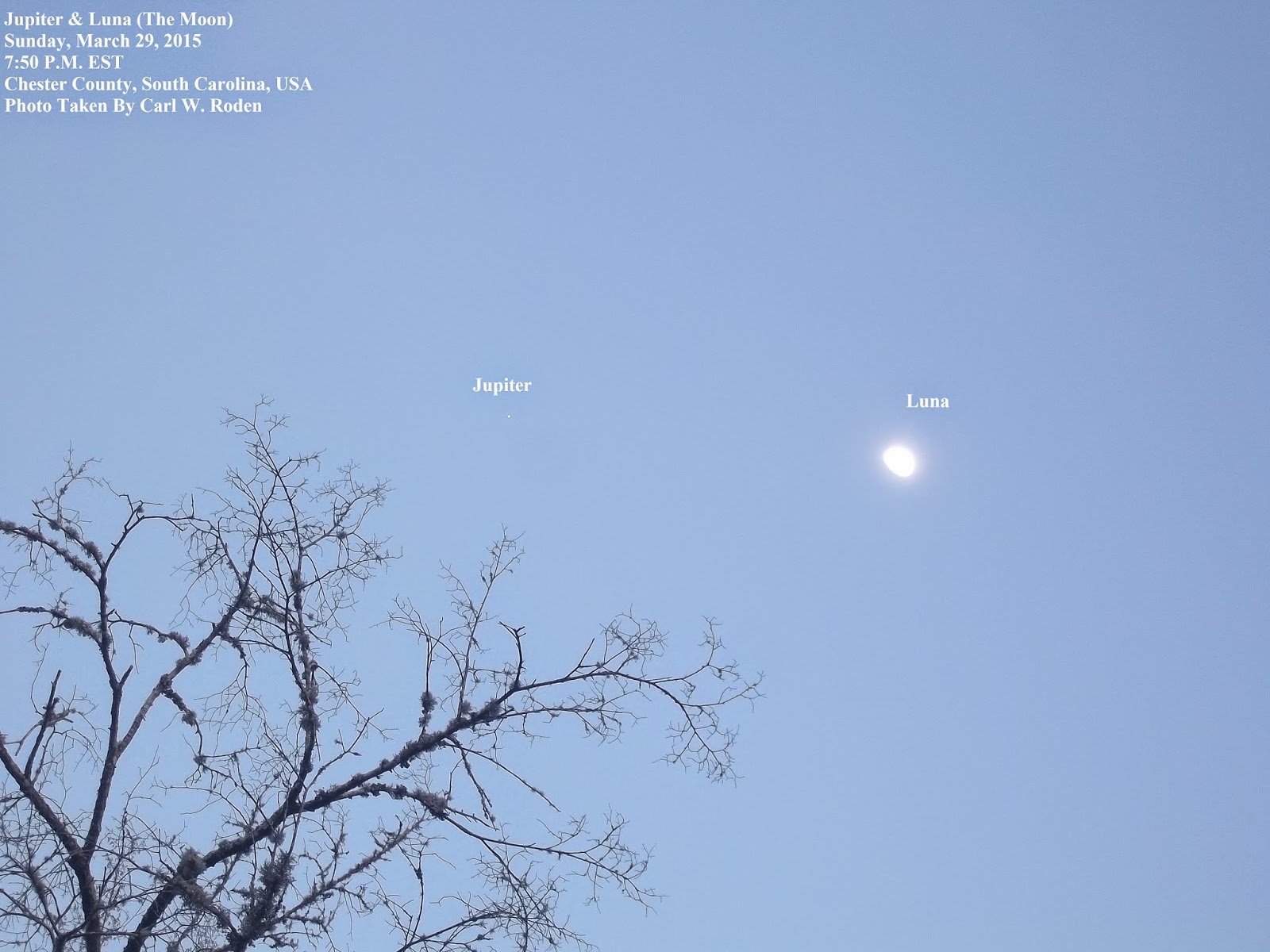
Night Sky Photography -- 03-29/30-2015 -- Luna & Jupiter Transition In Eastern Sky

These are the photos I took on Sunday, March 29th and Monday, March 30th showing Jupiter and Luna's progress as they seem to pass one-another in the evening sky.

These were taken on Sunday night between 7:50 PM - 8:10 PM EST in the eastern sky.


These were taken the following night on Monday evening between 7:58 PM - 8:00 PM EST in the same location as Jupiter appears above the moon.


I hope y'all enjoyed them.