Showing posts with label British Army. Show all posts

Sunday, August 16, 2026

The Battle Of Camden: Lord Cornwallis Defeats Gates -- August 16, 1780

The Maryland Continental Line fighting against the 71st Regiment of Foot "Frazer's Highlanders" at the
Battle of Camden, August 16, 1780. 
 
The Battle of Camden
Lord Cornwallis Defeats General Gates
Wednesday, August 16, 1780 

By: C.W. Roden 


(Part 9 or a 15 part series)

In April of 1780, General George Washington, responding to the call for reinforcements by General Benjamin Lincoln in Charleston, South Carolina, sent two Maryland Line regiments and the Delaware Line regiment supported by the 1st Continental Artillery Regiment with 18 guns to the southern theater. These men were under the command of Major General Baron Johann de Kalb.
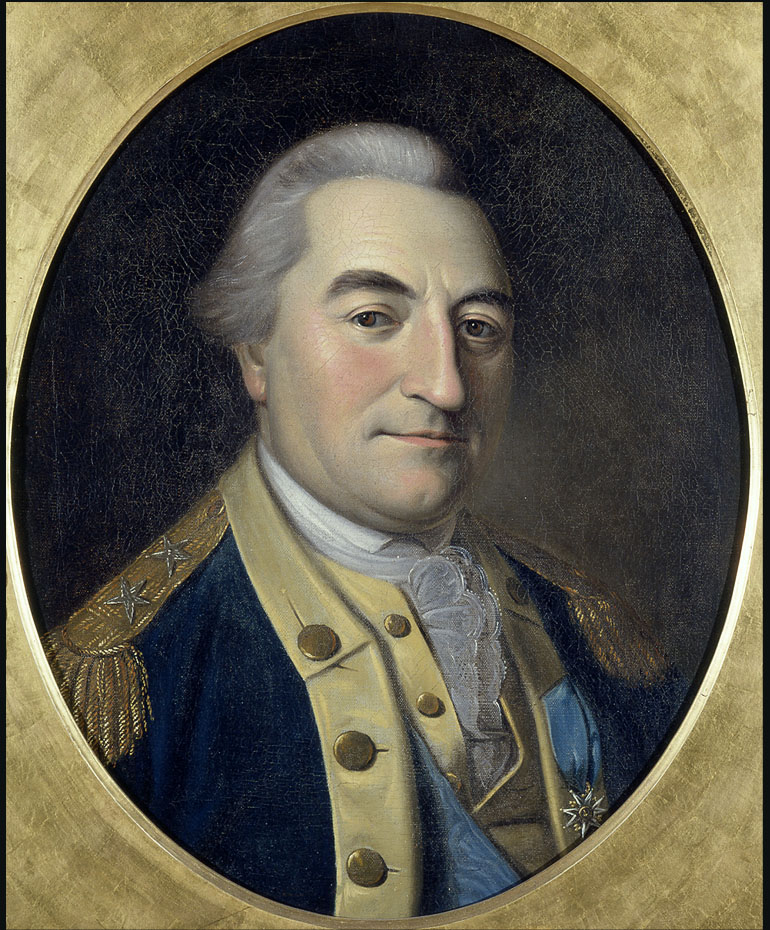
Portrait of Baron Johann de Kalb
by Charles Wilson Peale.

Baron de Kalb was perhaps one of the more interesting personalities that supported the American cause.


He was born in 1721 in Hüttendorf, a village near Erlangen, Principality of Bayreuth (modern-day Bavaria, Germany) and later earned a military
commission as a lieutenant in the Loewendal German Regiment of the French Army in 1743. He trained in the military school of Marshall Maurice de Saxe -- called “the Professor of all the generals of Europe” by Frederick the Great. A veteran of the War of the Austrian Succession (1740-1748) and the Seven Years' War (1756-1763), Baron de Kalb was promoted to lieutenant colonel and won the Order of Military Merit in 1763, and was elevated to the nobility with the title of baron.

When the American States declared their formal independence from Britain, Baron de Kalb sailed with eleven other European officers on the ship fitted out by the
Marquis de Lafayette. They arrived in Philadelphia, Pennsylvania in July 1777 and joined the Continental Army. He was appointed to the rank of major general on Friday, September 5, 1777. Baron de Kalb would spend the winter of 1777-87 at Valley Forge and serve in the Northern campaign against the British and fought at the Battle of Monmouth on Sunday, June 28, 1778.

De Kalb preferred to march on foot with his men rather than riding and hike up to 30 miles a day. He drank only water and was always a completely sober and controlled person. He would sleep by a camp fire with is soldiers, wrapped in his horseman's cloak. A perfect example of a classical field officer, he was well loved and respected by the men under his command.

These reinforcements departed New Jersey on Sunday, April 16, 1780, but were unable to reach Charleston before the city surrendered after a six week siege by British forces on Friday, May 10th.

General de Kalb remained with his troops in Granville County, North Carolina. It was hoped that the presence in the area of the Continentals would boost Patriot morale and entice recruitment after the disasters at Charleston and the Battle of the Waxhaws. Unfortunately, during those early months, very few recruits appeared.


The Continentals also experienced several hardships with campaigning in the South in late spring and early summer -- particularly an infestation of chiggers (Redbugs) and ticks that infested their camps, as well as mosquitoes that breed near the rivers and swampy areas. It must have been a miserable time for the Maryland and Delaware Continentals being covered in severe bites and suffering diseases contracted from the bugs. 

Short of proper food and with many his men sickening and suffering from the unaccustomed heat, bugs, and poor diet. Major General de Kalb moved his troops to camp near Buffalo Ford on the Deep River, 30 miles south of Greensboro, North Carolina, in July.

It would be here that his new commanding officer, Major General Horatio Gates arrived in camp near the end of the month.


"The Hero Of Saratoga"

Baron de Kalb was an excellent soldier, but as a foreigner did not have very much influence with the Continental Congress, where decisions of command were ultimately made -- for better, or worse.


General Horatio Gates, on the other hand, was widely admired by most of the Congress, largely for his supposed role in the major American victory at the Battle of Saratoga in 1777 -- a battle that was largely won because of the efforts of the field officers, notably: Benedict Arnold, Enoch Poor, Benjamin Lincoln, John Stark and Daniel Morgan. The battle was instrumental in winning the French over to the cause of American independence. Because he was in overall command of the soldiers, the title "Hero of Saratoga" was bestowed upon Gates by the Continental Congress.
General Horatio Gates in a 1794 portrait
by Gilbert Stuart.

Horatio Gates was born in
Maldon, Essex, Great Britain in 1727.  In 1745, Gates obtained a military commission with financial help from his parents and political support from the Duke of Bolton. Gates served with the 20th Regiment of Foot in Germany during the War of the Austrian Succession. Later he arrived in Halifax, Nova Scotia under Edward Cornwallis (uncle of British General Lord Charles Cornwallis, against whom he would later fight) and later was promoted to captain in the 45th Regiment of Foot the following year.

During the French and Indian War (1754-1763), Gates served with British General Edward Braddock in America. In 1755, he accompanied the ill-fated Braddock Expedition in its attempt to control access to the Ohio Valley. This force included other future Revolutionary War leaders such as: Thomas Gage, Charles Lee, Daniel Morgan, and George Washington. Gates was severely injured early in the action, among many other British soldiers. His experience in the early years of the war was limited to commanding small companies, but he apparently became quite good at military administration, and achieved the rank of major.


Later he would resign his commission in the British Army due to frustration with achieving higher rank from his lack of connections and settle in Virginia. When the American Revolutionary War broke out in 1775, he volunteered to serve in the newly formed Continental Army where he found himself at odds with Washington. Later he would become a major figure in the infamous Conway Cabal, which sought to replace Washington for Gates as commander in chief of the Continental Army.

When General Lincoln surrendered Charleston in May of 1780, the Continental Congress assigned Gates to take command in the Southern theater. Washington himself was never even consulted, though his low opinion of General Gates was well known.
If Washington would have had his way, command in the South would have gone to Major General Nathaniel Greene, the quartermaster general of the Continental Army and one of Washington's best field officers. Greene would later get the job in the late fall of 1780, but not until after the tragic events that would soon transpire for the Patriots in South Carolina under the dubious command of Gates.

With Gates' appointment begins the tragic story of a series of mistakes and bad judgments that would lead to one of the worst disasters in American military history. 


Gates Marches Into South Carolina

Horatio Gates and Baron de Kalb met at camp near the Deep River on Tuesday, July 25, 1780. Gates was greeted with all proper ceremony -- including a 13-gun salute as he took command of the entire Southern Department. Major General de Kalb was confirmed in his leadership of the Maryland and Delaware Continentals and made second in command. 


The "Grand Army" as Gates called it, was not much of an army at this point. It consisted of de Kalb's Continental infantry, three companies of artillery with 8 guns -- de Kalb had been forced to leave behind 10 of his 18 cannons in Granville County due to a lack of proper horses -- and Colonel Charles Armand's Legion of 60 dragoons and 60 foot soldiers. 

Baron de Kalb's original plan was to march southwest through Salisbury, North Carolina, taking advantage of the strong support for the Continental Army in that area and the rich farmland for provisions, then march on to Camden, South Carolina

However, Gates did not approve of taking the longer route. Instead, two days later on Thursday, July 27th, against the advise of his officers, including de Kalb and Colonel Otho Holland Williams of the Maryland Line, the "Hero of Saratoga" decided to march the army from Deep River directly on to Camden.

Although this route was fifty miles shorter than the one proposed by Baron de Kalb, it traversed the poor and somewhat barren Carolina Sandhills region. Gate's route also ran through the Cross Creek country, one of the Carolina's most pro-Loyalist areas, meaning the Patriots would find no local help with supplies as they struggled along the roads and through the creeks and swamps. What little food they found -- usually the occasional peach orchard, green corn, or small herds of sickly cows -- made the men sick as they were mercilessly pushed hard by their commanding general.

All of the troops had been short of food since arriving at Deep River, so once the army finally reached the Pee Dee River, they found crops of green corn which was harvested and eaten by the hungry men, with unhealthy consequences.


The "Grand Army" was soon joined by cavalry dragoons under Colonels William Washington and Anthony White, both of whom had taken refuge with their remaining men in North Carolina after both had been badly beaten by Tarleton's Legion at Moncks Corner and Lenud's Ferry back in May. They rode into camp expecting to join forces for the attack on Camden.

General Gates informed them that he did not want their help because he erroneously believed that cavalry was not useful for the southern field. A bizarre view given the successes of the mounted partisan bands operating in South Carolina since the fall of Charleston.

As military historian Henry Lumpkin explained in his
1981 book From Savannah to Yorktown: The American Revolution in the South:

"The South was especially well adapted to use of cavalry because of its wide reaches of open pine barrens, broad savannas, great distances, wild forests and swamps for concealment, and year-round natural forage for horses. Francis Marion, William Davie, Thomas Sumter, and Elijah Clarke -- all the great partisans on both sides -- were to prove time and time again the value of fast-moving, heavily armed, well mounted men in southern warfare."


The people in the South were natural horse soldiers, practically raised in the saddle, but this fact was apparently dismissed by Gates.
The fact that William Washington was second cousin to Gates' rival General George Washington might also have been a huge factor in his decision. Gates' foolish pride and his uninformed decision would deprive his army of essential troops in the coming battle.

Other partisans came forward to meet with Gates, including General Francis "Swamp Fox" Marion, who offered his services, as Washington and White had. Gates however had little use for Marion and his men, despite their successes in the Lowcountry against the British and Loyalists -- especially the hated "Bloody Ban" Tarleton. Gates had little use for militia, his view of them largely clouded due to experiences in the North with undisciplined guerilla bands like Ethan Allen's Green Mountain Boys, and treated Marion and his men with utter contempt.

Fortunately for the State of South Carolina and the future United States of America, Gates ordered Marion to leave his camp and move into the coastal regions to observe and harass the enemy there.


On Thursday, August 3rd, Lieutenant Colonel Charles Porterfield, an officer with an excellent record as a captain in the Continental Army, arrived at Gates' camp with 100 Virginia troops. The half-starved army then crossed the Pee Dee River and continued its ill-advised march through the sparsely populated enemy country.
Brigadier General Francis Lord Rowdan of the
Volunteers of Ireland.

The arrival of Gates' "Grand Army" did not go unnoticed by the British. General Francis Lord Rawdon was watching the approaching Patriots from the other side of the Little Lynches River with a strong reconnaissance force consisting of Loyalists from his Provincial Volunteers of Ireland
. As he watched the Americans approach, Rawdon ordered his forces and those stationed at Rugely's Mill, 15 miles north of Camden, to fall back to a post called Log Town, a mile above Camden. Despite de Kalb's advise to outflank Lord Rowdan by a forced night march, Gates pushed forward in broad daylight.

On Sunday, August 6th, General Richard Caswell arrived with 2,100 North Carolina militia, which now doubled Gates' army.  At Rugely's Mill Gates halted and was soon joined by an additional 700 Virginia militia under the command of General Edward Stevens.

During this time the upcountry Patriots under the command of Brigadier General Thomas Sumter had been operating on the British supply line to Charleston. He sent a courier (possibly young Andrew Jackson) to Gates requesting reinforcements to attack a British wagon train bringing supplies and ammunition to Camden.


For some reason, in spite of his dismissal of Marion, Gates seems to respond to Sumter favorably. Despite the fact a major battle was in the offering the closer he reached Camden, Gates somehow saw merit in Sumter's plan. Against the advice of his officers, he sent 100 of his Maryland Continentals and 300 North Carolina militiamen with two cannons to assist Sumter. This reduced his artillery to seven guns (an additional gun had come in with Caswell's militia).

For his part, Sumter wasted little time in implementing is plan. This time he hit a small outpost on the Wateree River below Camden. A garrison of 30 men defended a makeshift fort at a ferry crossing -- a vital link in the British communications chain. A detachment of Sumter's band commanded by militia Colonel Thomas Taylor took the outpost by surprise and captured the entire garrison and thirty-six wagons full of war supplies. In questioning his prisoners, Taylor discovered that a wagon convoy was en route from the British outpost at Ninety Six. Taking advantage of this intelligence, Taylor planned and executed a successful ambush of the convoy. 


Sumter informed Gates of the capture of the crucial ferry crossing and said that he would defend it until he received instructions to the contrary. No sooner had he sent the report than the British Army began crossing the Wateree River in large numbers below the ferry. Without hesitation, Sumter withdrew his men and moved his command ten miles up the river in order to protect his captured prisoners and supplies. 

Gates, anxious to score more praise from Congress for himself in the South, had pushed his now starving army to the point of exhaustion. At one point the miserable soldiers came close to mutiny. Totally oblivious to the condition of his men, the "Hero of Saratoga" pressed on, anxious to force a confrontation with Cornwallis.

He wouldn't have much longer to wait.


The British Response And Line of Battle


Lieutenant General Charles Lord Cornwallis, having been informed by courier of Gates' advance on Camden, rode from Charleston to Camden in four days. He also detached four companies of light infantry on a forced march from Ninety Six to Camden.

Lieutenant General Charles Lord Cornwallis,
British commander of the Southern Campaign
in the Carolinas 1780-81 from a painting
by Thomas Gainsborough.

The combat elements of the British forces included: three companies of the 23rd Regiment Royal Welsh Fusiliers, the 33rd Regiment of Foot, five companies of the 71st Regiment of Foot (Frazer's Highlanders), the Royal North Carolina Regiment, Lord Rawdon's Volunteers of Ireland, Tarleton's Legion of horse and foot, 170 men of the royal artillery with four 6-pounders and two 3-pounders, as well as an additional 300 South Carolina Loyalist militia.
Cornwallis and Rawdon now had around 2,200 men, mostly British regulars and highly trained provincials, some of the best men in the British Army.

Meanwhile Baron de Kalb's Maryland and Deleware Continentals had been reduced to 900 men by sickness, desertion, and the 100 soldiers that Gates sent to aid Sumter. Armand's Legion consisted of 60 horsemen and 60 foot soldiers. Lieutenant Colonel Porterfield commanded 100 Virginia light infantry, while Stevens and Caswell both led a combined 2,800 Virginia and North Carolina militia. Also included were about 70 South Carolina militia and 100 artillerymen with seven guns. Gates' "Grand Army" totaled around 4,100 Continental regulars and militia, but only 3,000 of which were fit for duty due to sickness caused by poor rations.

With an army composed primarily of untrained militia, Gates
ordered a night march to commence at 10 PM on Tuesday, August 15th. A night march in column is a difficult and complicated maneuver even for well-trained regular soldiers to perform, let alone for militia. Armand's 60 dragoons had been assigned the task of leading the army. Gates ignored the protests of Armand that cavalry had no place in the lead because of the noise the horses hooves made over great distances.

To make matters worse for the Patriot forces, beef, corn meal, and molasses that had been served for the evening rations. These had been procured locally in adequate quantities and the men prepared them hastily over fires before the march began. These men had been half-sick from a diet of green apples and corn, combined with bad water and the long march in hot and muggy August weather. The hastily cooked supper unfortunately
acted as a purgative causing severe stomach cramps and diarrhea. While they marched many of the men had to stop and go to the woods to relieve themselves all night long.

Apparently Gates planned on building defensive works a few miles north of Camden in an effort to force British abandonment of that important town. Gates told his aide Thomas Pinckney he had no intention of directly attacking Cornwallis with an army consisting mostly of militia, despite having the British outnumbered.


According to tradition, as Gates watched the column of his army file by, he is said to have boasted to his aides that he would have breakfast the next morning with Cornwallis as his prisoner and guest at his table.

Unknown to Gates however, Cornwallis' army was also commencing a night marching north on the road from Camden with Tarleton's dragoons at the lead of the British column, intent of fighting Gates just outside of the town.


The Battle

The first encounter between the two forces happened when Armand's horsemen ran into Tarleton's dragoons around 2 AM on the morning of Wednesday, August 16th. After some pistol firing in the dark, the aggressive Tarleton ordered a saber charge and smashed Armand's cavalry back on the leading elements of the American infantry commanded by Porterfield and Armstrong. In the confused night skirmish, Porterfield fell mortally wounded by a stray bullet as he swung his light infantry out of the woods and caught Tarleton's dragoons in an enfilading fire, forcing them to withdraw under the support of British infantry.


It was then, for the first time, that Gates discovered that he had literally stumbled into Cornwallis. 

With an army composed largely of inexperienced and undisciplined militia, most of them sick from the poor rations, and his plan to fortify and let Cornwallis come to him in ruins, Gates once again made another military gaffe. Against the advise of the Maryland Line's veteran Colonel Otho H. Williams -- who believed rightly that the best strategy would have been to retreat, find a good defensive position, and await the British attack -- Gates instead took the advise of the Virginia militia commander who insisted it was too late to retreat and that the army must fight. Gates concurred and ordered the army into a line of battle.

The battle was fought astride the road between the Waxhaws and Camden with a narrow, open forest of pine trees almost free of undergrowth on both sides. Flanking both sides were swamps impassable by wagons. Gates held a better position on slightly rising ground with a clear escape route behind him.

Gates formed his troops just before first light. Mordecai Gist's 2nd Brigade of three Maryland and one Delaware Continental regiments were stationed to the right of the road. On the left from the road Caswell's North Carolina militia and Steven's Virginia militia stood with the now leaderless Virginia light infantry on the flank and Armand's small legion in support. Smallwood's 1st Maryland Brigade was held in reserve behind the 2nd Maryland, and the seven artillery pieces were placed on the road in front of the center and between Caswell and Stevens. Baron de Kalb was given the place of honor, command of the right wing, while Gates and his staff took position some 600 yards to the rear of the line.

In the very early morning, Colonel Williams, riding along the waiting American line, saw the British advancing up the road. He summoned Captain Singleton of the artillery who estimated the enemy to be about 200 yards away. Williams ordered him to open fire. The British promptly unlimbered their advance field guns and replied.

The main battle was now joined. 

Colonel Williams rode back and reported to General Gates that the enemy were deploying from column into battle lines and that if he attacked them before they were fully formed he could throw them into confusion. Gates ordered Stevens and de Kalb to attack -- it was the last recorded order Horatio Gates gave in the battle.


Opposing Gates, Cornwallis quickly formed his line of battle with the Royal North Carolina Regiment, the infantry of Tarleton's Legion, and Lord Rawdon's Volunteers of Ireland from the left of the road, with Bryan's North Carolina Volunteers a short distance behind them on the left flank. Command of the left flank was given to Lord Rawdon. On the right were detachments of the 23rd Welsh Fusiliers and 33rd Regiment of Foot with the 4th Light Infantry company hugging the right flank. The right was commanded by Lieutenant Colonel James Webster. The five companies of the 71st Highlander Regiment were held in reserves behind the center with two 6-pounder field guns. Two more 6-pounders and two 3-pounders were placed in the front of the British center. Tarleton's dragoons waited in the rear of the battle line, ready to exploit any retreat by the enemy. 


A detailed map of the Battle of Camden.
Image courtesy of American Battlefield Trust.


At the same time both commanders order their armies to attack. The outcome of the battle was no contest, as Gates would make his final -- and ultimately fatal -- gaffe of the entire campaign.
 

A British Soldier of the 33rd
Regiment of Foot.
Being a former member of the British army, Gates followed British military tradition to the letter, including placing the best soldiers in the "position of honor" on the right flank in any major deployment. The problem here was that Cornwallis followed the same military tradition and did the exact same thing in his own deployment for the battle. Meaning that Gates' less experienced troops -- the inexperienced Virginia and North Carolina militiamen (most of them still suffering the ill-effects from their poor rations) -- were now facing the battle-hardened Welsh Fusiliers and the 33rd Regiment of Foot, some of Cornwallis' best and most disciplined soldiers; all of whom were far from unfit for duty that day.

Williams dismounted and called for volunteers, leading some 80 or so men within 40 yards of the deploying British, taking cover behind trees, and delivering harassing fire at close range. Cornwallis ordered Webster to counter-charge.

The 800 strong 33rd Fusiliers and 23rd Regiment closed ranks, fixed bayonets, and drove forward on the double quick, shoulder-to-shoulder. The 2,500 Virginia and North Carolina militia heard the deep British "Huzzah!" and saw the red coated line advancing on them with bayonets towards them in perfect order. They hesitated, a few of them firing and a few of the British soldiers dropped. This was the first time that most of these militiamen had been in battle or seen a real line of enemy soldiers, and a dreadful fear of those cheering soldiers and their steel-tipped muskets gripped the entire line.

A Virginia militiaman.

The entire left wing of Gates' "Grand Army" collapsed as the Virginia militia broke and ran. A moment later the North Carolinians on their flank also fled, many of them without even firing a shot, throwing down their still-loaded muskets and rifles. The Virginians fled so fast that they suffered only 3 wounded. The North Carolinians fled all the way back to Hillsborough, North Carolina. The fleeing militia broke through the 1st Maryland Brigade stationed in reserve behind the line, throwing the Continental unit into confusion. Tarleton's dragoons chased many of these men down, their sabers inflicting many casualties on the retreating Virginians and North Carolinians -- a number of them unarmed.


Seeing half of his army break and run from the British, the now-panicked Horatio Gates, the "Hero of Saratoga" and the darling of the Continental Congress, mounted his horse believing the day was lost, turned and raced away, deserting the remainder of his army at full gallop to their fate. He did not stop until he reached Charlotte sixty miles away, and only then to procure a fresh horse and gallop off another 120 miles to Hillsboro to put as much distance between him and Cornwallis' victorious army as he could.
A Continental soldier of the
Delaware Line.

General de Kalb and Mordecai Gist with the American right wing and the 1st Maryland Brigade still held the field. One regiment of North Carolina militia under the command of Colonel Henry Dixon did not join in the rout of the other militia on the left and fell back linking up with the Delaware Continentals. De Kalb called for the reserves, and Otho Williams, finding that Smallwood had also fled the battle, tried to bring the regulars to the left of the 2nd Brigade and Dixon's militia to form an L-shaped defensive line. However they could end up getting no closer than several hundred feet. Elements of the British 23rd and 33rd Regiments and already had advanced between the two American brigades and the gap could not be closed. Instead of ordering a pursuit of the routed militia, Cornwallis sent in Webster and his regulars against the 1st Marylanders. They fought, retreated, rallied around their colors and then finally broke completely, some of them escaping to safety through the swamps along the nearby Wateree River.


Now only the 2nd Maryland Brigade, the Delaware Regiment, and Henry Dixon's North Carolina militia continued to struggle against Cornwallis -- about 600 Continentals and militia against 2,000 British and Provincial regulars. The numbers now favoring the redcoats.

Twice Radwon's wing of the British army attacked the Continentals with bayonet charges, only to be driven back. The Continentals had even managed to take a few prisoners.
The Continental troops then launched a counterattack which came close to breaking Rawdon's line, which began to falter. Cornwallis rode to his left flank and steadied Rawdon's men. For another hour both sides charged, reformed, then charged again. De Kalb led his men personally on foot and with sword in hand, his horse having been killed early in the battle. Despite being wounded by a saber cut and being urged by his officers to withdraw while they still could, de Kalb refused to consider retreat. 

Baron de Kalb himself led one more charge, killing at least one British soldier opposing him, until finally being brought down mortally wounded after sustaining 11 wounds (the saber cut, 2 bullet wounds, and 8 bayonet cuts). His men closed ranks and repelled another bayonet attack courageously. By this point Tarleton had returned with his green-coated dragoons and attacked the American rear. The last remnant of the 2nd Maryland Brigade, the Delawares, and Dixon's militia stood and fought for a few moments, then broke and ran.
However, Gist was able to move 100 Continentals in good order through a swamp, where the cavalry could not follow. Additionally, about 60 Maryland and Delaware Line Continentals, under the leadership of Major Archibald Anderson, Colonel John Gunby, Lieutenant Colonel John Eager Howard, and Captain Robert Kirkwood, were able to retreat in good order from the battle through the surrounding woods in a compact fighting group. 

The rest of Gates' "Grand Army" were either killed, wounded and captured, or scattered throughout the forests and swamps being pursued by Tarleton's Legion.

The Battle of Camden lasted just barely over an hour. 


Scene depicting the fallen Baron de Kalb being protected by his aide-de-camp at the Battle of Camden. 
 Engraving from painting by American historical painter Alonzo Chappel.


The Aftermath


When British soldiers ran up to finish off Baron de Kalb, who lay mortally wounded on the field where he fell, his aide-de-camp and friend,
Charles-Francois du Buysson (a cousin of the Marquis de Lafayette), put his own body between the fallen general and the enemy bayonets shouting out de Kalb's name and rank. The wounded general was then propped up against a wagon wheel by the British soldiers and sat there until Cornwallis rode up seeing de Kalb and recognizing him.
 
Cornwallis told him, "I am sorry, sir, to see you, not sorry that you are vanquished, but sorry to see you so badly wounded." The British general then ordered Baron de Kalb carried on a litter to Camden to be given proper medical treatment. It is reported that Cornwallis supervised as de Kalb's wounds were dressed by his own surgeons.

As he lay dying, de Kalb was reported to have said to a British officer, "I thank you sir for your generous sympathy, but I die the death I always prayed for: the death of a soldier fighting for the rights of man."

Baron Johann de Kalb's grave in front of the
Bethesda Presbyterian Church in Camden.


According to legend, Cornwallis ordered this after he discovered that de Kalb was also a fellow Freemason. While this is likely, it was also customary in the 18th century for wounded captured officers to be given proper -- sometimes preferential -- treatment.


The brave Baron Johann de Kalb died with great courage and dignity three days later. Cornwallis had him buried with full military and Masonic honors in the churchyard of the Bethesda Presbyterian Church. Cornwallis, Lord Rawdon, and all the British and Loyalist officers attended the funeral.

Years later, after the war, George Washington himself would visit the grave of General de Kalb. He was reported to have said: "
So, there lies the brave de Kalb. The generous stranger, who came from a distant land to fight our battles and to water with his blood the tree of liberty. Would to God he had lived to share its fruits!"

The British casualties at Camden were 68 officers and men killed, 18 officers and 245 enlisted personnel wounded, and 11 men missing -- a total of 342 casualties. American losses were never fully reckoned, but 3 officers were killed in action with another 30 captured. From the 3,000 men Gates had at Camden, around 700 - 900 were killed or wounded, and another 1,000 were captured by the British.

The defeated Patriots -- those who were able -- fled north towards Charlotte, relentlessly pursued by Tarleton's Legion. Charles Steadman, an American Loyalist officer in Cornwallis army, reported the aftermath of the battle:


"The road for some miles was strewed with the wounded and killed, who had been overtaken by the legion in their pursuit. The number of dead horses, broken wagons, and baggage, scattered on the road, formed a perfect sense of terror and confusion: knapsacks and accoutrements found were innumerable: such was the terror and dismay of the Americans."


Patriot Major William Richardson Davie, who'd been on detached duty from General Sumter's brigade escorting wounded from the attack at Hanging Rock just over a week before to the field hospital at Charlotte, was riding back to join Sumter and possibly Gates' army, when he first received information of the disaster at Camden from one of the militia deserters. The tragic news of the defeat was soon confirmed by the sudden appearance of General Gates himself, shouting to Davie as he rode by that Tarleton and his dragoons were not far behind them. When Davie inquired if he and his men should ride to Camden and bury the American dead. Gates is reported to have told Davie that retreat was the only possible course of action -- that the dead could bury the dead. Gates did not stop any longer and continued his retreat.

The Battle of Camden ended in utter disgrace for the Continental Army. Despite having Cornwallis outnumbered, the many blunders made by Gates: marching his army through barren and hostile territory, the lack of proper provisions, ignoring the advise of his officers and men like Francis Marion and William Washington, and finally his tactical errors in the battle itself; all of which contributed to the costly defeat of the Southern Continental Army -- the second major defeat in three months. The tactical genius and expert skill of the experienced General Lord Cornwallis and Lord Rowdan were also factors. The only redeeming actions by the Americans were the steadfast courage of Baron de Kalb and his Continentals, as well as Dixon's North Carolina militia.


The story of Gates abandoning his command completely destroyed his reputation. Many in the Continental Congress were prepared to place Gates before a board of inquiry and a possible court-marshal for his actions. Fortunately for Gates, his previous efforts at Saratoga were enough to give his allies in Congress the room to allow him to simply retire from the army. Gates never held another command for the rest of the war. 


Even more fortunately for American independence, the disgrace of Horatio Gates gave George Washington the opening to recommend to Congress that his original choice, General Nathaniel Greene, should be given command of the Southern Department. This time the Congress was willing to listen to the commanding general and approved Greene's appointment. 

In the meantime, the Patriot forces in South Carolina were once again on their own, and just two days following the disaster at Camden, General Thomas Sumter and his men would find themselves facing off against Lieutenant Colonel Banastre Tarleton and his British Legion, which will be detailed in the next chapter of this series.


For more information about the Battle of Camden and its significance to American history please consult the following sources that were used to help with this blog post:

 Partisans & Redcoats: The Southern Conflict That Turned The Tide of the American Revolution  
by Walter Edgar (2001) ISBN 0-308-97760-5
   From Savannah to Yorktown: The American Revolution in the South by Henry Lumpkin (1981) ISBN0-87249-408-X
South Carolina's Revolutionary War Battlefields: A Tour Guide by R.L. Barbour (2002) ISBN 1-58980-008-7

Friday, November 24, 2023

Great Britain's German Soldiers: The Hessians In The American Revolutionary War (1775 - 1783)

Hessian soldiers charging over American fortifications during the Battle of Fort Washington,
Manhattan Island, New York on Saturday, November 16, 1776.
Artwork by Don Troiani.

Great Britain's German Soldiers
The Hessians In The American Revolutionary War (1775 - 1783)


By: C.W. Roden


In the early morning hours of Thursday, August 22, 1776, an advance British expeditionary force of about 4,000 soldiers under the command of Generals Sir Henry Clinton and Lord Charles Cornwallis landed on Long Island at Gravesend Bay (modern-day Brooklyn, New York City, New York). 

Among the regiments of redcoat-wearing British regulars were other regiments of men wearing dark blue uniforms with tall, silver helmets who spoke in sharp German voices. These men were commonly known
among both the British and Continental forces as Hessians -- German auxiliary soldiers hired out to the British government by German princes to fight on the American continent to restore the British Crown's authority in the rebellious land.

Most modern histories of the American Revolutionary War (1775-1783) barely mention the service of these foreign soldiers except in passing, and almost always in very dismissive terms. Almost all of these histories still erroneously refer to these men as mercenaries -- soldiers who sell themselves to fight for foreign causes for personal monetary gain.

No surprise when one considers that the vast majority of the history written about the war came from those who favored the winning side.

When most modern Americans think of the term "Hessian" they can often recall the story of George Washington's army crossing the frozen Delaware River on a snowy Christmas night of 1776 and surprising a bunch of hungover German mercenaries garrisoned in Trenton, New Jersey and soundly defeating them at sunrise the next morning. After this, these German soldiers are barely mentioned in most U.S. history books regarding the American Revolutionary War.

The truth is that the full story of these foreign-born soldiers serving with the British Army in North America is far more complex and interesting that just a single one-sided winter battle.


Throughout the course of the war these German soldiers would see action in many of the major campaigns of the American Revolutionary War from the New York and New Jersey Campaigns of 1776 to the defeat of Lord Cornwallis' British Army at Yorktown, Virginia in October of 1781.

The service of the Hessians were a critical part of the American Revolution, and understanding their history gives us a better understanding of the entire war.

This article will explore the question of who these German soldiers were and explain in detail about who these men were and their larger service in the struggle for American independence.


Who Were The Hessians?

The term "Hessian" itself is a somewhat inaccurate common American nickname for all the Germans soldiers who served alongside the British army. The exact origin of the synecdoche isn't really clear, though it likely originated in America with the soldiers of the Continental Army.

The name comes from the fact that roughly two-thirds of the estimated 34,218 German soldiers who ultimately fought with the British Army in North America came from the German states of Hesse-Kassel and Hesse-Hanau respectively
which led to all auxiliary troops being refereed to as Hessians, regardless of their true state of origin.

The remaining "Hessian" soldiers were from five other German states: Anhalt-Zerbst, Anspach-Beyreuth, Brunswick-Wolfenbuttel, Brunswick-Luneberg (Hanover) and
Waldeck.

These German auxiliary soldiers would make up about one quarter of the overall British and American Loyalist land forces during the course of the American Revolutionary War.

Although the British Empire did have a somewhat large standing army and powerful navy at the start of the war, the British military itself was spread thinly across their vast global empire in order to maintain its security.


In spite of having tens of thousands of troops in North America throughout the war (including American Loyalist regiments that served in British uniform) it was still necessary for the British to supplement their numbers with hired foreign soldiers. For this
King George III and his loyalists in the British Parliament turned to their German allies in continental Europe.

Germany in 18th century Europe was not the unified nation as we know it today. It was made up of nearly three hundred feudal-like smaller Principalities, Duchies, and Counties loosely organized under the declining Holy Roman Empire that shared the same language and historical culture.
All of these German kingdoms were ruled by a Landgrave -- or Landgraf in German -- a king, prince, duke, or other noble-born aristocrat who inherited his position.

There were numerous power struggles and almost constant internal warfare between these various Germanic states. These feudal conflicts led to the creation of small professional armies, which were consequently experienced and well trained. Many German societies became super militarized, with most men undergoing annual training from adolescence well into adulthood, often serving for life or until they were too old and retired.

When Frederick II von Hessen-Kassel became the Landgraf of the German state of Hesse-Kassel in 1760, his land became described as "the most militarized society in all Germany" even more so than Prussia led by his namesake Frederick II -- best known to history as Frederick The Great.

Frederick II von Hessen-Kassel (1720-1785) was
the Landgrave of the militarized German State of
Hesse-Kassel and the largest supplier of German
auxiliaries to the British Crown during the
American Revolutionary War.
Portrait by Johann Heinrich Tischbein.

Under his rule all boys in Hesse-Kassel were required to register for military service when they were just seven years old! Often times these young boys started out as regimental musicians, then later they were trained as soldiers from that time until they were sixteen when they became regular soldiers of the Hessian army.

Each year, all Hessian men from ages 16 to 30 were required to go before a military board to be possibly selected for military service. There were some who were given exemptions from serving because their regular occupations were needed at home.

Anyone who didn't serve an essential civilian occupation was a potential military recruit: those not in school, people who were bankrupt or unemployed, the homeless, vagrants, and any others considered "expendable" were often forced into military service though conscription or being press-ganged.

The standard infantry soldier was obtained in this manner, although the cavalry tended to come from the upper classes.
The officers were often well-educated and comprised of noblemen, or aristocrats.

A Hessian soldier was drilled constantly and endlessly conditioned to be among the most ruthlessly disciplined
with harsh punishments for breaking the rules, specifically the wide use
of corporal punishment. The most common punishment was 30 lashes with a whip and for more serious offenses the soldiers were forced to run through the gauntlet in which they were pummeled by their peers with sticks, or cudgels.

Capital punishment was also used more often than in traditional European armies. Men could be hanged for leaving their post and their families would also be punished for the misconduct of their husbands, or sons.

While the Hessian army was a tough one to be in, it offered benefits to the ones who were chosen to go on military campaigns. Morale was high because opportunities for promotion were plentiful and based on merit.

One of the benefits of military life in Hesse-Kassel was that soldiers and their families were absolved from having to pay certain taxes, and the wages were higher than regular civilian wages.

A 19th century colorized print depicting a male German
peasant being conscripted into Hessian service.
Moreover, although looting of enemy civilians was expressly verboten (forbidden) they had the promise of shares in plunder and "booty" from military campaigns, which included items they could sell for additional money.

While their training and the discipline that was drilled into these men was often times brutal and extreme, but they were also proud and instilled with a strong sense of espirit de corps.

Furthermore compared to Prussia where there were many foreigners serving in the army, the Hessians of Hesse-Kassel were almost exclusively
landkinder (local men and boys) who served as soldiers. Hesse-Kassel became so militarized, in fact, that out of a total population of just over 350,000, more than 24,000 (about 7 percent) were in uniform by 1770.


The Hessian Service In Europe

Conflicts within these German states, and with the other European powers, created a body of well-trained and experienced soldiers, but hurt the feudal economy. To alleviate this, the princes of these small German states often hired out their armies to supplement their income to other nations.

The hiring of foreign armies
was actually not an unusual practice in 18th century Europe.
War and military contracting were good for business, and 18th century Europe certainly did not want for military conflicts, nor the need for experienced and highly disciplined soldiers.

German troops saw combat during the War of the Spanish Succession (1701-1714) fighting for Prince Eugene of Savoy in Italy and the Spanish Netherlands.
In 1714, about 6,000 Hessians were rented out and served the Swedish Empire during The Great Northern War with Russia (1700-1721). During the War of the Austrian Succession, (1740-1748), hired German troops fought on both sides, some by Great Britain and others by the France and would fight each other in various battles.

Many of these German States were close British allies -- one of them, the
Duchy of Brunswick-Luneburg (Electorate of Hanover) was actually ruled by King George III, who was a prince of Hanover through royal blood. His grandfather, King George I, had been born in 1660 in Hanover, the eldest son of Duke Ernest Augustus and his wife, Princess Sophia of the Palatinate, who was the granddaughter of King James I of England through her mother, Elizabeth Stuart, Queen of Bohemia. George I became Duke of Hanover in 1698 upon the death of his father. 

As a result of the Hanoverian Succession in 1714 when George I came to power on the English throne, Great Britain effectively ruled the Duchy of Brunswick-Luneburg.
A
number of these Landgrafs were closely related to the British House of Hanover and were quite comfortable placing their troops under British command.

In addition to this the rulers of Brunswick-Wolfenbuttel came from the Bevern line of the House of Brunswick-Luneburg, while the British throne was occupied by the Hanover line of the same family.

King George I hired out 12,000 German auxiliaries from
Hesse-Kassel during the first Jacobite Rebellion of 1715 when war broke out with the Scots and French. In the 1740s and 1750s, Britain again deployed Hessians when French invasions threatened its shores, and again against the rebellious Scots in 1745-1746.

During the Seven Years' War (1756-1763), the crown would draw on more than 24,000 German soldiers from Hesse-Kassel which served with Germans from both the Anglo-Hanoverian and the Prussian armies against the French and their allies.

By 1760, during the height of the Seven Years' War, there were more German troops fighting for Great Britain than there were British soldiers in its own army in Europe at the time. Of the 90,000 men under arms at the time, only 22,000 were British, about 2,000 fewer than the Hessian contingent alone.

Time and time again, throughout the 1700s, these brutally disciplined soldiers of these feudal German states would prove themselves among Europe’s best fighting men.

With his own Hessian soldiers fighting abroad, Friedrich II was able to keep taxes low and spend money on public works projects in the state. Friedrich was even able to offer public welfare and public education with the money the hired out Hessian soldiers were bringing into their kingdom, which kept the citizens happy.

It was a winning proposition for everyone in Hesse-Cassel for them to be hired out as soldiers in foreign wars, even the soldiers themselves who saw their families reap the reward for their services even while many of them died brutally on some foreign battlefield far from home.


Hiring Out The Hessians


Although Great Britain had an army of about 45,000 soldiers in 1775, most of those were garrisoned all across the vast global British Empire with only about 8,850 in North America. Only about 3,000 of these redcoats where in Boston with General Thomas Gage with the rest garrisoned across the thirteen colonies and Canada.

Following the Battles of Lexington and Concord (Wednesday, April 19, 1775), and the subsequent Pyrrhic victory of the British military at the Battle of Bunker Hill (Saturday, June 17, 1775) during the Siege of Boston, King George III and the British Parliament realized that this rebellion would need far more than just a few thousand red-coated British soldiers in America to restore the Crown's authority.

On Wednesday, August 2, 1775, the British government issued the Proclamation of Rebellion, which declared that the American colonies were in an "open and avowed rebellion" and ordered officials of the British Empire to "use their utmost endeavours to withstand and suppress such rebellion."

Later that same year on Friday, October 27, 1775, the British government expanded on the proclamation with King George’s speech to the British Parliament in which he indicated that he intended to deal with the rebellion with armed force and asked for "friendly offers of foreign assistance" to suppress the rebellion.


Once again the British turned to their German allies on the Continent to acquire the manpower they would need to put down the rebellious American colonist.

In late 1775 George III sent General Sir William Fawcett to Germany to the principalities of Hanover and Hesse-Cassel to secure a deal for the hiring of soldiers. That same year Frederick II had a highly disciplined 12,000 man army ready for service in the field plus an additional 12,000 men serving in various garrison posts, all ready for service.

By mid-December 1775, a contract was drawn up between the parties involved.

On Wednesday, January 31, 1776, the British government struck a very expensive deal with Frederick II who promised them 12,000 Hessians soldiers -- fifteen infantry regiments, four grenadier battalions, two jager companies, and three companies of artillery -- with additional 1,000 replacements yearly for £3,000,000 pounds (£480 million today, or $597 million in U.S. dollars).

There was the provision that the landgraf would receive an additional payment for every three men wounded and each man killed in British service.

Duke Charles I of Brunswick-Wolfenbuttel and Brunswick-Luneburg (who again had strong family ties with King George III) signed a treaty with Britain to provide as many as 4,000 foot soldiers and 350 heavy dragoons for service in America and Europe.

Approximately 34,218 soldiers from seven German States were ultimately hired by the British Empire between 1776 to 1780: Hesse-Kassel (18,970), Hesse-Hanau (2,422), Anhalt-Zerbst (1,152), Anspach-Beyreuth (2,353), Brunswick-Wolfenbuttel (5,723), Waldeck (1,225), and Brunswick-Luneberg (Hanover) (2,373). Just under 30,000 of them would serve in North America and the rest would take part in other global conflicts, or garrison duty to free up British regulars for American service.

The cost of hiring out these well-trained and brutally disciplined soldiers was not cheap.
The subsidy agreements and treaties set the conditions by which each German principality would provide a certain number of troops, along with their equipment in exchange for subsidy payments from the British government. The German landgrafs also agreed to supply additional recruits, as needed, to make up for losses.

The British Parliament ultimately approved the annual expense by votes of 100-32 in the House of Lords, and 252-88 in the House of Commons.

The final overall numbers for the purchasing of their service, transportation of America, and military pay for these soldiers throughout the eight years of the war is estimated to have been about 32,000 German auxiliaries hired for the total cost of £4,700,000 pounds (the modern-day equivalent of about £7.5 billion British pounds, or $9.3 billion U.S. dollars)!


It was a huge cost for Great Britain to purchase the service of these soldiers, but the loss of the American colonies was deemed by King George III and the British authorities to be far more costly -- in both monetary terms and more importantly in terms of national prestige.


Were The Hessians Actually Mercenaries?

Word of the British hiring foreign mercenaries to fight in America quickly reached the rebellious North American colones in January of 1776. This news sparked great outrage as
the inhabitants of the American colonies feared the presence of such potentially dangerous and brutal European soldiers in their midst.

It was very useful for the propaganda of the Continental Army and the American Patriots to stress that there were foreign German mercenaries serving in the British army and to depict them as barbaric savages. This negative depiction of them became rooted in American memory and culture.

A standard Hessian Grenadier of the
Regiment Von Wutginau.
Artwork by Don Troiani.
American revolutionaries vilified the Hessians. In the Declaration of Independence the Second Continental Congress specifically condemned King George III for 27 colonial grievances. Listed among these acts is the hiring of German soldiers to fight in North America:

"He is at this time transporting large Armies of foreign Mercenaries to compleat the works of death, desolation and tyranny, already begun with circumstances of Cruelty & perfidy scarcely paralleled in the most barbarous ages, and totally unworthy the Head of a civilized nation."


In America, these hired German soldiers are still often referred to erroneously as "Hessian mercenaries" both during the war itself, but also in most historical accounts written in the nearly 250 years since, even up till the present day; but this is a major inaccuracy.

In the modern sense of the term mercenary it implies a soldier for independent hire who makes a large amount of money from their service.

The German soldiers had no choice; they were still in the army of their prince, who had decided to rent their services to a foreign power without the individual soldier’s approval.
The employment contracts provided for the purchase price of their service went to their German landgrafs.

As for the soldiers themselves, the Hessians received the standard low payment for a British soldier serving in North America.

Both the British redcoat private and Hessian auxiliary soldier earned on average 8 pence a day (just less than one-tenth of £1 pound sterling), or a monthly sum of about 2 pounds and 5 shillings. If he were a corporal or sergeant they could earn more, as much as 12 pence (or one shilling) a day.

Also consider that half of a British and Hessian soldier's eight pence a day would go towards basic amenities: paying for the cost of his uniform, shoes, food, medical care, ect. The rest would go for incidental expenses such as drinking alcohol, pipe tobacco, washing and mending clothes, and other necessities.

This was not a great deal of money even back then, roughly less than what an unskilled laborer earned and serves to paint a bit more of a realistic picture of how much of a "mercenary" the Hessian soldier actually was. He received no extra pay for his duty, and remained loyal to the German state of his origin.

For that little bit of personal money, these German soldiers were packed like sardines in the hull of wooden sailing transport ship, shipped across the Atlantic Ocean to a county almost half the world far from anything he'd ever known, and told to fight in a war he had no personal stake in because the prince of his land told him to.


The Uniforms And Organization of the German Auxiliaries
A private of the Brunswick-Luneburg
Regiments. Note the striped breeches.
Portrait by Don Troiani.


The roughly thirty regiments of Germans auxiliaries who served with the British Army were made up of five distinctive categories.

The well-disciplined regular infantrymen, who made up the backbone of the Hessian forces. The Grenadiers, who were specialized light infantrymen largely used for flanking maneuvers. The Hussars, who were light cavalry units that employed quick hit and run tactics. Three companies of German Artillery units that served in North America.

Finally the elite Jager Corps (or Jagerkorps), light infantrymen that served as sharpshooters on the flanks of the regular infantry.

Jager (sometimes spelled Jaeger) in German means hunter, or huntsman. They were recruited from
civilian occupations (hunters, policemen, and foresters) that made them well-suited to patrolling and skirmishing in rough terrain on an individual and independent basis, rather than as part of a large-scale military unit or traditional line infantry.

The Jagers also had their own unique rifled muskets, rather than the standard smooth-bore muskets carried by the regular infantry units.
Jagers operated as a own standing force. They communicated with hunting horns and went to battle in small groups. This made them work best as snipers and sharpshooters when patrolling in wooded areas, and they would prove more than a match for American riflemen in skirmishes. 

The German kingdoms of Hesse-Kassel and Anspach-Bayreuth both provided a large contingent of Jagers who were an equal match for the Continental army's riflemen.

Although these soldiers all came from rival states, the German auxiliaries
A member of the Hessian Jagerkorps.
Artwork by Don Troiani.
took great pride in their personal appearance. They wore distinctive uniforms and accessories that identified them as belonging to a particular regiment. German soldiers from the Brunswick-Luneburg regiments, for example, wore white and blue striped breeches, while those from Hesse-Kassel wore tan breeches.

Infantry and grenadier soldiers wore dark blue uniform coats with red and yellow lining and tall pointed
mitre caps with silver or brass facings that resembled helmets. Black books with dark, or white gaiters would also largely be worn, along with white, or tan breeches. Most Hessian soldiers also wore their hair long and tied in the back in braided ponytails, or short with wigs with a similar style. Some regiments wore red neck stocks which signified that they were veterans of previous wars.

The Jagers were probably the most distinctive in appearance with their red-lined green coats and tan breeches with black boots and gaiters. This made for better camouflage in wooded areas than the standard uniforms of their fellow Germans. They also carried short hunting swords called Hirschfangers, or deer catchers.

These German regiments were often named after, or referred to by the names of their commanding officers. Many of these changed over the course of the war. For example, the Hesse-Kassel Regiment Von Trumback later became the Regiment Von Bose in 1778 when its previous commanding officer was replaced by Colonel Carl von Bose.

Thought these Germans fought with the British military and were required to swear an oath of loyalty to the British Crown without renouncing their oaths to their landgrafs, their loyalties remained with their various German kingdoms and they proudly served underneath their own distinct and unique regimental flags rather than carrying the British King's Colours.


The Germans In The Northern Campaigns 1776-1778


The first division of 8,000 Hesse-Kassel troops, along with one of the Jager companies, set off for North America on Monday, May 6, 1776 from the Netherlands aboard Dutch sailing ships.

Many of these men where also accompanied by their wives and children.
It was a common practice in the 18th century for each British or Hessian regiment to bring along 50-80 wives who served as nurses and fulfilled other support roles for the army.

On the voyage from Europe to America, while officers generally enjoyed better quarters, conditions for the enlisted men herded below in the hulls of the wooden Dutch sailing ships were often were little better than those onboard North Atlantic slave ships. Cramped  and overcrowded  accommodations, rancid drinking water, and poor food were the norm for the nearly three month journey across the Atlantic Ocean.
Death on the transports to American often claimed thirty to forty German soldiers out of every thousand.

Colonel Carl Emil Ulrich von Donop
(1732-1777) of Hesse-Kassel served
with distinction in North America during
the New York and New Jersey Campaign
in the first years of the war commanding
the prestigious Hessian Jagerkorps.

After a brief stopover in Halifax, Nova Scotia, the first Hessian troops to arrive in America landed at Staten Island, New York on Thursday, August 15, 1776. These Hesse-Kassel troops commanded by
Hessian Generals Leopold Philip de Heister  and Wilhelm von Knypahausen, both men veterans of several continental European wars.

In their first official action of the war, the Hessian Jagerkorps took place at the village of Flatbush (modern-day Brooklyn) on Long Island, New York, where the Jagers, along with other Hessians, had stationed themselves on August 22. The Jagerkorps had been placed with the brigade under the command of Colonel Carl Emil Ulrich von Donop and were led by Captain August von Wreden, who would distinguish himself throughout the war, eventually earning the Hessian order Pour la Vertu Militaire from Frederick II, along with three other officers of the elite Jagerkorps -- 25 Hessian officers would be decorated with the order by Frederick II over the course of the war.

The Hessians first major engagement took place less than two weeks later, in the Battle of Long Island on Tuesday, August 27, 1776 where they were decisive in securing the British victory. Hessian casualties were 5 killed and 26 wounded -- their first casualties of the war.

German auxiliaries subsequently fought in almost every major battle of the New York and New Jersey Campaign that year.


The Hessians distinguished themselves at the Battle of White Plains on Monday, October 28, 1776, where two Hessian regiments of infantry under Colonel Johann Gottlieb Rall and Jagers under Colonel von Donop were instrumental in securing the British victory.

During the battle the Hessians took heavy casualties (about 53 killed and wounded) but remained calm and disciplined as they continued their march towards the American lines through grass that was on fire and heavy gunfire. Their iron discipline led to victory for the British and the grudging respect of their enemy.


A few weeks later at the Battle of Fort Washington on Saturday, November 16, 1776, these same Hessian regiments under General von Knyphausen overran the American defenders. Knyphausen gave the honor of requesting the American surrender to Colonel Rall. With these victories, the British would capture and hold New York City for the remainder of the war.

By December of 1776, with the help of their German allies, the British Army under General Sir William Howe had driven the survivors of General George Washington's Continental Army from New York and New Jersey, and began taking up winter quarters along the banks of the Delaware River, occupying several small towns and villages.

Two Hessian brigades under Colonels Johann Rall and Carl von Donop took up positions at the towns of Trenton and Bordentown along the New Jersey side of the Delaware River.

On the Christmas night of Wednesday, December 25, 1776, in one of the boldest actions of the war, Washington's Continental Army crossed the icy Delaware River during the middle of a snowstorm and surprised Colonel Rall's Hessians after sunrise the next morning.

The Battle of Trenton was a decisive victory for the Continental Army, with Colonel Rall mortally wounded and dying later that day and nearly his entire force captured, or killed. At Trenton the Germans lost 105 men killed and wounded and 918 men captured (including 23 officers) six brass cannons, four regimental standards, and nearly a thousand rifles and ammunition.

Remembered in American history as one of the most defining battles of the war, the Battle of Trenton was also the first major defeat for the German auxiliaries, but it would not be the last they would suffer in the northern campaigns.


The mortal wounding of Colonel Johann Rall at the Battle of Trenton on Thursday, December 26, 1776.
The battle was the first major defeat of the Hessians during the American Revolutionary War.
Artwork by Don Troiani.


Less well remembered, but certainly no less important, was the Battle of Assunpink Creek (or the Second Battle of Trenton) a week later on Thursday, January 2, 1777, where Hessian Jagers served as skirmishers with a British force commanded by General Lord Cornwallis attacked with the hopes of capturing Washington's army still holding Trenton.

The Jagers suffered 15 casualties in the battle (4 were killed and 11 wounded) along with 365 British casualties. Like the Battle of Trenton, this too was a strategic loss for the Crown's forces as Washington's army held the ground by the end of the day's fighting.

Washington's army would sneak out of Trenton that night, march further into New Jersey, and defeat British forces at the Battle of Princeton the next day on Friday, January 3rd, before returning across the Delaware River safely into Pennsylvania for the winter.

During the winter months of 1777, the Jager Corps would take part in an indecisive series of skirmishes known as the Forage War (January - March, 1777) and then later at the Battle of Bound Brook (Sunday, April 13, 1777) where Jagers under the command of Hessian Captain Johann von Ewald, along with Colonel von Dunop's Hessian
grenadier battalions, took part in the British victory.

When the major fighting resumed in the spring of 1777, the German auxiliaries continued to serve with distinction in the northern campaigns in Pennsylvania and New York, though with some considerable cost of life.

German troops from Hesse-Hanau and Hesse-Kasel and Anspach-Bayreuth served in Howe's British army during the Philadelphia Campaign (1777-1778).

The Hessians under General Knyphausen would be instrumental in the British victory at the Battle of Brandywine Creek on Thursday, September 11, 1777. Knyphausen launched the final attack against the weakened American center across Chadds Ford, breaking through and forcing the disheartened Continentals to retreat and leave behind most of their cannons. Of the 587 British casualties in the battle, about 40 were Hessians.

No less important in securing the British victory were Captain Von Ewald's Jager company who led Cornwallis' column on their flanking of Washington's Continentals. This action would result in Von Ewald receiving the Pour la Veiru Militaire from Frederick II.  

Almost a week later during the Battle of Whitehorse Tavern
Hessian battle flag used in the 1700s.
on Thursday, September 18, 1777, Von Donop's Hessian Jagerkorps bravely engaged the Americans during a pouring thunderstorm. The sharpshooter's weapons were virtually useless since the rain dampened the gunpowder, so they had to charge using their bayonets and swords. They captured 34 prisoners while only suffering 12 casualties --  5 killed and seven wounded.

Following Howe's capture of Philadelphia, Pennsylvania on Friday, September 26, 1777, the Hessians fought a successful defensive battle against Washington's attack at the Battle of Germantown on Saturday, October 4, 1777. Of the 520 British casualties at Germantown, 24 of them were Hessians.

The Battle of Red Bank, one of the last major battles of the Pennsylvania Campaign that year took place on the evening of Wednesday, October 22, 1777 on the New Jersey side of the Delaware River opposite Philadelphia at Fort Mercer. About 1,200 Hessians under Colonel von Dunop attacked the fort located on high ground at Red Bank and were defeated by the fort's outnumbered defenders.


The Hessians reported casualties of 82 killed and 228 wounded with 60 missing, or captured -- their worst defeat since the Battles of Trenton and Assunpink Creek. Among the wounded was Colonel Von Dunop himself, who would die of his injuries three days later on Saturday, October 25th and is buried at the Red Bank Battlefield.

Hessian and Brunswick troops served in New York and Canada with the British forces under General John Burgoyne during the ill-fated Saratoga Campaign (June 14 - October 17, 1777).

Of the 7,000 regular troops under Burgoyne's command, approximately 3,100 of these were Hesse-Hanau, Hesse-Cassel, and Brunswick-Wolfenbuttel troops commanded by
Major General Baron Friedrich Adolph Riedesel.

These troops took part in almost all the battles of the campaign, beginning with the Siege of Fort Ticonderoga New York (July 2 - July 6, 1777) and the subsequent Battle of Hubbardton, (modern-day Hubbardton, Vermont) on Monday, July 7th. During both actions 10 Germans were killed and 14 were wounded.

A month later, the Germans would suffer one of their worst defeats of the campaign at the Battle of Bennington on Saturday, August 16, 1777 where a Hessian and Brunswick force of about 1,400 men under the command of
Lieutenant Colonel Friedrich Baum and supported by Lieutenant Colonel Heinrich von Breymann were ambushed and soundly defeated by Brigadier General John Stark and his New Hampshire Militia along with Colonel Seth Warner's Green Mountain Boys. The battle ended with 207 Germans killed and wounded -- among the dead Colonel Baum -- and over 700 captured.

These losses, along with a lack of support from General Howe in Pennsylvania, led to the final Battles of Saratoga, New York at the Battle of Freeman's Farm (Friday, September 19th) and the Battle of Bemis Heights (Tuesday, October 7th).

Around 300 Brunswick-Wolfenbuttel men under the command of Lieutenant Colonel Heinrich von Breymann defended one of the two redoubts that defended the British position on Bemis Heights. The redoubt and the Germans were captured by Continental forces led by Major General Benedict Arnold.

It was during this battle that Arnold would be severely wounded in the leg by an unknown German auxiliary soldier retreating from the battle. The subsequent historical events that followed this action would have widespread consequences for Benedict Arnold personally, and for the American cause as a whole.

"Gentleman Johnny" Burgoyne would surrender his army soon after to America General Horatio Gates, leading to around 6,200 British and German troops becoming prisoners of war. 


Hessian Infantry of the Breymann Grenadiers (Brunswick-Wolfenbuttel Troops) retreating during the
Battle of Bemis Heights during the second day of the Battle of Saratoga on Tuesday, October 7, 1777.
Artwork by Don Troiani.


The Germans would find victory in battle again a year later during the Battle of Quaker Hill -- or the Battle of Rhode Island (Saturday, August 29, 1778) where four Hessian regiments and two Anspach-Beyreuth regiments under the command of Major General Frederich Wilhelm von Lossberg successfully engaged and defeated Continental and French forces attempting to recapture Aquidneck Island and the British and Hessian garrison there. Of the 260 British casualties of the battle, 128 were German. 


Prisoners & Deserters


Many of the estimated 6,000 Germans who were captured during the course of the war were held as prisoners around Lancaster, Pennsylvania. The area was ideal because of its distance from the fighting, and large German-speaking population. Hessian prisoners of war were put to work on local farms as laborers.

Today there is a stone memorial with a bronze plaque on the corner of Jordan and Gordon Streets in Allentown, Pennsylvania that marks the location of the prison camp where the Hessian prisoners of war were held.

Those Hessian and Brunswick auxiliaries who surrendered with Burgoyne's British Army at Saratoga were held as prisoners of war alongside their British counterparts at the Albemarle Barracks near modern-day Charlottesville, Virginia as part of what became known as the Convention Army.

Hessian POW Camp memorial in
Allentown, Pennsylvania, USA.

As prisoners of war, many of these Germans came to better know the people of the American States and came to realize that the "godless rebels" the British told about were anything but the sort. Learning this fact firsthand, many of these prisoners would later choose to remain in America following the war. A few others would even turn their coats and fight for the Continental Army.


The Continental Congress did attempt to entice Hessian soldiers and officers to desert the army. They issued several proclamations aimed at the Germans. Depending on rank a Hessian deserter was given 50 or more acres of land with officers granted more than 100 acres. It also promised no taxes for ten years, and all the rights and privileges of an American citizen.

Thousands of these Germans, seeing a good thing, would desert into the American woodlands and blended into the fabric of the country; but they did so at the risk of execution. Many deserters were hunted by the British and Loyalists and brought back to be executed by their own Hessian commanders, or face running the gauntlet by their more loyal comrades.


African-Americans In Hessian Service

Although
Great Britain's hired German allies
Black drummer of the Hesse-Hanau
Artillery.
Artwork by Don Troiani.
themselves came from societies where serfdom still existed for the most part, they were appalled by the British and American institution of African slavery and the general treatment of blacks by the American colonists.

Black British Loyalists, many of them former Patriots slaves who were motivated primarily by the promise of freedom for their service, joined the ranks of the Hessians.


The Germans sometimes hired these blacks as camp servants (cooks and laborers), as well as military pioneers, and occasionally incorporated them into their formations as musicians, particularly as regimental drummers which was considered a position of honor in European armies at the time.

In some cases, Black Americans actually served in the Hessian lines as uniformed infantry soldiers as vacancies from battlefield losses and deaths from disease decimated German ranks.

Blacks enlisted into German units held the same enlisted rank as some white soldiers.

Modern research into how many of these men served with the Hessians is difficult because, in many cases, their names were recorded by their German equivalent (examples: Carl becomes Karl, John becomes Johann, and Lewis becomes Ludwig). Also the records of Hessian service do not include the racial identity of these men, only that they were enlisted and served their military roles. The estimated numbers of Black Hessian service range from a few hundred to just under a thousand over the entire course of the war. 


Germans In The Southern Campaign


Although their role in the Southern Campaign of the American Revolutionary War was nowhere near as prominent as it would be in the north and in the rest of North America, the German auxiliaries did see some action in the southern States. Thousands of Germans served in the Southern Campaign, mostly as garrison troops in larger cities freeing up British soldiers; but some would also take part in several of the important final battles of the American Revolutionary War.

Four battalions of Germans (about a 1000 men) were present with the British and Loyalist Provincial forces in Georgia under the command of Scottish-born Lieutenant Colonel Archibald Campbell during the 1st Battle of Savannah (Tuesday, December 29, 1778).

Among them were the musketeers of the Hessian Regiment Von Bose which transferred south in November of 1778 and participated in the capture of Savannah. The grenadiers of the regiment would remain in New York for the remainder of the war.

At the Battle of Stono Ferry, South Carolina (Sunday, June 20, 1779), the regiment served successfully as part of the rearguard covering the retreat of British forces attempting to capture Charleston. The Von Bose regiment also fought in the 2nd Battle of Savannah (September 16 - October 18, 1779) along with British and Loyalist forces in successfully defending the occupied American port city from a combined Continental Army and French Naval siege.

The musketeers of the Regiment Von Bose under the command of
Major Johann Christian du Buy also participated in the British Siege and capture of Charleston (March 29 - May 12, 1780) and remained in Charleston as part of the occupation forces throughout the remainder of 1780 and early 1781.

The Von Bose Regiment would later march north with General Lord Cornwallis’s British Army and participated in the Pyrrhic victory at the Battle of Guilford Courthouse in North Carolina on Thursday, March 15, 1781 along with an attached 100 man Ansbach-Bayreuth Jager Company commanded by Captain Friedrich Wilhelm von RoderThe battle lasted about two hours. The total loss of the British was five hundred and thirty-two, eighty of which belonged to the Regiment von Bose and the Jagers. Lord Cornwallis would retreat to the North Carolina coast after the battle.

In addition to the musketeers of Regiment Von Bose, the German troops accompanying Lord Cornwallis' disastrous expedition to Yorktown, Virginia were Hessian and Ansbach-Bayreauth regiments. These included the Hessian Jager Company under Captain von Ewald, two Ansbach-Bayreuth Infantry Battalions commanded by Colonels Friedrich Voit von Salzburg
and Johann von Seybothen, Captain von Roder's Jager Company, the Ansbach-Bayreauth Artillery, the Hessian Prince Hereditaire Regiment under Lieutenant Colonel Matthew de Fuchs, and the Fusilier Regiment Erbprinz -- an estimated 1,800 German soldiers overall.

During the decisive three week Siege of Yorktown (September 28 - October 19, 1781) men of the Regiment Von Bose would fight in one of the final major engagements of the siege while defending Redoubt No. 9 from the assault by French soldiers on the evening of Sunday, October 14, 1781. The result of the engagement was the capture of the redoubt with 18 killed and another 50 British and Hessian soldiers captured.

With the capture of Redoubts 9 and 10, the Franco-American army was able to complete their last siege trench and, five days later, Cornwallis surrendered his army, effectively ending the major fighting of the war in North America.
Among the 8,000 soldiers of Cornwallis' Army that surrendered, almost 1,600 of them were German auxiliaries. The rest died either as a result of the siege, or mostly from diseases in camp contracted due to the close quarters within the town.

A late 18th century illustration showing the uniforms and flags of the Hessian Von Bose Regiment.

At least one force of Hessians, about 180 fusiliers of the Regiment von Ditfurth under the command of Lt. Colonel Ernst Leopold von Borck fought with British Loyalists and Provincials against an ambush by Patriot militia under the command of Brigadier General Francis "Swamp Fox" Marion at the Battle of Parker's Ferry in present-day Colleton County, South Carolina on Thursday, August 30, 1781. This engagement was a Patriot victory that led up to the Battle of Eutaw Springs just over a week later on Saturday, September 8, 1781.


German Service For Great Britain Outside Of America


Over the course of the seven years of war these German soldiers spent extended periods of time in locations as widely dispersed and varied, from Canada in the North to West Florida and Cuba in the South. Without the added strength of the German auxiliary troops, the British war effort in the wider global conflict against America's French and Spanish allies would have been seriously hampered.

One battalion of around 700 Anhalt-Zerbst men arrived in North America in May 1778 and were assigned to guard Quebec City and the Saint Lawrence River valley from another potential American invasion. Hessians also served in Nova Scotia for five years (1778–1783), where they protected the colony from American privateers, such as during the 1782 Raid on Lunenburg.

Another 770 German soldiers of the Waldeck Regiments served as garrison troops in the gulf port town of Pensacola in what was then British controlled Western Florida in 1779, helping to defend from the Spanish. Many of these men died from the elements and from disease. When the Spanish captured Pensacola on May of 1781 following a two month siege only about 250 Waldeck men were left to be taken prisoner.
British prisoners of war were later exchanged, but the Waldeck prisoners were kept by the Spanish in New Orleans, Veracruz, and for more than a year in Havana before finally being exchanged in 1782.

In addition to fighting in North America, German troops saw action in other parts of the British Empire, both in the defense of the British West Indies and in Europe and Asia. Perhaps most notably the Hanoverian troops commanded by General August de la Motte who served with the British during the Great Siege of Gibraltar (June 24, 1779 - February 7, 1783) -- the largest siege of the war. Hanoverians also served with the British during the Spanish invasion of Menorca (1781-1782). Two regiments from Hanover were also sent to British India, where they served in the indecisive Siege of Cuddalore (June 7 - July 25, 1783) during the Second Anglo-Mysore War (1780-1784).


The Human Cost Of War & Aftermath
 
The final German auxiliary soldiers departing America with the British soldiers and returning to Europe left Sandy Hook, New York on the morning of Tuesday, November 25, 1783 -- about seven years and three months from their arrival in North America. Many of their comrades whom their fought with did not return. 

Hessian casualties are estimated at about 7,554 throughout the course of the war in North America. Like most wars in the 18th and 19th century, the vast majority of these deaths were the results of
disease, illnesses, and accidents. Only about 1,200 were actually killed in combat actions. 

It has been estimated that, of the nearly 19,000 troops Hesse-Kassel contributed during the course of the Revolutionary War, 6,500 did not return -- the highest number of losses among the various German States that sent troops to North America.

Hesse-Hanau provided 2,422 troops; but only 1,441 returned in 1783. A significant number of Hessian soldiers were volunteers who had enlisted with the intention of staying in the Americas when the war was over.

Brunswick sent 5,723 troops to North America, of whom 3,015 did not return home. Some losses were to death or desertion, but many Brunswickers became familiar with America during their time as prisoners, and when the war ended, they were granted permission to stay (many of them with their families brought to America) by both Congress and their officers.

Ansbach-Bayreuth sent 2,353 soldiers, about 461 did not return to Germany.


Waldeck contributed 1,225 men to the war, and lost 720 as casualties or deserters. In the course of the war, 358 Waldeck soldiers died from sickness, and 37 died from combat related injuries.


Of the formerly enslaved black soldiers who joined the ranks of the Hessians, about one hundred of these men traveled back to Hesse-Kassel with the departing Hessian troops, bringing some of their family members with them and settling in Germany and other parts of Europe. These soldiers and their families would live the rest of their lives in Germany as free people, having gained the respect of their former comrades. Some of their descendants remain there to this day.

After the war some German soldiers chose to stay in the newly independent United States, drawn by the opportunity and freedom offered by the new nation. Its estimated that of the roughly about 6,000 Germans either deserted, or were discharged, and remained in the United States and Canada after the war. About 2,500 of these men and their families settled in Canada -- the majority in Quebec and the rest in Ontario, New Brunswick, Nova Scotia, and Prince Edward Island. The remainder settled in the newly formed United States in German-speaking areas in Pennsylvania, New York, New Jersey, Virginia, and the Carolinas.

When the final number is tallied, of the 29,840 German soldiers who served in the eight years of the American Revolutionary War in North America, 17,313 returned home to Europe and their respective German States, while 12,527 did not.

The practice of hiring out Hessians to foreign powers would continue in Europe until at least the end of the 18th century, with 12,000 Germans auxiliaries fighting in Great Britain's war with France in 1793 and another 1,000 would serve alongside the British in the Irish Rebellion of 1798.

Following the French defeat of Austrian and Russian coalition forces at the Battle of Austerlitz on Monday, December 2, 1805 and the subsequent signing of the Treaty of Pressburg later that month, Hesse-Kassel was annexed to the Confederation of the Rhine (1806-1813) by Napoleon Boneparte (Napoleon I of France). Less than a year later, on Wednesday, August 6, 1806, the Holy Roman Empire came to an end and with it the days of the hired Hessian soldier.


This blogger would like to thank the following sources for the information in this article:

Rodney Atwood, The Hessians: Mercenaries from Hessen-Kassel in the American Revolution. New York: Cambridge University Press, 1980.
David Hackett Fischer, Washington's Crossing. New York: Oxford University Press, 2004.
Charles Ingrao, Barbarous Strangers': Hessian State and Society during the American Revolution, The American Historical Review, 87 (1982), 954-976.
Edward J. Lowell, The Hessians, and the German Auxiliaries of Great Britain in the Revolutionary War (New York: Harper & Bros. 1884) ISBN-13 ‏: ‎ 978-1521121320.
Benson Bobrick, Angel in the Whirlwind: The Triumph of the American Revolution. New York: Penguin Books, 1997.
Michael Stephenson, Patriot Battles: How The War of Independence Was Fought. New York: Harper Perennial, 2007.

Captain Johann Ewald, Diary of the American War: A Hessian Journal. Yale University Press, 1979.
ISBN-0300021534 (ISBN13: 9780300021530).
Black Hessians: American Blacks as German Soldiers, Elliott W. Hoffman, Negro History Bulletin Vol. 44, No. 4 (October–November–December, 1981), pp. 81-82, 91. Published by the Association for the Study of African American Life and History.