Saturday, April 10, 2021

The Little Free Library Project

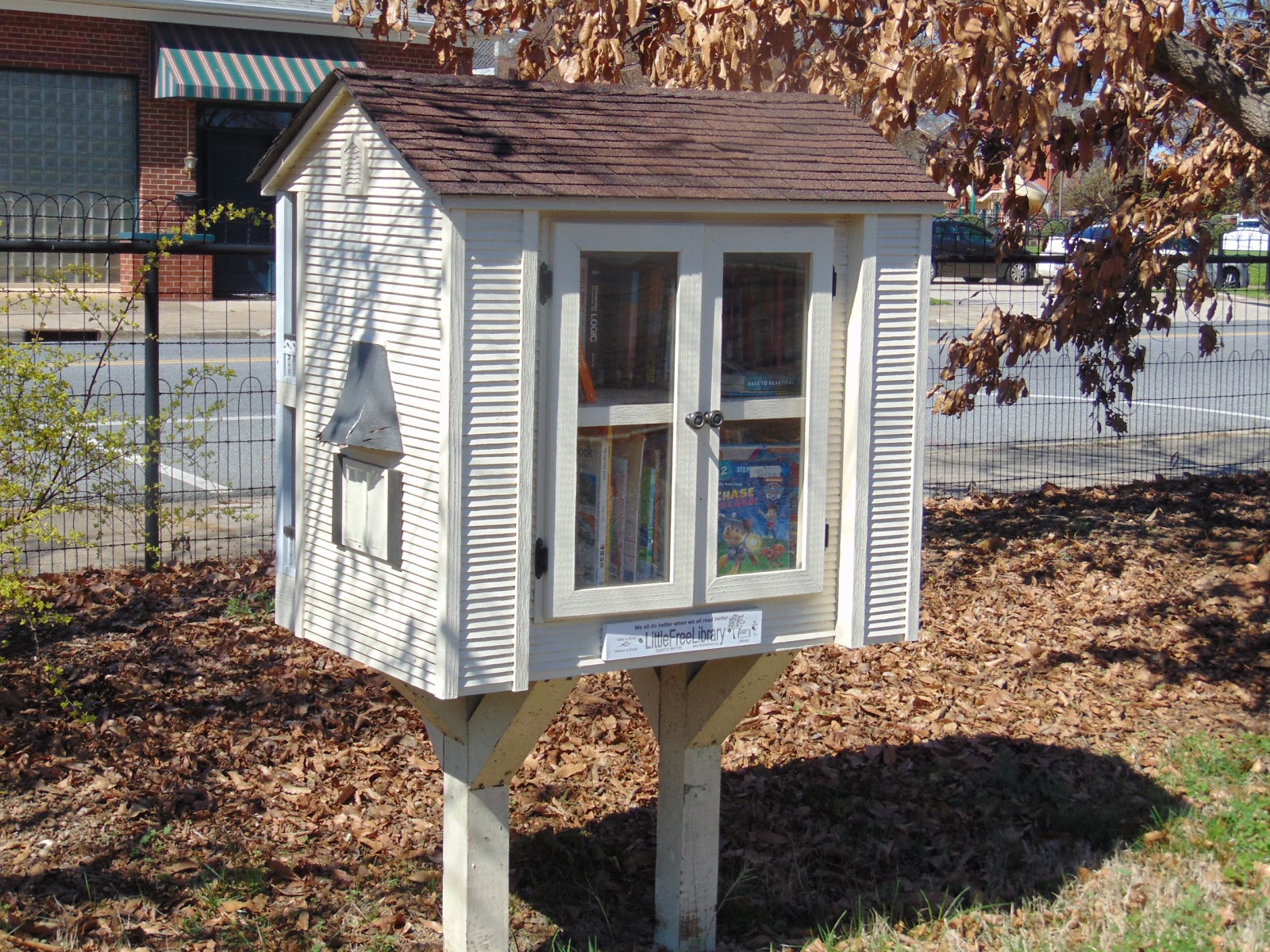
A Little Free Library that stands outside of a church in
my hometown of Chester, South Carolina, USA.


As an advocate for public libraries and reading initiatives for people of all ages, this blogger is a huge fan of community projects that promote the joy of reading.

Yeah, I suppose I just outed myself as one of those weirdos who still think that public libraries and physical books still serve a purpose in a digital world where Kindles and other hand-held electronic devices provide just about any novel at your fingertips.

Well call me old fashioned, or a Gen-Xer (both would be accurate) but no Kindle will ever be able to replace the feel of a nicely worn paperback, or the smell of glue and paper from a new hardcover book. Sure Kindles can be carried anywhere, are less cumbersome, take up less space, and can hold more information; but for me staring at a lit up screen is a poor substitute for losing yourself in the words printed on a page (and its far better on your eyes in the long run too!)

And books don't break down so easily either!


Quite recently, in the last couple of years, I've been very pleased by a somewhat new trend that has been popping up in my hometown, and in the the neighboring counties: Little Free Libraries.

These popular little book exchange boxes -- which some folks around my corner of South Carolina like to jokingly call "human bird feeders" -- provide easy access to free books for people (particularly young folks) to find physical books to read.
Little Free Libraries are also referred to as community book exchanges, neighborhood book exchanges, book trading posts, pop-up libraries, and micro-libraries.

The idea behind these book exchanges is simple: If you want a book, you take a book and leave another in its place. Some people donate used books to these little boxes and leave them for someone else to enjoy.

Little Free Library is a nonprofit organization that supports the worldwide movement to offer free books housed in small containers to members of the local community. The organization is based in Hudson, Wisconsin, USA.

The idea was popularized in 2009 when a man named
Todd Bol from Hudson, Wisconsin mounted a wooden container designed to look like a school house on a post on his lawn as a tribute to his mother, who was a book lover and school teacher. Bol shared his idea with his partner, Rick Brooks, who spread the word, and the idea spread rapidly across the American Midwest. By February 2013 all 50 U.S. States had Little Free Libraries.

Library owners can create their own library box, usually about the size of a doll house, or purchase one from the website. For a fee, libraries may be registered and assigned a number at the organization's website. Owners receive a sign that reads: Little Free Library, and often includes the phrase: "Take a Book. Leave a Book."

The international logo of the Little Free Library project.


Mr. Bol tragically passed away from pancreatic cancer in 2018 at the age of 62, but his wonderful tribute to his mother and the outstanding idea that it spawned lives on, not just here in the United States, but also across the entire world.

The Little Free Library World Map lists the locations of all registered boxes with GPS coordinates and information. As of 2020, there are nearly 100,000 Little Free Libraries registered across the world in over 90 countries, with millions of books donated, or exchanged. Many of these have been donated to rural areas that have no libraries of their own or that have been affected by natural disasters. Little Free Libraries come in all shapes and sizes, from small wooden houses to small building-sized libraries.

The following are photos I've taken of Little Free Libraries erected in my hometown and throughout the neighboring counties of York, Lancaster, and Union in upstate South Carolina. As y'all can see they are quite artistic in many cases and come in various sizes.


The books usually found in these boxes range from young reader books for children, to young adult novels, religious books (Bibles and Christian novels), and even adult mystery and suspense novels. You can find anything from the always popular Amelia Bedelia and Marc Brown's Arthur books, to literary classic novels, or fantasy and science fiction stories; even adult stories like the 50 Shades of Grey series. Some people even leave DVD movies and music CDs, even old Cassette tapes.

Little Free Libraries work very well considering that they rely on more than just a little bit of goodwill from the local communities -- especially considering what jerks people can be these days, even here in the American South. 

Many of these libraries show up in front of existing public libraries, churches, schools, and other public facilities. I'm also pleased to let y'all know that these little boxes (and sometimes not so little ones) also appear in poorer neighborhoods and rural areas where people don't usually have easy access to books -- something I would strongly continue to encourage more of in order to give people, especially young ones, a chance to lose themselves in the joy of reading.

Wednesday, April 07, 2021

Night Sky Photography -- 04-07-2021 -- The Moon, Jupiter & Saturn

Good morning, fellow Stargazers!

I took this wonderful shot of the moon with Jupiter and Saturn in the early morning sky just over an hour ago as I went into town, using the city buildings, street lights, and the power lines in the foreground.

The two largest planets appear as a pair of small bright stars from our vantage point here on Earth.


Tuesday, March 30, 2021

Native and Foreign-born Chinese Confederates In The War Between The States

Private Christopher Wren Bunker,
37th Battalion Virginia Cavalry, CSA.
Served from 1863 at age 18 till the end of the
War Between The States at age 20.
He fought with the Army of Northern Virginia
until he was wounded and captured.
Bunker served out the rest of the war at
Camp Chase POW camp in Columbus, Ohio.
 

The following blog post is dedicated to the memories of those Confederate veterans of Asian descent and their descendants living today -- and to the ongoing campaign to stop anti-Asian hatred in the United States today that this blogger fully supports.


The Southern-Confederate historical heritage that many Southern-born people of all races and religious creeds continue to honor today is defined by one important thing: the memories of those who served in defense of Dixie during the War Between the States (American Civil War 1861 - 1865) and the blood of those who died in defense of Southern independence.

While there were only a few hundred Asians (either foreign-born or native-born) living in the South at the time of the War Between the States, records exist showing that more than just a few of these men served as Confederate soldiers.

The following are the brief stories of some of these men.

Charles Chon's grave marker at the McGavock
Confederate Cemetery in Franklin, Tennessee.
Charles Chon, a Chinese National, was a private in Company K, 24th Texas Dismounted Cavalry Regiment. He was killed in action at the Battle of Franklin, Tennessee, on November 30, 1864, and is buried on the battlefield at the McGavock Confederate Cemetery.

William Henry Kwan served as a private in Company B, 15th Virginia Battalion of Light Artillery. Kwan is a Cantonese (Chinese) name though Kwan himself was believed to be of biracial parentage.

John Fouenty, was a cigar-maker in Savannah, Georgia, when the war broke out. He volunteered and served in the Confederate army for a year, then was released because he was under age. Later when the Confederacy began conscription, Fouenty left the South in 1864 and went to New York City through the Union blockade rather than be forced to serve in what was by then a losing war. Fouenty survived the war and later returned to his native China.

Charley Pang, a private in Company G, 1st Louisiana Infantry "the Orleans Light Guards" was captured during the second day of the Battle of Chickmauga, Georgia on September 20, 1863. According to Federal Rolls of Prisoners of war, Charley was forwarded to a military prison in Louisville, Kentucky, and then later transferred to Camp Douglas prisoner of war camp in, Chicago, Illinois.

Research done by the late Chinese-American researcher Miss Shaie-Mei Deng Temple (1950 - 2002) of the Asian/Pacific American Society of New Orleans reveals at least eighteen Asian-Confederates (with names like Chou, Coo, Ding, Fai, Foo, Gong, Hai, Ho, Joung, Lin, Lee, Lou, Pang, Poo, Ting, and Wong) served in various Louisiana units -- including a multi-ethnic unit raised in New Orleans called the Avegno Zouaves, which was Company F of the 13th Louisiana Infantry Regiment, CSA.

Wearing the colorful garb of the French Zouaves for which they are named, the Avegno Zouaves was composed of both native and foreign born volunteers including: French Creoles, Spaniards, Mexicans, Italians, Germans, Irishmen, biracial African-Americans (mulattoes), and Chinese. These men likely originally wore the same sort of French-style uniforms as the famous "Tiger Rifles 1st Special Battalion, Louisiana Volunteer Infantry (2nd Louisiana Battalion) -- later known as "Wheat's Tigers" for their original commanding officer, Major Chatham Roberdeau Wheat.

Another Chinese-born Confederate veteran was Dzau Tsz-zeh (aka. Charles K. Marshall).

Born in Jiaxing, Zhejiang Province, China in 1847 and orphaned at age 10, Tsz-zeh took the opportunity to study in America when offered by the Reverend James William Lambuth, a Southern missionary in Shanghai. After two years of lessons in English and Chinese, he accompanied the minister and his wife to Mississippi in 1859.

Dzau Tsz-zeh (aka Charles Marshall)
who at age 15 served at the Battle of
Fort Donelson in 1862.

At his baptism in 1860, he took the name of a Vicksburg planter and Methodist preacher, Charles K. Marshall, as his American name. When the Lambuth's returned to their missionary work in China, Mr. David C. Kelley, a former missionary who had a school in Lebanon, Tennessee, assumed responsibility for Tsz-zeh's education and care. When the war came a year later, Kelley formed a cavalry company that became a part of the 3rd Regiment, Tennessee Cavalry, CSA. Charlie, as Tsz-zeh was called then, went as his personal servant.

While personal attendants (body servants) were not called upon to fight as part of their duties, many usually did along with their units, and Tsz-zeh (then age 15) was among those Confederates who took part in the bloody defense of Fort Donelson in February 1862. It was during the fighting that his left hand was partially crushed beneath a caisson wheel. He was among those few defenders who escaped the fall of the fort. At the end of the war he would return home to his native China and become a famous Christian minister. 
 
Perhaps the most famous Chinese-American Confederate soldiers were cousins Christopher and Stephen Bunker, the two sons of the famed P.T. Barnum Circus entertainers and world-renowned conjoined twins, Chang and Eng Bunker.

Born in the Mae Klong Valley, Samut Songkhram Province, Siam (present day Thailand) in 1811 to a Chinese fisherman, Ti-aye, and a Chinese/Malaysian mother, Nok. The brothers, Chang and Eng Bunker (the last name they took when they settled in America), were born conjoined thoraopagus twins, the most common form of conjoined twins, they shared part of the chest wall, and their livers were fused. The term "Siamese Twins" is credited to the two brothers.

The Bunker Twins would eventually immigrate to the United States and become traveling circus performers, working with the world famous P.T. Barnam. Chang and Eng took the last name Bunker when they became naturalized U.S. citizens on October 12, 1839 to "Americanize" themselves. The two would marry a pair of twin sisters: Adelaide and Sarah Yates, and settle in Mount Airy, North Carolina becoming tobacco planters and slaveowners when they retired from the circus. The two couples would ultimately father and raise 21 children respectively.

Chang and Eng Bunker and their two sons,
Christopher Wren (right) and Stephen Decatur (left).


When the war broke out, the Bunkers were devoted to their adopted home state of North Carolina and the South, providing food, clothing and nursing to Confederate soldiers. The Bunker's two eldest sons joined the Confederate cavalry when they turned 18 years old.

Chang's son, Christopher Wren Bunker, enlisted in the 37th Battalion, Virginia Cavalry on April 1, 1863. He was among the 2,800 cavalrymen under Brigadier General John McCausland who raided Pennsylvania under Lieutenant General Jubal Early's 1864 campaign that led to the destruction of much of Chambersburg, on July 30th of that same year in retaliation for destruction in the Shenandoah Valley and the burning of the Virginia Military Institute (VMI) by Union forces the month before.

On August 7th, Union cavalry caught up with McCausland's cavalry force as they were camped near Moorefield, West Virginia and surprised them in a pre-dawn attack overrunning the Confederates inflicting a serious defeat. In this fight, Christopher Bunker was wounded -- one of about 4000 Confederate casualties in the battle -- and taken prisoner.

Bunker was ultimately sent to Camp Chase prisoner of war camp (four miles west of Columbus, Ohio) where he would be housed with about 200 other starving prisoners in a wooden barracks and eating rats for the remainder or the war until he was exchanged in March of 1865 after swearing the oath of allegiance to the United States. He returned home on April 17, 1865 -- eight days after General Robert E. Lee's surrender at Appomattox Court House.

Stephen Bunker, the son of Eng, joined the same cavalry unit as his cousin on July 2, 1864. He escaped the debacle at Moorefield, though he would later be wounded in fighting near Winchester, Virginia on September 3, 1864. He would return to action and be wounded again a second time in 1865 just before the war ended and also captured by the Union Army. Like his cousin, Christopher, he too would survive the war and return home.

Both Christopher and Stephen are buried in family plots in Mount Airy near their parents.

These men, and others like them whose names are largely forgotten by history, fought to defend Southern independence and their adopted country from invasion. They deserve to be remembered and their proud descendants likewise deserve to be respected as fellow Southerners and Americans as well.

No matter where our ancestors came from, some of whom wore the hallowed gray and butternut. They fought the same battles and shed the same Southern blood in defense of Dixie. Those men served as brothers, and we as their proud descendants should respect each other no less today.


Thank you and God bless y'all!


Special thanks to the following sources that helped in the writing of this article:

The Roster of Confederate Soldiers, 1861–1865: Oadneal, Alfred N. to Rand, William H. (1996).
The National Parks Service's Civil War Soldiers website
The University of North Carolina at Chapel Hill

Miss Shaie-Mei Deng Temple (1950 - 2002) RIP & The Asian/Pacific American Society of New Orleans
Asians & Pacific Islanders and the Civil War Handbook
(NPS 2015) ISBN#
9159922703597 9781590911679 1590911679
The U.S. Department of the Interior
The North Carolina Division Sons of Confederate Veterans (NC SCV)