Saturday, July 20, 2024

The Ludicrous Speed We Travel Through Our Universe


Being an amateur stargazer, I have to confess that very few sights on this planet can inspire more amazement and awe from me than the sight of the evening sky after sunset when twilight begins to deepen into night and the very first of our world's nearest heavenly neighbors begin to appear in our sky above.

Going outside at night and watching the moon rise, the planets of our Solar System appear, and thousands of visible stars and galaxies appear overhead in the night sky never ceases to amaze us stargazers.

Even the brightest star known to us, our own bright Sun that we see practically every clear, mostly cloudless daytime from sunrise to sunset, is a wonderful miracle in the heavens that most people seemingly take for granted because its a constant companion.

From our perspective standing here on our good Earth, everything in the heavens appears to be fixed -- aside from our lovely moon and the five visible "wanderers" that we can see with the naked eye.

However, outside of our visual range, our planet travels at an incredible speed of rotation every single day, and in orbit around the Sun. The planets of the solar system also cover distances that might seem surprisingly fast to most of us observing them. Our own bright Sun also travels at insanely fast speeds around our own Milky Way Galaxy.

The reason we don't readily notice this is because the space beyond our planet is so very vast, its nearly incomprehensible to imagine. The distances involved are so long that we cannot possibly measure them simply by miles.

Today, I'm going to tell y'all just how fast and how far we travel. Y'all better buckle up because this is gonna blow your minds.


The Sun, Earth, & The Moon

At the center of our solar system is our own beautiful Sun and this is where our journey begins.

Our Sun is a bright
G-type main-sequence star (or G-Type Star) that comprises about 99.86% of the mass of the Solar System. The Sun itself rotates at an average of about 28 days, although this varies at different latitudes since the Sun isn't a solid body but rather a giant ball of gaseous plasma. Its width is measured at approximately 864,000 miles, or 109 times that of Earth, with its mass measured at about 330,000 times that of the Earth.

To give you an idea of how huge that actually is, let me explain to y'all the exact speed and distance it takes our Earth to travel in its orbit around the Sun in a single year.

Our planet Earth is the third planet out from the Sun and the fifth largest planet in our Solar System. The mean diameter of the Earth
(the distance from one side to the other through Earth's center) is about 7,926 miles across. However, the interesting thing to realize here is that Earth is not quite a total sphere.

Our planet bulges out a bit more around the equator than it does at the poles because of its rotation
caused by the flattening at the poles, making it a slight oblate spheroid. Earth is therefore slightly smaller when measured between the North and South Poles (or the meridional circumference), which gives a diameter of 7,907 miles -- or a difference of about 20 miles. Earth's circumference (the distance all the way around the equator) is around 24,900 miles.

Earth itself rotates on its axis in space counter-clockwise approximately once every 23 hours, 56 minutes, and 4 seconds in a standard 24 hour day; spinning
at an incredible speed of about 1,037 miles and hour.
Because Earth spins steadily, as well as moves at a constant rate in orbit around the sun, we have the gravity that holds us all tightly in its grip to this beautiful blue world we all know and love.

The mean distance from the surface of the Sun to the surface of the Earth is around 93 million miles. This distance is measured by astronomers as one
astronomical unit (AU).

Since the Earth revolves in an oval shaped path (or elliptical orbit) around the Sun, rather than an even circular path, the exact distance varies
ranging between the extremes of perihelion (closest approach) in January and aphelion (most distant orbital position) in July. This actually puts Earth’s orbital distance from the Sun from between approximately 91.5 million to 94 million miles respectively.

Earth travels about 1.6 million miles daily at about 68,000 miles per hour in its orbit around the sun.
Over the span of the 365.26 days that makes up a single year, our planet Earth travels around 584 million miles in its orbit around the Sun.

That's pretty incredible huh?

Next to us in the night sky is our own beautiful lunar companion, Luna -- better known as simply the Moon.

The Moon's mean radius is 1,079.6 miles wide with an overall diameter of 2,159 miles, or about a little less than one-third the width of the Earth. Because of tidal forces that keep the Moon from rotating, one side always faces the Earth as it circles us in its monthly rotation.

Like the Earth travels around the sun in an oval-shaped path, the Moon also travels in an oblong orbit. When the Moon is the farthest away from Earth (or at its Apogee), it’s 252,088 miles away, while at it's closest approach (or at its Perigee), the Moon is 225,623 miles away -- the equivalent of about 32 Earths distant.

The Moon makes a complete orbit around the earth every 27.3 days, or approximately 13 times in a calendar year. Given the distance from the Earth and speed, the Moon travels a full distance of 1,423,000 miles an hour at a speed of 2,288 miles per hour to complete this orbit. Because of the rotation of the Earth and our own perspective standing on the surface, we humans do not perceive just how fast this is from our observations -- but its pretty fast!


The sunlight we see here on Earth takes approximately 8 minutes
and 20 seconds to travel the 93 million miles from the surface
of the Sun through the gulf of space to reach Earth.

The Speed Of Light 

Our Solar System is so large in sheer scale that using ordinary units of measurement like feet, or miles, simply won't do. On average, Pluto -- the farthest planet in our solar system (and yes, it's still a planet even if its a small one!) has a mind-blowing average mean distance of 3.6 billion miles from the Sun and takes a whopping 247.9 years to orbit the Sun just once!

In order to measure the size of our Solar System more accurately we must use the speed of light as our yard stick.

We use this because the speed of light is constant throughout the universe, traveling in the vacuum of space at an incredible speed of about 186,282 miles per second -- or
about 670.6 million miles per hour. To put that in perspective, if you could physically travel at the speed of light, you could go around the Earth a mind-blowing 7.5 times in one second; or travel from Earth to the Moon in about 1.5 seconds.

Now that's
ludicrous speed folks, and theoretically nothing can move faster than light outside of science fiction.

One light-minute is about 11,160,000 miles. One light-hour is 671 million miles -- roughly the distance between the sun and halfway between the planets Jupiter and Saturn in our Solar System. One light-day is 16.1 billion miles -- more than four times the distance between the Sun and Pluto. Finally, one light-year is a whopping 5.8 trillion miles!


Standing on the surface of the Earth, when we look up at the bright yellow Sun in the sky and the light that makes up the daytime hours; that light we see takes approximately 8 minutes and 20 seconds to travel the 93 million miles from the surface of the Sun through the gulf of space to reach Earth. So, one AU is a bit more than 8 light-minutes in distance.

From the 3.6 billion miles from Sun to Pluto at the far end of the Solar System, it would take sunlight about 5 hours and 40 minutes to cover that distance, or roughly about 39.5 AU.

Now when measuring distances outside of our Solar System, we must turn to another unit of measuring distances called parsecs. A parsec is approximately equal to 3.26 light-years, or 19.2 trillion miles (206,000 AU). A distance of 1,000 parsecs (or 3,262 light years) is called a kiloparsec (KPC).

Beyond our Solar System the nearest stars are in the Alpha Centauri system, a triple star system made up of three stars: Rigil Kentaurus (Centauri A), Toliman (Centauri B), and the small, red dwarf star Proxima Centauri (Centauri C). The closest of these stars, Proxima Centauri, sits at about 4.24 light-years (or 1.30 parsecs) from the Sun.

To put another way, the light from our stellar next door neighbors that we would see standing her on Earth took just over four years to reach us.
Also, if we tried to measure that in standard miles, that would be roughly 24,000,000,000,000 miles away! Now that's a lot of zeroes, y'all.


The Milky Way And Beyond

Our entire Solar System -- our Sun with its family of planets, asteroids, and comets -- orbits around the center of the large Milky Way Galaxy.

The Milky Way itself is a large barred spiral galaxy believed to be about 100,000 light years across (30.66 kiloparsecs) and made up of an estimated 100 - 400 billion stars, nebulae, and exoplanets.

The Solar System itself does not lie near the center of our Galaxy, rather it lies about 29,000 lights years (or 8 kiloparsecs) from the Galactic Center on what is known as the Orion-Cygnus Arm of the Milky Way.

Our Sun and Solar System move in a huge orbit around the center of the Milky Way Galaxy at about about 500,000 miles an hour.
That's roughly about 12,500 miles in 90 seconds. Because the Milky Way is such a big place, even at this ludicrous speed, it takes our Sun and Solar System approximately 225-250 million years to complete one single orbit around the galaxy’s center. To put that in perspective, that's roughly Earth's early-to-mid Triassic Period when the first dinosaurs appeared till the present day! This amount of time is referred to as a cosmic year, or a galactic year.

The Milky Way itself travels through the Universe at large at an astonishing 1.3 million miles an hour!

Outside of our galaxy the nearest local bodies are the two Magellanic Clouds that orbit the Milky Way. The
Large Magellanic Cloud (LMC) is approximately 163,000 light-years (49.9 kiloparsecs) away while the Small Magellanic Cloud (SMC) is approximately 206,000 light-years (63 kiloparsecs) away.   

Beyond the Magellican Clouds the closest neighboring galaxy is the Andromeda Galaxy (Messier 31, or NGC 224). Like the Milky Way, it is also a barred spiral galaxy approximately 2.5 million light years (770 kiloparsecs) from our Sun.
The Andromeda Galaxy has an estimated diameter of about 220,000 light years (67 kiloparsecs).

On and interesting note, due to the ever expanding nature of the Universe, the Andromeda Galaxy is currently racing toward our own Milky Way Galaxy at an estimated speed of about 70 miles per second and the two galaxies are expected to collide with each other sometime in about 4-5 billion years from now.

Once we move further out into the Universe itself, the distances become even more daunting. 
Astronomers typically express the distances between neighboring galaxies and galactic clusters in megaparsecs (MPC) and gigaparsecs (GPC) the largest units of length commonly used. A megaparsec is one million parsecs (or 3,260,000 light-years) and a gigiparsec is one billion parsecs (or 3.26 billion light-years)!

The most distant and probably oldest known galaxy in the observable Universe is
GN-z11 approximately 32 billion light-years (or 9.75 gigaparsecs) away from the Milky Way in a Universe that is estimated to be 93 billion light-years (or 28 gigaparsecs) across!

Now that's truly incredible to think about, y'all!


Conclusion

Going about our daily lives we can easily take for granted that we are traveling through this galaxy and universe of ours, propelled at incredibly ludicrous speeds.

Looking up at the night sky, seeing the heavens above us in the sky dome,
its truly a humbling experience knowing that in all of that infinity we are all of us merely a small speck of sand in an insanely large ocean of stars and galaxies -- and perhaps far more than we can readily observe even with our best astronomical instruments.

Probably the only thing more infinite than our known Universe is the human imagination itself.

I hope y'all have enjoyed this post, have a wonderful Dixie evening and y'all come back now, ya hear!


This blogger would like to offer a special thanks to the wonderful folks at earthsky.org and NASA for providing the information in this article.

Tuesday, July 16, 2024

Night Sky Photography -- 07-15-2024 -- Mars & Uranus Conjunction Before Sunrise!

Greetings fellow stargazers!

On the morning of Monday, July 15, 2024, your favorite blogger had to wake up early -- about 90 minutes before sunrise to be exact -- to drive out into the country a little and find a nice spot to capture the conjunction of the planets Mars and Uranus. I was also able to capture some wonderful shots of the planet Jupiter and the bright red giant star, Aldebaran, in the Constellation Taurus the Bull.

After setting up my tripod, I captured this first photo over the tree line facing south-southeast. I decided not to label this one so you can get an idea of how I saw it for myself.


You can see what appears to be two red points and a large bright point set in a oblong triangle in the nautical twilight as they appeared to the naked eye. The large bright spot is Jupiter, while the smaller red spots are Aldebaran positioned to the right of Jupiter and the planet Mars in the upper corner.

Using the lens as a filter to capture more points of light not quite visible to the naked eye, I captured nearly all the stars of the Hyades Star Cluster -- which make up the "face" of the Constellation Taurus the Bull -- and the nearby Pleiades Star Cluster between Mars and the current position of Uranus in the night sky as seen from the Earth's surface. The wider shot also captured the nearby stars Elnath and Capella closer to the east and coming sunrise. The close up shot shows both the Hyades and Pleiades clusters more clearly.


Mars is easy to spot due to its bright red-orange hue, though distant Uranus is impossible to see with the naked eye and requires a really good lens to spot. Thankfully I have a good 35X Sony Optical Zoom lens on my camera and, at maximum magnification, was successfully able to capture a really good close-up of the two planets together at just half-a-degree apart.


Although they appear to be "meeting" in the early morning sky from out vantage point here on the surface of the Earth; the two worlds are actually quite a distance apart.

The large ice giant planet Uranus, the 7th planetary body in our Solar System, is roughly about 1.86 billion miles (just over 3 billion kilometers, or 20.16 AUs) from our Earth at the moment, while Mars, the 4th planet and our nearest planetary neighbor, is about 155 million miles (around 250 million kilometers, or 1.67 AUs) from Earth.

Finally, I took a couple of good shots of Jupiter, now currently a part of the Constellation Taurus for at least the next month in the early mornings. The first show a close-up of Jupiter with bright red Aldebaran, the "Eye of the Bull" close by. The final show captures all the stars of the Hyades Cluster, which I highlight outlining the head of the Constellation Taurus.
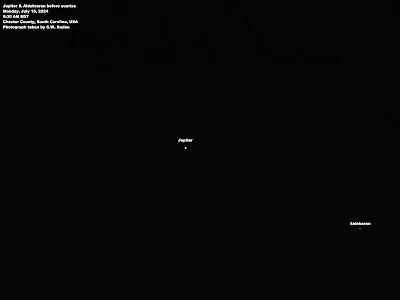


The large gas giant planet, Jupiter, the 5th planet in the solar system, is currently about 532 million miles (857 million kilometers, or 5.7 AUs) from the Earth. Aldebaran is much father away at a distance of approximately 65 light-years from our Sun and is the 14th brightest star in the night sky as seen from Earth.

Later this month, on Tuesday, July 30th, the crescent moon will cross between Mars and Jupiter in the early morning sky. Over the next month both planets will continue to move closer to each other towards their own conjunction in the morning sky on Monday, August 12, 2024....which I hope to be able to photograph, God and good clear skies willing.


Well folks, I hope that y'all enjoyed my photos and to all my fellow amateur sky watchers be sure to keep your eyes to the night skies, y'all hear.

Thursday, July 04, 2024

Happy Independence Day America! - The Declaration Of Independence

 
IN CONGRESS, July 4, 1776.
The unanimous Declaration of the thirteen united States of America,

When in the Course of human events, it becomes necessary for one people to dissolve the political bands which have connected them with another, and to assume among the powers of the earth, the separate and equal station to which the Laws of Nature and of Nature's God entitle them, a decent respect to the opinions of mankind requires that they should declare the causes which impel them to the separation.
We hold these truths to be self-evident, that all men are created equal, that they are endowed by their Creator with certain unalienable Rights, that among these are Life, Liberty and the pursuit of Happiness. That to secure these rights, Governments are instituted among Men, deriving their just powers from the consent of the governed, That whenever any Form of Government becomes destructive of these ends, it is the Right of the People to alter or to abolish it, and to institute new Government, laying its foundation on such principles and organizing its powers in such form, as to them shall seem most likely to effect their Safety and Happiness. Prudence, indeed, will dictate that Governments long established should not be changed for light and transient causes; and accordingly all experience hath shewn, that mankind are more disposed to suffer, while evils are sufferable, than to right themselves by abolishing the forms to which they are accustomed. But when a long train of abuses and usurpations, pursuing invariably the same Object evinces a design to reduce them under absolute Despotism, it is their right, it is their duty, to throw off such Government, and to provide new Guards for their future security.
Such has been the patient sufferance of these Colonies; and such is now the necessity which constrains them to alter their former Systems of Government. The history of the present King of Great Britain is a history of repeated injuries and usurpations, all having in direct object the establishment of an absolute Tyranny over these States. To prove this, let Facts be submitted to a candid world.
He has refused his Assent to Laws, the most wholesome and necessary for the public good.
He has forbidden his Governors to pass Laws of immediate and pressing importance, unless suspended in their operation till his Assent should be obtained; and when so suspended, he has utterly neglected to attend to them.
He has refused to pass other Laws for the accommodation of large districts of people, unless those people would relinquish the right of Representation in the Legislature, a right inestimable to them and formidable to tyrants only.
He has called together legislative bodies at places unusual, uncomfortable, and distant from the depository of their public Records, for the sole purpose of fatiguing them into compliance with his measures.
He has dissolved Representative Houses repeatedly, for opposing with manly firmness his invasions on the rights of the people.
He has refused for a long time, after such dissolutions, to cause others to be elected; whereby the Legislative powers, incapable of Annihilation, have returned to the People at large for their exercise; the State remaining in the mean time exposed to all the dangers of invasion from without, and convulsions within.
He has endeavoured to prevent the population of these States; for that purpose obstructing the Laws for Naturalization of Foreigners; refusing to pass others to encourage their migrations hither, and raising the conditions of new Appropriations of Lands.
He has obstructed the Administration of Justice, by refusing his Assent to Laws for establishing Judiciary powers.
He has made Judges dependent on his Will alone, for the tenure of their offices, and the amount and payment of their salaries.
He has erected a multitude of New Offices, and sent hither swarms of Officers to harrass our people, and eat out their substance.
He has kept among us, in times of peace, Standing Armies without the Consent of our legislatures.
He has affected to render the Military independent of and superior to the Civil power.
He has combined with others to subject us to a jurisdiction foreign to our constitution, and unacknowledged by our laws; giving his Assent to their Acts of pretended Legislation:
For Quartering large bodies of armed troops among us:
For protecting them, by a mock Trial, from punishment for any Murders which they should commit on the Inhabitants of these States:
For cutting off our Trade with all parts of the world:
For imposing Taxes on us without our Consent:
For depriving us in many cases, of the benefits of Trial by Jury:
For transporting us beyond Seas to be tried for pretended offences
For abolishing the free System of English Laws in a neighbouring Province, establishing therein an Arbitrary government, and enlarging its Boundaries so as to render it at once an example and fit instrument for introducing the same absolute rule into these Colonies:
For taking away our Charters, abolishing our most valuable Laws, and altering fundamentally the Forms of our Governments:
For suspending our own Legislatures, and declaring themselves invested with power to legislate for us in all cases whatsoever.
He has abdicated Government here, by declaring us out of his Protection and waging War against us.
He has plundered our seas, ravaged our Coasts, burnt our towns, and destroyed the lives of our people.
He is at this time transporting large Armies of foreign Mercenaries to compleat the works of death, desolation and tyranny, already begun with circumstances of Cruelty & Perfidy scarcely paralleled in the most barbarous ages, and totally unworthy the Head of a civilized nation.
He has constrained our fellow Citizens taken Captive on the high Seas to bear Arms against their Country, to become the executioners of their friends and Brethren, or to fall themselves by their Hands.
He has excited domestic insurrections amongst us, and has endeavoured to bring on the inhabitants of our frontiers, the merciless Indian Savages, whose known rule of warfare, is an undistinguished destruction of all ages, sexes and conditions.

In every stage of these Oppressions We have Petitioned for Redress in the most humble terms: Our repeated Petitions have been answered only by repeated injury. A Prince whose character is thus marked by every act which may define a Tyrant, is unfit to be the ruler of a free people.
Nor have We been wanting in attentions to our British brethren. We have warned them from time to time of attempts by their legislature to extend an unwarrantable jurisdiction over us. We have reminded them of the circumstances of our emigration and settlement here. We have appealed to their native justice and magnanimity, and we have conjured them by the ties of our common kindred to disavow these usurpations, which, would inevitably interrupt our connections and correspondence. They too have been deaf to the voice of justice and of consanguinity. We must, therefore, acquiesce in the necessity, which denounces our Separation, and hold them, as we hold the rest of mankind, Enemies in War, in Peace Friends.
We, therefore, the Representatives of the united States of America, in General Congress, Assembled, appealing to the Supreme Judge of the world for the rectitude of our intentions, do, in the Name, and by Authority of the good People of these Colonies, solemnly publish and declare, That these United Colonies are, and of Right ought to be Free and Independent States; that they are Absolved from all Allegiance to the British Crown, and that all political connection between them and the State of Great Britain, is and ought to be totally dissolved; and that as Free and Independent States, they have full Power to levy War, conclude Peace, contract Alliances, establish Commerce, and to do all other Acts and Things which Independent States may of right do. And for the support of this Declaration, with a firm reliance on the protection of divine Providence, we mutually pledge to each other our Lives, our Fortunes and our sacred Honor.

The signers of the Declaration of Independence of the original thirteen American States ratified by the Second Continental Congress at Independence Hall in Philadelphia, Pennsylvania on Thursday, July 4, 1776: 

Georgia:  
Button Gwinnett, Lyman Hall, George Walton
North Carolina:  
William Hooper, Joseph Hewes, John Penn 
South Carolina:  
Edward Rutledge, Thomas Heyward Jr., Thomas Lynch Jr., Arthur Middleton
Massachusetts:
John Hancock
Maryland: Samual Chase, William Paca, Thomas Stone, Charles Carroll 
Delaware: 
Caesar Rodney, George Read, Thomas McKean
New York:
William Floyd, Philip Livingston, Francis Lewis, Lewis Morris 
New Jersey:
Richard Stockton, John Witherspoon, Francis Hopkinson, John Hart, Abraham Clark
New Hampshire:  
Josiah Bartlett, William Whipple
Massachusetts:
 Samuel Adams, John Adams, Robert Treat Paine, Elbridge Gerry 
 Rhode Island: 
Stephen Hopkins, William Ellery
Connecticut: 
Roger Sherman, Samuel Huntington, William Williams, Oliver Wolcott
New Hampshire: 
Matthew Thornton    
Virginia:
George Wythe, Richard Henry Lee, Thomas Jefferson, Benjamin Harrison, Thomas Nelson Jr.,
Francis Lightfoot Lee, Carter Braxton
Pennsylvania:
Robert Morris, Benjamin Rush, Benjamin Franklin, John Morton, George Clymer, James Smith, George Taylor,
James Wilson, George Ross


Declaration of Independence by American artist John Trumbull. (1826)


From one of the original thirteen independent American States, 

this blogger would like to wish each and every one of my fellow Americans across the United States a very
 Happy Independence Day! 

Wednesday, July 03, 2024

American Veterans At Gettysburg 1938


This photo was taken at a reunion of American veterans of the War Between The States (American Civil War) 1861-1865 at Gettysburg, Pennsylvania on Sunday, July 3, 1938 showing Confederate and Union veterans shaking hands across the stone wall on Cemetery Ridge at the Gettysburg National Battlefield -- 75 years after the Battle of Gettysburg (July 1-3, 1863).